Plants have several ways to send offspring away from the parent. Some use the sudden launch described in our article on explosive seed dispersal. A dandelion uses a far gentler-looking structure: a circle of fine hairs that lets a tiny fruit descend slowly through the air.
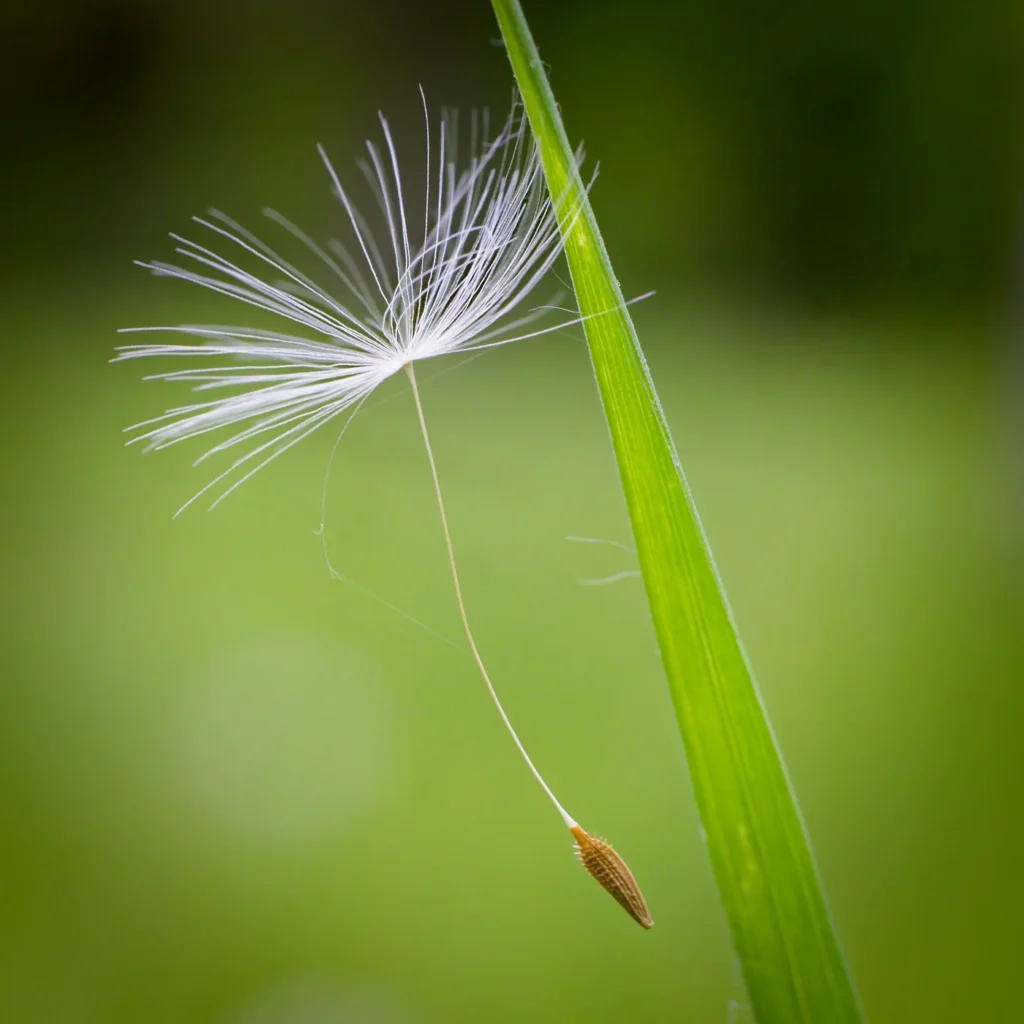
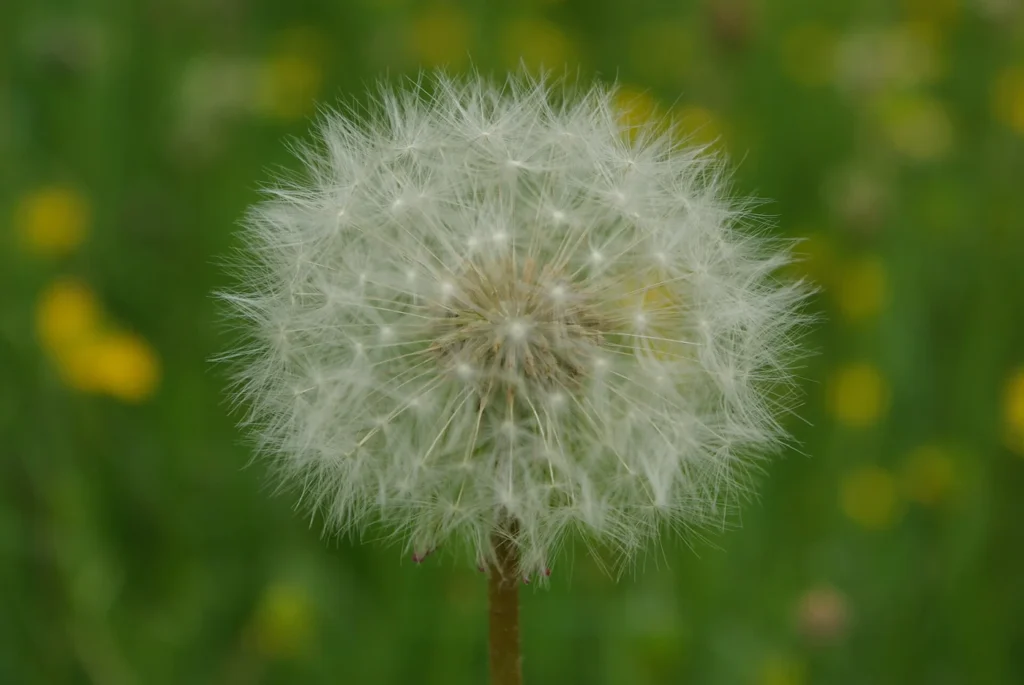
The familiar white tuft is called a pappus. It looks like a miniature parachute, but it has no solid canopy. Air passes through the gaps between its hairs. Research has shown that those gaps are central to its flight, not merely missing material in an otherwise ordinary parachute.
The flying object is more than a bare seed
What people call a flying dandelion seed is an achene, a small dry fruit containing a seed. A slender beak connects it to the pappus. Together, those structures form the dispersal unit: the part that leaves the plant and travels.
The distinction is useful because flight depends on the whole arrangement. The mass at the bottom, the connecting stalk and the spreading hairs all contribute to the object’s behavior. Looking only at the seed inside the fruit would leave out most of its flight equipment.
Gravity acts downward while the interaction with moving air produces resistance. A slowly falling unit remains in the air longer than a rapidly falling one released from the same height. That extra time can give surrounding air more opportunity to move it, although real dispersal also depends on weather, release conditions and obstacles.
A ring of circulating air sits above the pappus
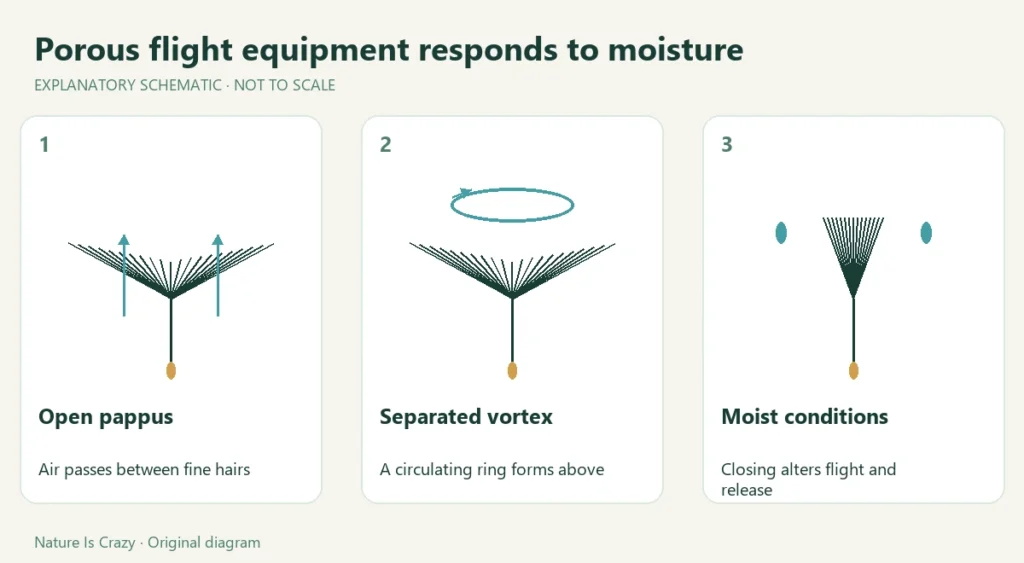
In a 2018 study of dandelion flight, researchers visualized a separated vortex ring above the pappus. This is a circulating region of air that remains detached from the tuft rather than simply hugging a solid canopy.
The porous arrangement helps produce this flow. Air can travel between the hairs, and the tuft’s circular geometry influences the resulting circulation. The researchers also examined artificial porous discs, allowing them to test the importance of porosity beyond the details of one natural fruit.
A vortex ring is not a pocket of air the seed carries around like a balloon. It is a pattern in fluid motion. Describing it that way prevents the misleading impression that the pappus traps a permanent supply of buoyant air. The seed still needs forces from its interaction with the surrounding flow.
Why a tuft can work differently from a sheet
A solid disc forces air around its outer edge. A porous disc also allows flow through its interior. Those different routes change the wake and the distribution of forces. The dandelion’s hairs therefore do something that cannot be understood by measuring only the tuft’s outer diameter.
Spacing matters as well as size. A structure can be extremely light because it uses little material, yet still interact effectively with the air. The pappus combines those properties in a way that makes its everyday appearance deceptively simple.
Another wingless traveler uses a very different geometry: a gliding snake reshapes its body. Both examples show why “it has no wing like a bird” does not settle the question of how an object moves through air.
The pappus changes shape when it becomes moist
The tuft is not permanently locked open. Higher humidity can make it close, drawing its hairs into a narrower arrangement. A study of the tissues controlling that movement linked the change to patterned swelling near the attachment region.
Different portions of the tissue respond differently to water. Because they are joined, their unequal swelling changes the shape of the structure and moves the attached hairs. This is a material response, rather than a movement commanded by nerves.
The word “responsive” does not imply that the dispersal unit predicts the weather. The structure changes when conditions change. Natural selection can produce a useful relationship between a material response and an environmental circumstance without the plant making a conscious assessment.
Closing changes both release and flight
A subsequent study of environmentally responsive dispersal examined open and closed pappi in wind-tunnel experiments and modeled the consequences. Closing changed the vortex and reduced aerodynamic drag, increasing falling speed. It also made dispersal units less likely to detach from the parent under the tested conditions.
These are two distinct effects. One concerns whether the unit begins traveling; the other concerns its behavior once airborne. A complete dispersal explanation needs both. An excellent flight structure contributes little to a journey if it remains attached, while easy release does not guarantee a long journey.
The modeling suggested benefits to the moisture-dependent arrangement under the weather scenarios studied. That result is conditional on the model and its assumptions; it does not mean every closing tuft will later produce a successful seedling farther away.
Slow falling is only part of traveling far
Research on dandelion dispersal and upward air movement emphasized the importance of updrafts for rare long journeys. A seed that descends slowly can still land nearby. A seed carried into rising air may remain aloft much longer.
That helps explain why one dramatic long-distance event should not be treated as the fate of every seed. Dispersal distances form a range. Release height, turbulence, vegetation and eventual landing conditions contribute alongside the pappus itself.
For a contrasting aerodynamic solution, read how spinning maple seeds generate lift. The dandelion’s solution is unusually delicate: a porous tuft whose geometry, surrounding vortex and moisture response all influence when and how a tiny fruit travels.
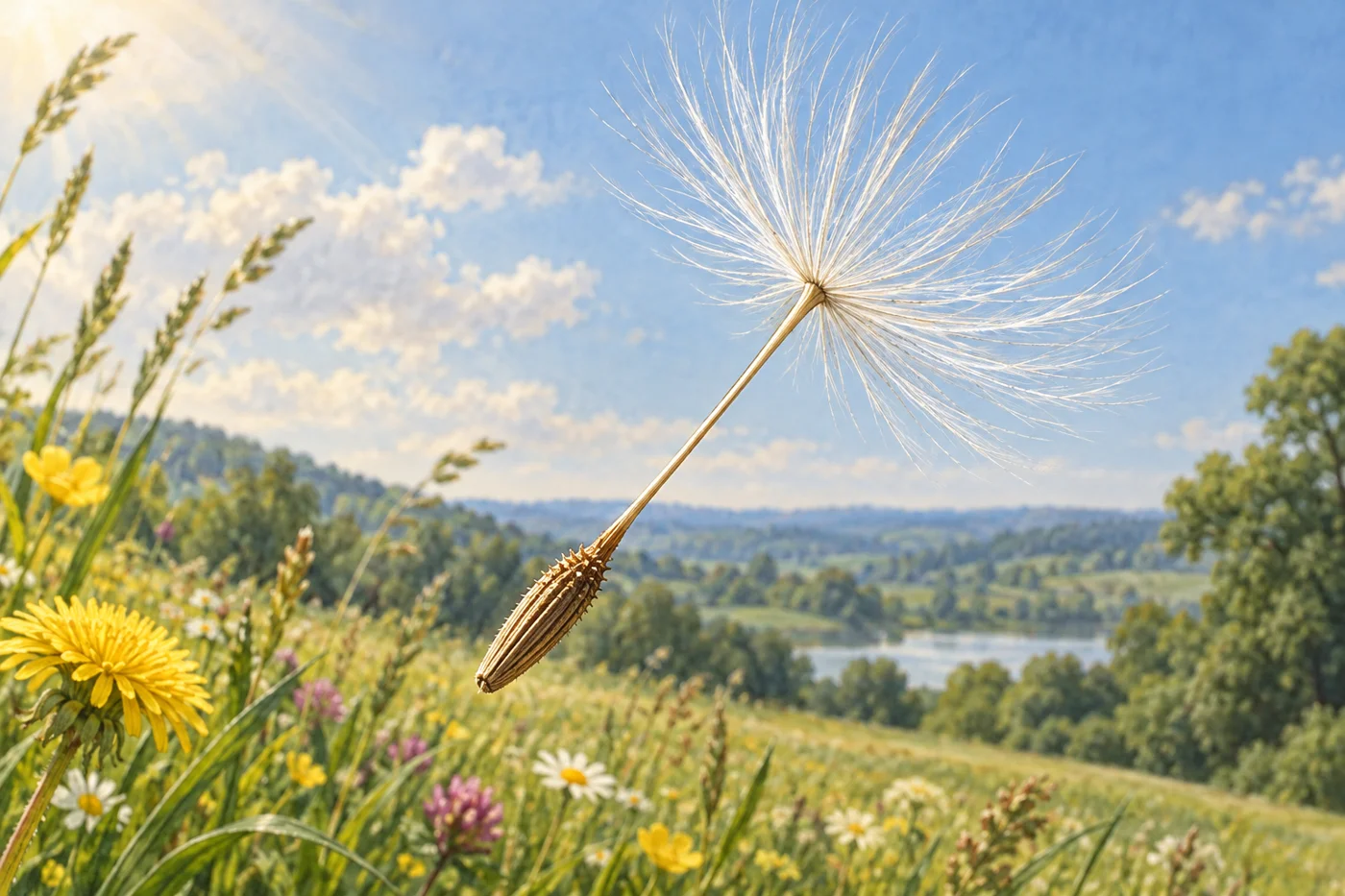
Featured image credit: AI-generated editorial illustration of dandelion pappus. Conceptual imagery, not a documentary photograph; anatomy and scale are illustrative.