
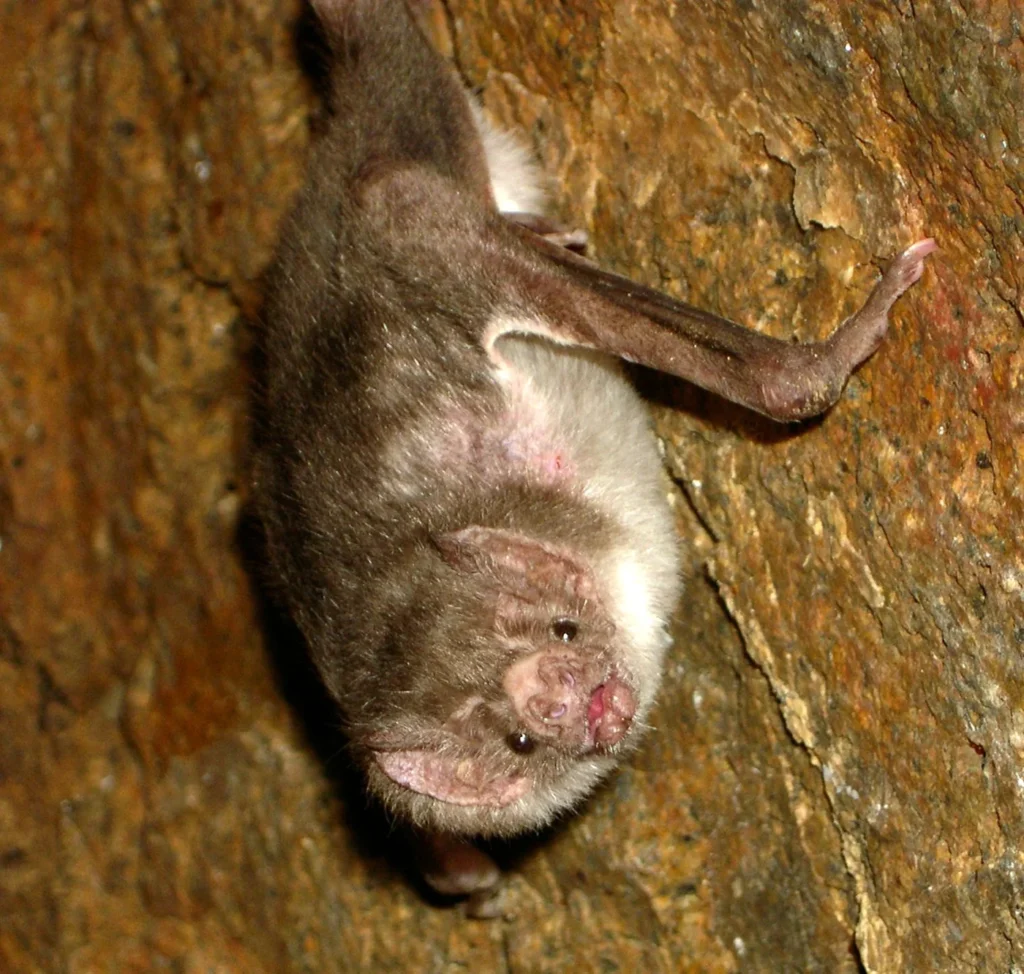
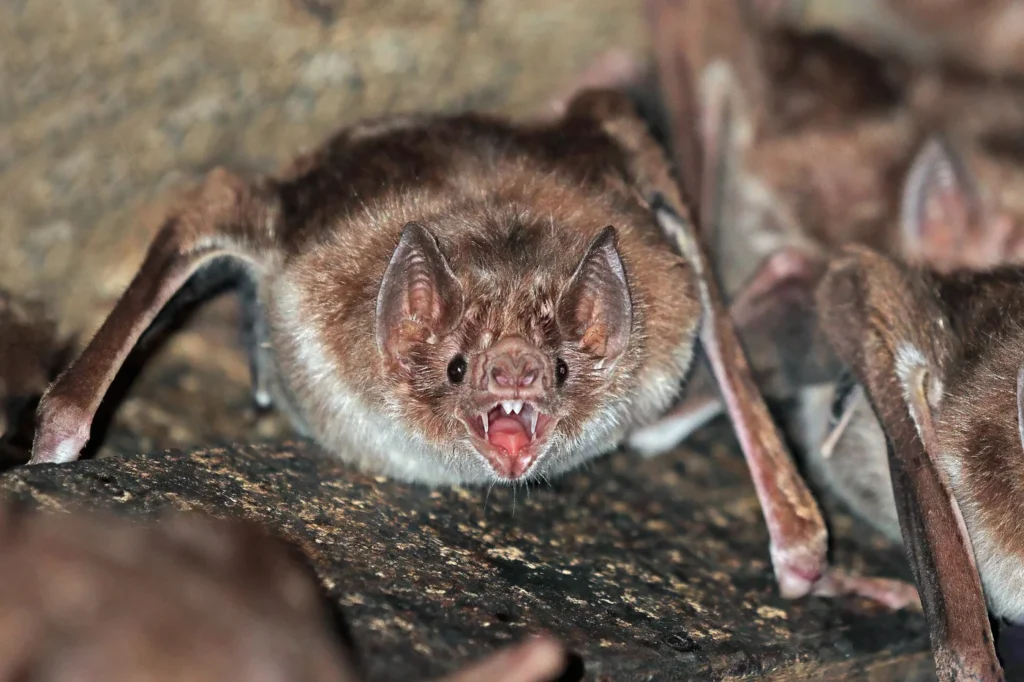
Blood feeding is only part of a vampire bat’s story. The common vampire bat, Desmodus rotundus, can also donate a meal to another bat that failed to feed. Unlike the one-way parental sacrifice described in our article on an animal mother becoming her offspring’s food, this help can occur between adult partners that interact repeatedly.
The donation happens through regurgitation. A bat returns some ingested blood and another receives it through mouth contact. This is a costly transfer of food, not simply two animals tolerating each other beside the same food source. The puzzle is why a donor gives away part of a resource it needs.
A failed feeding trip creates a serious problem
A specialist diet ties the common vampire bat’s energy intake to successful blood feeding. A bat that fails to obtain a meal cannot compensate by casually switching to fruit or catching insects. Research on food sharing has used controlled fasting to investigate what happens when one bat needs help.
In a study comparing explanations for donations, researchers tracked food transfers among bats with differing degrees of relatedness. They asked whether sharing was best explained by kinship, reciprocal help or pressure from recipients.
That comparison matters because the same visible behavior can arise for different reasons. A mother feeding her young benefits a close relative; a persistent beggar might pressure a reluctant donor; a long-term partner might provide help that can be returned later. Observation alone must be supplemented by measurements that distinguish those possibilities.
Sharing is connected to previous help
The controlled study found that help received was a stronger predictor of help given than relatedness within the tested group. Many food-sharing pairs were unrelated. Donors also initiated transfers often enough to make a simple harassment-only explanation inadequate.
This does not mean kinship is irrelevant in vampire bat life. Nor does it establish a strict rule that a bat repays every donation on the next encounter. The findings support reciprocal benefits within ongoing relationships, rather than a moment-by-moment accounting system.
The useful question is therefore broader than “Was this meal immediately repaid?” A partner may be valuable because it provides reliable help over time. Repeated interactions create an opportunity for that relationship to matter.
Grooming can come before food donations
How does such a partnership begin between strangers? A study following the development of new relationships introduced previously unfamiliar bats and monitored grooming and food sharing over time.
The bats tended to build lower-cost grooming interactions before beginning the more costly food donations. The investigators interpreted this as evidence consistent with gradually increasing investment in cooperative partners. That is more informative than looking only at pairs whose relationships are already established.
Grooming provides a way to spend time interacting with another individual before transferring a substantial resource. It does not follow that bats consciously think through an investment strategy. A pattern can fit a behavioral model without implying human-style reasoning or a spoken bargain.

Communication also has a role in these animals’ lives, as our article on mammalian echolocation explores in another setting. Food sharing asks a different question: how an individual’s past interactions affect which companions it helps.
Being nearby can change who becomes a partner
A further experiment on forced proximity tested whether placing randomly selected females together could promote enduring cooperative relationships. Researchers measured grooming before and after the imposed period of closeness.
Its importance is experimental control. Animals that already prefer each other may naturally spend more time together, making it difficult to tell whether closeness creates a bond or reflects one. Manipulating proximity helps separate those explanations.
The work shows that a social network is shaped by opportunities as well as preferences. An animal cannot develop a history of repeated interaction with every possible partner. Which individuals share space can influence which relationships have a chance to strengthen.
Laboratory bonds can matter outside the laboratory
Captive experiments make food-sharing relationships easier to observe, but they raise an obvious question: do those relationships survive when animals return to a more complex environment?
A study tracking bats after release used proximity sensors to examine that question. Patterns of grooming and sharing observed in captivity predicted later associations in the wild. The researchers could connect relationship history with behavior beyond the controlled setting.
This does not erase every difference between captivity and a natural roost. It supplies a bridge between them. A relationship observed under controlled conditions can have consequences when animals again have broader choices about whom they encounter.
Cooperation has more than one evolutionary ingredient
In a review of the evolution of vampire bat food sharing, researcher Gerald Carter discussed the possibility that an ancestral form of maternal care was extended into relationships offering reciprocal benefits. This is an evolutionary explanation to evaluate, rather than an event that researchers witnessed directly.
Kinship, partner choice, repeated contact and the cost of helping can therefore belong in the same account. There is no need to force every donation into one exclusive category. The biology is more interesting when those influences remain visible.
For a very different form of individuals contributing to a collective outcome, read how salp chains move through distributed jetting. Vampire bat cooperation depends on relationships rather than physical attachment: a failed meal can become survivable because another individual has a reason to help.
Featured image credit: AI-generated editorial illustration of common vampire bat. Conceptual imagery, not a documentary photograph; anatomy and scale are illustrative.