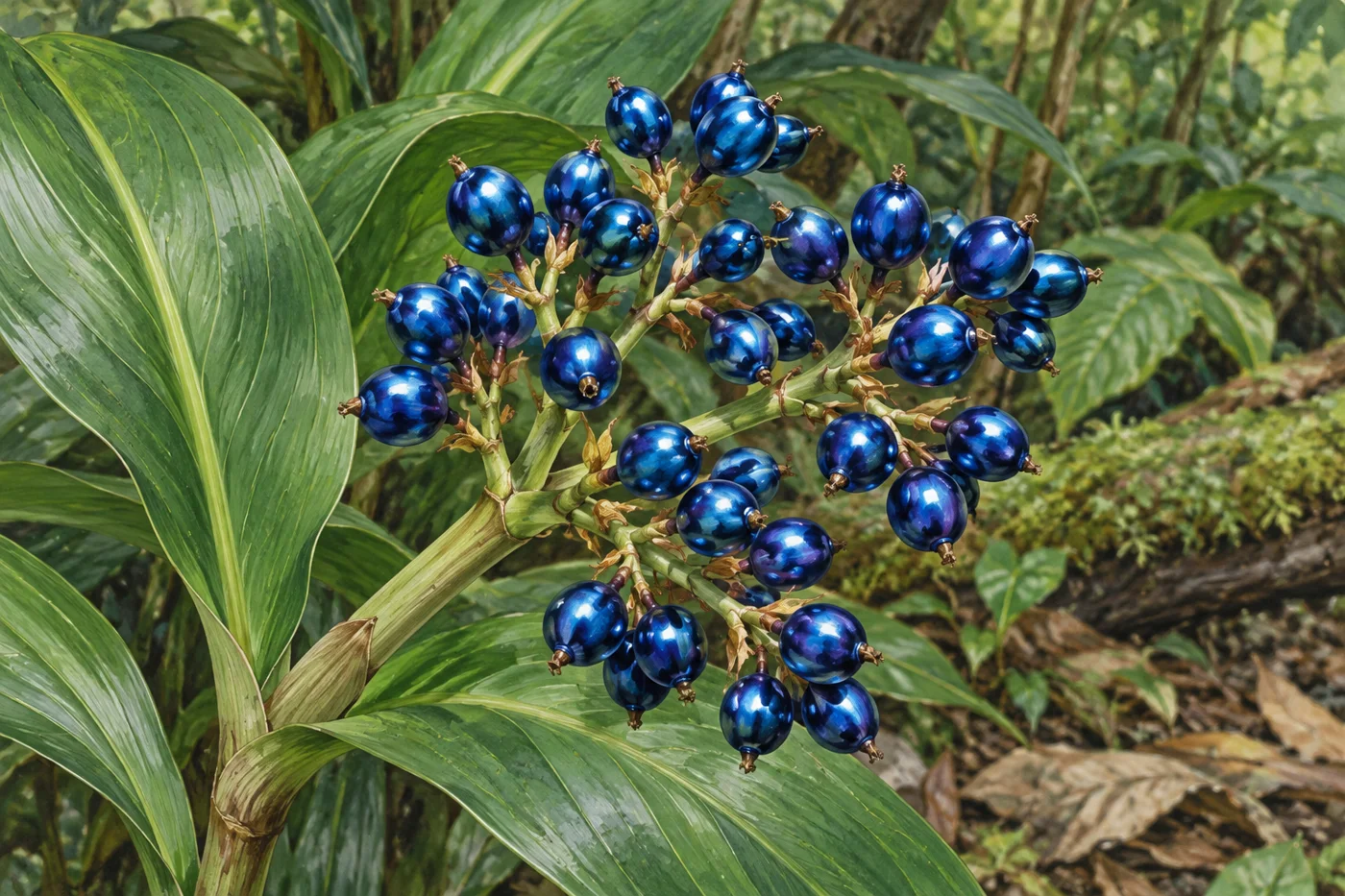
A brilliant color does not always come from a brilliant pigment. Our article on the changing colors of rainbow eucalyptus bark follows one route to a colorful plant surface. The metallic blue fruit of Pollia condensata follows a very different route: microscopic structures in its cell walls selectively reflect light.
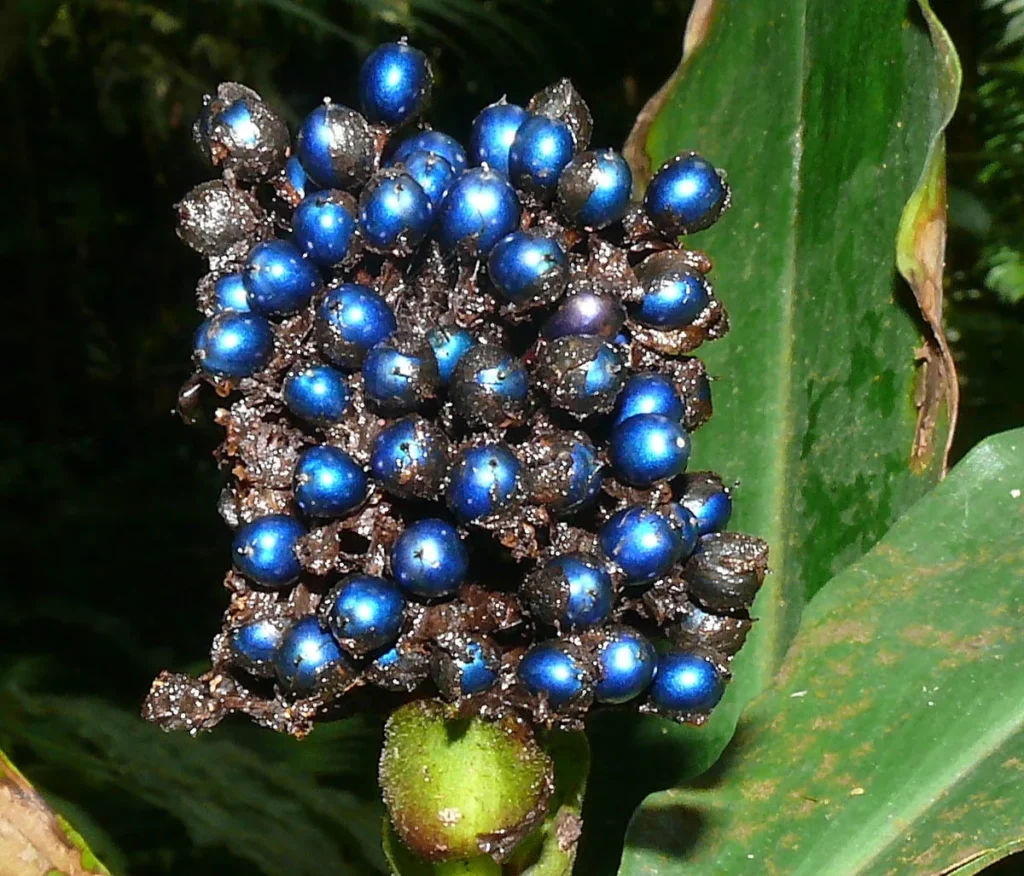
The fruit can resemble a small polished bead, with blue, green and reddish points catching the light. Its shine is not produced by a metallic coating. Researchers found that the relevant material is cellulose, organized at a scale that makes its arrangement optically important.
Pigment color and structural color work differently
A pigment absorbs some wavelengths more strongly than others. The remaining light gives a surface its apparent color. Structural coloration instead depends on how light interacts with a material’s geometry. The size, spacing and organization of its microscopic parts can favor the reflection of particular wavelengths.
These processes can occur together in nature, but identifying one does not automatically establish the other. A plant being blue is not sufficient evidence for a blue pigment. Scientists need to examine the material and its optical behavior.
A research review of photonic structures in plants describes how microscopy and optical measurements can be combined to investigate structural color. For Pollia, the important structures occur within the outer fruit tissue, where organized cellulose changes the light returned to an observer.
Cellulose forms a twisting stack
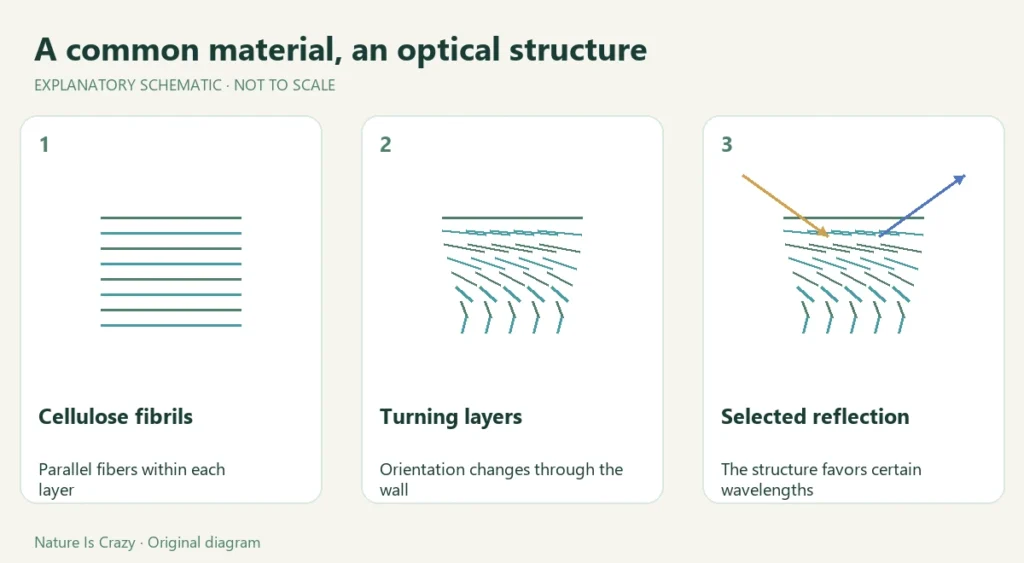
Cellulose is a familiar structural component of plant cell walls. What matters here is not simply its presence but its orientation. In the fruit, parallel cellulose microfibrils form layers whose orientation turns progressively through the wall, producing a helicoidal arrangement.
You can picture the geometry by stacking thin sheets while rotating each slightly relative to the one below it. The analogy describes the changing orientation, not the actual size or manufacture of the plant’s wall. Light interacts with this repeated organization, and selected wavelengths are reflected strongly.
The original study of structural color in Pollia fruit connected the bright appearance with these helicoidally organized cellulose microfibrils. Researchers examined the tissue’s structure and measured its optical properties. That combination explains the shine more convincingly than appearance alone could.
A cellulose wall is not ordinarily thought of as an optical device. Here, the same broad class of material that helps support a plant also creates a striking visual signal. Biology can change what a material does by changing how it is organized.
The fruit looks like a mosaic of tiny colored points
Individual surface cells do not all return precisely the same color. Differences in the layered organization produce variation from cell to cell. The combined appearance is therefore pointillist: numerous tiny reflecting regions create the fruit’s overall shimmer.
This is different from imagining a uniform blue paint spread across a sphere. The observer sees many small optical structures together. A close view can reveal bright spots of different hues even though the fruit’s dominant impression is blue.
For another animal whose visual appearance depends on organized tissue rather than a simple surface label, see the seasonal blue of reindeer eyes. Similar-looking colors need not come from the same structures or serve the same biological role.
The twisting direction has an optical consequence
The helicoidal arrangement can turn in either direction. That handedness affects its interaction with circularly polarized light, a form of light in which the electric-field direction rotates as the wave travels. Human unaided vision does not directly display that property as a separate color.
A later study of cell-wall composition and handedness investigated why Pollia can form structures with different twisting directions. The researchers combined analysis of the natural tissue with material experiments, linking wall composition to the organization of cellulose architectures.
That makes the fruit more than an attractive illustration of blue coloration. It provides a natural system in which scientists can investigate how composition and assembly interact. A change in the molecular ingredients can influence the geometry, which in turn changes the optical behavior.
Why preserved fruit can remain colorful
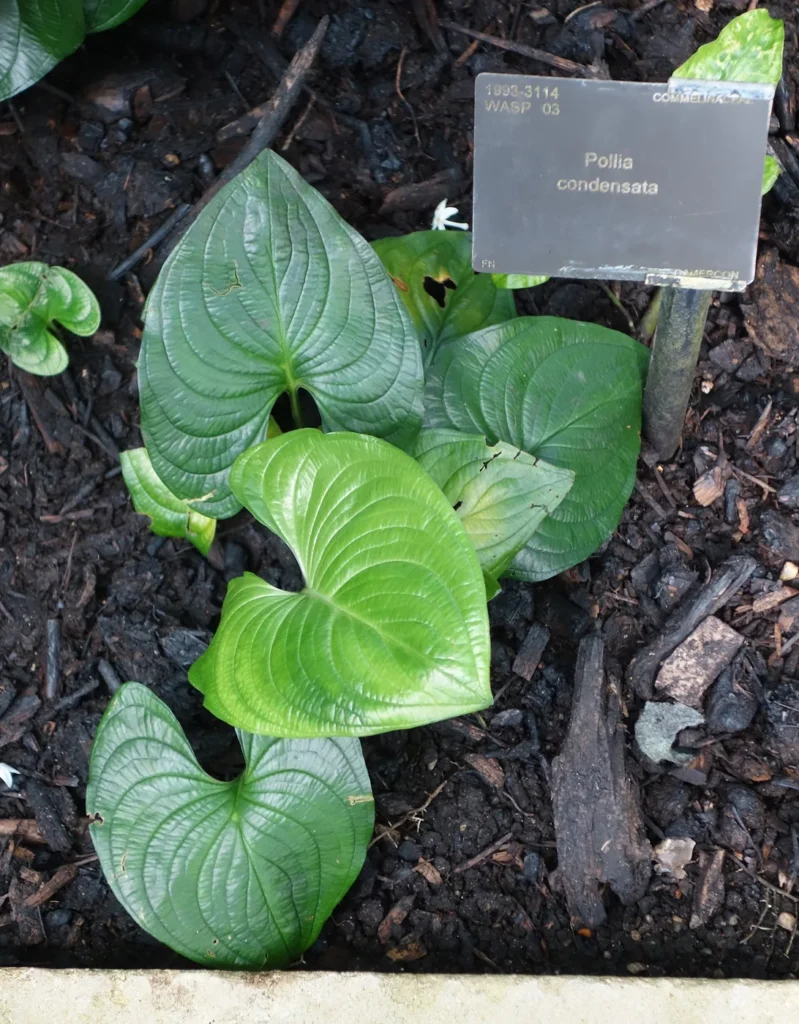
A structural color can persist while the structure responsible for it remains intact. In reporting the original research, the University of Cambridge highlighted colorful preserved specimens. This durability differs from the fading expected when particular pigments degrade.
It would still be too strong to call the fruit’s color indestructible. Crushing, changing or damaging an optical structure can alter the light it reflects. “No blue pigment” also does not mean that every component of the fruit is colorless or chemically irrelevant. The claim concerns the mechanism responsible for its remarkable blue appearance.
A striking signal is not a complete dispersal explanation
The reflective fruit has prompted suggestions about attracting animals and dispersing seeds. An eye-catching surface makes those ideas plausible, but plausibility and demonstrated behavior are different kinds of evidence. The optical studies establish how the color is made; they do not by themselves prove exactly how every visitor responds to it.
Claims that birds use the fruits to decorate nests should therefore be presented as proposed explanations unless supported by direct observations. A good natural-history account can preserve the wonder while keeping the boundary between mechanism and hypothesis visible.
For another plant that manages light through a specialized physical arrangement, read how Lithops leaf windows admit light. Pollia sends selected light outward instead: a tiny fruit whose cell walls turn a common biological material into an extraordinary reflective surface.
Featured image credit: AI-generated editorial illustration of Pollia condensata fruit. Conceptual imagery, not a documentary photograph; anatomy and scale are illustrative.