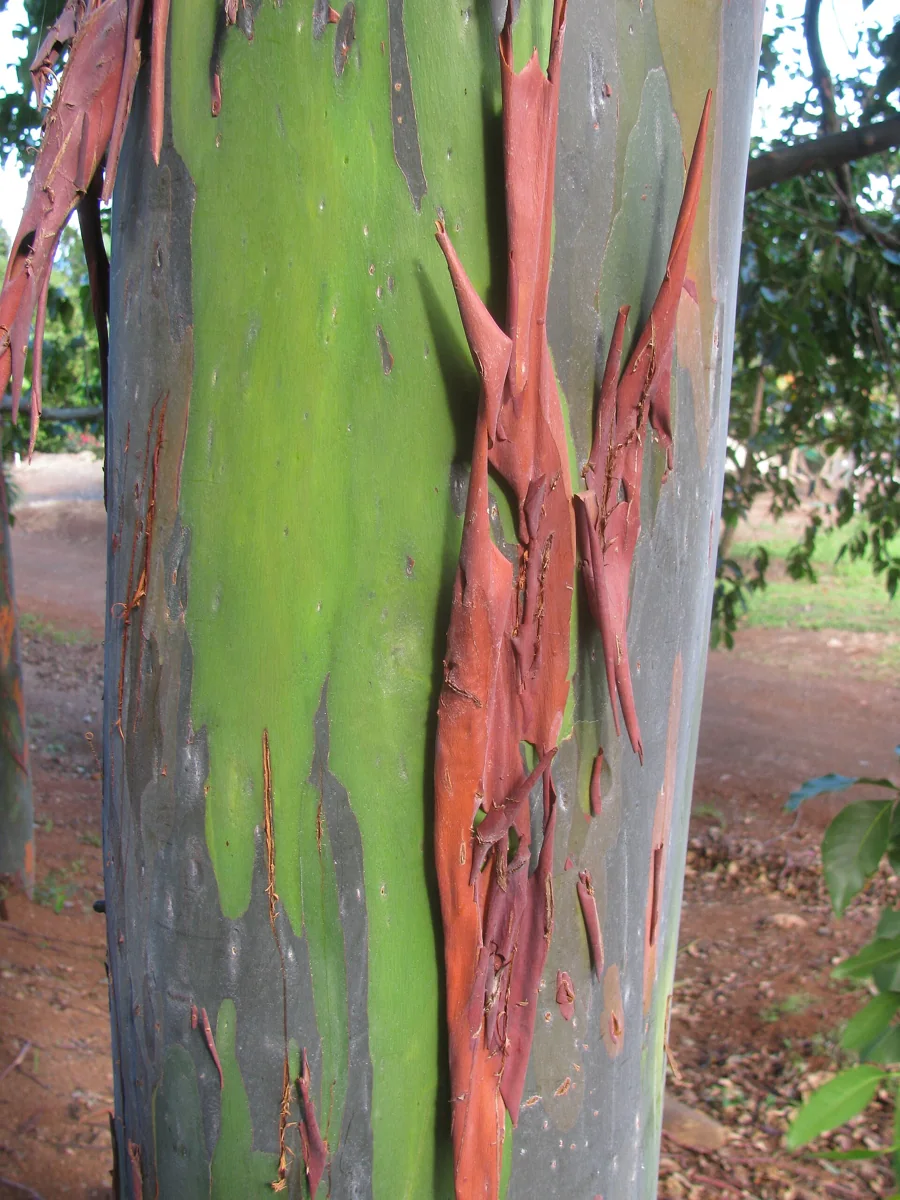
A rainbow eucalyptus trunk can look as though someone brushed it with green, orange, and purple paint. The colors belong to the bark. As outer strips peel away, younger surfaces are exposed and then change as they mature. Patches at different stages create the striking appearance. Its renewing surface is a different phenomenon from the red sap of trees that appear to bleed.
The tree behind the colors
Eucalyptus deglupta is also known as rainbow gum or Mindanao gum. Singapore’s National Parks species account places its native range in the Philippines, Indonesia, and New Guinea. Its habitats include tropical rainforest, correcting the assumption that every eucalyptus belongs to a dry Australian landscape.
The colorful trunk is part of a whole tree with leaves, branches, and flowers. A close-up can make the bark look like an isolated abstract object. Understanding the process means putting the colors back on a growing, shedding surface.
Bark is a living system with an outer surface
The word bark can make the trunk seem like a painted shell, but a tree’s outer covering belongs to a layered biological system. Protective outer tissue and the living tissues beneath it do not have the same roles. Shedding a surface layer should not be confused with removing everything between the air and the wood.
Penn State’s explanation of tree tissues places phloem beneath the outer bark and xylem inside the cambium. These tissues are involved in transport and growth. The colorful surface is therefore only the visible part of a functioning trunk.
This matters when interpreting a close-up. A patch exposed by normal shedding is not necessarily a wound, and a change in surface color does not mean that the wood inside has acquired the same stripes. The photograph records a particular surface at a particular time.
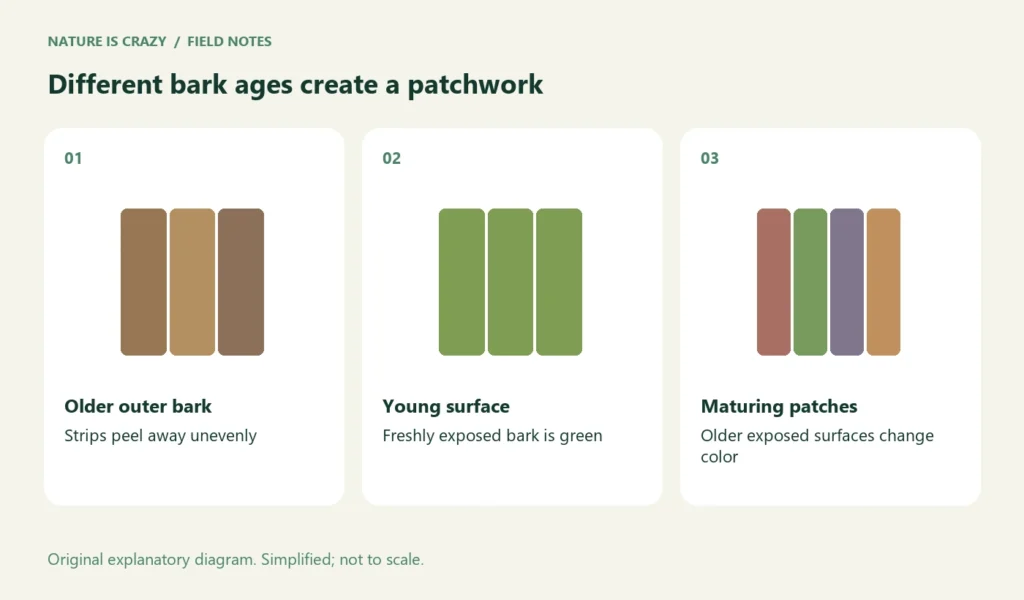
Peeling reveals younger bark
NParks describes uneven strips exposing bright green bark, followed by darker blue, purple, orange, and maroon tones as the surface matures. Because the trunk does not peel all at once, differently aged patches remain side by side.
Think of a wall repaired on different dates: its patches may differ despite following the same process. The eucalyptus, however, has no painter adding external pigments. Its pattern arises from renewal and maturation of its own bark.
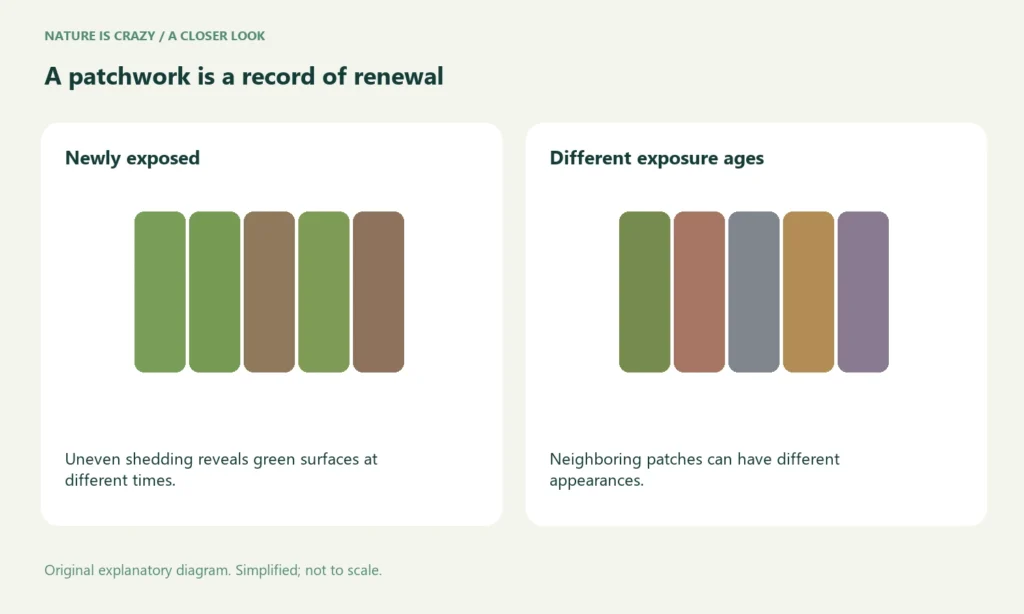
A pattern built from patches of different ages
If a whole trunk changed uniformly, its color could shift without producing a patchwork. Rainbow eucalyptus instead exposes different regions at different times. At any moment, young green areas can sit beside surfaces that have been exposed longer.
A useful observation is to follow the boundaries between patches. Some mark edges where outer bark is lifting; others separate exposed surfaces with different appearances. The trunk is a record of overlapping renewal events rather than one perfectly synchronized color cycle.
Light reaching that surface and returning to the eye makes it visible. This is why the bark’s colors belong to a different category from light produced by bioluminescent mushrooms. A colorful object need not generate light of its own.
Why every trunk looks different
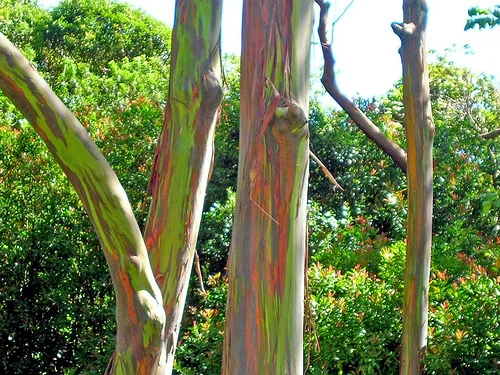
The Port St. Lucie Botanical Gardens account notes that the bark can be less colorful outside tropical settings. Growing conditions and the patches exposed at a particular time help explain why images of the species differ.
A species name does not guarantee that every trunk will display saturated stripes. Nor should a heavily processed photograph become the standard for judging a living tree. Natural colors can be remarkable without every hue appearing maximally bright.
How to read photographs without exaggerating the tree
A wide view and a bark close-up answer different questions. The close-up reveals texture and local contrasts; the wider view shows how much of the trunk carries the pattern and how the tree fits its surroundings. Using both prevents a small colorful patch from being mistaken for the appearance of every part of the tree.
Photographic light and processing also matter. Shade, direct sun, white balance, and saturation can change the recorded colors. That does not make all photographs unreliable. It means the camera’s treatment should not be confused with a fixed biological palette that every individual must reproduce.
To make a useful comparison, photograph the same region under similar lighting at different times. Include enough surrounding trunk to locate the patch again. A sequence can reveal surface change that a single dramatic image cannot. This is a suggested observation method, not a claim that every patch follows an identical timetable.
Another plant-surface comparison comes from the translucent windows in Lithops leaves. There, the surface admits light into internal tissue. Rainbow bark is chiefly striking because of the light reflected from neighboring exposed patches. The two stories show why appearance becomes more informative when the path of light is considered.
Color is not bleeding or glowing
This differs from red sap that makes cut trees appear to bleed. Rainbow bark does not require a wound that releases liquid. The visible surface changes as it sheds and matures.
It also differs from bioluminescent mushrooms. Bark is seen through reflected light; a glowing organism produces light chemically. “Colorful” describes an appearance, not one universal biological mechanism.
Singapore’s Lakeside Garden trail guide highlights the shedding bark as a feature visitors can observe directly. Looking at neighboring patches offers a useful lesson in how a process creates a pattern.
Featured image credit: Image: Forest and Kim Starr. Original image · CC BY 3.0 us. Resized and converted to WebP; image remains under its original license.