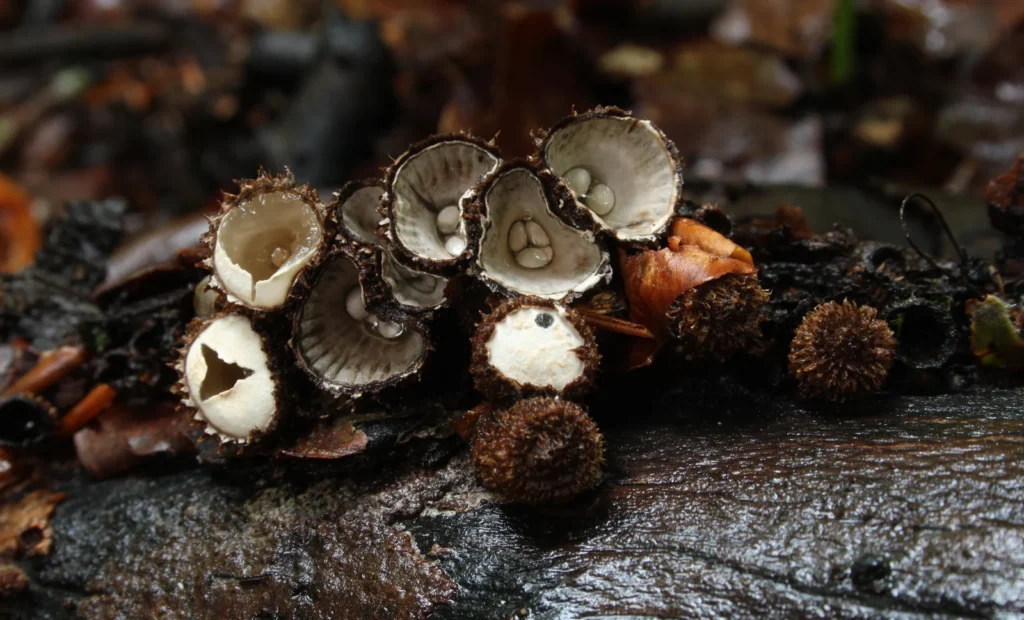
A miniature nest appears among the wood chips, holding what look like tiny eggs. No bird built it. Bird’s-nest fungi produce cup-shaped fruiting bodies containing spore packets, and a falling raindrop can send those packets flying. The resemblance is charming; the mechanism is splash-powered dispersal. Its rain-powered mechanism differs from fungi that recruit infected insects to disperse spores.
The eggs are packets of spores
The University of Florida’s bird’s-nest fungi guide names the nest-like structure a peridium and the egg-like bodies peridioles. The feeding network is the mycelium within surrounding material. The visible cup is a reproductive structure, not the whole fungus.
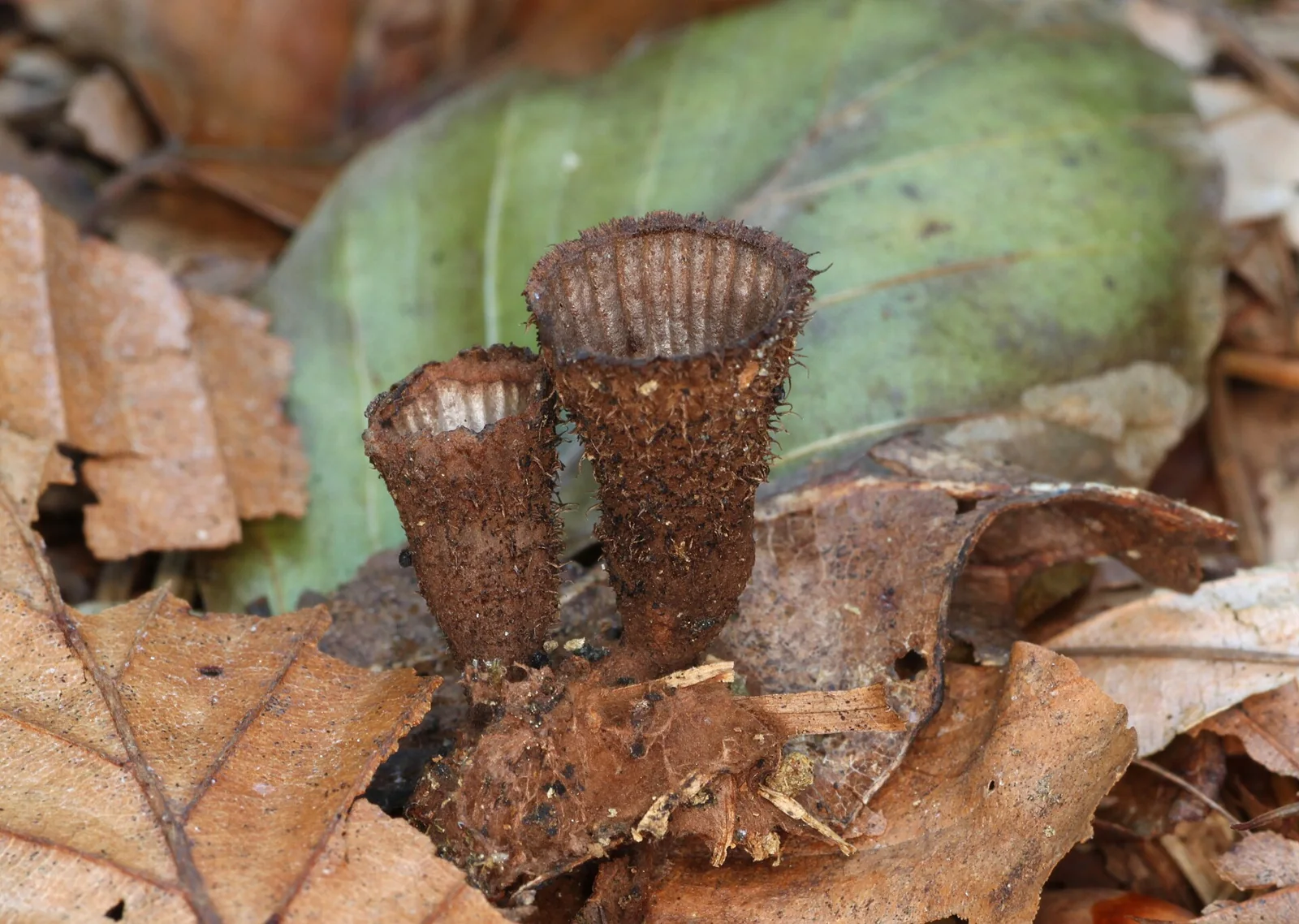
Species such as Cyathus striatus have grooved inner walls and hairy exteriors. A peridiole is not an animal egg, and photographs of different cup-shaped fungi should not automatically be labeled as one species.
A miniature nest is a reproductive structure
The nest-like cup draws attention because it resembles something familiar at an unfamiliar scale. Its function is easier to understand when that resemblance is set aside. The cup holds packages of reproductive material above the substrate, where an external force can move them.
The mycelium supplies the fungus’s larger feeding network. A fruiting body is therefore more like a reproductive output than the whole organism. Removing one cup would not demonstrate that every connected fungal strand in the material had disappeared.
The packaging also matters. A peridiole carries many spores together, so what leaves the cup is a coherent packet rather than a visible handful of loose dust. The launch problem is consequently about moving that packet, including its attachment structures in the cord-bearing groups.
How a raindrop launches a packet
A drop striking inside a suitable cup drives a splash upward and outward. Spore packets can travel with the moving water. Research using high-speed imaging examined this launch process and its attachment mechanism in Cyathus and Crucibulum.
The cup gives falling water a shape to interact with. Rather than simply soaking the fungus, impact can redirect motion toward dispersal. Energy transfers from rain to the packet; the fungus does not need to consciously decide when to fire.

Cup shape redirects the impact
A falling drop brings motion to the encounter. The cup’s geometry influences where the resulting water moves, while the packet’s position influences whether it joins that splash. The launch is an interaction among a drop, a structure, and a packaged payload.
The fungus is not storing the same kind of release-ready mechanical tension used by some plants that explosively disperse seeds. Rain supplies the immediate energy in the splash system. Similar-looking sudden movement can therefore have a different source of force.
High-speed imaging makes these distinctions visible. An ordinary glance can show that a packet disappeared after rain; a slowed sequence reveals the order of impact, splash, launch, and attachment. Mechanism depends on that sequence, not merely the final location.
A cord helps it stay put
In the studied fungi, a packet is associated with an extensible funicular cord and an adhesive structure. Biomechanical work from Miami University investigated how these structures help launched packets attach to vegetation.
A splash supplies transport; attachment helps preserve the new position. These are related but separate jobs. Detailed structures vary across the wider group, so the cord mechanism should not be assigned indiscriminately to every bird’s-nest fungus.
Not every bird’s-nest fungus launches the same way
A study of Nidularia pulvinata documented a different arrangement. Its rounded fruiting bodies open to expose packets in a gelatinous matrix. Water impact produced short-range, predominantly horizontal dispersal, without the funicular cords characteristic of the studied Cyathus and Crucibulum systems.
That comparison prevents a memorable species-level mechanism from becoming a false rule for the entire family. The familiar fluted cup, its contents, and its cord are one solution. Another fungus can use rain while packaging and releasing its spores differently.
Attachment also changes what happens after launch. A cord-bearing packet can be secured on vegetation rather than simply landing loose on the substrate. Studying dispersal therefore requires following more than the flight: the next surface and later movement can matter as much as the initial splash.
A useful parallel is the giant larvacean’s particle-loaded mucus house. Rain launches the fungus’s reproductive packets outward, while seawater flow gathers food into the larvacean’s filter. Both depend on structures that interact with moving water, but the transported material and biological purpose are very different.

What are they doing in mulch?
Penn State’s guide to fungi in mulch describes these organisms among decomposers associated with organic landscaping materials. Their presence does not by itself mean a nearby plant is infected. They can feed on dead wood rather than living roots.
This differs from fungi that use infected insects to disperse spores, and from plants that release seeds using stored mechanical energy. Each must move reproductive material, but the source of force differs.
Featured image credit: Image: Holger Krisp. Original image · CC BY 3.0. Resized and converted to WebP; image remains under its original license.