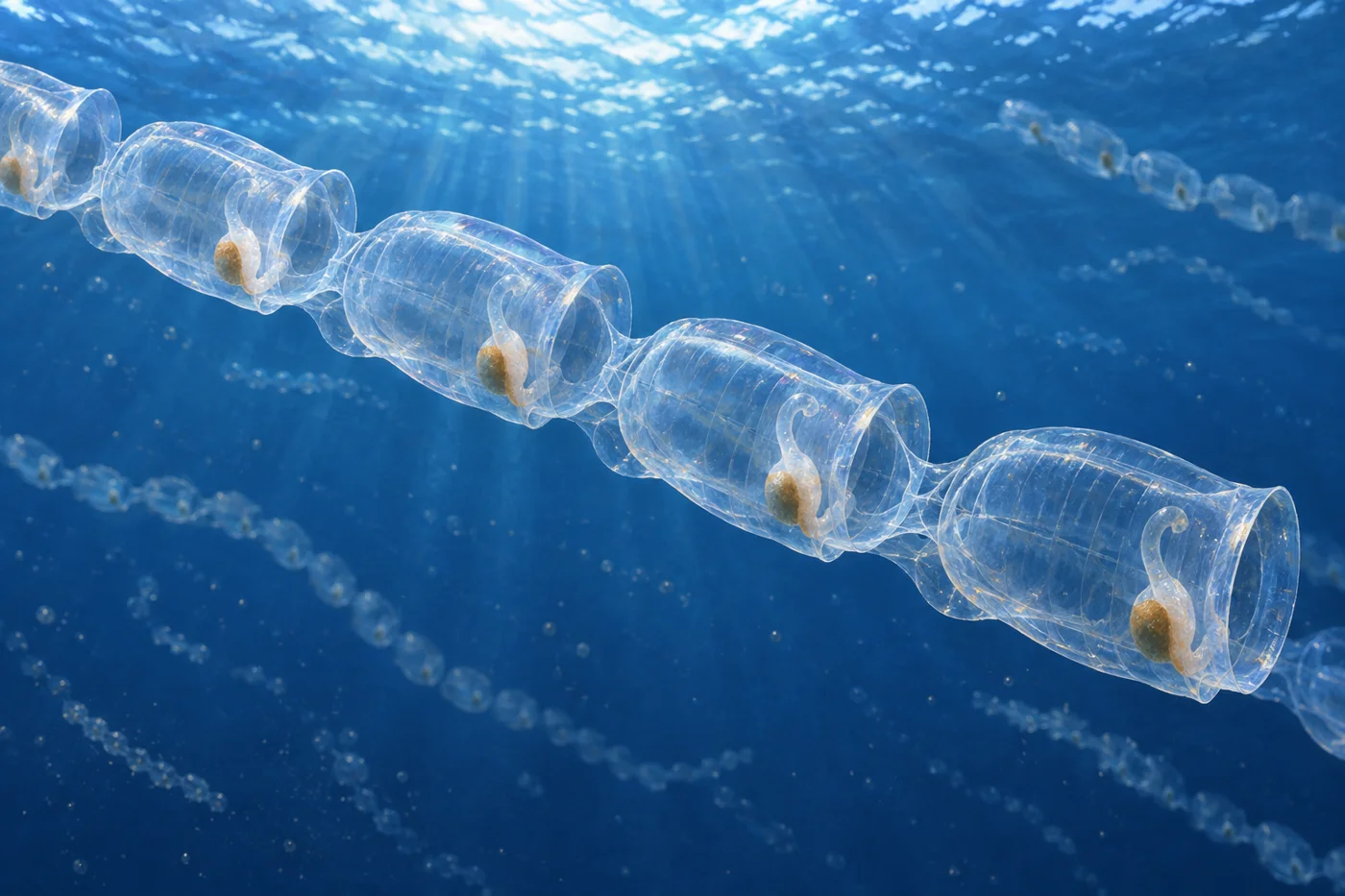
Transparent ocean animals often solve feeding and movement problems in ways that are hard to see from a photograph. Our article on giant larvaceans and their mucus houses follows one such solution. Salps offer another: during part of their life cycle, individual animals remain attached in chains and move with several water jets instead of a single shared propulsive organ.
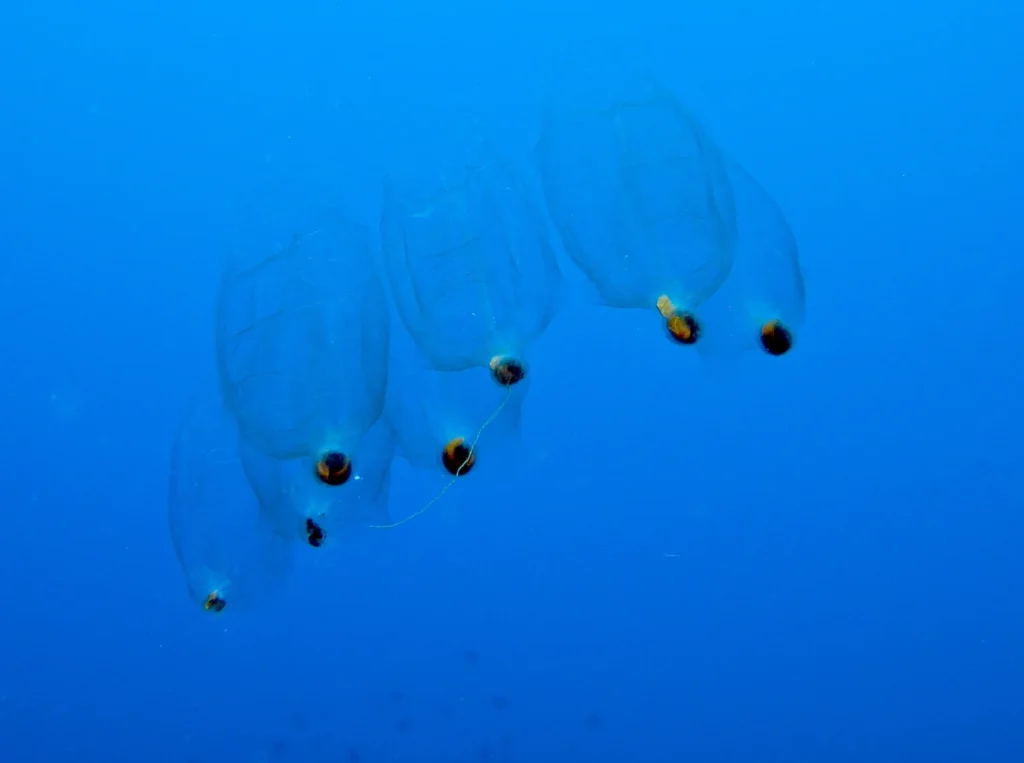
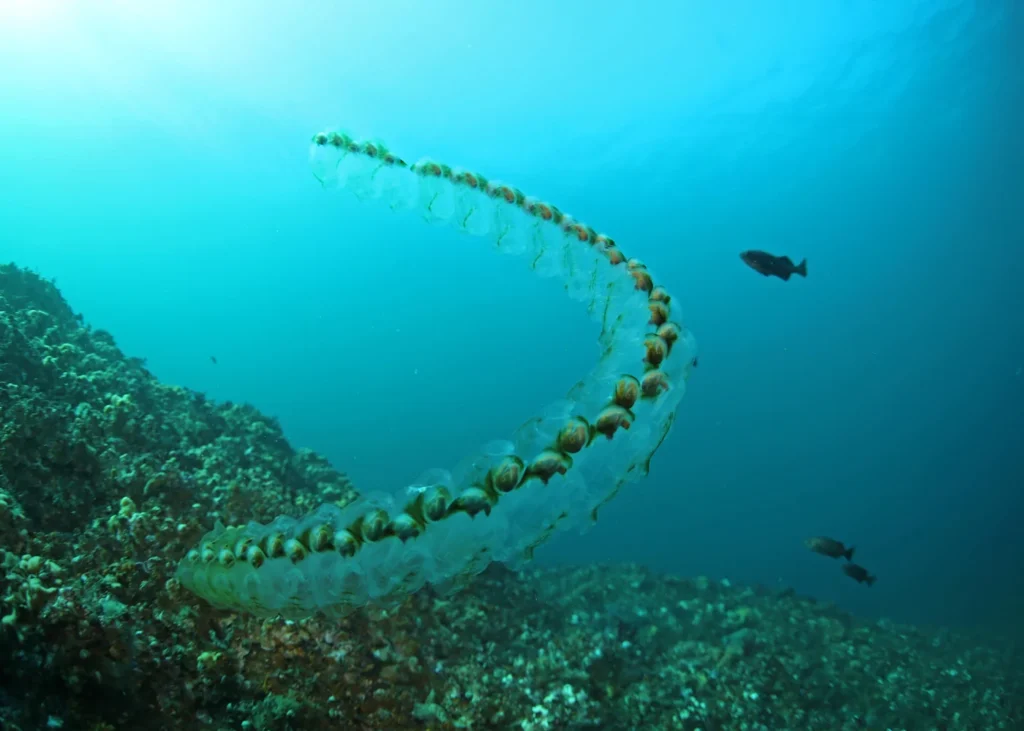
A salp chain can look like a necklace made of gelatinous barrels. Each barrel is a zooid: an individual unit with its own body and pumping apparatus. The chain’s movement emerges from those units operating together. The surprising result is that perfectly synchronized strokes are not always the most effective arrangement.
Each zooid is a small jet-propelled swimmer
Salps are tunicates, not jellyfish. Their bodies take in water through one opening and expel it through another. Circular muscle bands contract around the barrel-shaped body, driving a pulse of water backward and pushing the animal forward. A comparative study of salp jet wakes examined these swimming mechanics across differently shaped species.
Unlike a boat propeller that turns continuously, this is an intermittent source of thrust. An isolated animal can speed up during a pulse and slow between pulses. That variation matters because resistance from the surrounding water depends on movement. A chain provides a way to distribute propulsive events over time.
A study of the hydrodynamic advantages of salp chains combined theory, high-speed video and observations of flow. It found that asynchronous jetting could smooth the chain’s speed and reduce the drag costs associated with large speed fluctuations. The benefit was not simply that a bigger group has more muscles.
Taking turns without a marching rhythm
Imagine several people pushing a wheeled object. If they all give one brief shove and then pause, the object repeatedly accelerates and slows. If their pushes overlap at different times, its motion can be steadier. This analogy illustrates the timing problem; the detailed fluid mechanics of a salp chain require measurements rather than a comparison with wheels.
In the studied aggregates, individual zooids did not need to fire each pulse in exact unison. Their separate pumping cycles together produced a smoother overall velocity profile. The researchers also visualized the wakes of swimming chains and found that asynchronous jetting limited interactions between jets.
That is a helpful distinction between collective performance and uniform behavior. A group can produce a coherent result while its components do different things at a particular instant. Calling the chain “coordinated” should not automatically imply that every zooid contracts at the same moment.
The arrangement of the chain also matters
There is no single universal salp-chain shape. A molecular study of salp relationships and colonial architecture examined how different arrangements evolved. Species can organize their zooids into differing geometries, including linear and oblique chains and more complex forms.
Geometry affects the directions of the jets as well as the outline of the group. A thrust that points straight along the chain’s direction of travel has a different effect from a thrust at an angle. The placement and orientation of zooids therefore belong in the explanation alongside their pulse timing.

Our article on the lattice of a glass sponge skeleton looks at another case where arrangement matters as much as the material itself. A salp chain is a moving example: the same kinds of pumping units can produce different outcomes when their positions and orientations differ.
Some chains follow a helical path
Researchers have also observed chain-forming salps moving in helices in the open ocean. In a study using three-dimensional imaging, the orientation of zooids helped explain how their jets generated both forward motion and torque. The investigated chains could spin, and longer chains showed transitions toward helical swimming paths.
Torque is a turning effect. A jet that does not act through the same central direction as another can contribute to rotation as well as translation. This makes a corkscrew-like path physically understandable without imagining a central animal steering the entire group.
The study concerned a particular chain-forming species and its observed configurations. It does not establish that every salp chain always swims in a helix. Photographs showing a straight chain and observations showing a curved path need not contradict each other: species, geometry and time all matter.
A chain is a stage of a life cycle
The colonial architecture study also emphasizes that the linked animals arise within a life cycle containing solitary and aggregate stages. Solitary salps produce chains asexually; the aggregate stage participates in sexual reproduction. A chain is therefore not just a chance gathering of unrelated animals that happen to travel together.
Understanding that history prevents another misleading comparison. A school of fish consists of separate swimmers maintaining positions through behavior. Salp zooids are physically connected products of a distinctive reproductive cycle. Both are groups, but their connection, formation and mechanical constraints differ.
What the research actually establishes
The strongest case for distributed jetting comes from matching observation with explanation. Video reveals how speed changes; flow visualization reveals where water goes; a model tests why one pattern may reduce particular mechanical costs. None of those alone would justify a claim that salps are the most efficient swimmers in every situation.
A chain can gain a timing advantage without being perfect, and an elegant mechanism can have limits. The important discovery is that several intermittent jets can collectively create comparatively steady motion. The group’s performance depends on the relationship between its parts.
To explore another animal whose body organization challenges a familiar assumption, read how Trichoplax feeds without a mouth. Salp chains show a different kind of organization: each member keeps its own pumping machinery, while the connected arrangement changes what the whole group can do.
Featured image credit: AI-generated editorial illustration of salp chain. Conceptual imagery, not a documentary photograph; anatomy and scale are illustrative.