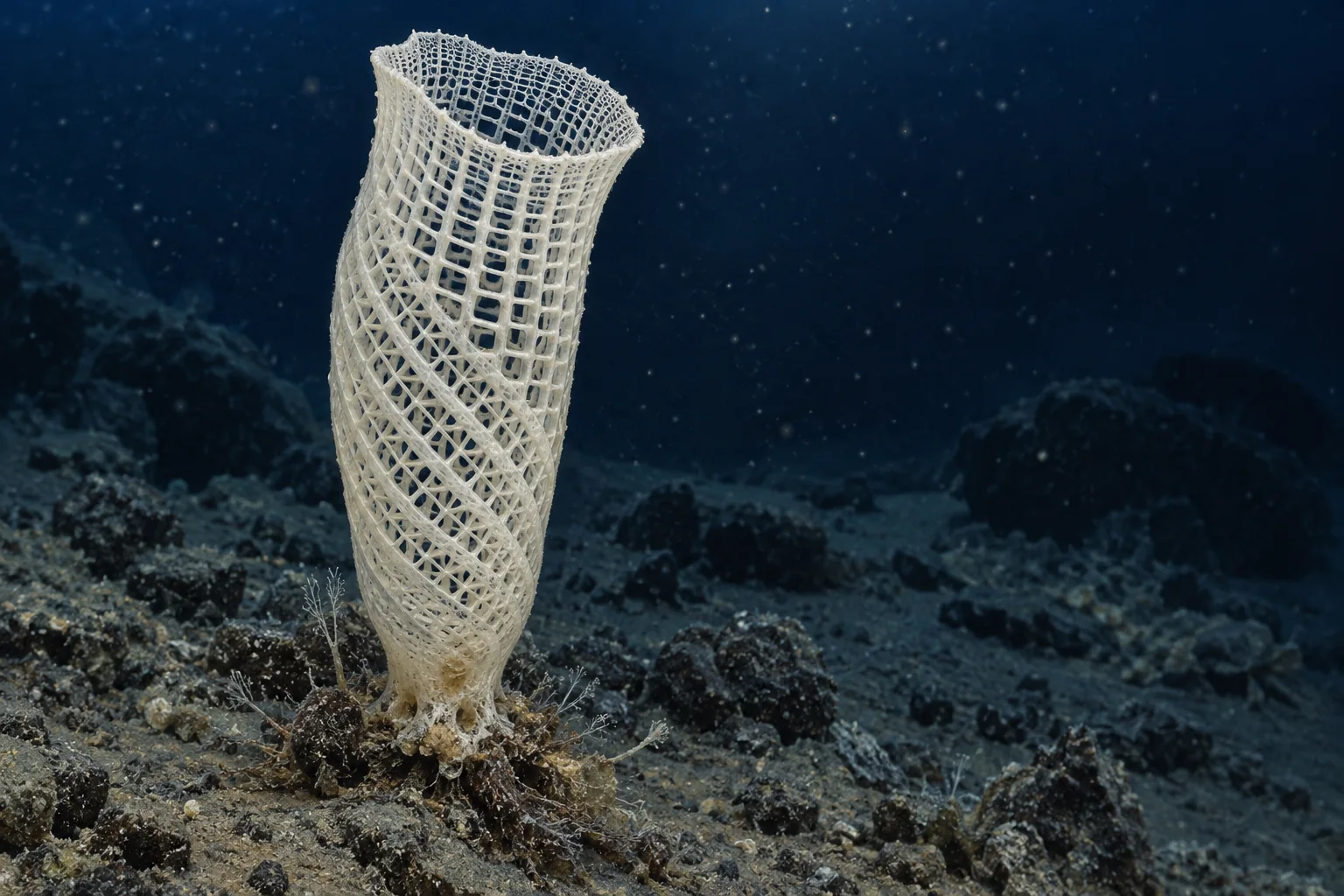
A Venus flower basket looks like a sculpture woven from glass. It is the skeleton of an animal. Glass sponges build mineral supports from silica, arranging them into structures that resemble architectural models. Their beauty becomes even stranger under a microscope. Its mineral framework belongs beside other unusual biological materials, including the ironclad beetle’s crush-resistant armor.
Glass-like supports inside an animal
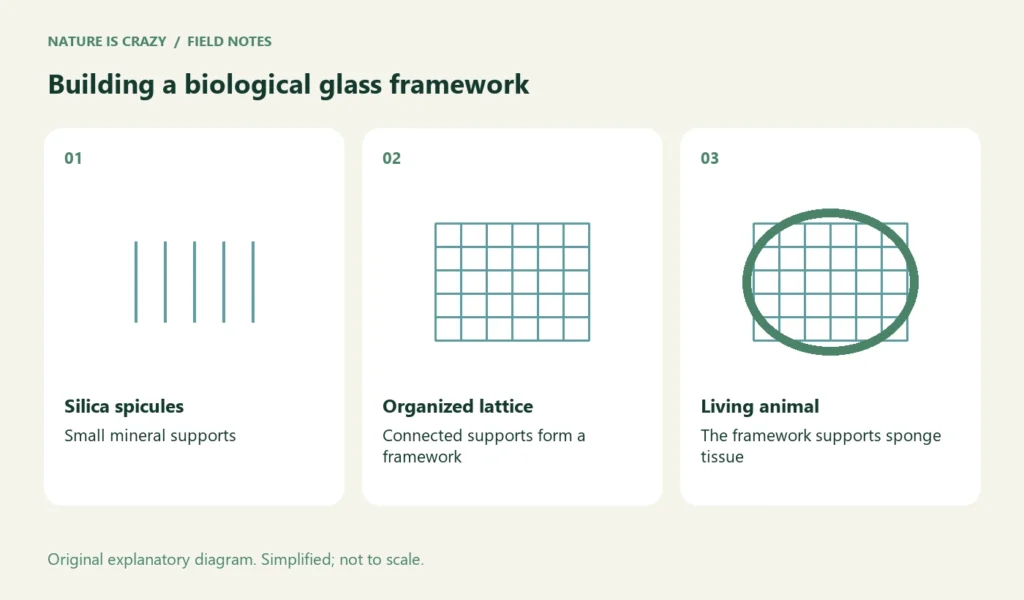
NOAA identifies glass sponges as members of the class Hexactinellida. Their tissues contain silica structures called spicules. In some species, the supports fuse into elaborate frameworks that persist after the animal dies.
“Glass” refers to the material, not a manufactured bottle. A biological skeleton is organized under seawater conditions, not poured from molten glass into a mold. Its mineral composition is only part of the story.
Why a fragile ingredient can support a durable structure
Glass has a reputation for shattering, but “made of silica” is not a complete mechanical description. Thickness, layering, connections, and geometry determine how forces move through a structure. A short supported element and a long unsupported one do not respond to loading in the same way.
The sponge’s skeleton is therefore best understood as an organized material system. Spicules operate as components of something larger, and the larger framework influences the stresses experienced by each component. A single strand cannot reveal everything about the cage that contains it.
That distinction also helps explain the exceptional material properties of limpet teeth. Testing a tiny biological component and predicting the performance of a whole structure are related, but separate, tasks.
Structure at several scales
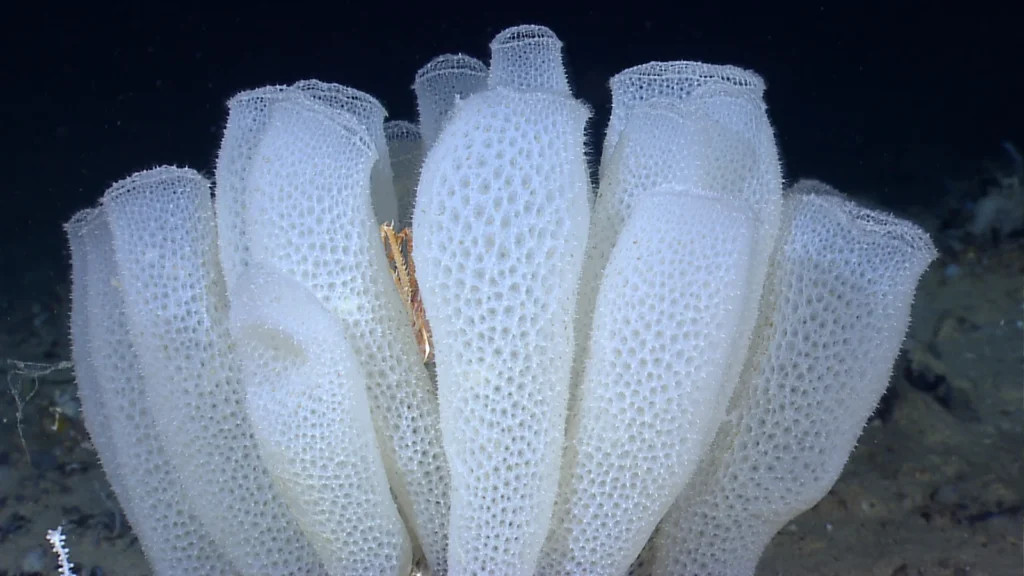
In Euplectella, small components contribute to a larger cage-like lattice. Research on its anchoring spicules describes silica deposited around an organic filament, with layers and compositional differences. The arrangement matters as much as the ingredients.
Imagine the difference between a pile of rods and a bridge. The same material behaves differently when its elements are connected differently. The sponge does not consciously design buildings; the analogy shows why structure contributes to function.
Diagonal reinforcement and the problem of buckling
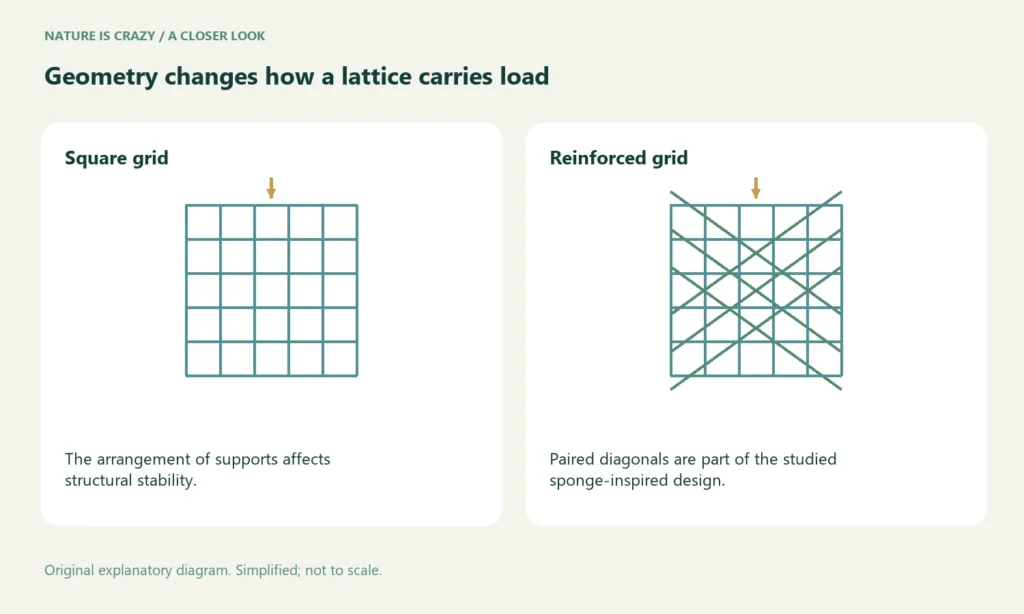
A column can fail by bending sideways before its material is simply crushed. This is buckling: a loss of structural stability that matters in buildings, bridges, and slender biological supports. Adding material everywhere is one response; distributing it more effectively is another.
Harvard researchers studied the sponge’s reinforced lattice by reproducing its geometry and comparing it with other designs. Its arrangement combines a square grid with paired diagonal reinforcements. Experiments and simulations showed improved resistance to buckling without simply increasing the total material.
The comparison concerned particular geometries under tested loads. It does not mean that every sponge is stronger than every bridge, or that the animal’s exact skeleton can be scaled up unchanged into a skyscraper. It offers a design principle that engineers can adapt and test.
Can the spicules carry light?
A 2003 optical study showed that individual Euplectella spicules can guide light under experimental conditions. This invites comparison with manufactured optical fibers and interests researchers studying how organisms control a mineral’s fine structure.
It does not establish that a sponge uses an underwater internet. Demonstrating light transmission in a specimen and proving a natural biological role are different tasks. The optical study proposed possible functions rather than proving communication through a skeleton.
Optical evidence and biological function are different questions
An optical fiber carries light because its internal structure affects how light travels through it. The sponge research is striking because a living animal produces a layered mineral structure with experimentally useful optical properties under ordinary environmental conditions.
To establish a biological purpose, however, researchers would also need evidence about the light available, how it couples into the spicule, where it emerges, and whether that changes the animal’s performance or survival. A laboratory beam demonstrates a physical capability without resolving all those ecological questions.
The distinction is productive rather than disappointing. The same specimen can support investigations in material chemistry, mechanics, optics, and natural history. Each approach asks a different question, and the answers should not be merged into one exaggerated claim.
The feeding architecture also has a useful counterpart in the giant larvacean’s mucus filter. A larvacean repeatedly discards its structure, whereas some glass sponge skeletons persist. Comparing those lifetimes reveals how the choice of material shapes both an animal’s feeding system and its contribution to the surrounding habitat.
A living filter, not just a framework
Many sponges feed by processing small organisms and particles from surrounding water. A skeleton supports that life. NOAA’s description of sponge mounds explains how persistent fused skeletons can also contribute to structures accumulating across generations.
Compare this framework with the ironclad beetle’s protective armor or the strong teeth of limpets. Strength and shape serve particular jobs; no material is best at everything.
Featured image credit: AI-generated editorial illustration, not a photograph or a precise anatomical reconstruction.