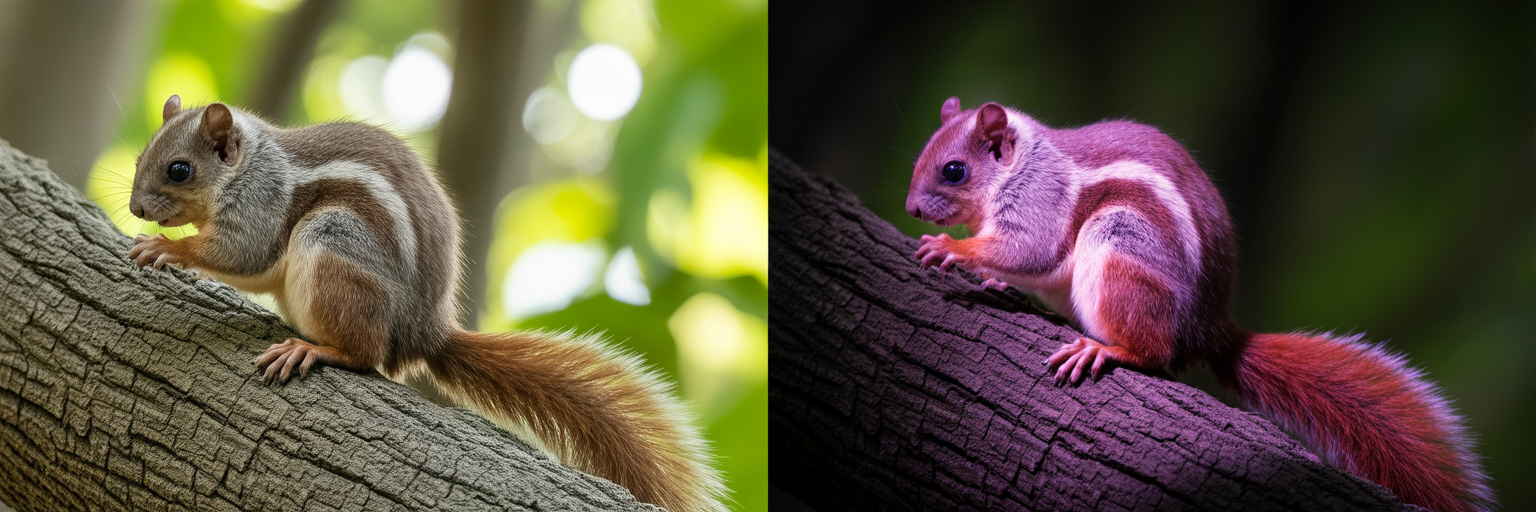
In 2020, a team of scientists examining museum specimens made a startling discovery. When they shone an ultraviolet lamp on a platypus, its drab brown fur erupted in a soft, ethereal glow of green and blue. This finding added another layer of strangeness to an already peculiar mammal and highlighted a rapidly growing field of study: animal biofluorescence. From wombats and flying squirrels to frogs and deep-sea sharks, the list of creatures that glow under certain light is expanding at a dizzying pace. But this explosion of observations has raised a far more difficult question than what glows. The real mystery is why.
Understanding Animal Biofluorescence
At its core, animal biofluorescence is a passive optical phenomenon. It is not the same as creating light. Instead, it involves the absorption of high-energy light from an external source, such as the sun, and its nearly instantaneous re-emission at a lower-energy, longer wavelength. For example, a protein or pigment in an animal’s skin might absorb invisible ultraviolet (UV) light and re-emit it as visible green light. The effect of UV light on animals can produce these hidden patterns, which are completely invisible to the human eye under normal daylight conditions. This process is fundamentally different from other ways organisms interact with or produce light, a distinction that is critical for understanding its potential purpose.
The confusion between biofluorescence vs bioluminescence is common but significant. Bioluminescence is an active process, a chemical reaction inside an organism that produces light from within, much like a firefly’s lantern. Biofluorescence, on the other hand, is entirely dependent on an external light source to “charge” it. Without that incoming light, the glow ceases to exist. To clarify these differences, it helps to categorize the various light-related phenomena seen in nature.
| Phenomenon | Light Source | Mechanism | Common Example |
|---|---|---|---|
| Biofluorescence | External (e.g., sunlight, UV light) | Absorption and instant re-emission of light at a longer wavelength. | Corals glowing green under blue ocean light. |
| Bioluminescence | Internal | Light produced by a chemical reaction within the organism. | Fireflies creating their own light. |
| Phosphorescence | External | Absorption and delayed re-emission of light. | Some minerals that glow after light exposure. |
| UV Reflectance | External | Light is bounced off a surface without changing its wavelength. | Certain butterfly wings that appear iridescent. |
| Visible Coloration | External (e.g., white light) | Pigments absorb some wavelengths and reflect others. | A cardinal’s red feathers. |
Think of a fluorescent highlighter pen. Under normal office light, its color is bright because pigments reflect visible light. But under a blacklight, which emits UV radiation, the ink glows intensely. The molecules in the ink are absorbing the invisible UV energy and re-emitting it in the visible spectrum. Animal biofluorescence works on the same principle. However, this analogy also reveals a crucial limitation. The spectacular, vibrant images of glowing animals seen online are almost always taken in a dark lab with powerful UV lamps. In the wild, an animal is bathed in the full spectrum of sunlight. Any faint glow produced by fluorescence is typically overwhelmed and washed out by the much brighter reflected light, rendering it invisible to a casual observer, and perhaps even to other animals.
Proposed Functions of Glowing in the Wild
The discovery that so many animals glow has led scientists to propose a wide range of potential evolutionary functions. These hypotheses attempt to explain how a faint, conditional glow could provide a survival or reproductive advantage. It is important to view these as scientific proposals currently under investigation, not as established facts.
- Mate Attraction: One of the most compelling ideas is that fluorescent patterns act as signals during courtship. A bright, vivid glow could be an “honest signal” of an individual’s health, diet, or genetic quality. A potential mate capable of perceiving this glow might choose the brightest partner, ensuring healthier offspring. This would be similar to how the vibrancy of a peacock’s feathers indicates its fitness.
- Species Recognition: In visually complex environments like a coral reef, where hundreds of similar-looking fish species coexist, unique fluorescent patterns could act like a team jersey. This would allow individuals to quickly and accurately identify members of their own species, preventing wasted energy on courting the wrong partner or mistakenly challenging a different species.
- Camouflage: It seems counterintuitive that glowing could help an animal hide, but several theories exist. An animal might glow to match a fluorescent background, such as certain corals or algae, effectively disappearing. Alternatively, fluorescent patterns could create disruptive coloration, breaking up the animal’s body outline and making it harder for a predator to recognize its shape.
- Warning Coloration (Aposematism): Just as the bright colors of a poison dart frog or a monarch butterfly warn predators of their toxicity, a sudden fluorescent flash could serve as a universal “danger” sign. A predator attempting to bite a fluorescent animal might be startled by the unexpected glow, associating it with a negative experience and avoiding that species in the future.
- Prey Luring: In the dim light of the deep sea, a small, glowing spot could act as a lure for curious prey. A predator could remain hidden in the darkness while dangling a fluorescent appendage, drawing smaller fish or crustaceans toward its mouth. When discussing the diverse and sometimes surprising strategies animals use to attract prey, it’s interesting to compare biofluorescent luring with other specialized hunting techniques, such as how the archerfish shoots bugs out of the air with water.
- Enhanced Vision: This hypothesis suggests the fluorescence isn’t for signaling to others but for helping the animal itself see better. In environments dominated by blue light, like the ocean, an animal could have fluorescent pigments in or around its eyes. These pigments would convert the abundant blue light into green or red light, which could increase contrast and make it easier to spot prey or predators against the blue background.
Evaluating the Evidence for Functional Glows
Observing a glow is easy. Proving it has a purpose is incredibly difficult. To move from a curious observation to a confirmed biological function, scientists generally require three key pieces of evidence. First, the necessary excitation light must be present and abundant in the animal’s natural habitat. Second, the animal itself, or other species it interacts with, must possess the visual system capable of detecting the faint, specific wavelengths of the emitted glow. Third, and most critically, a controlled experiment must show that the presence or absence of the fluorescence directly alters the animal’s behavior.
Meeting all three criteria is rare, which is why the field of fluorescent animals explained is filled more with questions than answers. The current state of research can be sorted into several categories based on the strength of the evidence.
| Category of Evidence | Description | Status of Evidence | Example Species |
|---|---|---|---|
| Function Experimentally Supported | Controlled behavioral experiments have proven the fluorescence serves a specific purpose. | All three scientific criteria met. | Budgerigars (mate choice). |
| Function Plausible but Untested | The context (e.g., nocturnal behavior, eye anatomy) suggests a function, but no behavioral experiments exist. | Criteria 1 and 2 may be met, but 3 is missing. | Flying squirrels (species recognition). |
| Fluorescence Confirmed, Function Unknown | The animal is known to glow, but there is no evidence for why. This is the largest category. | Only the existence of the glow is confirmed. | Platypus, many marine fish. |
| Possible Preservation Artifact | The observed glow may be caused or intensified by chemicals used in museum preservation. | The glow may not be present in living animals. | Some historical mammal specimens. |
| Popular Claim Unsupported | A widely cited function lacks rigorous scientific backing or has been challenged by research. | Evidence is anecdotal or correlational at best. | Scorpions (prey luring). |
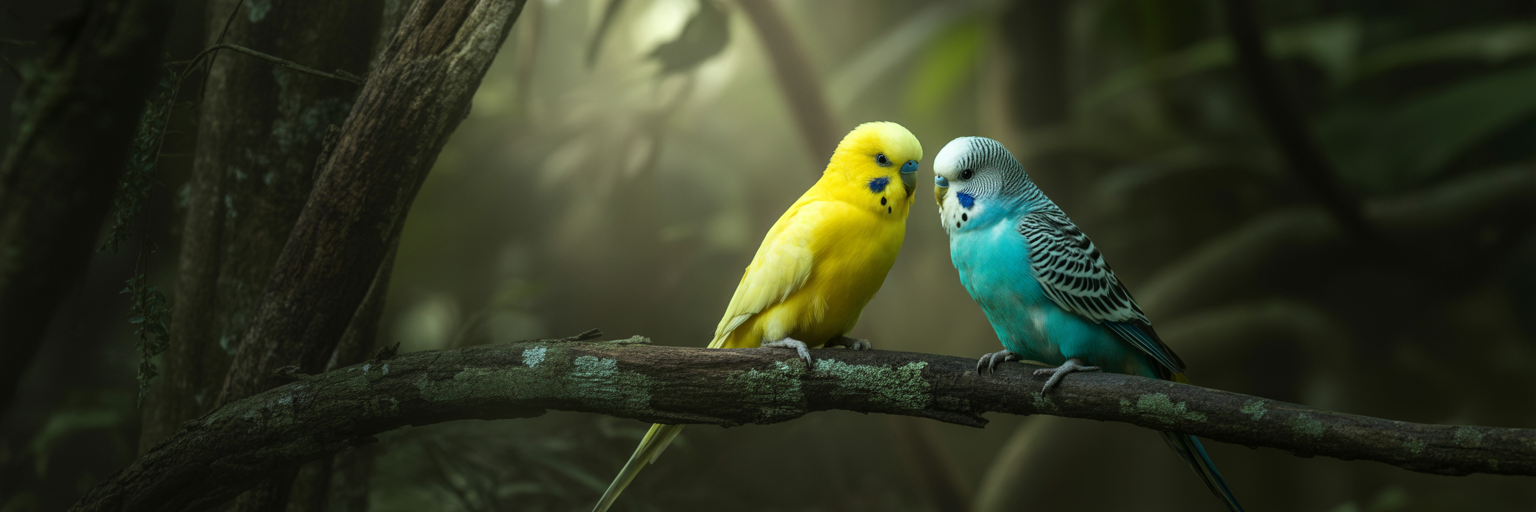
The gold standard for evidence comes from budgerigars. These small parrots have fluorescent yellow feathers on their crowns that glow under UV light. In clever experiments, scientists placed males and females in enclosures separated by UV-transmitting or UV-blocking glass. Females consistently showed more interest in males viewed through the UV-transmitting glass, where their glowing crowns were visible. When the glow was blocked, their appeal diminished. As highlighted in studies published by the National Center for Biotechnology Information, this demonstrates how fluorescence can act as a means of colour signal enhancement, directly linking the physical trait to a behavioral outcome in mate choice.
In contrast, the case for flying squirrels is plausible but untested. These nocturnal mammals glide between trees at night, and their pinkish glow could theoretically help them spot each other in the dark. Their eyes are suited for low-light vision, but no behavioral experiments have been done to prove the glow is used for signaling.
The platypus falls squarely into the “function unknown” category. It glows, and it’s active in low-light conditions, but there is no evidence its eyes can even perceive the glow, nor is there any hypothesis for what it might be used for. Finally, the popular idea that scorpions use their bright cyan glow to lure prey has been largely debunked. Research shows that insects are not attracted to the scorpion’s glow and may even be repelled by it, placing this long-held belief in the “unsupported” column.
Challenges in Studying Animal Fluorescence

The journey to understand why do animals glow is fraught with methodological challenges and potential red herrings. Several factors can mislead researchers and complicate the interpretation of results, making this a particularly tricky area of biology.
One of the first major hurdles is the museum artifact problem. Many of the initial discoveries of fluorescent mammals were made using specimens prepared decades or even a century ago. The chemicals used in taxidermy, such as arsenic, borax, or certain varnishes, can themselves be fluorescent. This means a glowing animal on a museum shelf might be a “false positive,” where the observed glow comes from the preservative, not the animal’s biology. Distinguishing between natural fluorescence and a preservation artifact requires careful chemical analysis and, ideally, comparison with living specimens.
This leads to the next challenge: the limitations of studying dead animals. A preserved skin or skeleton can tell you if an animal contains fluorescent compounds, but it cannot tell you anything about behavior. A dead specimen cannot court a mate, flee a predator, or hunt for prey. Proving a function requires observing living animals in controlled settings, which is often impractical or impossible for rare, deep-sea, or nocturnal species.
Perhaps the most significant challenge is the byproduct hypothesis. Many common biological materials are inherently fluorescent. Keratin, the protein that makes up fur, feathers, claws, and beaks, has a natural tendency to glow under UV light. Bones and teeth, rich in collagen and phosphate minerals, also fluoresce brightly. Furthermore, metabolic waste products like porphyrins are highly fluorescent and can be deposited in an animal’s fur or skin. This suggests that for many animals, especially mammals, fluorescence may not be an adaptation at all. Instead, it could simply be an accidental chemical property of the materials their bodies are made of. As a recent analysis by the Royal Society shows, widespread fluorescence across mammals is often linked to the chemical properties of their fur and skin rather than a visual signal.
Another pitfall is photographic exaggeration. The stunning, vibrant images of glowing animals that circulate online are created using long-exposure photography in complete darkness with powerful, concentrated UV light sources. This technique captures every last photon of emitted light, creating an image that is far brighter and more dramatic than what any animal would perceive in its natural environment, where ambient light would wash out the effect.
Finally, scientists must constantly guard against the temptation to confuse correlation with causation. Just because a platypus is nocturnal and its fur glows does not automatically mean the glow is an adaptation for seeing at night. Without a demonstrated mechanism and a controlled behavioral experiment, the connection remains purely speculative. The simple coexistence of two traits is not evidence that one causes or serves the other.
Case Studies Across the Animal Kingdom
Mammals: The Platypus and Flying Squirrels
The recent discoveries of fluorescence in mammals like the platypus and flying squirrels generated immense public excitement, but they also serve as perfect examples of why scientists remain skeptical. Both are nocturnal, and their fur glows vividly under UV light—a pinkish hue for the squirrels and a cyan-green for the platypus. This context makes a signaling function, such as species recognition in the dark, seem plausible. However, the leading hypothesis is far less exciting. The glow in both animals is likely a non-functional byproduct of the chemical composition of their fur. There is currently no evidence that their eyes are adapted to see these specific wavelengths or that the glow influences their behavior. The discovery of biofluorescence in a mammal as unique as the platypus adds to its list of bizarre biological traits, rivaling other strange reproductive strategies in the animal kingdom, such as how the Suriname toad gives birth through holes in its back. For now, their glow remains a curiosity, not a confirmed function.
Amphibians: The Polka-Dot Tree Frog
The case of the polka-dot tree frog (Boana punctata) from South America represents a significant step up in evidence. When scientists discovered its glow, they didn’t stop there. They analyzed the frog’s visual system and found that its retinal photoreceptor cells have a sensitivity peak that perfectly matches the wavelength of the light its skin emits. This anatomical link is powerful evidence. It suggests that the frogs are biologically equipped to see their own glow, making a role in communication or mate choice highly probable. While behavioral experiments are still needed for definitive proof, the alignment between the emitted light and the eye’s sensitivity moves this case beyond the byproduct hypothesis and into the realm of plausible function.
Birds: The Budgerigar Gold Standard
Among all fluorescent animals studied, the budgerigar (a type of parakeet) provides the strongest evidence for a functional glow. The yellow feathers on their crown contain a fluorescent pigment that glows brightly under UV light, which is abundant in their native Australian habitat. Crucially, budgerigars have excellent color vision that extends into the UV spectrum. The definitive proof came from behavioral experiments where female budgies were allowed to choose between males. When a UV-blocking filter was placed in front of a male, obscuring his fluorescent crown, females showed significantly less interest. This elegant experiment directly demonstrated that the fluorescence plays a causal role in mate selection, making it the benchmark against which all other claims of functional fluorescence are measured.
Marine Life: A World of Unknown Glows
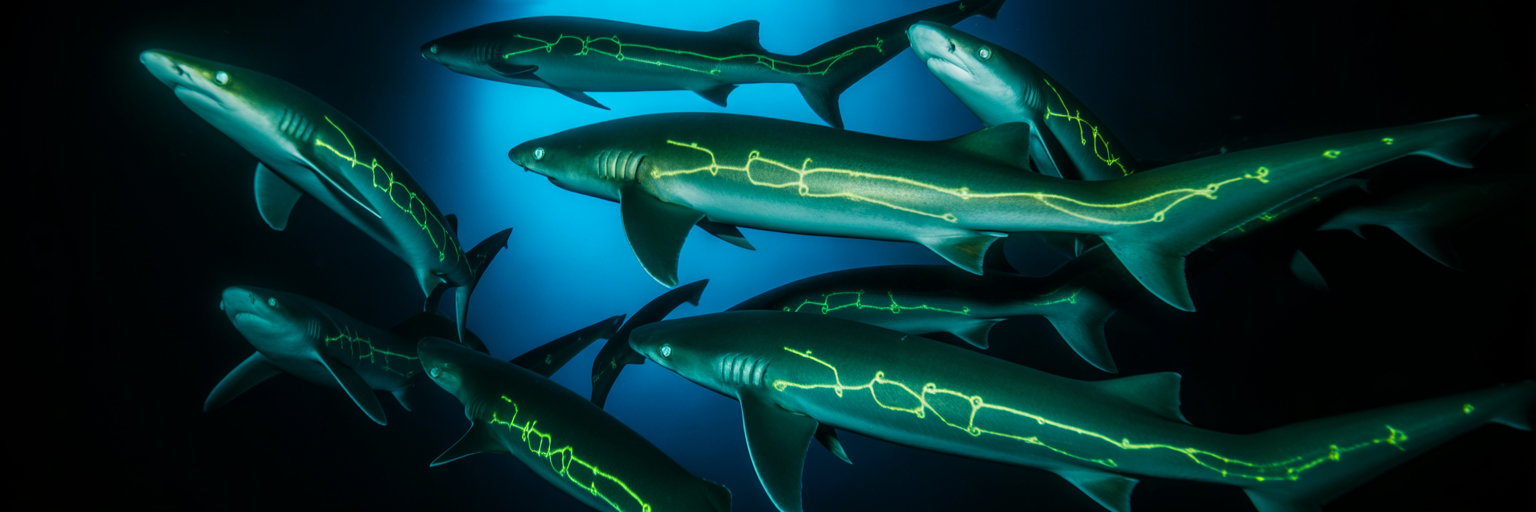
Nowhere is biofluorescence more widespread than in the ocean. From sharks and rays to countless species of fish and corals, the marine world is awash in hidden light. In the blue-filtered light of aquatic environments, even at moderate depths, the conditions are perfect for fluorescence. High-energy blue light penetrates the water and is absorbed by animals, who then re-emit it as green, orange, or red light. This creates a secret visual world where patterns invisible in white light become prominent. However, despite its prevalence, the function of this fluorescence in the vast majority of marine species remains a complete mystery. For every case where a function is suspected, such as in species recognition for reef fish, there are thousands where the glow has been documented but its purpose is entirely unknown, underscoring the immense scale of what we have yet to discover.
A Glow Without a Purpose?
With so many animals glowing for no apparent reason, scientists are increasingly turning to a fundamental concept in evolutionary biology: not every trait is an adaptation. Some features are simply byproducts of other biological necessities. In architecture, a spandrel is the triangular space formed between two arches; it isn’t designed for a purpose but is an unavoidable consequence of putting two arches next to each other. Much of animal biofluorescence may be a biological spandrel.
If the proteins and pigments that make up an animal’s body happen to fluoresce, and that faint glow provides no advantage but also causes no harm, then there is no evolutionary pressure to get rid of it. The trait simply persists as a neutral, non-functional artifact of the animal’s biochemistry. This perspective requires a shift in the scientific approach. Instead of asking “What is this glow for?”, the more rigorous starting point is the null hypothesis: assume the fluorescence has no function until proven otherwise.
Proving a function requires a disciplined, multi-step investigation. First, researchers must perform a spectral analysis to characterize the exact wavelengths of light the animal absorbs and emits. Second, they must assess the visual system of the animal and any species it interacts with to see if their eyes are even capable of perceiving the glow. Finally, and most importantly, they must design controlled behavioral studies that isolate the fluorescence as a variable. This often involves using filters to block the glow and observing whether the animal’s behavior changes in a predictable way, as was done with the budgerigars.
The widespread mystery of animal biofluorescence serves as a perfect illustration of the scientific process in action. It begins with a “wow” moment of discovery, followed by the slow, methodical, and often frustrating work of testing hypotheses and ruling out alternative explanations. It is a vibrant and active frontier of biology, reminding us that even in a world we think we know, there are hidden layers of reality waiting to be revealed. Understanding whether biofluorescence is a functional trait or a biological accident is a major puzzle, much like other mysteries in biology, such as the secrets of planarian regeneration.
Frequently Asked Questions About Biofluorescence
What is the main difference between biofluorescence and bioluminescence?
The key difference is the source of light. Biofluorescence is a passive process where an organism absorbs light from an external source (like the sun) and re-emits it as a different color. Bioluminescence is an active process where an organism creates its own light through an internal chemical reaction, like a firefly.
Can humans see animal biofluorescence without a special light?
Almost never. The glow is typically very faint and requires a specific high-energy light source, like a UV or blue light, to become visible. Under normal daylight, the bright, reflected sunlight completely overpowers and washes out any fluorescent glow, making it invisible to our eyes. This is why it has been discovered so recently in many species.
Does my pet cat or dog glow under UV light?
Yes, parts of them likely will. Common biological materials like keratin (in claws and white fur) and the minerals in teeth and bones are naturally fluorescent. If you shine a UV light on your pet in a dark room, you will probably see their claws, teeth, and any white patches of fur glow. However, this is considered a non-functional byproduct of their chemical makeup, not a form of communication.
Is animal fluorescence always a form of communication?
No, definitely not. While communication is one of the leading hypotheses, it has only been experimentally proven in a very small number of cases, such as in budgerigars for mate choice. For the vast majority of animals, the current evidence suggests the glow is likely an accidental, non-functional byproduct of their biology with no evolutionary purpose.
Why are scientists discovering so many glowing animals now?
The recent explosion in discoveries is due to a combination of factors. Technology like portable, high-intensity UV lights and highly sensitive digital cameras has become more accessible and affordable for field researchers. This, combined with a surge in scientific curiosity following a few high-profile discoveries, has led more scientists to actively look for the phenomenon across all branches of the animal kingdom, revealing it to be far more common than previously imagined.