Long before humans invented horror movies with masked killers and spooky ghosts, nature was already directing the goriest, most unsettling thrillers imaginable. Forget jump scares. Nature prefers slow-burn psychological horror, and one of its masterpieces involves a fungus that turns innocent ants into mindless, walking puppets. It’s a tale of betrayal, mind control, and a very, very bad day at the office.
The World’s Worst Roommate: Ophiocordyceps Unilateralis
Meet Ophiocordyceps: The Uninvited Guest
Let’s get acquainted with our villain, Ophiocordyceps unilateralis. This is not your friendly neighborhood portobello mushroom you’d slice onto a pizza. Think of it as the world’s worst roommate. It shows up uninvited, eats all your food, takes over your body, and then uses your head as a launchpad to find its next victim. This charming ant parasite fungus thrives in lush tropical forests, where the living is easy and the ants are plentiful. And it’s not just one fungus, it’s a whole family of specialists, each with a favorite ant species it loves to torment. It’s a deeply personal, deeply creepy relationship.
A Day in the Life of an Unsuspecting Ant
To appreciate the horror, you first need to meet the victim: a humble carpenter ant. Picture her, just trying to make a living. Her day is filled with important tasks like following scent trails, carrying food back to the nest, and maybe gossiping with her colony mates about which larva is the cutest. She’s a diligent, tiny office worker contributing to a massive, well-organized corporation. Life is predictable, orderly, and all about the colony. She has no idea that her biggest career change is just around the corner, and it involves becoming a mindless drone for a fungus with delusions of grandeur.
An Ancient Grudge
This parasitic takeover isn’t some new fad. This is an evolutionary masterpiece of terror that has been perfected over millions of years. Scientists have found fossilized evidence of this fungal puppetry, proving that ants have been getting zombified since long before humans were even a rough draft. This isn’t a new trick. It’s a classic horror story that nature loves to retell, generation after generation. The fungus has had eons to fine-tune its methods, turning a simple infection into a sophisticated, multi-step plan for world domination, one ant at a time.
A Very Fungal First Date
The Initial Contact
The whole nightmare begins with a moment of spectacularly bad luck. Our unsuspecting ant, while going about her business, brushes past a fungal spore. This isn’t just any speck of dust. It’s a tiny, sticky grenade of doom, armed and ready. The spore latches onto the ant’s exoskeleton, clinging on like a piece of bad news you just can’t shake. For the ant, it’s a forgettable moment. For the fungus, the first date has officially begun, and it has no intention of being ghosted.
Breaking and Entering, Fungal Style
Once attached, the spore doesn’t politely knock or look for an open window. It’s a full-on home invasion. The fungus produces a cocktail of enzymes that chemically melts a hole right through the ant’s tough exoskeleton. It’s the biological equivalent of a burglar deciding not to pick the lock but to melt the entire front door instead. This aggressive entry ensures the fungus gets inside, where the real party can begin. The ant’s body is no longer its own, it’s just become a new home for a very demanding tenant.
The Invasion Within
Once inside, the fungus reveals its genius. It doesn’t just start wrecking the place. It has a plan, a sinister three-step program for total domination that turns the host into a zombie ant fungus.
- Stealth Mode: At first, the fungus exists as single, yeast-like cells, floating around in the ant’s blood (hemolymph). It’s playing it cool, trying to go unnoticed by the ant’s immune system, like a spy blending in at a party before causing chaos.
- Building a Network: These individual cells start to multiply and connect, forming a vast, interconnected network of fungal threads called mycelia. It’s like it’s installing its own private internet service throughout the ant’s body.
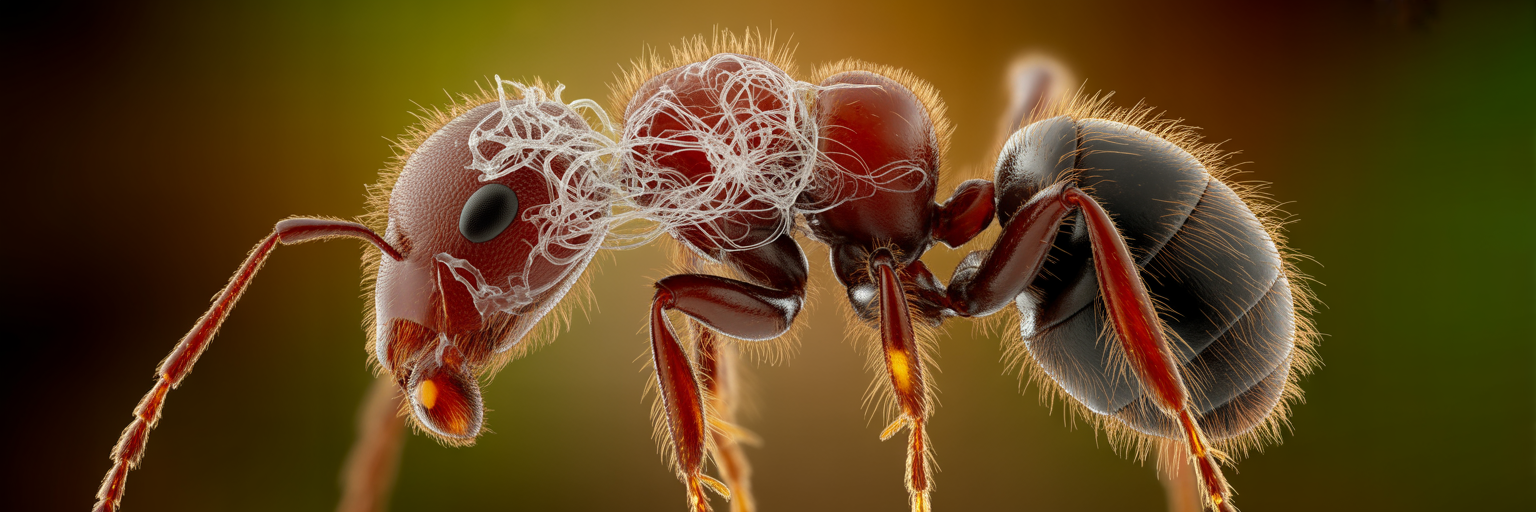
- The Fungal Takeover: This network doesn’t just sit there. It grows everywhere, weaving through the ant’s body and slowly consuming its non-vital soft tissues. The ant is, quite literally, becoming a walking fungal apartment complex. At this point, the ant is more fungus than ant, a hollowed-out shell waiting for its new master to start pulling the strings.
Puppet Masters of the Undergrowth
Who’s Really in Control?
Here’s where it gets even creepier. You’d think the fungus would go straight for the brain, right? Wrong. The fungus cleverly leaves the ant’s brain completely intact. The ant is still in there, aware but powerless. Imagine being a pilot trapped in your cockpit, watching helplessly as someone else flies your plane straight into a mountain. That’s the ant’s reality. This is the chilling core of how fungus controls ants. The brain can send all the signals it wants, but nobody is listening anymore. The phone lines have been cut.
A Chemical Cocktail of Chaos
So if not the brain, how does it work? The fungus unleashes a flood of bioactive compounds into the ant’s body, essentially drugging it from the inside out. This is the secret behind cordyceps mind control. These chemicals hijack the ant’s central nervous system, causing it to abandon its colony, wander aimlessly, and twitch uncontrollably. It loses all sense of its daily routine and survival instincts, embarking on a bizarre, unwilling solo mission dictated by its fungal overlord. As scientists continue to study this, they uncover more about the fungus’s chemical toolkit. For instance, a 2023 study published in Scientific Reports used advanced analysis to show how the fungus deploys specific metabolites to hijack both the nervous and muscular systems without ever touching the brain.
Cutting the Wires
While the chemical cocktail messes with the ant’s head, the mycelial network gets physical. The fungal threads actively weave themselves around and through the ant’s muscle fibers, creating a kind of biological marionette. The fungus can now physically contract the ant’s muscles, forcing its limbs to move. The ant’s brain might be screaming “Go left!” but the fungus, wrapped around the leg muscles, says “Nope, we’re going right, and up.” It’s a complete physical takeover, turning the ant from a living creature into a fleshy robot.
| Behavior | Healthy Carpenter Ant | Infected ‘Zombie’ Ant |
|---|---|---|
| Social Interaction | Communicates with colony, follows pheromone trails | Becomes anti-social, wanders away from the nest |
| Movement | Purposeful foraging on the forest floor or in the canopy | Erratic, aimless wandering and convulsions (‘the worm’) |
| Daily Rhythm | Follows a typical day/night activity cycle | Loses all sense of time, active 24/7 |
| Response to Heights | Avoids exposed, high-risk areas | Actively seeks out high places (summiting behavior) |
| Final Action | Dies within or near the nest | Climbs a plant and performs a ‘death grip’ bite |
The Final Climb and a Killer Bite
The Death March
With full control established, the fungus initiates the final phase: the death march. It forces the ant to abandon its normal life on the forest floor and begin a final, upward climb. The ant scales a plant stem or the underside of a leaf, moving against every instinct it has ever had. This is its last, unwilling act, a strange pilgrimage to a destination it doesn’t understand. It’s the grand finale of the puppet show, and the ant has the starring, and only, role.
Location, Location, Location
Why the climb? Because the fungus is an incredibly picky landlord. It needs a very specific spot to reproduce, one with the perfect temperature and humidity. It’s like a real estate agent from hell, forcing its client to find a north-facing leaf, approximately 25 centimeters off the ground, with good airflow and a nice view. This precision is a key part of the Ophiocordyceps unilateralis explained narrative. The fungus has manipulated its host to find the exact microclimate needed for its own survival, ensuring its offspring get the best possible start in life.
The Death Grip
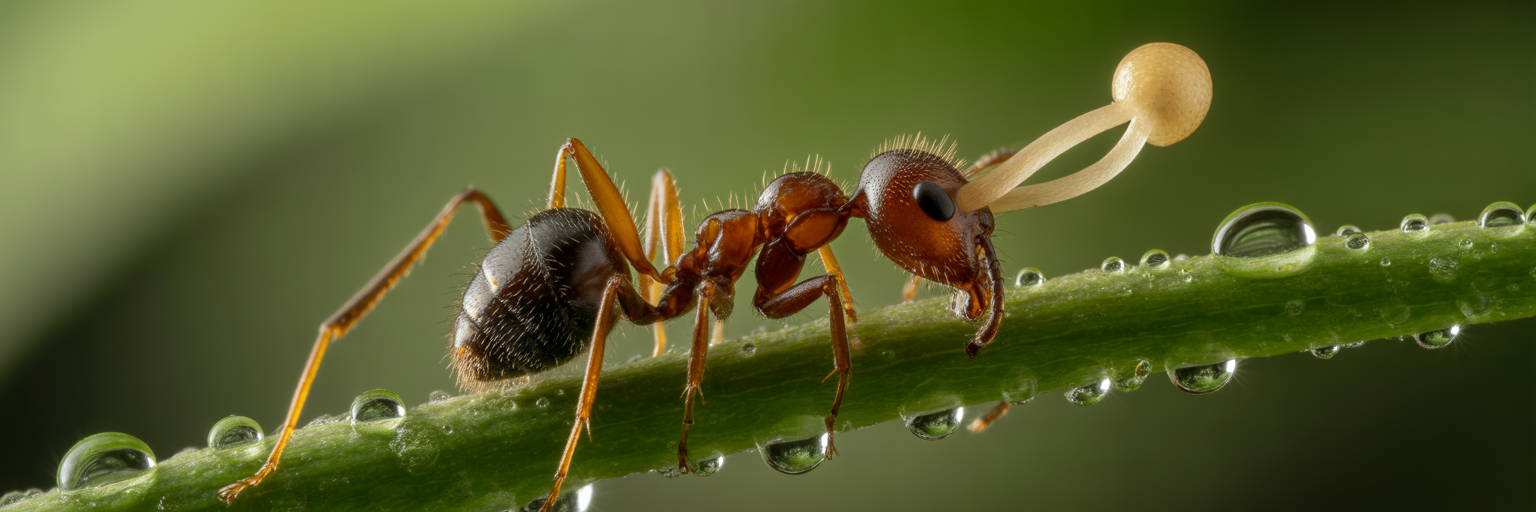
Once the ant reaches the perfect spot, the fungus delivers its final command. It triggers a massive convulsion, forcing the ant to bite down hard on a leaf vein or twig. This isn’t just any bite, it’s the death grip. To make sure the ant stays put, the fungus then causes the ant’s jaw muscles to atrophy and lock in place, permanently. It’s like a driver parking their car perfectly and then breaking the steering wheel to make sure it never moves again. The ant’s corpse is now a stable, secure anchor, a monument to the fungus’s success. As a study in the Journal of Experimental Biology found, the fungus cleverly preserves the jaw muscles just long enough for the final bite before destroying them to lock the jaw permanently.
It’s Raining Spores, Hallelujah!
The Grand Finale
With the ant dead and anchored, you’d think the show is over. Oh no, that was just the opening act. Now, the fungus gets to work on its final project: building a reproductive structure. It digests the ant’s remaining innards, using the nutrient-rich slurry as fuel for its grand finale. The ant’s body has served its purpose as a vehicle and is now being repurposed as a buffet and a nursery. It’s the ultimate act of recycling.
The Alien Eruption
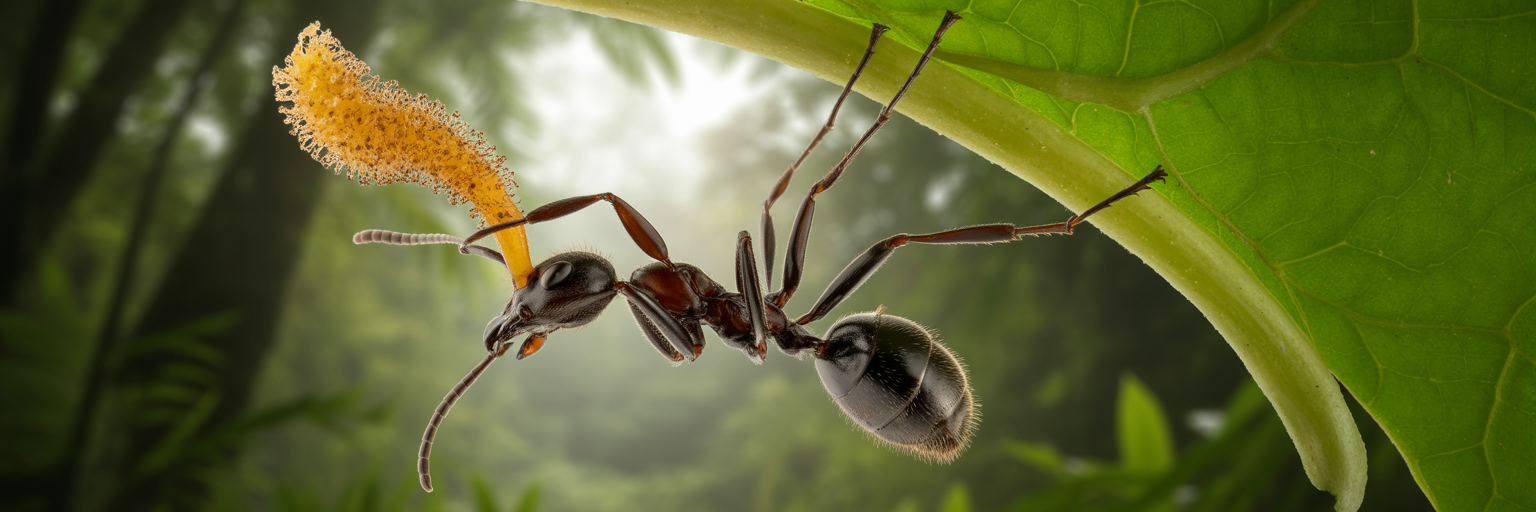
After a few days, the horror reaches its visual peak. A stalk, called a stroma, begins to grow out of the back of the ant’s head. It erupts from the corpse like something out of a sci-fi horror film, a gruesome antenna of death pointing towards the sky. This is one of the weirdest animal behaviors you’ll ever see, except the animal is just the stage. The fungus is the star, and it’s not shy about making a dramatic entrance. This stalk is the fungus’s ticket to the next generation.
A Deadly Minefield
The stroma matures and develops a pod at its tip. When the time is right, this pod bursts, releasing a shower of fresh spores onto the forest floor below. And where do they land? Right on the busy ant highways where other unsuspecting victims are foraging. The whole elaborate process, from the mind control to the death climb, was designed to create the perfect drop zone. The fungus has effectively turned the area below its victim into a deadly minefield, ensuring its creepy, parasitic cycle can begin all over again. For the fungus, it’s a mission accomplished.
An Evolutionary Masterpiece of Mayhem
This whole bizarre saga is a stunning example of what biologists call an “extended phenotype.” In chummy terms, it means the ant’s zombie-like behavior is actually an expression of the fungus’s genes. The fungus isn’t just a passenger, it’s wearing the ant like a biological suit, using its body as a tool to climb, bite, and build a reproductive launchpad. It’s a hostile takeover on a genetic level.
The evolutionary advantages of this complex strategy are brutally effective:
- Ensures Transmission: It guarantees the fungus gets to the perfect spot to spread its spores, rather than leaving it to chance.
- Eliminates Competition: By killing the host in an elevated, isolated spot, it avoids scavengers and decomposition on the busy forest floor.
- Maximizes Reach: The high-altitude perch allows the spores to cover a wider area, dramatically increasing the odds of infecting a new host.
What’s more, these fungi are often picky eaters. Different Ophiocordyceps species have evolved to target specific ant species, locking them in a deeply committed, long-term toxic relationship. But the ants aren’t totally helpless. Healthy ants can often recognize an infected colony member by its erratic behavior. And what do they do? They carry the twitching “zombie” far away from the nest and dump it, a primitive but effective form of quarantine. It’s a miniature zombie apocalypse in the undergrowth, and the ants have already figured out the first rule: remove the infected before they can bite.