A Desert Survivalist with a Built-In Canteen
In the ancient, sun-scorched dunes of the world’s oldest desert, the Namib desert beetle carries out a ritual that borders on the bizarre. This is a place of extremes, a vast expanse of sand where rainfall is a forgotten memory and surface water is nonexistent. For most creatures, this landscape is a death sentence, a kiln that bakes life into dust. Yet, this tiny, black insect has not only survived here for millennia, it has mastered its environment with a chillingly effective strategy. It doesn’t dig for water, nor does it wait for rain. It harvests it directly from the air, using its own body as a sophisticated collection device.
Imagine a survivalist so prepared, so meticulously adapted, that they have a built-in water canteen engineered onto their back. That is the reality for this beetle. Each morning, before the sun rises to its merciless peak, the beetle performs a strange, calculated dance. It emerges from its cool, sandy burrow and climbs to the highest point of a dune, a solitary figure against a sea of sand. There, it performs a headstand, pointing its rear into the wind, waiting. It’s a posture that looks almost comical, but it is a deadly serious act of survival. This isn’t a random pose. It is a precise, life-sustaining maneuver that allows the beetle to drink fog.
How does an insect pull fresh water from thin, dry air? The secret lies in a combination of its peculiar behavior and the extraordinary architecture of its shell. This isn’t just a simple protective covering. It is a microscopic landscape of peaks and valleys, a marvel of biological engineering designed for one purpose: to coax water from the morning fog. The beetle’s entire existence hinges on this single, highly specialized trait. It is one of the most striking examples of desert survival adaptations, where evolution has produced a solution so elegant it seems almost alien. The animal kingdom is full of creatures with unique solutions to life’s challenges, such as the bizarre reproductive strategy of the creature that gives birth through its back, and the Namib beetle is no exception.
This daily quest for hydration is a high-stakes game. By exposing itself on the dune crest, the beetle becomes a visible target for predators like lizards, chameleons, and birds who are also looking for a morning meal. It is a calculated risk, a trade-off between the danger of being eaten and the certainty of death by dehydration. For this insect, the morning fog is not just weather. It is life itself, and its ability to harvest it is the only thing standing between it and oblivion in one of the harshest environments on Earth. The story of this beetle is not just about survival. It is about outsmarting a desert that wants to kill you.
The Life-Giving Fog of the Namib
To understand the beetle, you must first understand the fog. In the Namib Desert, water does not fall from the sky in the form of rain. Instead, it rolls in from the sea as a thick, ghostly blanket. This is not your typical morning mist. It is a dense advection fog, born from a massive collision of temperatures. The cold, nutrient-rich Benguela Current flows north from the Antarctic along the coast of southwestern Africa. As warm, moist air from the Atlantic Ocean passes over this frigid stream of water, it cools rapidly. The moisture within it condenses, forming a vast bank of fog that is then pushed inland by the prevailing winds.
This fog is the lifeblood of the Namib. It is the primary, and often only, source of water for an entire ecosystem of plants and animals that have adapted to depend on its predictable arrival. It typically forms at night and rolls across the dunes in the early hours before dawn, sometimes penetrating more than 30 miles inland. It arrives like a silent, ethereal ghost, shrouding the landscape in a cool, damp embrace. But its presence is fleeting. As the sun begins to climb, its warmth quickly burns away the mist, leaving the desert as bone-dry as it was before. This ephemeral nature creates a narrow window of opportunity, a daily race against time for every living thing that relies on it.
The fog’s character is one of reliable inconsistency. While it arrives on most mornings, its density and reach can vary. Some days it is a thick, drenching cloud, while on others it is a thin, wispy veil. For the creatures of the Namib, this variability is a constant source of uncertainty. They have evolved to be exquisitely sensitive to the subtle atmospheric shifts that signal its approach, a change in humidity, a drop in temperature, a shift in the wind. The beetle’s entire daily routine is dictated by this atmospheric event. Its internal clock is synchronized not with the sun, but with the arrival of the fog. When the damp air begins to flow over the dunes, it is a trigger, an alarm bell that signals the start of its most critical daily task: the hunt for water.
The Peculiar Headstand of the Namib Desert Beetle
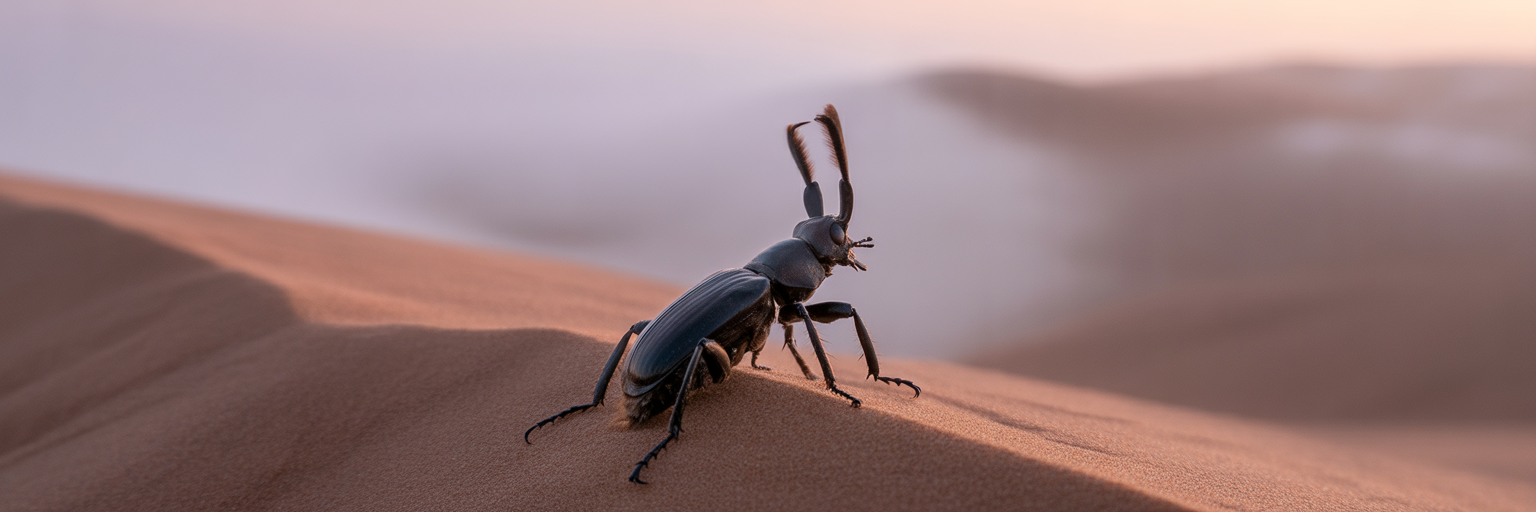
Long before the first rays of sunlight touch the sand, the Namib desert beetle begins its methodical ritual. Stirred from its subterranean shelter by the rising humidity, it scuttles out onto the cool surface of the dune. It does not wander aimlessly. It has a destination. With an instinct honed over millions of years, it climbs to the very crest of the dune, the highest ridge where the wind flows with the least amount of turbulence. Here, it prepares for its performance.
This is where the beetle performs its iconic “fog-basking” headstand. It lowers its head, raises its abdomen, and orients its body to face directly into the moist, oncoming wind. The posture is precise, holding its back at a 45-degree angle to the ground. This is not a position of rest or defense. It is a carefully calibrated stance engineered for maximum efficiency. The angle is critical. It presents the largest possible surface area of its back to the fog-laden breeze, increasing the chances of capturing water droplets. At the same time, the steep incline uses gravity to its advantage, ensuring that any water that does collect will flow directly downwards, toward its mouthparts.
This behavior is the key to understanding how beetles drink fog. They are not passively waiting for condensation. They are actively positioning themselves in the optimal location and posture to harvest it. The dune crest is the perfect spot because the wind speed is higher and the flow is more laminar, meaning the tiny water droplets in the fog travel in straight, predictable lines. By standing at the peak, the beetle intercepts this flow before it becomes chaotic and turbulent lower down the dune. It is a masterclass in fluid dynamics, performed by an insect. The beetle’s precise, calculated maneuver to secure a meal of water is a testament to nature’s ingenuity, much like the archerfish that shoots bugs out of the air with water, showcasing another example of a creature using physics to its advantage.
Every morning, this ritual is a gamble. By positioning itself on an exposed ridge, the beetle makes itself an easy target for predators. A desert chameleon perched nearby or a Peringuey’s adder hiding just beneath the sand could end its life in an instant. Yet, the drive for water is stronger than the fear of being eaten. The headstand is a portrait of desperation and brilliance, a silent, daily prayer to the fog, performed with the cold, calculated precision of an engineer.
A Microscopic Landscape Engineered for Hydration
The beetle’s headstand would be useless without the extraordinary technology built into its back. Its shell, or elytra, is not a simple, smooth surface. On a microscopic level, it is an intricately patterned landscape designed to attract and channel water with remarkable efficiency. This is possible because it is a hydrophilic hydrophobic surface, a material that combines two opposite properties in a single system. To understand this, think of a freshly waxed car hood. Water beads up and rolls off easily because the wax is hydrophobic, or water-repelling. Now, think of a paper towel. It soaks up water instantly because the paper is hydrophilic, or water-attracting. The beetle’s shell has both of these surfaces arranged in a precise, repeating pattern.
The Dual-Surface Secret: Hydrophilic vs. Hydrophobic
The genius of the beetle’s shell lies in this duality. It is not enough for a surface to simply attract water, nor is it enough for it to repel it. The magic happens when these two properties work together. The hydrophilic parts of the shell act as magnets for water, pulling tiny droplets out of the passing fog and holding onto them. The hydrophobic parts act as slippery channels, creating low-friction pathways that guide the collected water exactly where it needs to go. Without this combination, the water would either not collect at all or would simply stick to the shell and evaporate before the beetle could drink it.
Anatomy of the Shell: Peaks and Troughs
The shell’s surface is covered in a grid of tiny, flattened bumps, or “peaks,” that are spaced about half a millimeter apart. These bumps are the hydrophilic sites. Their surface is non-waxy and chemically structured to attract water molecules. As the fog-laden wind flows over the beetle’s back, these bumps act as nucleation points, grabbing onto microscopic water droplets and causing them to accumulate. As more droplets collect, they merge and grow into a larger, visible drop of water, clinging to the peak.
Surrounding these water-loving bumps are the “troughs,” which are the waxy, superhydrophobic channels. Once a droplet on a hydrophilic peak grows large enough, about 5 millimeters in diameter, its weight overcomes the forces holding it to the bump. At this point, it detaches and rolls down the shell. Because the troughs are so water-repellent, the droplet glides down with almost no resistance, like a marble on a greased slide. This efficient transport system prevents the water from being lost to evaporation and funnels it directly toward the beetle’s mouth. The intricate design of the beetle’s shell has been a subject of intense scientific interest. As detailed in studies published in journals like PMC, the specific geometry and chemical properties of these surfaces are key to their function. These Stenocara gracilipes facts reveal a level of natural engineering that continues to inspire scientists.
| Component | Surface Property | Primary Function | Real-World Analogy |
|---|---|---|---|
| Microscopic Bumps (Peaks) | Hydrophilic (Water-Attracting) | Act as nucleation sites, grabbing and accumulating tiny water droplets from the fog. | A tiny sponge or paper towel that soaks up moisture. |
| Waxy Channels (Troughs) | Hydrophobic (Water-Repelling) | Create low-friction pathways, ensuring water droplets roll efficiently without sticking or evaporating. | A freshly waxed car hood where water beads up and rolls off. |
| Overall Shell Structure | Patterned Combination | Maximizes water capture on peaks and directs the flow through troughs towards the mouth. | A high-tech gutter system designed for microscopic water collection. |
| Beetle’s Headstand Posture | Gravitational Assist | Uses gravity to pull the collected, heavy droplets down the hydrophobic channels to the mouthparts. | Tilting a tray to make marbles roll into a cup. |
The Journey of a Single Water Droplet
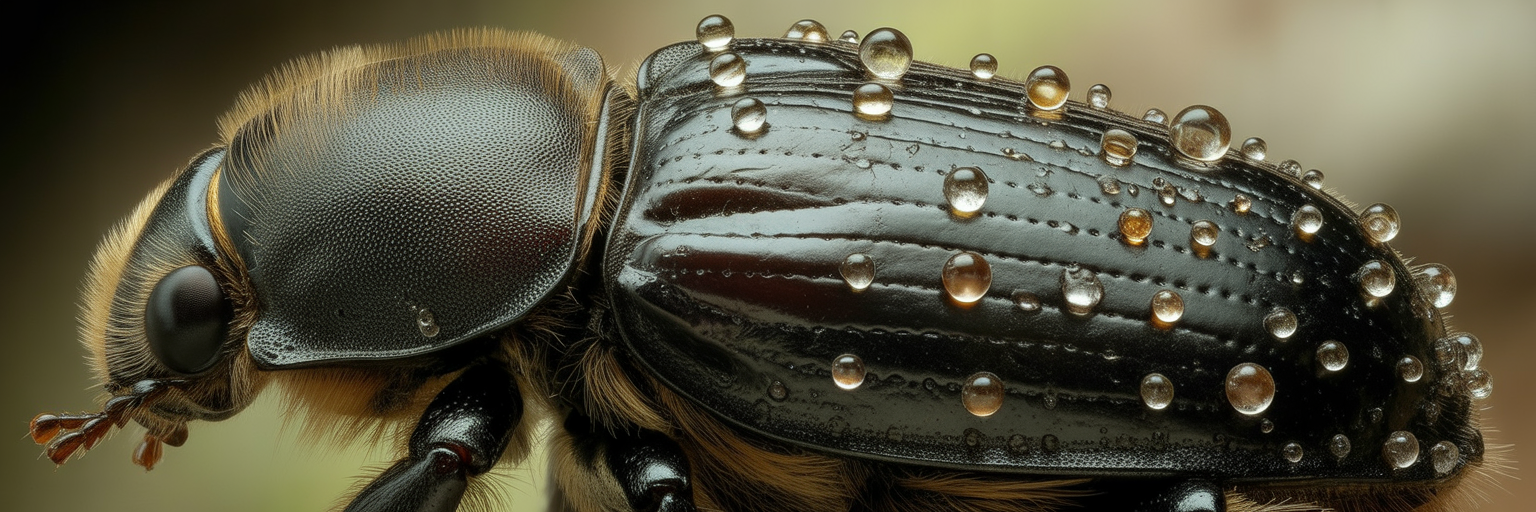
The science behind the beetle’s shell is fascinating, but to truly appreciate the process, it helps to follow the journey of a single drop of water. It is a microscopic drama that unfolds every morning on the back of a beetle, a step-by-step sequence that turns thin air into a life-sustaining drink. This step-by-step biological process, where one action triggers the next in a perfect sequence, is a common theme in nature’s most fascinating mechanisms, much like the plant that can count before it eats, which also follows a precise, multi-stage process to secure its meal.
The journey unfolds in six distinct stages:
- Interception: It begins as a nearly invisible molecule of H₂O, suspended in the cool morning air. As the fog-laden wind sweeps across the crest of a sand dune, it flows over the beetle’s angled back. The journey begins the moment this molecule makes contact with the shell.
- Nucleation: The water molecule doesn’t just bounce off. It is immediately drawn to one of the many hydrophilic bumps scattered across the shell’s surface. This bump acts as a seed, or nucleation site, grabbing the molecule and holding it fast. It is quickly joined by others, as the bump’s water-attracting properties pull more moisture from the air.
- Accumulation and Growth: As thousands of molecules are captured, they begin to merge. A microscopic droplet forms, then grows larger and larger as it continues to pull in moisture from the passing fog. It swells on its hydrophilic perch, becoming a tiny, perfect sphere of water.
- Reaching Critical Mass: The droplet continues to grow until it reaches a critical size and weight. At this point, the force of gravity pulling it downward becomes stronger than the adhesive forces holding it to the hydrophilic bump. The droplet becomes unstable, ready to break free.
- The Roll: The droplet detaches from the bump and lands on the waxy, hydrophobic channel below. Instantly, it begins to roll. The super-repellent surface offers almost no friction, so the droplet glides effortlessly down the steep, 45-degree incline of the beetle’s back, picking up speed as it goes.
- The Final Destination: The waxy troughs are not random. They are arranged to form a network of microscopic gutters that all lead in one direction: forward. The droplet’s journey ends as it is funneled directly to the beetle’s mouthparts, where it is consumed. A single drink, won from the air itself.
Human Innovation Inspired by a Thirsty Insect
The Namib desert beetle’s creepy-crawly survival tactic is more than just a biological curiosity. It is a blueprint, a masterclass in water collection that has captured the attention of scientists, engineers, and designers around the world. This is the core of biomimicry: looking to nature’s time-tested patterns and strategies to solve human problems. The beetle, with its elegantly simple and effective system, has become a poster child for this field, offering a solution to one of humanity’s most pressing challenges: water scarcity.
The principles behind the beetle’s shell are now being adapted to create technologies that could change lives. The potential applications of biomimicry water collection inspired by this insect are vast and varied:
- Fog-Harvesting Systems: In arid, coastal regions from Chile to Morocco, large-scale “fog nets” modeled on the beetle’s back are being used to provide drinking water for entire communities. These nets use a mesh with a hydrophilic coating to capture water from fog, which then drips into collection troughs, providing a sustainable source of fresh water where none existed before.
- Self-Filling Water Bottles: Researchers are developing bottles with surfaces that mimic the beetle’s shell. Left outside overnight in a humid environment, these bottles can theoretically pull moisture from the air and collect a measurable amount of drinking water by morning.
- Fog-Free and Self-Cleaning Surfaces: The same hydrophilic-hydrophobic principle can be used to create surfaces that resist condensation. This could lead to glasses, camera lenses, and vehicle windshields that never fog up. The water-channeling properties could also lead to self-cleaning windows, where morning dew collects dirt and then rolls off, leaving the surface clean.
- Improved Industrial Efficiency: In power plants and large-scale HVAC systems, condensers are used to turn steam back into water. By coating these condenser surfaces with a beetle-inspired pattern, their efficiency can be dramatically improved, saving both water and energy.
The beetle’s shell is a marvel of natural engineering, a reminder that nature often perfects designs long before humans even conceive of them, similar to the incredible sensory abilities of the star-nosed mole that eats faster than you can blink. It is a profound thought that a tiny insect, performing its strange headstand in a desolate desert, holds the key to technologies that could provide clean water, improve energy efficiency, and make our daily lives better. It proves that sometimes, the most advanced solutions are not found in a high-tech lab, but on the back of a beetle.