
The Ocean’s Most Frantic Trendsetter
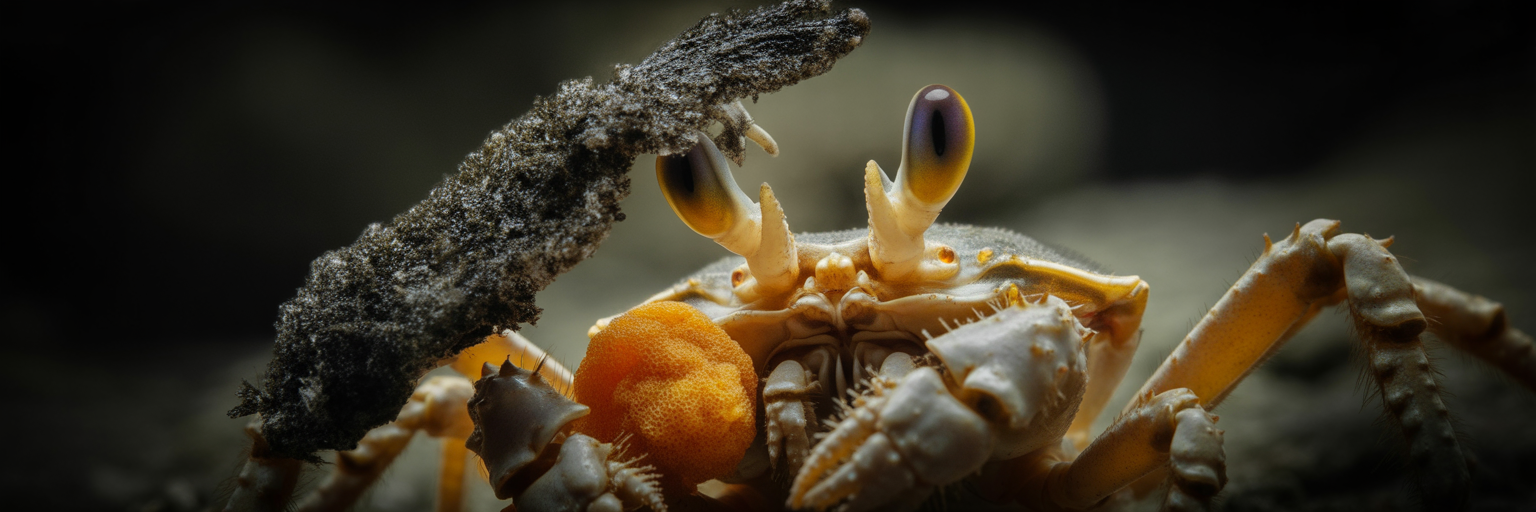
While many animals are masters of elegant disguise, the decorator crab is the ocean’s equivalent of a frantic hoarder who just rolled through a dumpster. Imagine the shallow coastal waters not as a sun-dappled paradise, but as a brutal, high-stakes arena where visibility is a death sentence. In this world, predators are everywhere, and survival depends on not being seen. For most creatures, this means sleek patterns or color-changing skin. For the decorator crab, it means gluing garbage to its back and hoping for the best.
At first glance, you might not even register it as an animal. It looks like a forgotten clump of algae, a piece of sponge, and maybe a bit of shell, all jumbled together in a chaotic pile. It’s a shambling mound of seafloor debris that seems to drift aimlessly with the current. Then, it moves. Two tiny eyes on stalks poke out, and spindly legs begin to scuttle sideways. The unsettling realization dawns that this walking junk pile is alive, watching, and very deliberately trying to look like anything but a crab.
This is not the work of a master artist. This is the desperate act of a creature that knows it’s a slow, delicious snack for any passing fish or octopus. The disguise is so messy, so haphazard, that it works through sheer confusion. A predator looking for the clean, crisp outline of a crab is met with a lumpy, asymmetrical blob that defies categorization. It’s a strategy born from panic, a visual mess designed to short-circuit a hunter’s brain. The ocean is filled with strange survivalists, and the decorator crab’s method is a testament to nature’s bizarre ingenuity, much like the toad that gives birth through its back.
The crab’s appearance is a puzzle. Is it a rock? A plant? A bit of trash? By the time a predator figures it out, the crab has often scuttled away into a crevice, leaving the hunter to wonder what it just saw. This isn’t about beauty or perfection. It’s about creating just enough doubt to survive another day in an environment that is constantly trying to eat you. The bad disguise, it turns out, is the perfect disguise.
Anatomy of a Walking Scrap Heap
The transition from a clean, naked crab to a mobile mound of debris is not accidental. It is a deliberate, meticulous process that relies on specialized anatomy and surprisingly complex behaviors. The crab’s success as a master of disguise is built upon a foundation of tiny, specialized tools covering its own body. Understanding this process reveals the genius behind the apparent chaos.
Nature’s Velcro: The Hooked Setae
The secret to the decorator crab’s entire strategy lies on the surface of its shell, or carapace. It is covered in patches of specialized bristles known as setae. But these are not ordinary hairs. Under a microscope, they are revealed to be a dense field of tiny, chitinous hooks, curved and stiff like microscopic grappling hooks. This natural Velcro provides the perfect anchor for anything the crab wants to attach.
These hooked setae are not randomly distributed. They are concentrated in specific areas on the crab’s back and legs, forming a pre-planned canvas for its camouflage. The density and arrangement of these hooks allow the crab to build a three-dimensional disguise that breaks up its silhouette from every angle. It is a permanent, built-in system for attaching and reattaching its wardrobe as needed.
A Meticulous, Multi-Step Process
So, how do decorator crabs decorate? The process is far from random. It is a careful, multi-step procedure that each crab performs with painstaking precision. While it may look like it just rolled in detritus, the reality is closer to a slow, methodical art project.
- Selection and Snipping: The process begins with selection. The crab uses its sharp pincers, or chelae, to investigate potential decorations. It might choose a piece of seaweed, a bit of sponge, or a colony of feathery hydroids. Once it finds a suitable piece, it carefully snips off a fragment of the right size.
- Mouthpart Preparation: This is the most crucial and often overlooked step. The crab does not immediately stick the material to its back. Instead, it brings the snipped fragment to its mouthparts. It then meticulously chews or frays one end of the material. This is not for eating. The purpose is to shred the end, creating a soft, fibrous base that will grip the hooked setae more effectively, much like teasing the end of a rope before tying a knot.
- Precise Attachment: With the end properly prepared, the crab uses its pincers to reach back and press the frayed material firmly onto a patch of hooked setae. It will push and twist the decoration until the hooks catch and the item is securely fastened. The crab will repeat this process over and over, sometimes for hours, until its entire back is covered to its satisfaction.
This methodical approach allows the crab to use an incredible variety of materials. While seaweed and algae are common, they also use living organisms like sponges, anemones, and bryozoans. In areas with human activity, they are not picky, readily incorporating bits of plastic, fishing line, or fabric into their mobile mosaics. This adaptability makes them successful in a wide range of environments, turning whatever is locally abundant into a life-saving shield.
A Camouflage Strategy for Every Neighborhood
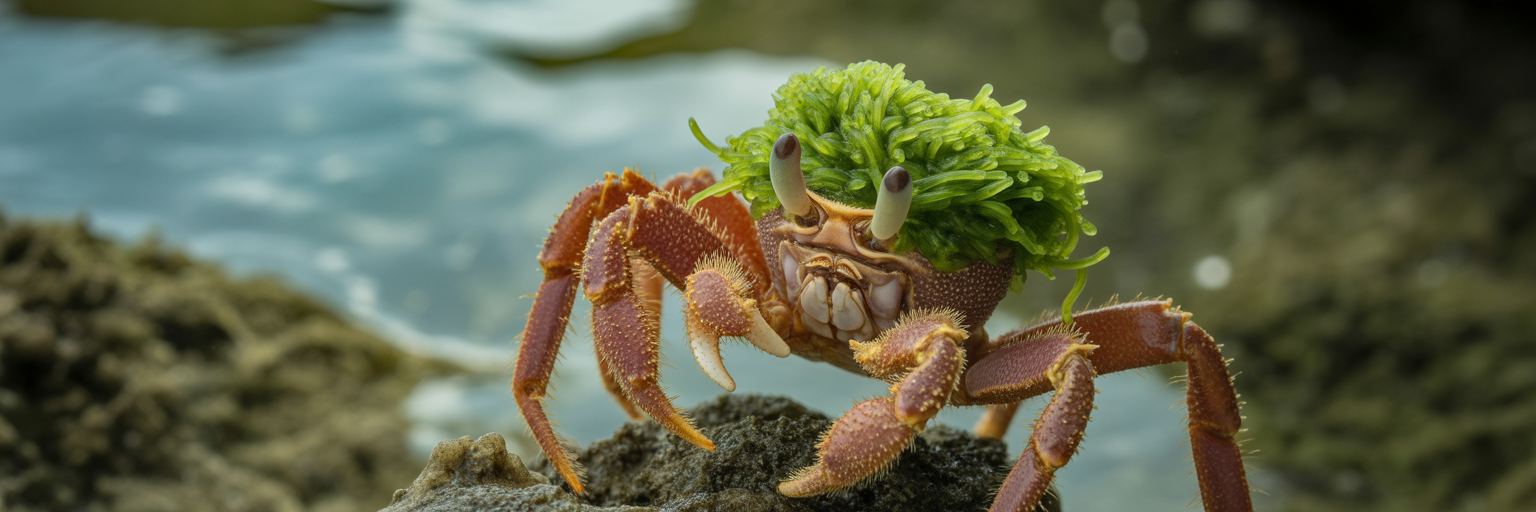
The meticulous process of decoration serves one primary purpose: to disappear. But unlike animals with fixed patterns, the decorator crab’s strategy is dynamic and adaptable. It doesn’t just have one disguise; it creates a new one for every environment it inhabits. This active approach to crab camouflage is what sets it apart from most other camouflaged creatures in the animal kingdom.
The Art of Becoming the Seafloor
The goal of the decorator crab is not to look like a specific object, but to look like nothing at all. Its primary technique is crypsis, the art of avoiding detection. By covering its distinctly crab-shaped body with a chaotic assortment of local materials, it effectively destroys its own silhouette. A predator’s brain is wired to recognize the shape of prey: the curve of a shell, the angle of a leg. The decorator crab’s jumble of textures, colors, and shapes breaks up these recognizable outlines, making it blend into the visual noise of the seafloor.
It becomes a piece of the background. In a bed of green algae, it covers itself in green algae. On a reef dotted with orange sponges, it painstakingly attaches bits of orange sponge. The crab is essentially sampling its immediate surroundings and pasting them onto its back, creating a near-perfect match that allows it to vanish in plain sight.
Active Camouflage vs. Passive Disguise
Imagine a stick insect. Its camouflage is perfect, but only when it is among twigs. If it finds itself on a flat rock, it is completely exposed. This is passive camouflage. The decorator crab, however, practices active camouflage. It constantly assesses and updates its disguise to match its location.
Consider a crab living in a lush bed of seaweed that decides to move to a nearby rocky outcrop covered in colorful sponges. It will not simply hope its green, leafy outfit works in its new, vibrant home. Instead, it will methodically begin to remove its old seaweed decorations and replace them with freshly snipped pieces of sponge from its new environment. This behavior demonstrates that the decoration is not a one-time event but an ongoing, deliberate process of adaptation. This is a level of behavioral flexibility that is rare, and it’s not the only animal to build its own unique form of protection. For example, the parrotfish creates a sleeping bag of its own slime, another bizarre yet effective survival tactic.
This adaptability comes at a cost, requiring constant effort and energy. However, it gives the decorator crab the freedom to move between different habitats, a significant advantage over animals locked into a single disguise. The following table puts its unique strategy into a broader biological context.
Comparing Animal Camouflage Strategies
| Strategy Type | Example Animal | Mechanism | Key Advantage | Key Disadvantage |
|---|---|---|---|---|
| Active Camouflage | Decorator Crab | Attaching environmental debris to the body. | Adaptable to different backgrounds. | Requires constant effort and is lost during molting. |
| Passive Camouflage (Crypsis) | Stick Insect | Body shape and coloration permanently mimic a specific object (e.g., a twig). | No energy expenditure to maintain. | Only effective in a specific environment; vulnerable if discovered. |
| Countershading | Shark / Penguin | Dark dorsal side and light ventral side to blend with light from above and darkness from below. | Highly effective in open water environments. | Less effective in complex, close-quarters habitats. |
| Mimicry (Batesian) | Viceroy Butterfly | A harmless species evolves to imitate the warning signals of a harmful species (Monarch). | Borrows the defensive reputation of another species. | Effectiveness depends on the predator’s prior negative experience with the harmful model. |
Weaponizing Your Wardrobe with a Decorator Crab
If you thought the decorator crab’s strategy was solely about hiding, you’ve underestimated its creepy genius. For many species, the decorations are not just for camouflage; they are a crucial part of their animal defense mechanisms. The crab doesn’t just put on a costume; it puts on armor, and sometimes, that armor bites back. This is where the behavior shifts from passive concealment to active, weaponized accessorizing.
Borrowed Toxicity: A Chemical Shield
Many decorator crabs are highly selective about their materials, and their choices are not always based on visual matching. They have been observed preferentially picking and attaching pieces of sponges or algae that are noxious or outright toxic. By covering themselves in these foul-tasting organisms, they are essentially wrapping themselves in a chemical shield. A fish that might have seen through the camouflage and decided to take a bite will be met with a mouthful of unpleasant chemicals, making it think twice about trying to eat a decorator crab again.
This is a brilliant outsourced defense. The crab itself may be perfectly palatable, but by borrowing the toxicity of other organisms, it becomes an undesirable meal. As a 2015 article in New Scientist noted, this accessorizing is a key strategy for avoiding predation. The crab effectively advertises its unpalatability, turning its disguise into a warning sign.
The Living Weapon: Stinging Sea Anemones
The most dramatic example of defensive decoration involves a fascinating symbiotic relationship with sea anemones. Some species of decorator crabs, particularly those in the Dorippidae family, will actively seek out, detach, and place stinging sea anemones on their shells. This is the equivalent of a medieval knight mounting cannons on his armor.
The crab will carefully approach an anemone and gently pry it from its rock, using its pincers to stroke the anemone’s base until it releases its grip. Then, it hoists the living, stinging creature onto its back and secures it. The benefit to the crab is obvious: it is now armed with powerful, venomous tentacles that can deter almost any predator. An octopus or fish attempting to grab the crab will get a painful sting for its efforts.
In return, the anemone gets mobility, allowing it to access new feeding grounds, and protection from its own predators, like sea stars. This delicate placement, ensuring the anemone stays healthy, is a form of biological curation. It’s a reminder that even in nature, applying living accessories requires care, a principle echoed in human practices like guides to safe and hygienic body art. The crab isn’t just carrying a weapon; it’s tending to a living partner, creating one of the most bizarre and effective alliances in the ocean.
The Awkward, Naked Phase of Growing Up
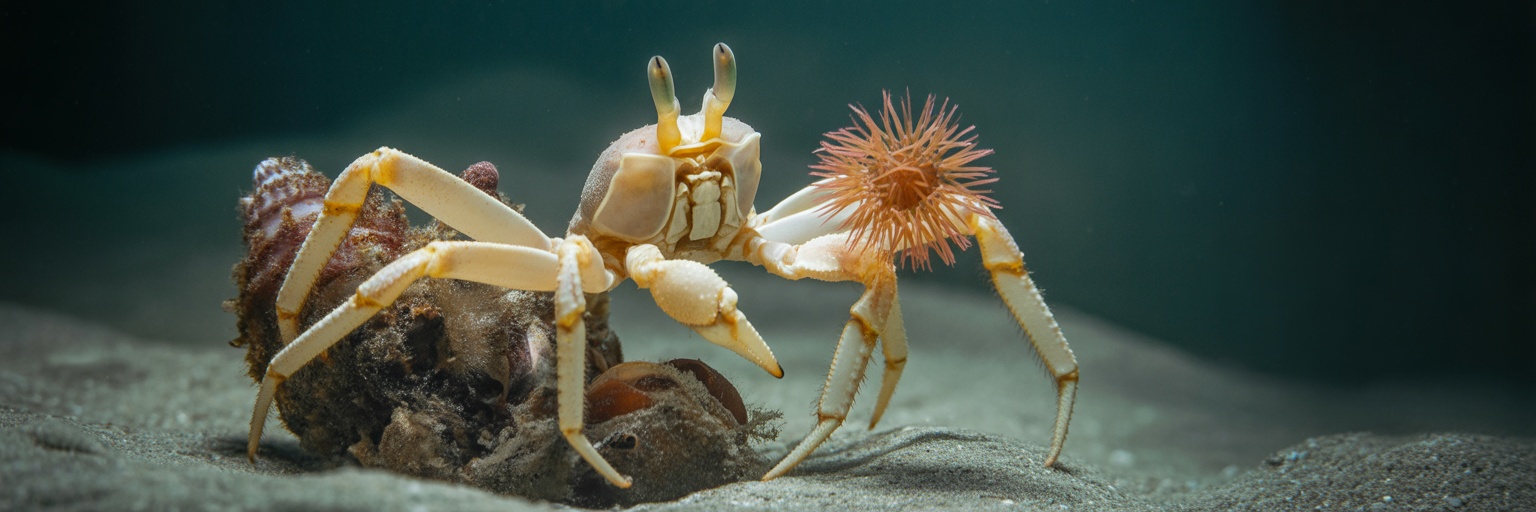
The decorator crab’s elaborate, life-saving disguise has one major weakness. Like all crustaceans, a crab cannot grow incrementally. To get bigger, it must undergo a perilous process called molting, or ecdysis. This is the most vulnerable moment in a decorator crab’s life, a time when its entire survival strategy is literally stripped away, leaving it soft, exposed, and utterly defenseless.
The process involves shedding its entire hard exoskeleton. But for a decorator crab, this means losing more than just its shell. It means losing every single piece of its carefully collected camouflage, its toxic chemical shield, and its living, stinging weapons. The crab emerges from its old shell larger, but also completely naked. Its new carapace is soft and pliable, offering no protection, and its painstakingly assembled costume lies discarded with its old skin.
For a brief period, the crab is a predator’s dream: a soft-shelled, brightly colored, and easily identifiable meal. It must hide and wait for its new shell to harden, a process that can take hours or even days. The vulnerability of this moment is a stark reminder of the brutal life-or-death cycles in the animal kingdom, some of which are even more intense, such as in species where siblings are eaten in the womb before they are even born.
However, these crabs have developed a remarkable behavior to mitigate this risk. Many species seem to anticipate the molt. Just before shedding their old shell, they will carefully and methodically remove their most valuable decorations, especially living anemones or specific toxic sponges. They will hold onto these prized items with their pincers throughout the entire molting process. Once they have wriggled free of their old exoskeleton, and while their new shell is still hardening, they begin the painstaking process of re-decorating. They will carefully re-apply their saved decorations to their new, larger body. This incredible act of foresight transforms the decorations from mere attachments into a curated, essential toolkit, proving just how vital this “bad disguise” is to their survival.
A Lookbook of Majoidea Superfamily Styles
The term “decorator crab” is not a single species but a behavioral description that applies to hundreds of different species, primarily within the superfamily Majoidea, also known as spider crabs. This group is a hotbed of crustacean fashion, with each species developing its own unique style based on its habitat, body shape, and the materials available. Exploring these variations reveals a surprising diversity of approaches to the same fundamental survival strategy and provides some fascinating Majoidea crab facts.
A Family of Fashionistas
While the core principle of attaching debris is the same, the execution varies wildly. Some crabs are minimalists, while others are maximalists. Some are specialists, while others are generalists. This diversity makes them some of the most intriguing weird ocean creatures to study.
- The Moss Crab (Loxorhynchus crispatus): Found along the U.S. West Coast, this species is the king of the shaggy look. It cultivates a dense, overgrown covering of algae, bryozoans, and hydroids, making it look like a piece of the reef that has been forgotten for years. Its disguise is so thick and unruly that the crab itself is almost completely obscured.
- The Graceful Decorator Crab (Oregonia gracilis): As its name suggests, this crab has a more delicate touch. It is highly selective, often choosing just a few specific types of hydroids or sponges to create a sparser, more curated appearance. Its long, spindly legs are often left bare, with decorations concentrated on its body to break up its outline without adding too much bulk.
– The Red Decorator Crab (Schizophrys aspera): This species from the Great Barrier Reef demonstrates extreme specialization. As a study published in Coral Reefs analyzed, this crab has very specific preferences for the community of organisms it wears, choosing particular epibionts that provide the best combination of camouflage and chemical defense in its specific coral reef environment.
Instinct or Interior Design?
This incredible diversity raises a fascinating question: is this behavior purely a hardwired instinct, or is there an element of learning and individual choice involved? The evidence suggests it’s a complex mix of both. The fundamental drive to decorate is almost certainly instinctual, programmed into the crab’s DNA. The basic motor patterns of snipping, chewing, and attaching are consistent across the superfamily.
However, the specific choices a crab makes seem to be influenced by its environment and possibly even by experience. A crab that successfully avoids predation while wearing a certain type of sponge may be more likely to seek out that sponge in the future. Individual crabs in the same area have been observed with distinctly different “styles,” suggesting that while the drive to decorate is innate, the art of it may be learned. Scientists are still exploring the cognitive abilities of these creatures, leaving us to wonder about the line between instinct and a very primitive form of interior design. It’s a puzzle that ensures these walking scrap heaps will continue to fascinate and mystify us.