The Ocean’s Sneakiest Predator
Imagine a place where the weight of the world is literal. Thousands of feet below the surface, in the twilight and midnight zones of the ocean, the pressure is immense enough to crush a submarine like a soda can. Sunlight is a forgotten memory, replaced by an absolute, ink-black darkness that feels less like an absence of light and more like a physical substance. This is not just an environment; it is an alien frontier, hostile and profoundly strange.
In this crushing void, life communicates with a glowing language. Bioluminescence, the ability of living things to create their own light, is the primary method of expression. Flashes, glows, and shimmering trails are used to find mates, lure food, and scream for help. But this glowing conversation almost universally happens in just two colors: blue and green. It is a shared, public frequency that everyone is tuned into, for better or for worse.
Then there is the monster that breaks the rules. Meet the stoplight loosejaw fish, *Malacosteus niger*. If you were to design a creature for a horror movie, you might end up with this. It looks less like a fish and more like a disembodied, skeletal head floating through the abyss. Its jaw is nightmarishly unhinged, capable of swinging open to terrifying angles, and its fangs are so long they don’t even fit inside its own mouth when closed. It is one of the truly weird deep sea creatures that evolution cooked up in its darkest laboratory.
But its appearance is not the scariest part. The loosejaw possesses a superpower that gives it an almost supernatural advantage. It has figured out how to operate on a private wavelength, a secret channel of light that no one else can see. While the rest of the deep sea is broadcasting on a public network of blue and green, the loosejaw has a key to a lock no one else knows exists. It wields a beam of red light, turning the darkness into its own private hunting ground. How does this ultimate stealth adaptation work? Let’s unravel the terrifying genius of this evolutionary marvel.
Why the Deep Sea Is a World of Blue
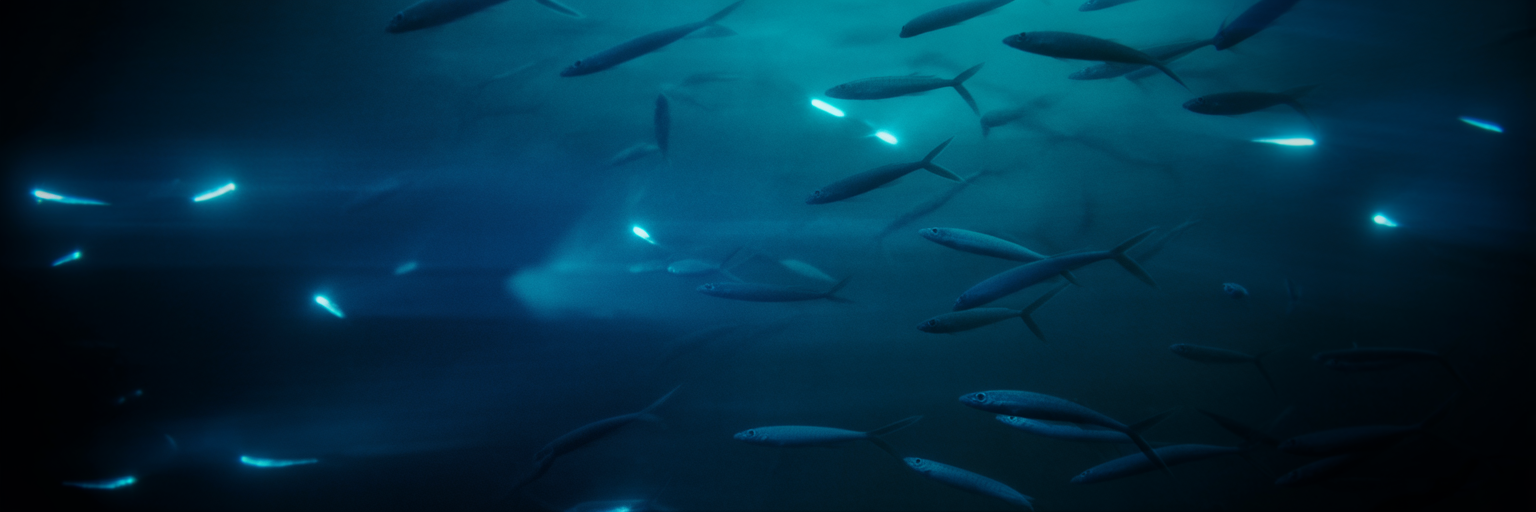
To understand why the loosejaw’s red light is such an incredible advantage, we first need to appreciate the physics of its home. The deep sea isn’t just dark; it’s specifically, stubbornly blue. This isn’t an aesthetic choice by Mother Nature but a simple consequence of how water interacts with light.
The Physics of a Blue-Tinted World
Sunlight is made of a whole spectrum of colors, from long-wavelength reds and oranges to short-wavelength blues and violets. When this light hits the ocean surface, the water acts like a giant filter. It quickly absorbs the longer, less energetic wavelengths. Reds are gone within the first 50 feet, followed by oranges and yellows. Only the high-energy, short-wavelength blue and green light has enough punch to penetrate hundreds or even thousands of feet down. This is why the deep ocean is a fundamentally blue-tinted environment. Any light that makes it down here is blue, so it’s the only color that really matters.
Bioluminescence: The Public Broadcast System
Life in the deep adapted to this reality. Since blue light travels farthest, evolving the ability to produce blue light is the most energy-efficient way to be seen. As a result, bioluminescence became the public broadcast system of the abyss, a versatile tool used for every aspect of survival. This glowing blue language serves several critical functions:
- Attracting Mates: Specific flash patterns act like a secret handshake, allowing species to find each other in the vast darkness.
- Luring Prey: The classic example is the anglerfish, which dangles a glowing blue lure to draw in unsuspecting victims.
- Defense: A sudden, bright flash can startle an approaching predator, giving the prey a moment to escape. Some creatures even spray luminous fluid, creating a confusing cloud of light.
- Counter-illumination: Many animals have light organs on their bellies that match the faint blue light filtering down from above, effectively erasing their silhouette and making them invisible to predators looking up.
The Evolutionary Blind Spot
This blue-dominated world had a profound consequence for evolution. Over millions of years, most deep-sea creatures developed eyes that are hyper-sensitive to blue light and effectively blind to all other colors. Why waste energy developing receptors for red or yellow light if those colors don’t exist in your world? This specialization makes their vision incredibly efficient for their environment, but it also creates a massive evolutionary blind spot. Every signal sent on the blue-green network is a public announcement. A flash meant for a mate could just as easily attract a hungry predator. There is no privacy. This sets the stage for the loosejaw’s game-changing trick. In a world where everyone is on the same open channel, having a private one is the ultimate power.
The Fish With a Private Red Wavelength
The stoplight loosejaw didn’t just find a loophole in deep-sea biology; it built an entire arsenal around it. Its ability to generate a deep sea red light is a masterpiece of evolutionary engineering, turning it into one of the most sophisticated bioluminescent predators in the ocean. To understand how, we need to look at its horrifying anatomy and the clever chemistry it employs.
Anatomy of a Nightmare
The loosejaw is built for stealth and terror. Its skin is a deep, velvety black, covered in pigments that absorb light rather than reflect it, making it nearly invisible. Its fangs are like glass needles, protruding from its jaw even when its mouth is shut. But its most unsettling feature is the jaw itself. Unlike most animals, there is no “floor” of tissue connecting the two sides of its lower jaw. This allows it to swing its mandibles open to an incredible 120 degrees, launching them forward to engulf prey. It’s less a bite and more a spring-loaded trap.
Dotted along its body are the standard-issue photophores that produce blue-green light, allowing it to communicate on the public channel when needed. But the main event is the pair of large, powerful light organs located just behind its eyes. These suborbital photophores are its secret weapon, the source of its private red searchlight.
The Two-Step Light Conversion Trick
Here’s the truly ingenious part: the loosejaw doesn’t actually create red light from scratch. Doing so would be incredibly energy-intensive. Instead, it performs a clever two-step conversion trick. First, the photophore produces a standard, high-energy blue light, just like countless other deep-sea creatures. But then, that blue light passes through a special screen containing a unique fluorescent protein. This protein acts as a down-converter. It absorbs the blue light and then re-emits it at a much lower energy level, as long-wavelength red light.
Think of it like putting a red filter over a powerful white flashlight. The bulb is standard, but the output is completely different. This unique visual system, allowing the fish to both produce and perceive long-wavelength red light, is a significant evolutionary adaptation. As reported by Phys.org, this gives *Malacosteus niger* a secret night-vision privilege that sets it apart from virtually all other deep-sea inhabitants. It has military-grade infrared vision in a world where everyone else is stumbling around in the dark. The loosejaw’s ability to create light is a fascinating adaptation, much like how other creatures have evolved to use light for hypnosis. For readers interested in other bioluminescent predators, you can explore the story of the predator that hypnotizes prey with light.
| Feature | Standard Blue Bioluminescence (Most Deep-Sea Life) | Private Red Bioluminescence (Stoplight Loosejaw) |
|---|---|---|
| Wavelength | Short (approx. 470-490 nm) | Long (approx. 700 nm) |
| Visibility to Others | High (Visible to nearly all deep-sea creatures) | Extremely Low (Invisible to almost all other species) |
| Energy Efficiency | High (Direct light production is efficient) | Low (Requires a two-step energy conversion process) |
| Primary Function | Communication, Luring, Defense (Public broadcast) | Stealth Hunting, Covert Communication (Private channel) |
| Evolutionary Trade-off | Effective but lacks privacy | Energy-intensive but provides total stealth |
How to Hunt When You’re Invisible

Having a secret red headlight is one thing; using it to become the perfect ghost-assassin is another. The strategy behind Malacosteus niger hunting is a beautiful and terrifying example of evolutionary warfare. The loosejaw uses its red beam not just to see, but to turn its prey’s own defenses against them in the most ironic way imaginable.
The loosejaw drifts silently through the crushing dark, sweeping its invisible red beam back and forth like a sniper’s targeting laser. Since no other creature can see this light, it can illuminate its surroundings without ever revealing its position. It is a ghost, watching a world that has no idea it’s being watched. And what it’s looking for is the perfect victim: small, red-pigmented crustaceans like copepods.
Here lies the delicious irony. In the blue-lit world of the deep sea, being red is one of the best forms of camouflage. Red objects don’t reflect blue light; they absorb it. To any creature with blue-sensitive eyes, a red animal appears black and effectively vanishes against the dark background. Many crustaceans evolved this red coloration as a shield of invisibility. But the loosejaw’s red light turns this brilliant defense into a fatal flaw. When its red searchlight hits a red copepod, the copepod doesn’t absorb the light—it reflects it brilliantly. The animal’s camouflage is instantly broken, and it lights up like a bright red beacon against the blackness.
The hunt unfolds with horrifying efficiency:
- The Sweep: The stoplight loosejaw drifts through the abyss, its red searchlight silently scanning the water. It is completely invisible to everything around it.
- The Reveal: A small red copepod, perfectly camouflaged to every other eye in the ocean, floats into the beam. Instead of remaining hidden, its red shell reflects the light, and it suddenly glows like a stoplight. Its location is instantly and fatally exposed.
- The Strike: Before the copepod can even register the danger, the loosejaw’s unhinged jaw snaps open and forward, engulfing the helpless prey in a fraction of a second. The fight is over before it even began.
This is the ultimate unfair fight. The loosejaw found a way to circumvent the entire deep-sea evolutionary arms race. While other creatures were busy evolving ways to hide in a blue world, the loosejaw changed the rules of the game by bringing its own light. The loosejaw’s strategy of turning another animal’s defense into a weakness is a masterclass in evolutionary warfare. This theme of subverting expectations is also seen in other parts of the animal kingdom, such as the strange case of nature’s creepiest illusion: how fake eyes scare predators.
Building Eyes for a Secret Spectrum
Producing red light is only half the battle. It’s a useless trick if you can’t see the light you’re making. This is the second, and perhaps even more bizarre, piece of the puzzle that makes the stoplight loosejaw fish truly exceptional. It had to evolve an entirely new visual system, one that involved not just unique anatomy but also hijacking chemicals from its food.
A Retina Tuned to Red
The eyes of most deep-sea fish are packed with visual pigments, called rhodopsins, that are specifically tuned to detect the short wavelengths of blue and green light. They are one-trick ponies, but it’s a very effective trick for their environment. The loosejaw, however, plays a different game. Its retinas contain the standard blue-sensitive pigments, but they also have additional, much rarer pigments that are sensitive to the far-red end of the spectrum. This gives it true color vision in a world that is supposed to be monochromatic. It can see the public blue channel and its own private red one.
Eating Your Night-Vision Goggles
Here is where the story goes from strange to utterly unbelievable. For a long time, scientists were baffled as to how the loosejaw produced these red-sensitive molecules. The leading theory is something straight out of science fiction: the loosejaw doesn’t make them on its own. It steals them. The copepods that the loosejaw loves to eat get their food from phytoplankton that drift down from the sunlit zones. These phytoplankton contain chlorophyll, the molecule that plants use for photosynthesis.
When the loosejaw eats a copepod, it digests the crustacean but absorbs the chlorophyll byproducts from its gut. These chlorophyll derivatives are then transported to the fish’s retina, where they act as a “photosensitizer.” They essentially attach to the eye’s visual pigments and boost their ability to detect long-wavelength red light. The fish is literally eating its night-vision goggles. It has outsourced its chemical supply chain to its own food source. This is the ultimate evolutionary commitment; its ability to hunt is dependent on the diet of its prey. This incredible strategy of hijacking materials from its food source is a stunning example of evolutionary resourcefulness. A similar, equally bizarre strategy is employed by the sea slug that steals sunshine, literally incorporating parts of its food to gain new abilities. According to the Woods Hole Oceanographic Institution, this adaptation makes it one of the most sophisticated visual predators in the deep-sea twilight zone.
More Than Just a Hunting Tool
The loosejaw’s private red channel is undeniably a devastating hunting weapon, but its usefulness likely doesn’t end there. While observing these subtle behaviors thousands of feet below the surface is incredibly difficult, scientists have compelling hypotheses about how this secret light could be used for more than just finding dinner. The most fascinating idea is that it serves as a covert communication system.
Imagine two loosejaws in the vast, crowded darkness of the abyss. They need to find each other to mate or perhaps warn a rival away from their territory. Using the standard blue-green bioluminescence would be like shouting in a crowded library; everyone would turn to look, including larger predators. It’s a risky proposition. But with their red light, they can send signals that are completely invisible to every other species. It’s the equivalent of two spies in a dark room passing notes written in infrared ink that only they can see.
This concept is similar to the “friend-or-foe” (IFF) systems used in military operations. Soldiers and pilots use signals that are invisible to the enemy to identify each other and avoid friendly fire. The loosejaw may be doing the exact same thing in the perpetual warfare of the deep sea. A quick flash of red light could be a simple, safe way to say, “I’m one of you, don’t eat me,” or “This is my spot, back off.” This would be crucial for organizing social behaviors like mating and territorial disputes without becoming a glowing target for something bigger and meaner.
While these ideas remain speculative, they are a logical and fascinating extension of possessing a completely private communication channel. It adds another layer to the creature’s mystique, suggesting it’s not just a lone hunter but part of a secret society operating on a wavelength no one else can access. Nature is full of weird ways animals communicate, like the creature that can hear with its knees, showing that evolution finds many paths to pass along information.
The Abyss’s Most Clever Monster
The stoplight loosejaw is more than just a fish; it is a masterclass in evolutionary innovation. In the crushing, blue-tinted darkness of the deep sea, it found a loophole in the laws of physics and biology and exploited it to absolute perfection. It is a creature that plays by its own set of rules, armed with a suite of adaptations that make it one of the ultimate bioluminescent predators.
Let’s recap the genius of this monster. It developed a way to produce a deep sea red light, a private channel in a world where everyone else communicates on a public frequency. It then built custom eyes to see this secret light, a feat it accomplished by hijacking chemical components from the very prey it hunts. It weaponized this invisible beam, turning its victims’ own camouflage into a fatal weakness, making them glow like beacons in the dark. And to top it all off, it wields a horrifyingly efficient, unhinged jaw to ensure the hunt is over in an instant.
The loosejaw is a testament to the sheer creativity of evolution. It demonstrates that even in one of the most extreme environments on Earth, life finds a way not just to survive, but to dominate with terrifying cleverness. It reminds us that the deep ocean is the planet’s last great frontier, a realm filled with secrets we are only just beginning to understand.
So the next time you think of the deep sea, don’t just picture darkness. Picture a silent, skeletal hunter sweeping its invisible red gaze through the abyss. Picture a monster that forces its victims to reveal themselves, a ghost that hunts with a light no one else can see, forever unseen by the world it so effectively terrorizes. The stoplight loosejaw is just one of countless bizarre and brilliant creatures on our planet. To discover more stories of incredible adaptations and evolutionary genius, you can explore the wider world of wonders at Nature is Crazy.