More Than Just Nemo’s Dad
Most of us met the clownfish through Marlin, the devoted single father frantically searching for his son. That story cemented a simple image in our minds, but the reality of their family life is far more complex and fascinating. The truth revolves around the biological marvel of the clownfish sex change, a survival strategy that ensures their lineage continues against all odds. This isn’t a random quirk of nature; it’s a highly organized system built on a surprising rule: every single clownfish is born male.
That’s right. The big, dominant female leading every clownfish group was not born that way. She was once a he. This transformation is the cornerstone of their society, a built-in succession plan that keeps their small colonies stable and productive. It’s a world where social status directly dictates biology, and the loss of a leader triggers a remarkable chain of events.
Forget the simple father-son narrative. The real story involves a rigid social ladder, a power vacuum, and a complete biological overhaul that turns a male into a fully functional female. This article explores the intricate clownfish social structure, what triggers this incredible transformation, and the evolutionary genius that makes them a true master of adaptation.
Life in the Anemone: A Clownfish Social Ladder
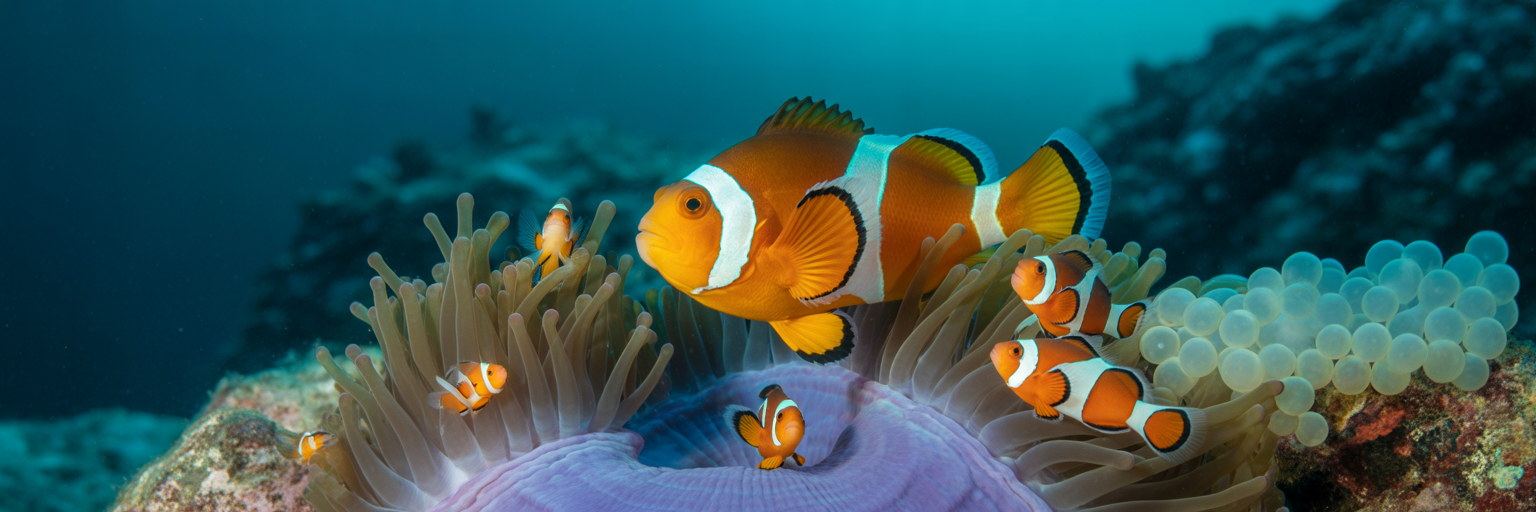
To understand the clownfish, you have to understand their home. A sea anemone isn’t just a place to live; it’s a fortress with stinging tentacles that protects them from a sea full of predators. But this fortress is small, and space is limited. This scarcity of safe real estate is the driving force behind the rigid clownfish hierarchy that governs every aspect of their lives. It’s less of a happy home and more of a high-stakes corporate ladder where everyone knows their place.
At the very top is the queen: the dominant female. She is the largest, most aggressive fish in the group, and her job is singular. She is the sole egg-layer. Her dominance, asserted through nips and chases, isn’t just for show. It releases hormones that suppress the reproductive abilities of every other fish in the anemone. Just below her is the breeding male, the second-largest fish and her exclusive partner. He is the only other sexually mature fish in the group, responsible for fertilizing the eggs and tending to the nest.
Beneath this ruling pair is a queue of smaller, non-breeding males. These fish are sexually immature, and they stay that way on purpose. They actively stunt their own growth to signal their submissiveness. Getting too big, too fast would be seen as a challenge to the breeding male, an act of insubordination punishable by exile from the anemone’s safety. For a clownfish, exile is a death sentence. So they wait, biding their time at the bottom of the social ladder, hoping for a promotion that only comes when someone above them disappears.
| Role | Description | Primary Function | Key Behavior |
|---|---|---|---|
| The Dominant Female | The largest and most aggressive fish in the group. | Sole reproducer; lays all the eggs for the colony. | Asserts dominance to suppress breeding in others. |
| The Breeding Male | The second-largest fish, and the only sexually mature male. | Fertilizes the female’s eggs and tends to the nest. | Displays submissive behavior to the female but is dominant over other males. |
| Non-Breeding Males | A queue of smaller, sexually immature males. | Wait for a chance to move up the social ladder. | Actively stunt their own growth to signal non-aggression. |
| Juveniles | The smallest and newest members of the group. | Survive and grow slowly at the bottom of the hierarchy. | Remain on the periphery, avoiding conflict. |
When the Queen Is Gone: The Trigger for Transformation
Life in the anemone is stable, but the ocean is unpredictable. When a predator strikes or disease takes hold, the dominant female might suddenly vanish. Her disappearance creates an immediate power vacuum and a social crisis. The colony has lost its only egg-layer, and its entire future is at risk. This moment of loss is the singular trigger for one of nature’s most incredible transformations.
The female’s dominance wasn’t just behavioral; it was chemical. Her constant presence suppressed the other fish. With her gone, those suppressive signals vanish. For the breeding male, this is a green light. His brain and body immediately respond to the absence of his queen. He begins the involuntary, hardwired journey to become her replacement. This isn’t a choice; it’s a biological imperative for the colony’s survival.
This mechanism is the core of how do clownfish reproduce with such efficiency. Instead of searching for a new female, they simply create one. As the breeding male starts his transformation, a domino effect occurs. The largest of the non-breeding males, now free from the suppression of two dominant fish, is released from his state of arrested development. He will undergo a growth spurt and mature to become the new breeding male. The sudden disappearance of the female creates a high-stakes survival scenario, not unlike the pressures faced by other species. For instance, some animals have evolved to survive by shrinking their own organs when resources are scarce. For clownfish, the solution is not to shrink, but to change.
The Remarkable Biology of Clownfish Sex Change

The transformation from male to female is a profound biological overhaul, a process known as protandrous hermaphroditism. This isn’t just a change in behavior; it’s a complete anatomical and hormonal restructuring that can take months to complete. This process, known as protandrous sequential hermaphroditism, is a well-documented phenomenon in marine biology. As noted in scientific resources like Wikipedia, clownfish live in strict social hierarchies where the disappearance of the dominant female triggers the breeding male to change sex, ensuring the group’s reproductive continuity.
The Hormonal Green Light
It all begins in the brain. Without the female’s suppressive signals, the male’s endocrine system flips a switch. The production of androgens, or male hormones, plummets. In their place, the body ramps up the production of estrogen, the primary female hormone. This hormonal cascade is the starting gun for every change that follows.
Growing into the Role
The first visible sign of the change is a rapid growth spurt. To be the queen, the fish must be the largest. The surge of new hormones fuels this growth, while also rewiring the brain. Neural pathways associated with submissive male behaviors are dismantled, and new ones supporting dominant, aggressive female behaviors are formed. The fish starts acting like a queen long before it can function as one.
A Complete Anatomical Overhaul
The most critical step happens internally. Clownfish are born with both undeveloped ovarian and testicular tissues. In a male, the testes are active, and the ovarian tissue lies dormant. During the sex change, this process reverses. The functional testicular tissue begins to atrophy and is absorbed by the body. Simultaneously, the dormant ovarian tissue activates, matures, and develops into a fully functional ovary, capable of producing eggs. The fish is now, for all intents and purposes, female.
- Hormonal Cascade: The brain stops receiving suppressive signals from the female, triggering a shift from androgen (male hormone) to estrogen (female hormone) production.
- Rapid Physical Growth: The transitioning male undergoes a significant growth spurt to become the largest fish, a physical requirement for the female role.
- Behavioral Shift: The fish’s brain reorganizes, causing it to switch from submissive male behaviors to aggressive, dominant female behaviors.
- Gonadal Restructuring: The male reproductive tissues (testes) atrophy and are absorbed, while dormant ovarian tissues within the same gonad activate, mature, and begin producing eggs.
Survival of the Group: The Evolutionary Genius of Changing Sex
From the outside, this process might seem strange. But from an evolutionary standpoint, being a fish that can change gender is a stroke of genius. It’s an elegant solution to several critical survival challenges faced by a small fish living in a dangerous world. This adaptation isn’t a curiosity; it’s what makes the clownfish colony a resilient, self-sufficient unit. This incredible adaptation for survival is one of many in the animal kingdom. For example, the archerfish has developed an equally impressive skill, learning to shoot bugs out of the air with jets of water to secure its food.
The advantages of this system are clear and profound:
- Guaranteed Reproduction: The colony doesn’t depend on finding a new mate from the outside, which is a dangerous and uncertain process in the vast ocean. A new breeding pair is always on standby.
- Safety in Place: Clownfish are tied to their host anemone for protection. This ability means no fish has to undertake the perilous journey into open water to find a partner.
- Social Stability: The predictable line of succession prevents constant infighting. Subordinate males are incentivized to stay and cooperate, knowing they will eventually get their chance to reproduce.
- Energy Efficiency: The group wastes no time or energy on lengthy courtships or mate-searching. The transition is an internal, streamlined process that keeps the colony functioning without interruption.
This strategy trades the genetic diversity of introducing an outsider for the near-certainty of survival and continuity. For a species with a high mortality rate and a very specific habitat, it’s a brilliant evolutionary bet that has clearly paid off.
A Chain Reaction: How One Change Reshapes the Entire Colony
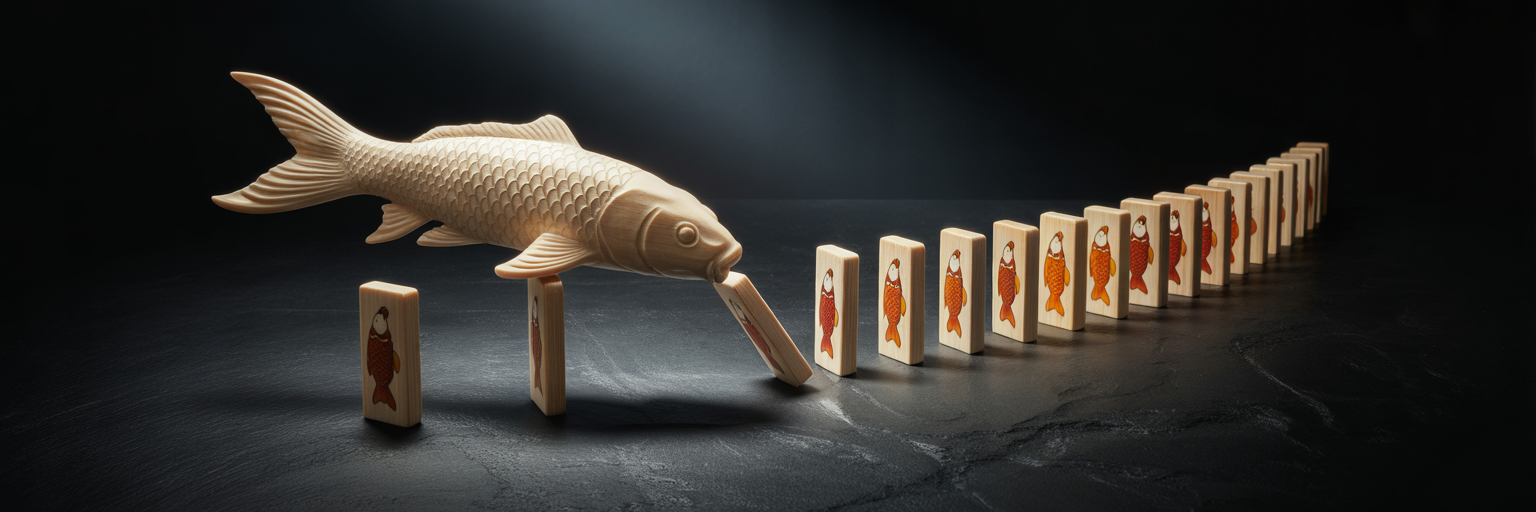
The transformation of the breeding male into a new female is only the first domino to fall. His change sets off a chain reaction that recalibrates the entire social machine of the colony. The spotlight now turns to the “new king”: the largest of the non-breeding males who has been patiently waiting in the wings. With the former breeding male now transitioning, the top subordinate is finally free from suppression.
He immediately begins his own transformation, though a less dramatic one. A growth spurt kicks in, and his reproductive organs, which have been intentionally suppressed, finally mature. He steps into the role of the new breeding male, ready to serve the newly crowned queen. This promotion has a ripple effect down the entire line. Every other non-breeding male in the queue moves up one rung on the ladder. The second-largest becomes the new number one contender, the third becomes the second, and so on. The entire waiting game resets.
This highlights the calculated strategy of self-regulated growth. These subordinate fish aren’t just small; they are actively managing their size to avoid conflict while staying in the game. It’s a delicate balance of ambition and patience, communicated through subtle chemical signals and ritualized behaviors that keep the peace. This intricate social manipulation, where one individual’s change affects the entire group, is reminiscent of other complex natural strategies, such as the caterpillar that tricks ant colonies into raising it as one of their own. The clownfish sex change isn’t an isolated event; it’s the engine that drives their entire social system.
A Masterclass in Adaptation
The clownfish has engineered a social and biological system that makes it incredibly resilient. The clownfish sex change is not just a bizarre fact; it is a masterclass in adaptation, a perfect response to the pressures of its environment. By ensuring a new breeding pair is always available, the colony becomes a self-sufficient unit, capable of weathering the loss of its most important member without missing a beat.
This phenomenon, known as sequential hermaphroditism, is a tool nature uses in various ways. While clownfish are protandrous (male-to-female), other species like the massive Asian sheepshead wrasse are protogynous, where a dominant female changes into a male when the ruling male dies. It’s a flexible evolutionary strategy applied to solve different social problems.
Ultimately, the clownfish story is far more compelling than any cartoon could capture. It’s a tale of rigid hierarchy, social ambition, and a biological flexibility that borders on science fiction. They are not just cute fish living in a fancy anemone. They are masters of social engineering, whose survival hinges on their remarkable ability to become what the group needs them to be.