
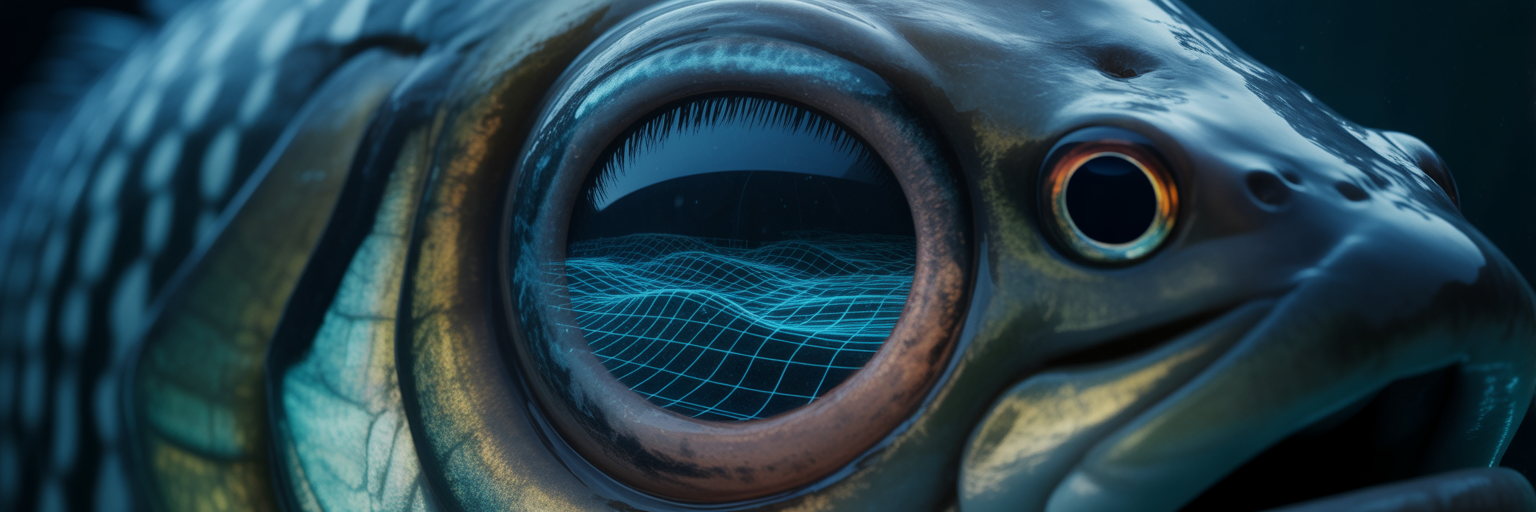
An Unseen Web in the Water
Water is a strange and uncooperative substance. It is dense, nearly incompressible, and it clings to everything that moves through it. This physical reality is what allows a fish to push against it and swim. But for certain predators, this same property transforms the entire aquatic world into a high-fidelity surveillance network, a liquid grid where nothing goes unnoticed.
Imagine you are a small fish, hiding in the murky depths. You have found a perfect spot, nestled among decaying leaves and silt. Your camouflage is flawless, blending you into the background. You are holding perfectly still, suppressing the urge to even twitch a fin. You are invisible. You are safe. But you are wrong. You were detected the moment you arrived. The slight push of water your body made as you settled into your hiding spot was all it took. An alarm has been tripped, and your exact coordinates are now logged.
The predator isn’t looking for you. It isn’t sniffing for you. It is simply monitoring the feed. The water itself is the medium, a vast, interconnected system where every action creates an equal and opposite disturbance. These are not sounds or smells that fade over distance. They are physical pressure waves, ripples of information that travel through the dense liquid with unnerving clarity. A panicked flick of a tail, the gentle flutter of gills to breathe, even the subtle shift of weight from one fin to another—each movement sends out a signature.
This is the chilling reality of some underwater predator senses. The hunter does not need to see you. It does not need to hear you. It only needs to feel the water tell it where you are. The entire body of water has become its web, and your slightest sign of life is the vibration that signals your doom. The predator is not actively searching; it is passively observing a live broadcast of every disturbance in its territory. Any ripple is an alert, a red dot appearing on a tactical map, pinpointing the source with absolute precision. You believe you are hiding, but you are broadcasting your existence with every beat of your heart.
The Biological Surveillance Network
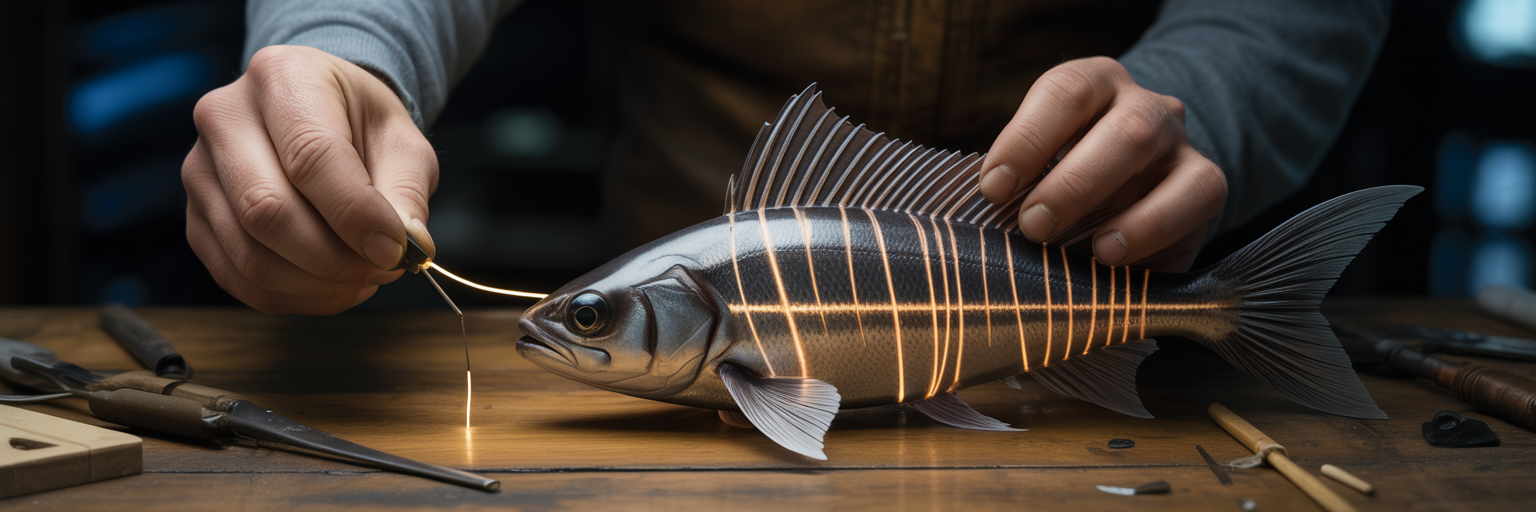
The unsettling ability to read the water is not magic. It is the product of a sophisticated biological apparatus, a living surveillance system wired directly into the predator’s body. This network is known as the lateral line. It is not a single organ but a sprawling array of sensors that run along the sides of the body and branch out across the head, forming a comprehensive grid that monitors every subtle shift in the surrounding environment.
A Network of Living Sensors
Think of the lateral line as a series of hyper-sensitive touch receptors, but instead of feeling direct contact, they feel the water itself moving. The lateral line system explained simply is a way for an animal to “touch” things at a distance. It is an external sensory organ that maps the hydrodynamic world. This system is one of many bizarre solutions nature has developed for perception. To illustrate the diversity of sensory adaptations, some insects have evolved unique auditory organs, and you can learn more about the creature that can hear with its knees.
Superficial vs. Canal Neuromasts: A Two-Layered System
This biological network has two distinct layers of security, each with a specialized role. The first layer consists of superficial neuromasts. These sensors sit directly on the surface of the skin, exposed to the water. They are the close-quarters motion detectors, responsible for sensing slow, gentle water flow. They can tell the predator about the steady current or the slight displacement of water caused by an object moving very close by.
The second, deeper layer is made of canal neuromasts. These sensors are housed inside fluid-filled channels that lie just beneath the skin and scales. This protected environment shields them from the background noise of gentle currents, allowing them to focus on more significant events: high-frequency vibrations and sudden pressure changes. They are the long-range listening posts, picking up the tell-tale signature of a fish swimming or struggling from much farther away. Together, these two systems provide a complete picture of the aquatic environment, from the faintest whisper of movement nearby to the distant shout of a potential meal.
| Sensor Type | Location | Primary Function | Detection Range & Type |
|---|---|---|---|
| Superficial Neuromasts | On the surface of the skin | Detecting slow, direct water flow | Very close range; senses velocity and direction of water currents |
| Canal Neuromasts | Inside fluid-filled canals beneath the skin | Detecting vibrations and pressure waves | Longer range; senses acceleration and high-frequency disturbances from prey or predators |
| Analogy | Perimeter motion sensors | Long-range listening posts | Provides a layered security grid |
Decoding the Whispers of Water
To truly understand this system’s terrifying precision, we must zoom in to the microscopic level, to the functional unit of the lateral line: the neuromast. Each neuromast is a tiny bundle of sensory cells, known as “hair cells,” whose delicate tips are embedded in a gelatinous, dome-shaped structure called a cupula. This cupula protrudes either directly into the water or into the fluid of the subdermal canals, acting as a tiny lever.
The process is brutally simple and mechanical. When a pressure wave from a nearby movement reaches the neuromast, it physically pushes against the cupula, causing the entire dome to bend. This bending motion deflects the microscopic hair cells embedded within it. This is the critical moment of transduction, where a physical force is converted into a piece of hard data. The deflection of the hair cells forces open ion channels at their base, triggering an electrical nerve impulse that shoots directly to the predator’s brain. The whisper of the water has just become a concrete, undeniable signal.
The efficiency of this system is what makes it so formidable. It can detect water displacements measured in mere nanometers. For perspective, a human hair is about 80,000 to 100,000 nanometers wide. This means a twitch so small it is functionally imperceptible is more than enough to bend the cupula, fire the nerve, and send a precise alert to the predator’s brain. This is the answer to the question of how do fish sense movement with such accuracy. They are not just sensing movement; they are sensing the fabric of their world being disturbed on a near-atomic scale.
This is not speculation. As noted in a report by Scientific American, the flow sensors along a fish’s body function like “hydrodynamic antennas,” picking up incredibly detailed information about water flow and the vortex patterns created by anything moving through it. Each neuromast is a single pixel, and together they form a high-resolution image of a world made of pressure.
Building a World from Ripples

Receiving a signal is one thing; interpreting it is another. The predator’s brain does not just get a simple “something is there” alert. It receives thousands of these signals per second from the network of neuromasts spread across its body, and its brain acts as a powerful central processing unit to make sense of it all. This is where the raw data of pressure waves is transformed into a detailed, three-dimensional mental image of the surrounding world.
By analyzing the timing, strength, and sequence of signals, the brain can determine the direction, distance, size, and even the shape of the object causing the disturbance. A large, slow-moving object creates a different pressure signature than a small, fast-moving one. The rhythmic pulse of a fish breathing in its hiding spot is distinct from the chaotic vibrations of a struggling insect on the surface. The predator’s brain can differentiate the hydrodynamic signature of prey from that of a rival, a potential mate, or a drifting piece of debris.
This process is a form of hydrodynamic imaging. The predator is not just passively listening; it is actively building a pressure map of its environment. This is especially crucial for hunting in total darkness or in murky water where vision is useless. The flow of water around the predator’s own body provides a baseline, and any deviation from that baseline is instantly registered and analyzed. The brain’s ability to construct a complex map from simple inputs is a recurring theme in nature. This is conceptually similar to other complex biological computations, such as the way some organisms process environmental cues, like the plant that can count before it eats, which also relies on processing sequential stimuli.
The surveillance metaphor evolves here. The neuromasts are the sensors, but the brain is the advanced analytical software. It constructs a live, real-time tactical map of the battlefield, allowing the predator to anticipate the prey’s next move before it even happens. It knows not just where the prey is, but where it is likely to go. This is the core of hydrodynamic sensing in fish: turning invisible water movements into a predictive model of another creature’s behavior.
Nowhere to Hide in a Liquid World
From the prey’s perspective, the physics of the situation are hopeless. Because water is a dense and incompressible medium, any movement, no matter how slight, inevitably creates a pressure wave that propagates outward. There is no “stealth mode” that can fool physics. Camouflage is useless. Hiding behind a rock is useless. The water itself betrays you.
Every action you take creates a distinct, trackable hydrodynamic signature. The predator’s sensory system is tuned to detect these giveaways, turning your survival instincts against you.
- The Escape Wake: A panicked attempt to flee creates a powerful, turbulent wake. This is the equivalent of shouting your location and direction of travel to the predator. It is a clear, unambiguous signal of distress.
- The Breath of Life: Even if you remain perfectly still, you must breathe. The rhythmic expansion and contraction of your gills displaces a tiny amount of water, creating a subtle, pulsing pressure wave. It is a beacon broadcasting your continued existence.
- The Distorted Flow: Hiding behind a rock or a log seems like a good idea, but it only changes your signature. The water flowing around the obstacle is distorted by your body’s presence. A predator familiar with the normal flow patterns in its territory will instantly detect this anomaly. You are not hidden; you are a disruption.
The only true defense is absolute, complete stillness, which is biologically impossible to maintain for long. Once you are detected on the pressure grid, the hunt is effectively over. The predator may not strike immediately. It can stalk you with perfect knowledge of your location, all while remaining unseen and unfelt. It waits for the perfect moment, for you to make one more mistake, but it never loses you. While hydrodynamic sensing makes many defenses useless, prey in other environments have developed elaborate tricks. It is interesting to contrast the prey’s futility here with the clever strategies of other animals, such as the bird that builds fake doors to confuse predators, a tactic that would be completely ineffective in this liquid surveillance state.
Masters of Hydrodynamic Hunting
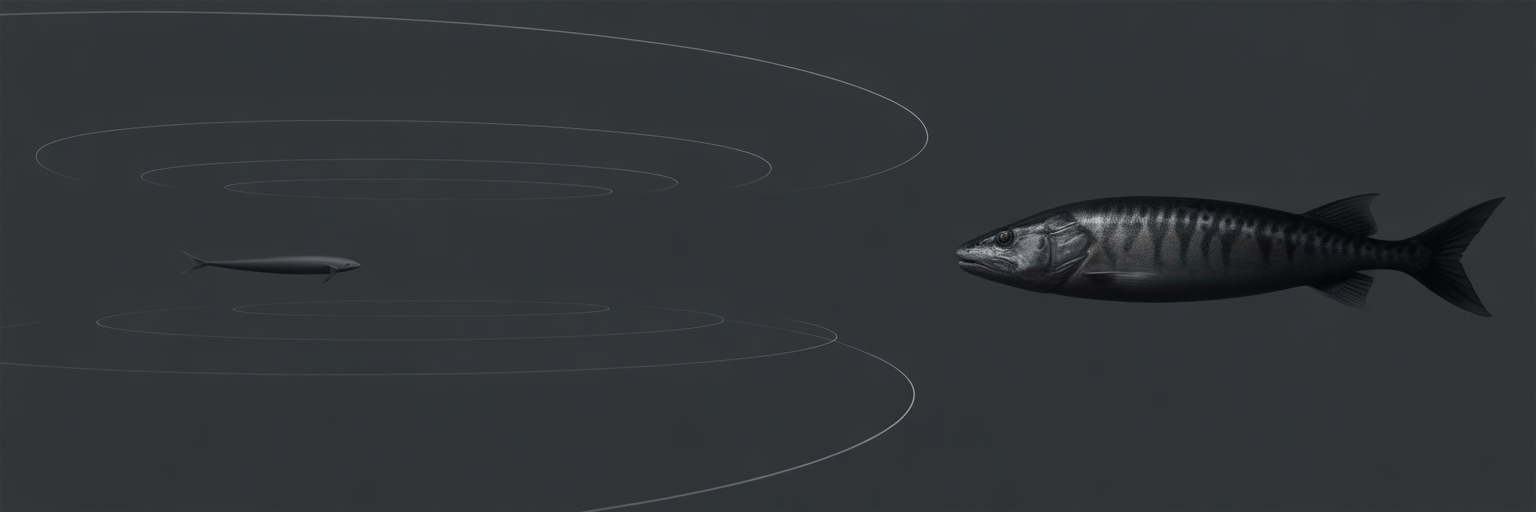
This unsettling sensory system is not a theoretical concept or a rare mutation. It is a widespread and highly successful evolutionary tool, perfected by a wide range of aquatic and semi-aquatic predators. These are some of the true masters of hydrodynamic hunting, a collection of animals that sense pressure waves with lethal proficiency.
- Ambush Predators: Fish like the Northern Pike and the Mottled Sculpin are classic examples. They remain completely motionless, often for hours, blending in with their surroundings. They are not waiting to see prey; they are waiting to feel it. Their lateral line system allows them to detect the precise moment a smaller fish enters their strike zone, enabling an explosive, perfectly aimed attack with no prior warning.
- The Blind Cavefish (Astyanax mexicanus): This is perhaps the most extreme case. Living in perpetual darkness, this fish has lost its eyes entirely. It navigates, finds food, and avoids collisions by relying almost exclusively on its hyper-sensitive lateral line. It builds a complete map of its cave environment using nothing but pressure waves, a testament to the power of this sense.
- Sharks: Apex predators like sharks use their lateral line as a long-range detection system. They can pick up the low-frequency vibrations of a struggling fish from hundreds of meters away. This sense works in concert with their famous ability to detect electrical fields (electroreception), giving them a dual-layered tracking system that is nearly impossible to evade.
- The African Clawed Frog: This ability is not limited to fish. These amphibians hunt insects and other small prey on the water’s surface. They sit motionless and use a lateral line system on their skin to detect the faint ripples created by an insect landing on the water. They can pinpoint the source and strike with incredible accuracy, even in the dark.
These examples showcase some of the most weird animal abilities documented by science. The lateral line is a well-documented sensory organ, and as Wikipedia reports, this system is crucial for schooling behavior, prey detection, and predator avoidance in countless species. This method of hunting is just one of many strange and effective strategies found in nature. To explore another bizarre predatory adaptation, consider reading about the predator that hypnotizes prey with light, which uses a completely different but equally unsettling technique.