Meet the Gladiator of the Undergrowth
The net-casting spider is a creature that seems ripped from a horror film, a nightmare hunter that actively throws a web over its prey. Forget the patient, passive webs of orb-weavers you see in your garden. This spider is a tiny gladiator, and the forest floor is its arena. It doesn’t wait for food to come to it; it stalks, aims, and attacks with a custom-forged weapon of silk.
This active hunting style sets it apart from most of its arachnid relatives. While other spiders engineer static traps, the net-casting spider has adopted one of the most unique spider hunting methods in the natural world. It’s a strategy that feels almost intelligent, a calculated sequence of preparation and execution. This bizarre approach is a reminder of nature’s strange solutions, much like the caterpillar that tricks ant colonies into raising it, which we’ve explored in our article on deceptive insects.
The entire hunt is a chilling four-act play:
- Crafting the Weapon: The spider meticulously weaves a small, rectangular net made of highly specialized silk.
- Assuming the Position: It hangs upside down from a leaf or twig, holding the net open with its front pairs of legs, waiting in absolute stillness.
- Targeting the Victim: Using its enormous, forward-facing eyes, it locks onto unsuspecting prey walking below.
- Executing the Attack: In a flash, the spider that throws a web lunges and stretches the net over its victim, ensnaring it instantly.
This combination of tool use, patience, and aggressive action makes the net-casting spider a truly formidable predator of the leaf litter. It has turned a defensive material into an offensive weapon, rewriting the rules of what it means to be a spider.
The Ogre’s Gaze: A Masterpiece of Night Vision
If you were to meet this spider, the first thing you would notice—and the last thing its prey ever sees—are its eyes. Its two main, forward-facing eyes are so disproportionately huge that they earned it the nickname “ogre-faced spider.” The name is fitting. They stare out from its head like the headlights of a car, giving it an unsettling, monstrous appearance that fuels plenty of ogre faced spider facts.
These are not just for show. They are among the most powerful night-vision instruments in the entire animal kingdom. According to the Australian Museum, these eyes are so sensitive they can see in conditions that would appear as total darkness to humans. Each night, the spider synthesizes a massive, light-sensitive membrane inside these eyes. This membrane is so delicate that it is destroyed by the light of dawn and must be regrown every single evening. It’s a biological process that sounds like science fiction.
This incredible adaptation gives the spider a distinct advantage. It can hunt in the pitch-black undergrowth, detecting the faintest movements of a cricket or ant below. While other nocturnal predators rely on sound or vibration, this spider has the gift of sight in a world of shadows. It’s one of the most extreme examples of spiders with large eyes, where anatomy is pushed to its evolutionary limit for a specific purpose.
However, this specialization comes with a trade-off. Its daytime vision is terrible. The same sensitivity that makes it a master of the night renders it nearly blind in the sun. This forces it into a strictly nocturnal lifestyle, spending its days in perfect camouflage, waiting for darkness to fall so it can once again open its ogre-like eyes and begin the hunt.
Engineering a Silken Death Trap
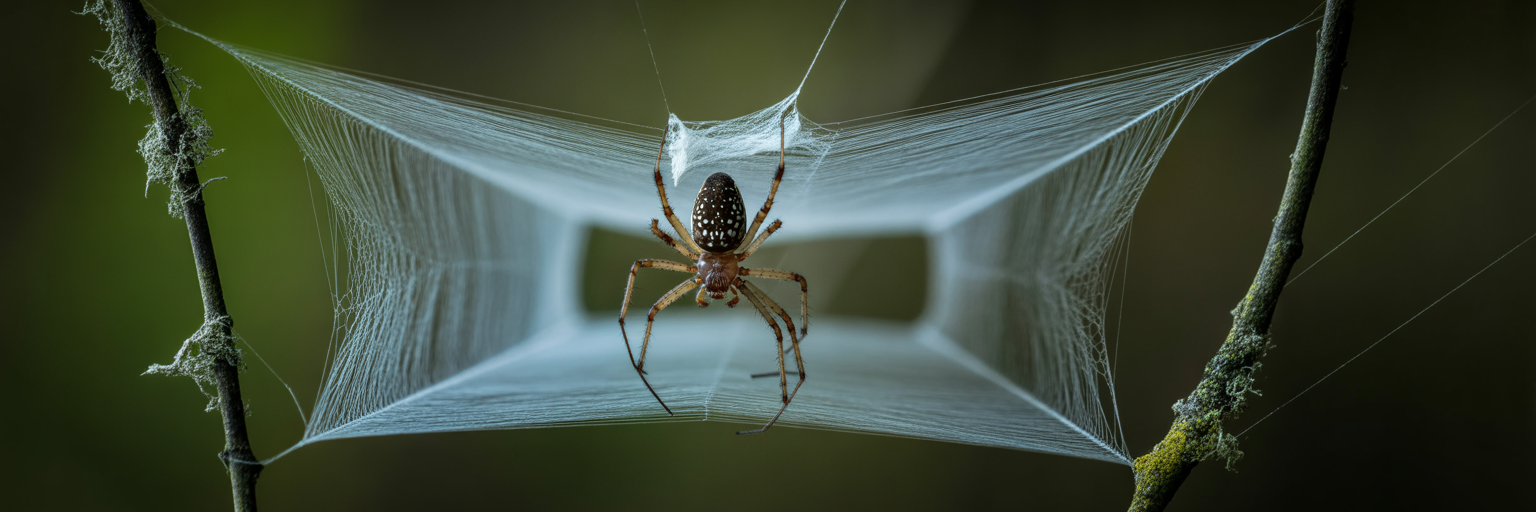
The weapon of the net-casting spider is as remarkable as its eyes. At first glance, the net is unimpressive: a small, fuzzy, bluish-white rectangle of silk that looks almost delicate. But this seemingly harmless patch is a marvel of biological engineering, a trap designed for rapid expansion and instant entanglement.
The net is made from cribellate silk, a type of non-sticky but highly effective material. Instead of glue, it uses thousands of microscopic, fuzzy loops that act like organic Velcro. These fibers are also electrostatically charged, causing them to actively cling to an insect’s exoskeleton and antennae. The moment it touches prey, escape becomes nearly impossible. This method of engineering a tool for hunting is a fascinating parallel to other creatures, such as the archerfish that shoots bugs out of the air with water, a topic we covered in our look at nature’s marksmen.
The most critical property of this silk is its incredible elasticity. The spider holds the net in a folded, compact state. But upon release, it can stretch to many times its original size. A report in Science News highlights how the silk’s unique molecular structure allows it to expand dramatically in a fraction of a second without breaking. This explosive expansion is what allows the spider to cast it over prey with such success. Each night, the spider builds a fresh net, a ritual that reinforces its image as a gladiator preparing its equipment for the coming battle.
Comparison of Spider Silks: Net-Caster vs. Orb-Weaver
| Property | Net-Casting Spider Silk (Cribellate) | Orb-Weaver Silk (Viscid) |
|---|---|---|
| Structure | Fuzzy, looped microfibers on a core strand | Smooth fiber coated in sticky droplets |
| Capture Method | Entanglement (microscopic Velcro) and electrostatic charge | Adhesion (glue) |
| Elasticity | Extremely high; can expand up to 24x its size | High, but designed for absorbing impact, not rapid expansion |
| State When Held | Held folded and under tension | Already stretched in a static web |
| Reusability | A new net is built nightly | Web is often maintained or partially rebuilt |
This table highlights the specialized engineering of the net-casting spider’s silk compared to the more common adhesive silk of orb-weavers. The data emphasizes differences in structure and function, showing why the net-caster’s silk is uniquely suited for an active, thrown trap.
Setting the Stage for a Perfect Ambush
The hunt of the net-casting spider is a masterclass in patience and preparation. After crafting its net, the spider selects a strategic ambush point, typically a low-hanging leaf or twig about a foot off the ground. From there, it hangs upside down, its long body perfectly still, holding the folded net with its first two pairs of legs. It becomes a living booby trap, waiting for the right moment.
Here is where the strategy becomes truly chilling. To improve its aim, the spider often creates a “target” on the forest floor directly below its perch. It deposits a few spots of white droppings onto a leaf, creating a pale landing zone that stands out in the dim light. Any insect that walks across these white spots is perfectly positioned in the kill zone. This pre-calculation turns a speculative hunt into a precise strike.
The setup for the ambush follows a calculated sequence:
- Location Scouting: The spider identifies a high-traffic area for ground-dwelling insects.
- Positioning: It establishes its upside-down perch, ensuring a clear line of sight to the ground.
- Target Creation: It marks the ground below with white spots, defining the optimal strike zone.
- The Wait: The spider enters a state of absolute stillness, conserving energy and waiting for its target to appear.
This entire process answers the question of how do net casting spiders hunt: with methodical, sniper-like precision. The spider’s ability to remain motionless for hours, only to explode into action, is remarkable. This readiness for a sudden burst of speed is seen in other predators, like the star-nosed mole that eats faster than you can blink, a creature we detailed in our feature on nature’s speedsters. The tension of the wait is palpable, a quiet moment before a violent conclusion.
The Net-Casting Spider’s Lightning-Fast Attack
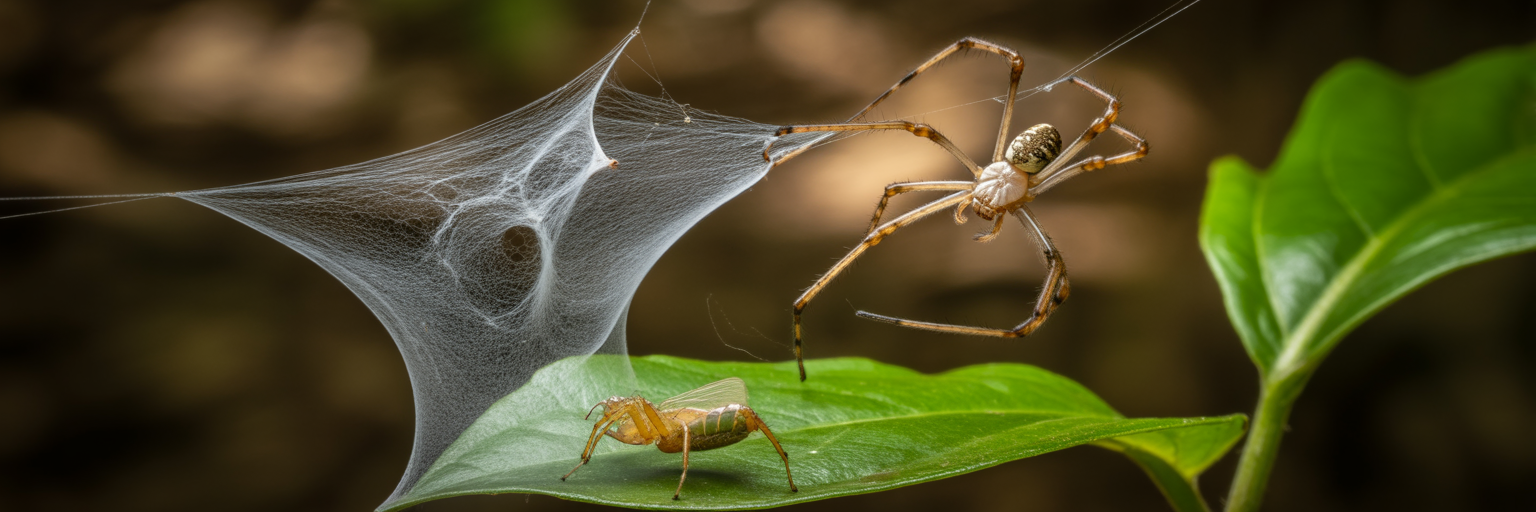
The climax of the hunt is a blur of motion. After hours of stillness, the trigger is pulled. An unsuspecting cricket, beetle, or slug wanders into the spider’s pre-marked target zone. Watched from above by those two enormous, unblinking eyes, the prey is completely unaware of the danger hanging just inches away.
In the instant the prey crosses the target, the net-casting spider attacks. The motion is explosive. It lunges downward, a sudden, violent drop that covers the distance in milliseconds. As it lunges, it simultaneously stretches its front legs far apart. This action causes the folded net to expand dramatically, opening from a tiny rectangle into a wide, silken canopy.
The net smothers the victim. The fuzzy, electrostatically charged silk instantly snags on its legs, antennae, and body. There is no struggle. The entanglement is immediate and absolute. The prey is pinned to the ground, hopelessly trapped in a web that was thrown over it with terrifying accuracy. The entire attack, from lunge to capture, is over before the victim can even react.
Once the prey is secured, the spider’s work is not done. It quickly crawls over its ensnared meal, wrapping it more tightly in additional silk to prevent any chance of escape. With the victim fully immobilized, the spider delivers a swift, venomous bite. The venom is potent for insects, quickly paralyzing and liquefying its insides. The gladiator’s final blow has landed, and the hunt is over as clinically as it began.
A Hunter That Hears with Its Legs
Just when you think the net-casting spider could not get any more terrifying, science reveals another of its secrets. It doesn’t just see its prey in the dark; it can also hear it coming. This spider has the astonishing ability to “hear” with its legs, adding another layer to its formidable predatory senses.
This is possible through a process called mechanoreception. The spider has highly specialized sensory organs on its legs that are tuned to detect specific frequencies of sound vibrations traveling through the air. It can distinguish the faint sound of an insect’s wing beats or the subtle crunch of its footsteps on the leaf litter. This gives the spider a dual-threat capability that makes it an even more effective hunter. It’s an unconventional sense, much like the predator that hunts using invisible pressure waves, which we explored in our article on strange sensory abilities.
This auditory sense allows the spider to hunt in multiple directions. While its massive eyes are fixed on the ground below, its legs are listening for targets in the air. If a low-flying moth or mosquito passes by, the spider can detect its approach through vibrations alone. In a stunning display of versatility, it can perform a backward somersault, lunging upwards and casting its net to snatch the insect right out of the air.
This ability completes the profile of a true nightmare hunter. There is almost no escape. It sees you if you walk below. It hears you if you fly nearby. For the small creatures of the undergrowth, the net-casting spider is an inescapable threat, a silent monster that attacks from the shadows with senses that seem almost supernatural.
Fearsome Hunter, Harmless Neighbor
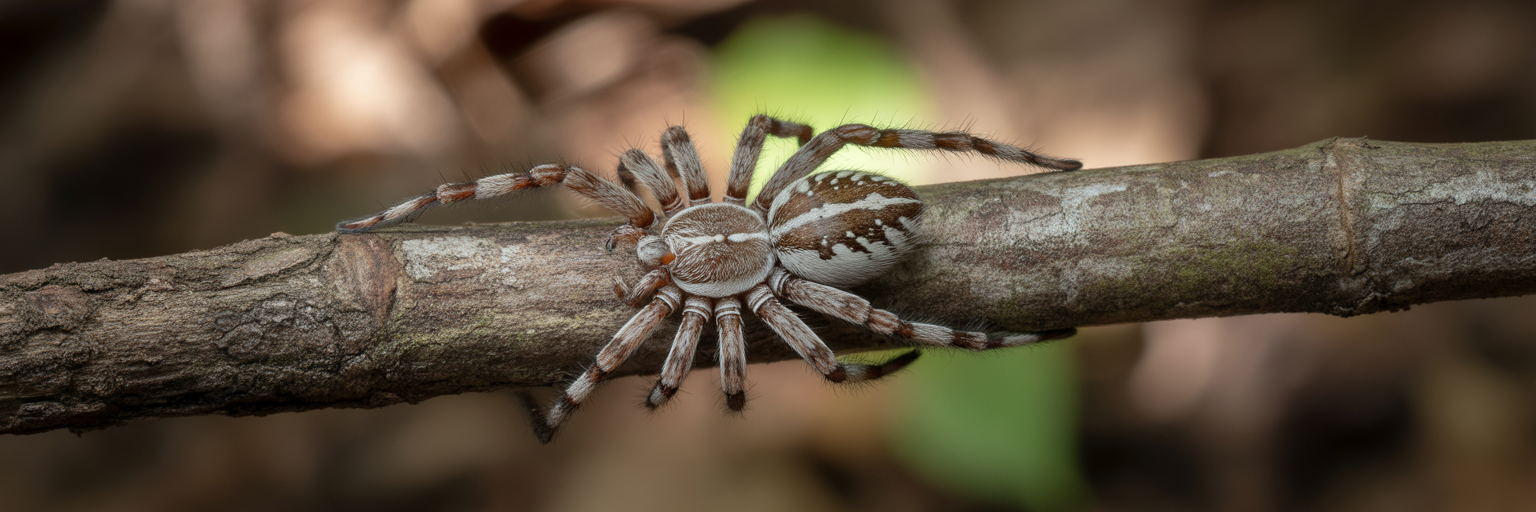
After learning about its ogre eyes, gladiator net, and lightning-fast ambush, it’s natural to feel a little unnerved. But here is the most important fact of all: the net-casting spider is completely harmless to humans. Its fangs are tiny, and its venom is only potent enough to subdue small insects. It has no interest in us whatsoever.
In fact, its daytime persona is the complete opposite of its nighttime terror. When the sun rises, the spider abandons its hunting perch and finds a safe place to hide. It straightens its long body and legs, pressing itself against a twig or the underside of a leaf. Its mottled brown coloration provides perfect camouflage, making it look exactly like a dead piece of vegetation. It becomes practically invisible, a ghost that melts into the forest. This twig-like camouflage is a brilliant survival tactic, similar to other strange defenses like the parrotfish that sleeps inside a bubble of its own slime, a strategy we covered in our look at bizarre animal behaviors.
Far from being a monster, this spider plays a valuable role in its ecosystem, helping to control populations of insects. It is a marvel of specialization, a creature that has perfected a unique and highly effective way of life. From its gladiator’s net and ogre’s eyes to its twig-like camouflage, the net-casting spider is a testament to evolution’s creativity. It serves as a powerful reminder that nature is often far stranger, and more fascinating, than anything we could ever imagine.