A Strange Light in the Dark
Imagine you are in your backyard on a moonless night. Armed with a UV flashlight, you are on the hunt for scorpions, those little arachnids known for their eerie, blue-green glow. You scan the ground, the fence posts, the old woodpile. Nothing. Then, out of the corner of your eye, a flicker of movement. You swing the beam up into the branches of an old oak tree and see it. A common flying squirrel, frozen in the purple light, suddenly erupts in a shocking, bubblegum-pink glow. It is ghostly, alien, and feels utterly wrong.
For a moment, it feels like you have stumbled upon a secret layer of reality, a hidden world of light that nature never intended for human eyes to see. This is not a trick of the light. You have just witnessed biofluorescence, the name for this bizarre and unsettling phenomenon. The squirrel is not creating its own light. Instead, its body is doing something far stranger. It is absorbing the invisible, high-energy UV radiation from your flashlight and re-emitting it as a vibrant, visible color. It is a silent, passive transformation that turns an ordinary animal into a forbidden spectacle.
This discovery feels less like science and more like folklore. It is a secret whispered between atoms, a property that only reveals itself under a specific kind of light. It is a reminder that nature is full of deceptions, much like how some creatures use fake eyes to create an illusion of being a larger, more threatening predator. The sudden appearance of this hidden light raises an immediate and deeply unsettling question. Why is this happening? Is it just a meaningless quirk of biology, or are these animals living a secret life that only activates when bathed in ultraviolet light? The question of why do animals glow under UV is not just a scientific curiosity; it feels like pulling back a curtain on a show we were never meant to watch.
Decoding the Ghostly Glow
The sight of a glowing squirrel might feel like magic, but the mechanism behind it is surprisingly straightforward, even if its purpose is not. To understand it, think of a neon highlighter pen. In normal light, it is bright. But under a blacklight, it screams with color. That is biofluorescence in action. The ink contains fluorescent molecules that absorb the invisible UV light and spit it back out as a lower-energy, intensely visible color. Animals are doing the exact same thing, just with proteins in their fur, skin, or even bones.
The process is a simple, three-step chain reaction:
- High-energy, invisible UV light photons from the sun, moon, or your flashlight strike the animal’s body.
- Specific proteins or other biomolecules within the animal’s tissues absorb the energy from these photons, becoming “excited.”
- As these molecules return to their normal state, they release that absorbed energy as lower-energy photons, which our eyes perceive as visible, often neon, colors like pink, green, or blue.
It is crucial to understand that this is not the same as bioluminescence. A firefly performing its nightly light show is using bioluminescence. That is an active chemical process, like lighting a tiny biological lantern. It is a deliberate broadcast. Biofluorescence, on the other hand, is passive. It is a property, not an action. An animal cannot decide to fluoresce; it just happens when the right kind of light hits it. This is what makes it feel so secretive and almost accidental. It is a hidden feature that is only revealed under interrogation by a UV beam.
This distinction helps answer the question of what is biofluorescence by highlighting its ghostly nature. The compounds responsible for the glow are sometimes just ordinary byproducts of an animal’s metabolism, things their bodies produce anyway. This deepens the mystery. Is this vibrant, hidden light an intentional feature evolved for a specific purpose, or is it just a strange and beautiful accident of biochemistry? The answer remains frustratingly unclear.
The Secret Society of Glowing Animals
For a long time, biofluorescence was thought to be the exclusive domain of corals, jellyfish, and other deep-sea oddities. In the twilight zones of the ocean, where blue light penetrates but other colors fade, sharks and rays use it to create eerie, glowing patterns on their skin. As documented by National Geographic, this trait appears in diverse environments. But in recent years, scientists started pointing their UV lights at things on land, and the secret society of glowing animals turned out to be much, much larger than anyone imagined.
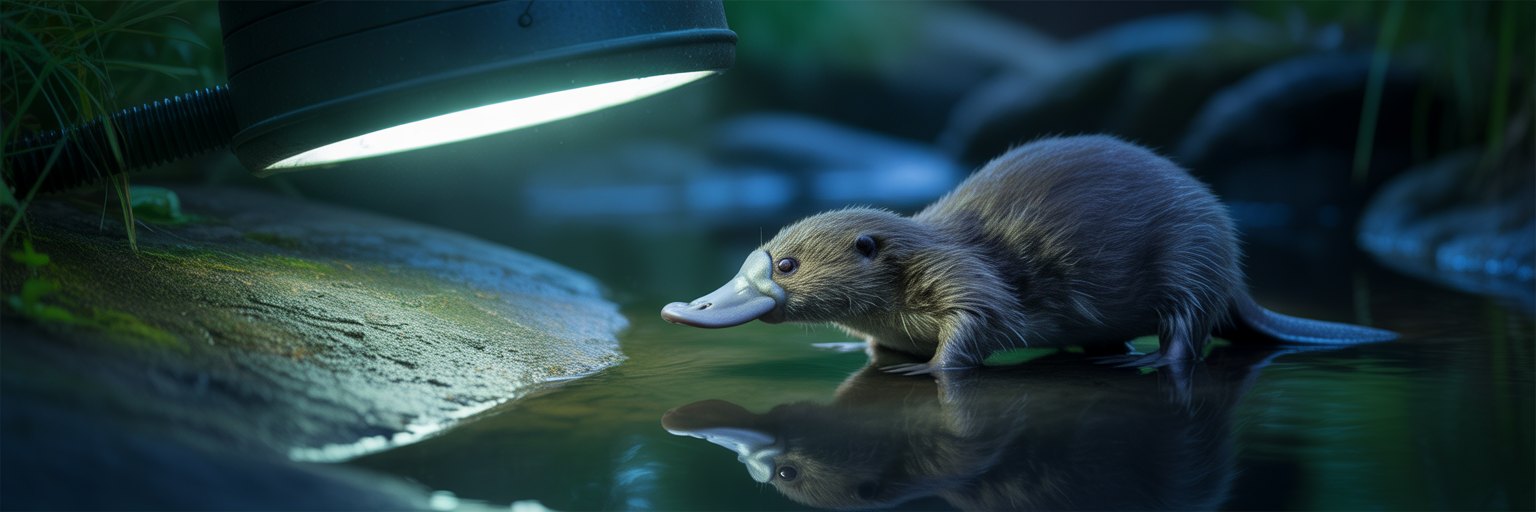
The most mind-bending discovery was the glowing platypus mystery. The platypus was already nature’s weirdest creature, a venomous, egg-laying mammal with a duck’s bill. When researchers discovered it also glows a psychedelic blue-green under UV light, it felt like a cosmic joke. This animal is already a collection of bizarre adaptations, not unlike the creature that survives by shrinking its own organs. Adding a secret glow to the mix just made it stranger.
The platypus was just the beginning. The list of unexpected members in this glowing club is growing at a shocking rate. It is not just a few freaks of nature; it is a widespread phenomenon. Some of the most surprising members include:
- Flying Squirrels: The ones that started the recent wave of discoveries, glowing a vibrant bubblegum pink.
- Wombats: These stocky Australian marsupials have glowing patches on their noses, ears, and around their eyes.
- Scorpions: The classic example, their entire bodies glow a brilliant cyan under UV light.
- Reptiles and Amphibians: Many frogs, salamanders, and chameleons display intricate fluorescent patterns that are completely invisible in normal light.
- Springhares: These African rodents exhibit a dazzling, patchy fluorescence that makes them look like living lava lamps.
Scientists are constantly adding new species to the biofluorescent mammals list, suggesting this is an ancient and common trait that has been hiding in plain sight for millennia. This ubiquity is what makes the phenomenon so scientifically compelling and so deeply unsettling. It is a secret kept by a huge portion of the animal kingdom, a silent, colorful world layered right on top of our own.
A Purposeful Power or a Cosmic Accident?

With a growing list of glowing animals, the central question becomes more urgent: why? Scientists are currently in a detective story, trying to figure out if this hidden light is a powerful tool or just a bizarre biological accident. The investigation has led to three main hypotheses.
Hypothesis 1: A Secret Communication Channel
The most exciting theory is that animals are using these patterns for secret animal communication. In low-light conditions like dawn or dusk, many animals are active. If their eyes are tuned to see these fluorescent frequencies, they could send signals to each other that are invisible to predators. A flash of a glowing patch could be a mating signal, a territorial warning, or a way for parents and young to keep track of each other in the dark. It would be a private visual language, a silent conversation happening just outside our range of perception.
Hypothesis 2: Otherworldly Camouflage
This theory sounds counterintuitive: how could glowing possibly help an animal hide? In certain environments, it might be the perfect camouflage. In the ocean’s twilight zone or in a forest under a bright moon, the ambient light is rich in blue and UV wavelengths. An animal that glows could perfectly match this background light, preventing it from appearing as a dark, obvious silhouette to predators hunting from below. Instead of standing out, the glow would help it disappear into the environment’s natural light field.
Hypothesis 3: A Useless Biological Quirk
Perhaps the weirdest and most unsettling possibility is that for many species, the glow has no function at all. It could simply be an accidental byproduct of the chemical composition of their tissues. The proteins and pigments in an animal’s fur, skin, or bones might just happen to have fluorescent properties. In this scenario, the secret light show has no purpose and no intended audience. It just happens. This theory adds a layer of cosmic strangeness, suggesting nature is filled with beautiful, pointless secrets.
| Hypothesis | Core Idea | Supporting Evidence | Major Challenge |
|---|---|---|---|
| Secret Communication | Animals use glowing patterns as a private signal to mates or rivals. | Some fish species have eye filters that enhance their ability to see fluorescent patterns on other fish. | Why would land mammals like polar bears, which are mostly solitary, need a secret visual signal? |
| Camouflage | Glowing helps an animal blend in with ambient blue or UV light in its environment. | In the ocean’s twilight zone, glowing can match the background light, hiding an animal from predators below. | This doesn’t explain fluorescence in animals living in environments with little ambient UV light, like dense forests or burrows. |
| Accidental Byproduct | The glow is a non-functional, random side effect of an animal’s tissue composition. | Fluorescent compounds are often simple metabolic byproducts, not complex, evolved structures. | This theory doesn’t account for species where the glowing patterns are intricate, consistent, and seem too specific to be random. |
The Mammal Glow-Up We Never Saw Coming
For decades, mammals were considered the boring group when it came to biofluorescence. They were thought to be largely non-glowing, relying on smell and hearing rather than strange light shows. That assumption has been completely shattered. A recent wave of research has revealed that this hidden glow is not just present but incredibly common in mammals, a discovery that has sent shockwaves through the scientific community.
To substantiate this, a groundbreaking 2023 study published in Royal Society Open Science confirmed biofluorescence in 107 out of 125 mammal species tested. The trait appears to be the rule, not the exception. The biofluorescent mammals list now includes an astonishing array of creatures, from cats and bats to zebras and even polar bears. Even parts of our own bodies, like our teeth and fingernails, glow weakly under UV light.
This discovery forces us to reconsider everything we thought we knew. It is one thing for a deep-sea fish to glow; it is another thing entirely for the animals we see every day. Why would a polar bear, living in a bright, snowy landscape, need to glow a ghostly white? Why does your pet cat have fluorescent patches in its fur? The fact that this phenomenon is present in animals we share our homes and cities with makes the mystery personal and immediate. It suggests we are surrounded by a secret world of light that has been hiding in plain sight all along. It is another reminder of how little we truly know about animal senses, much like the discovery of the creature that can hear with its knees, which upended our understanding of hearing.
The Unsolved Case of Nature’s Hidden Light

We have come a long way in this strange investigation. We know what biofluorescence is, and we are finding it everywhere we look, from the deepest oceans to our own backyards. But the central question of why remains one of modern biology’s most tantalizing and unsettling mysteries. The leading theories of communication, camouflage, or pure accident are all plausible, yet none of them fully explains the sheer breadth and variety of this phenomenon. Each theory has holes, leaving the case wide open.
There is something deeply compelling about this puzzle. The fact that this glow is completely invisible to our naked eyes makes it feel like forbidden knowledge. It is as if we have found a key, the UV light, that unlocks a secret layer of reality that has existed all around us, unseen and unknown. It proves that animals experience the world in ways we can barely imagine, using senses and signals that are completely alien to us. Even the most familiar creatures, like squirrels and platypuses, hold profound secrets.
The investigation is far from over. Every new glowing animal that is discovered only deepens the mystery, adding another clue to a puzzle that may never be fully solved. It serves as a humbling reminder that nature is filled with hidden wonders, much like the plant that can sense when its neighbor is being attacked. It leaves us with a final, haunting question: What other secrets are hiding in plain sight, just waiting for the right kind of light to be revealed?