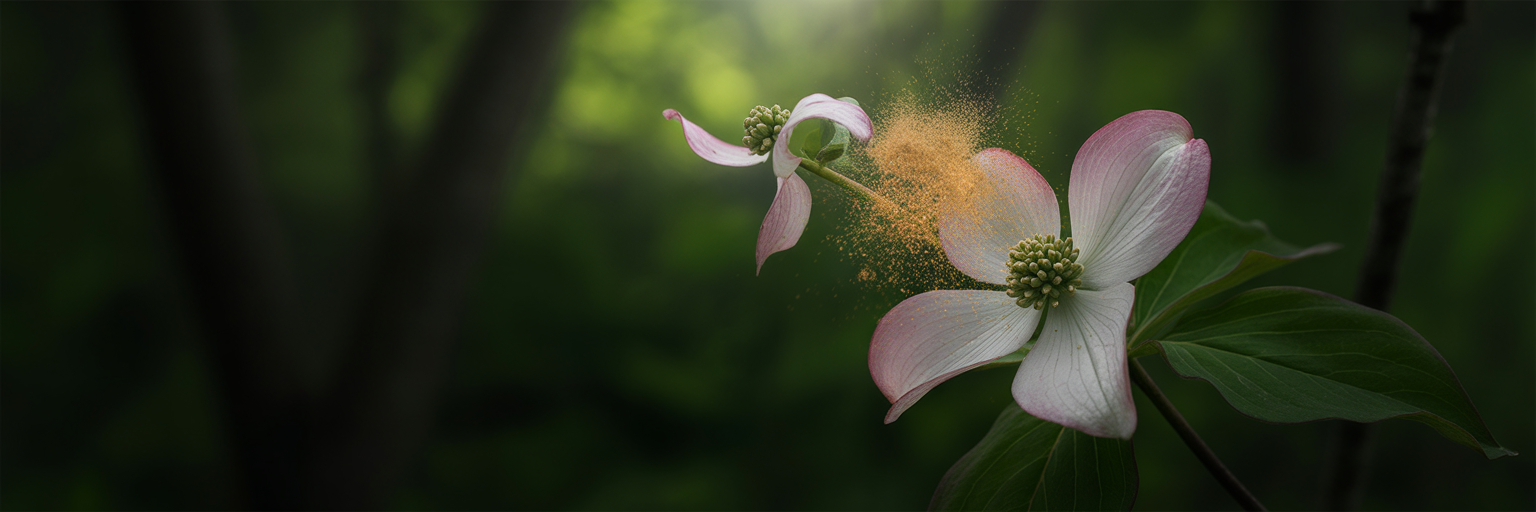
Imagine a quiet walk through a North American forest. Sunlight filters through the canopy, dappling the moss and fallen leaves. It’s a scene of profound tranquility. Yet, beneath your feet, hidden in plain sight, lies a silent and sophisticated weapon system. The bunchberry dogwood (Cornus canadensis), a common and unassuming groundcover, is armed and ready. This tiny plant that launches pollen holds the record for the fastest-moving flower on Earth, a botanical marvel that snaps open in less than half a millisecond. It doesn’t gently offer its pollen to the breeze; it fires it with the explosive force of a microscopic cannon.
This isn’t a gentle dusting. It’s a violent, precisely engineered act of botanical ballistics. The plant has evolved a vegetative trebuchet, a spring-loaded mechanism designed to overcome the stillness of its environment with overwhelming force. Its entire reproductive strategy hinges on this single, explosive moment. We often think of plants as passive, but the bunchberry dogwood challenges that assumption with chilling efficiency. It has weaponized pollination, turning a delicate process into a high-speed ambush. This article explores the physics, the evolutionary strategy, and the sheer mechanical genius behind how this humble plant built itself a cannon.
A Silent Weapon on the Forest Floor
The effectiveness of any covert weapon lies in its camouflage, and the bunchberry dogwood is a master of disguise. It presents itself as nothing more than a charming bit of greenery on the forest floor. Typically growing no more than six to nine inches tall, it forms lush carpets in the cool, shaded understory of forests across the United States and Canada. You can find it from the misty woods of the Pacific Northwest to the rolling hills of the Appalachians. Its structure is distinctive yet subtle: a single stem rises from a creeping rhizome, topped with a characteristic whorl of four to six oval leaves. These leaves, with their prominent veins curving toward the tip, create a neat, symmetrical pattern that is easily overlooked among the forest’s complex textures.
This plant’s appearance is a study in deception. It seems delicate, even fragile, thriving in the damp, acidic soil beneath pines and spruces. Its low stature and preference for shade place it in a world far removed from the bustling, sunlit canopy above. Down here, the air is heavy and still. This environment is central to its story, as it presents a significant challenge for a plant that relies on pollen dispersal. Without wind to carry its genetic material, it had to devise another solution. The serene setting belies the immense evolutionary pressure that forged its explosive secret. The quiet of the understory is not a sign of peace; it is the problem that demanded a violent answer.
More Than Meets the Eye: Bracts vs. Flowers
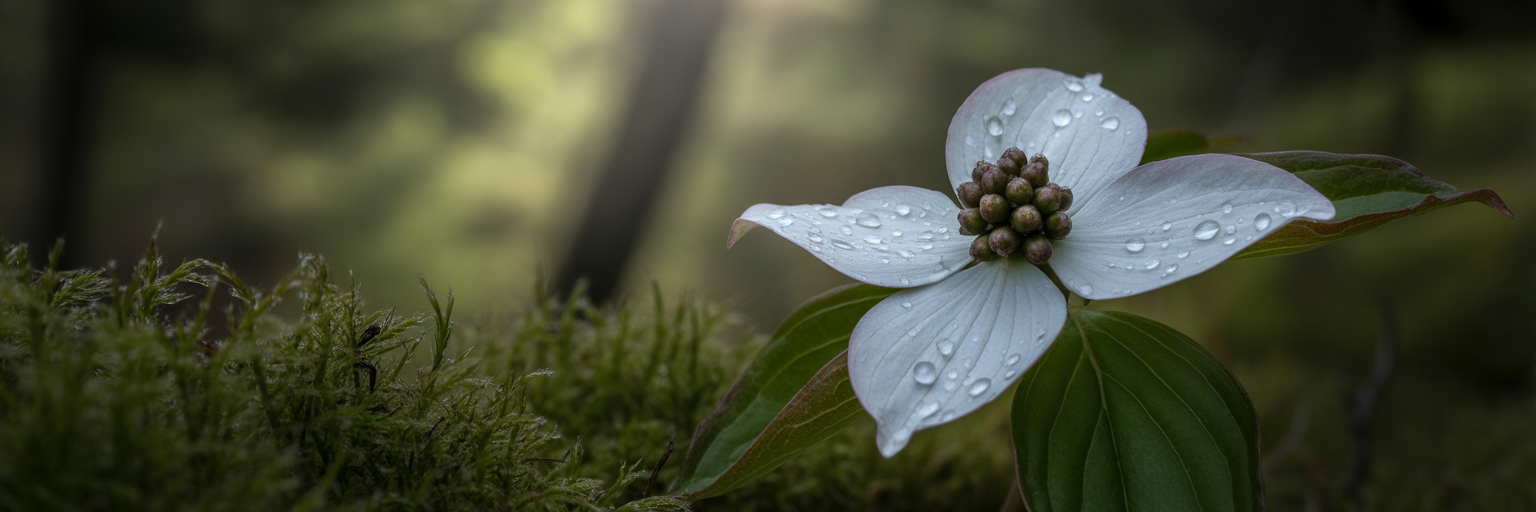
The first layer of deception lies in what most people assume are its petals. When the bunchberry dogwood blooms in late spring and early summer, it displays four large, brilliant white, petal-like structures. These are not petals at all. They are modified leaves called bracts, and their sole purpose is advertising. Like a brightly painted sign, they serve to attract the attention of passing pollinators, signaling that a reward is nearby. They create a stark, white cross against the dark greens and browns of the forest floor, a beacon for any flying insect large enough to be a worthy courier.
The real action is happening in the center. Nestled at the heart of these four showy bracts is a dense cluster of tiny, greenish-purple buds. These are the true flowers, and there can be dozens of them packed together. Each one is a miniature, self-contained explosive device, a tightly wound package of stored energy. This is where the plant hides its payload. While the bracts offer a friendly invitation, the flowers themselves are primed for a far more aggressive interaction. This is one of the most fascinating Cornus canadensis facts: its beauty is a lure, drawing visitors toward a carefully set trap.
The Still Air of the Understory
To fully appreciate the genius of the bunchberry’s strategy, one must understand the physics of its environment. The forest understory is a world of near-total calm. The dense canopy of trees above acts as a massive windbreak, absorbing the energy of breezes and leaving the air near the ground almost completely stagnant. For a plant that stands only a few inches tall, this is a major reproductive hurdle. Wind-pollinated plants like grasses and pine trees release vast clouds of pollen high up, relying on atmospheric currents to carry it for miles. The bunchberry has no such luxury.
Releasing pollen into still air is like dropping a handful of dust in a closed room; it settles almost immediately. The grains would simply fall to the ground around the parent plant, resulting in self-pollination and a lack of genetic diversity. To survive and thrive, the plant needed a way to get its pollen up and out of this dead zone of air. It needed to create its own wind, a localized, powerful gust that could propel its genetic material into the faint, unpredictable air currents that exist just a few inches higher. This environmental constraint is the “why” behind the “how.” The stillness of the forest floor is not just a backdrop; it is the adversary that the bunchberry dogwood evolved to defeat with brute force.
Anatomy of a Microscopic Trebuchet
The bunchberry dogwood flower is not just a flower; it is a machine. To understand its explosive power, we must first examine its components, much like an intelligence analyst briefing on a newly discovered piece of enemy hardware. The entire mechanism is a marvel of natural engineering, designed to store and release a tremendous amount of energy in an instant. The flower remains armed and ready, a microscopic trebuchet waiting for the slightest touch. Its design is a perfect example of how evolution can produce solutions of incredible complexity. This kind of natural engineering, where an organism develops a unique tool for survival, is seen elsewhere in nature. For instance, some predators have evolved to use projectiles, as seen in the case of the archerfish that shoots bugs out of the air with water.
The mechanism can be broken down into four critical parts:
- The Pressurized Cap: Each tiny flower bud is composed of four minuscule petals. Unlike the petals of a rose or a lily that open gently, these are fused together at their tips. This fusion creates a rigid cap that holds the entire structure under tension. It acts as a restraint, a biological safety pin that contains the immense pressure building up inside. As the flower matures, the internal components swell, pushing outward against this cap and turning the entire bud into a pressurized container.
- The Elastic Filaments: Inside this pressurized chamber lie the stamens, the male reproductive organs of the flower. Each stamen consists of two parts: the anther, which holds the pollen, and the filament, a long, slender stalk. In the bunchberry dogwood, these filaments are extraordinarily long and elastic. To fit inside the tiny bud, they are folded in half and compressed, like a powerful spring being forced into a small box. This compression is where the magic happens. The filaments store an incredible amount of elastic potential energy, waiting for the moment of release.
- The Pollen Payload: At the tip of each coiled filament is an anther. This is the payload of our botanical weapon. The anthers are filled with pollen grains, the genetic cargo that the plant needs to deliver. But the anthers themselves are also part of the weapon system. They are attached to the filaments by a hinge-like structure. As we will see, this hinge plays a crucial role in the launch, acting like the sling of a trebuchet to whip the pollen forward and maximize its velocity.
- The Hair-Trigger: The final component is the trigger. Protruding from the very top of the fused petal cap is a single, tiny, antenna-like appendage. This delicate structure is the only thing an outside force needs to interact with. It is incredibly sensitive. The slightest pressure on this antenna is enough to break the seal holding the petals together. It is a hair-trigger in the most literal sense, designed to be activated by the weight of a specific type of visitor, ensuring the weapon is not discharged accidentally.
With these components in place, the flower is a fully armed and operational weapon. The petals form a pressurized containment vessel, the filaments are compressed springs loaded with energy, the anthers are hinged slings carrying the ammunition, and the antenna is the sensitive trigger. The entire system waits patiently on the forest floor, a silent testament to nature’s capacity for violent ingenuity.
The Physics of an Ultrafast Explosion
The moment of detonation is where the bunchberry dogwood’s quiet existence shatters into an event of astonishing violence and speed. When a sufficiently large insect, like a bee or a syrphid fly, lands on the flower cluster to investigate, its leg or body inevitably brushes against the hair-trigger antenna. This single touch is all it takes. The pressure on the antenna breaks the delicate fusion at the tips of the petals. Instantly, the pressurized cap gives way, and the petals fly backward. Freed from their restraint, the four compressed filaments snap open with unimaginable speed. In less than 0.5 milliseconds, they straighten out, launching their pollen-laden anthers into the air. The entire event is over so quickly that it is completely invisible to the human eye. Without high-speed cameras, this botanical explosion remained a secret for centuries.
Faster Than a Blink, Stronger Than a Rocket Launch
The term “explosion” is not an exaggeration. The bunchberry dogwood is officially the fastest flower on earth, and the forces involved are astronomical. According to research from Williams College, the filaments unfold with such violent precision that they accelerate pollen at 24,000 meters per second squared. To put that in perspective, this subjects the tiny pollen grains to 800 times the force of gravity (800 Gs). A trained fighter pilot can withstand about 9 Gs before losing consciousness. The astronauts on the Space Shuttle experienced a mere 3 Gs during launch. The pollen from this tiny flower endures forces that would instantly obliterate any human.
The trebuchet analogy becomes literal here. As the filament arm snaps upward, the hinged anther at its tip acts like a sling. It whips forward at the end of the filament’s arc, multiplying the speed and flinging the pollen away from the flower at an even higher velocity. This two-stage launch mechanism is a masterpiece of efficiency, ensuring the pollen achieves maximum speed and altitude. The acceleration is so extreme that it atomizes the pollen, breaking up the clumps into a fine, aerosolized cloud that hangs in the air. Nature is full of creatures that operate at incredible speeds, such as the star-nosed mole that eats faster than you can blink, but the bunchberry’s acceleration is in a class of its own.
| Event | Peak Acceleration (G-Force) | Description |
|---|---|---|
| Bunchberry Dogwood Pollen | 800 Gs | Pollen grains launched by the flower. |
| Fighter Jet Pilot (in a tight turn) | 9 Gs | The maximum force a trained pilot can withstand. |
| Space Shuttle Launch | 3 Gs | The force experienced by astronauts during ascent. |
| Mantis Shrimp Strike | 10,000 Gs | The acceleration of its club-like appendage. |
| Jellyfish Stinging Cell (Nematocyst) | 5,400,000 Gs | One of the fastest known biological accelerations. |
While the mantis shrimp and jellyfish nematocyst achieve higher G-forces, they do so over microscopic distances to puncture a target. The bunchberry dogwood is unique in that it uses this incredible acceleration for dispersal, launching its payload into the open air. It is a true cannon, a biological artillery piece designed for range and coverage, all hidden within a flower no bigger than a pinhead.
The Strategic Goal of Botanical Ballistics
A weapon of this sophistication is not evolved by accident. The bunchberry dogwood’s explosive pollen mechanism is the direct result of intense evolutionary pressure, a perfectly tailored solution to a specific set of environmental problems. Now that we have explored the intricate “how” of the explosion, we can focus on the strategic “why.” The entire process is a ruthless and efficient survival tactic, a high-stakes gamble to ensure its genes are passed on in an environment where conventional methods would fail. This kind of elaborate deception to ensure reproductive success is not unique in nature; consider the caterpillar that tricks ant colonies into raising it as their own.
The primary problem, as established, is the still, windless air of the forest understory. The plant’s ballistic system overcomes this challenge with several key strategic advantages:
- Creating Its Own Wind: The most obvious advantage is that the explosion generates the force needed to get the pollen airborne. Instead of waiting for a breeze that may never come, the bunchberry dogwood creates its own. The violent launch acts as a localized, powerful gust, propelling the pollen away from the parent plant with enough velocity to escape the stagnant layer of air hugging the ground. It is an act of taking control, of refusing to be a passive victim of its environment.
- Achieving Critical Altitude: The launch is not just about speed; it is about height. The explosion hurls the pollen about 2.5 centimeters (roughly one inch) into the air. This may not sound like much, but for a flower that is only a couple of millimeters tall, this is a monumental achievement. It is the equivalent of a person throwing a baseball to the top of a 30-story building. This altitude is critical because it lifts the pollen out of the dead zone and into a region where faint, almost imperceptible air currents exist. Once there, even the slightest air movement can carry the pollen cloud to neighboring plants.
- Maximizing Dispersal with a ‘Pollen Cloud’: The extreme acceleration serves another purpose. It is so violent that it causes the pollen grains, which are initially clumped together with a sticky substance, to de-aggregate and atomize. The payload doesn’t launch as a single projectile but as a fine, expanding mist. This dramatically increases the surface area of the pollen and allows it to hang in the air for longer, like smoke. This “pollen cloud” maximizes the statistical probability that at least some of the grains will drift onto the stigma of a nearby bunchberry flower, ensuring successful cross-pollination.
This entire strategy represents a massive energy investment for the plant. Building the pressurized buds and elastic filaments requires significant resources. But it is a necessary cost. In the high-stakes game of reproduction, the bunchberry dogwood has gone all-in on a single, explosive strategy. It demonstrates a fundamental principle of evolution: extreme environments often favor extreme solutions. The plant’s floral cannon is a testament to the power of natural selection to produce outcomes that are as efficient as they are shocking.
Choosing the Right Accomplice for the Heist
The bunchberry dogwood’s strategy is even more sophisticated than just launching pollen into the air. The mechanism is not just a cannon; it is a smart weapon. It is calibrated to select the right accomplice for its reproductive heist, ensuring that its precious pollen is entrusted only to the most effective couriers. The plant actively filters its pollinators, ignoring undesirable visitors and targeting only those that can guarantee successful, long-distance dispersal.
The trigger mechanism is the key to this selection process. It is designed to be set off only by a certain amount of force. Small, ground-dwelling insects like ants or mites, which frequently crawl over low-growing plants, are generally too light to trip the sensitive antenna. This is a crucial adaptation. Ants are notoriously poor pollinators; they are not very mobile, often traveling short distances, and they secrete substances that can render pollen sterile. Wasting a pollen explosion on an ant would be a complete reproductive failure. The bunchberry dogwood simply ignores them, saving its ammunition for a more promising target.
The ideal accomplices are larger, flying insects, particularly bees and syrphid flies. These insects are heavy enough to depress the trigger mechanism when they land to probe the flowers for nectar. More importantly, they are highly mobile, capable of flying between different patches of bunchberry plants, sometimes hundreds of feet apart. This ensures cross-pollination and promotes genetic diversity within the population, which is essential for the long-term health of the species. The plant has effectively designed a bouncer for its own club, only letting in the high-rollers who can get the job done.
Furthermore, the explosive force itself serves a dual purpose. When the flower detonates, it doesn’t just launch pollen into the air; it simultaneously plasters the underside of the visiting insect with a dense coating of it. The high-speed impact embeds the pollen grains deep into the insect’s fuzzy hairs, making it difficult for the pollinator to groom the pollen off and eat it, which many bees are inclined to do. The plant is not offering a gift; it is forcing its cargo onto an unwilling delivery vehicle. The insect, startled by the tiny explosion, flies off to the next flower cluster, carrying the securely attached pollen with it. This turns the pollinator from a casual diner into a highly effective, albeit unwitting, courier in the bunchberry’s genetic scheme.
From Explosive Flower to Forest Jewel
The violent, microscopic drama of the bunchberry dogwood’s pollination eventually gives way to a peaceful and beautiful conclusion. The successful detonation and dispersal of pollen is not the end of the story but the beginning of the next chapter in the plant’s life cycle. After the explosive act, the fertilized flowers transform. Throughout the summer, the central cluster of tiny green buds slowly ripens into a tight bunch of bright red, glossy berries. It is this vibrant fruit cluster that gives the plant its common name: bunchberry.
These berries are as important to the ecosystem as the flowers are to the plant’s reproduction. They are a valuable food source for a variety of forest creatures in the late summer and fall. Birds like thrushes and grouse, as well as small mammals like chipmunks and bears, consume the berries. In doing so, they carry the seeds far from the parent plant, ensuring the bunchberry dogwood can colonize new areas of the forest floor. The plant’s life cycle thus comes full circle, from a hidden weapon to a vital part of the forest food web.
The next time you find yourself on a quiet trail in the forests of the United States, from the Appalachians to the Rockies, take a moment to look down. You might see the familiar whorl of leaves and the stark white bracts of the bunchberry dogwood. Now you know the secret it holds. This humble plant is a masterclass in natural engineering, a perfect example of the many weird plant adaptations that exist all around us. It proves that the most unassuming organisms can hide shocking complexity and power. The story of its life cycle is as strange as that of the Suriname toad that gives birth through holes in its back, proving nature’s endless capacity for surprise. A quiet walk in the woods will never feel quite the same.