There is a widely shared video of a truck overturning on an Oregon highway and spilling its cargo of live hagfish across four lanes. What follows looks like a special effect. Within moments the road is buried under a translucent grey mass that engulfs a car. The hagfish had been jostled, and hagfish that get jostled produce slime.
It is not an exaggeration to call this the fastest-expanding material known in biology, synthetic or otherwise. A single pinch on the tail of an adult Pacific hagfish — an animal about 45 centimetres long with a body volume of roughly 0.14 litres — can generate close to 0.9 litres of slime. That is about seven times the volume of the animal producing it, deployed in a fraction of a second.
What hagfish slime is actually made of
Almost nothing. That is the first surprise.
Hagfish slime is approximately 99.9% seawater. The solid content is on the order of 100 milligrams per litre — a mucus concentration around a thousand times more dilute than the mucus lining your own stomach. By any reasonable expectation, a mixture that dilute should simply be water. Instead it behaves like a cohesive, elastic net.
The structure comes from two ingredients, packed into glands running in a row down each side of the body. Pacific hagfish carry roughly 79 pairs of these glands; Atlantic hagfish carry around 97.
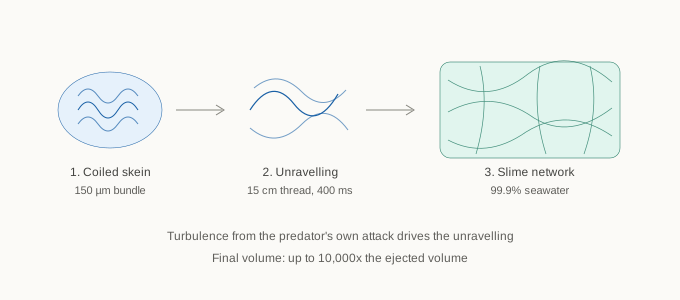
Inside each gland sit two cell types. Gland mucous cells hold vesicles packed with mucins — proteins with an enormous capacity to hold water. Gland thread cells hold something considerably stranger: a single protein thread, up to 15 centimetres long and only one to three micrometres thick, wound into a tight ellipsoidal bundle about 150 micrometres across.
Think of a skein of yarn wound so precisely that it unrolls without tangling. That thread is roughly a hundred times longer than the package containing it, and it is the largest cytoplasmic polymer known in biology. Made from intermediate filament proteins, these threads rival spider silk in strength and toughness — which is exactly why materials scientists keep trying, and mostly failing, to replicate them.
The deployment sequence
When something bites a hagfish, muscles surrounding the nearby glands contract and fire their contents out through a duct as a concentrated slurry. Crucially, only the glands near the attack fire. The animal does not empty itself in a panic; it releases locally, which is likely why hagfish are rarely caught without ammunition in reserve.
What happens next takes about 400 milliseconds.
The cells rupture on contact with seawater. Mucin vesicles swell and deform, drawing out into long elastic strands. The thread skeins unravel — and here is a detail that took years to establish. The threads do not simply spring open. Work by Timothy Winegard and Douglas Fudge showed that unravelling requires two things simultaneously: vigorous hydrodynamic mixing, and the presence of the mucins. Still water produces very little slime. It is the turbulence of an attacking predator’s own movement that triggers full deployment.
The predator, in other words, provides the energy that arms the weapon.
The result is an interpenetrating network — stiff protein microfibres threaded through a mucin matrix — that traps a colossal volume of seawater between its strands. Measured expansion reaches around 10,000 times the ejected volume.
Why hagfish slime is lethal to fish and harmless to you
If you handle hagfish slime it feels unpleasant and nothing more. It is not toxic, not caustic, not venomous. Against a gill-breathing predator it is nearly fatal.
Jeanette Lim, Douglas Fudge and colleagues tested this directly in 2006, pushing water through both an artificial gill model and real fish gills with and without slime present. The slime dramatically increased the resistance the gills presented to water flow. A shark or a conger eel that bites a hagfish gets a mouthful of expanding gel drawn straight into its gill chamber, where it lodges and chokes off respiration. Video from deep-sea observations has caught predators breaking off attacks and thrashing to clear their gills.
The mechanism is subtler than “sticky goo blocks holes.” Fudge’s later work found the slime does not bind water tightly — it acts more like an extremely fine sieve, slowing water through viscous entrainment. Compared against engineered hydrogels made from xanthan gum and psyllium husk, hagfish slime impeded flow roughly 120 to 130 times more effectively.
This one defence appears to explain a great deal about hagfish as a group. They are essentially exempt from predation by gill-breathing animals, which is a plausible reason a soft-bodied, jawless, largely blind creature has persisted for a very long time in an ocean full of things with teeth.
What we still do not know about hagfish slime
The evolutionary origin remains open. A 2023 study identified epidermal threads in hagfish skin — thread-producing cells outside the slime glands entirely — suggesting the machinery may have been repurposed from an ancestral skin function rather than invented wholesale for defence.
The unravelling physics is also not fully solved. No engineered material yet reproduces the uncoiling behaviour of a thread skein, and that failure is why the slime remains an active target for materials research. A fibre that deploys 15 centimetres of high-strength thread from a 150-micrometre package, using only ambient turbulence as its power source, would be useful for a great many things. Naval research has looked at it as a non-lethal deterrent. Textile researchers have looked at it as a replacement for petroleum-derived synthetic fibres.
For now, the hagfish remains the only manufacturer.
The obvious problem with living inside your own weapon
If you flood the water around you with a gel that suffocates gill-breathers, and you are yourself an aquatic animal, you have created a difficulty.
Hagfish solve it in two ways. The first is anatomical: they can sneeze. Hagfish periodically force water forcefully out through their single nostril, clearing slime from the airway. It is precisely as undignified as it sounds and it appears to work.
The second solution is the one that gets the attention. A hagfish can tie itself in a knot.
Starting near the tail, it forms a loose overhand knot in its own body and then slides that knot forward along its length, scraping accumulated slime off as the knot travels. The same manoeuvre serves at least two other purposes. Hagfish have no jaws — they feed with a rasping tongue-like structure lined with keratinous teeth — so to tear a chunk from a carcass they anchor the tissue in their mouth, throw a knot into their body, and push against the knot for leverage. It is a portable fulcrum made of hagfish.
Knotting also gets them out of trouble. A hagfish gripped by a predator can knot up and shove itself backwards out of the grip, which combined with slime deployment makes them extraordinarily difficult to actually hold.
Why this matters beyond the deep sea
Hagfish occupy a genuinely important ecological role, and it is not glamorous. They are among the primary consumers of large carcasses on the seafloor, entering bodies through the mouth or gills and feeding from the inside out. They can also absorb dissolved organic matter directly across their skin and gills — meaning a hagfish inside a whale carcass is, in a real sense, eating with its entire body surface.
They are also commercially significant in ways most people never connect to the animal. “Eel skin” leather — wallets, belts, bags — is usually hagfish. And the species is fished heavily enough in some regions that populations have declined sharply, which is an odd fate for an animal whose defence renders it almost immune to natural predators.
The slime itself has attracted sustained industrial interest. A material that self-assembles into a strong fibre network from a tiny dehydrated package, using only seawater and turbulence, is close to an engineer’s fantasy. Research groups have pursued it as a bio-derived alternative to petroleum-based synthetic fibres, as a component in protective fabrics, and as a non-lethal deterrent capable of fouling propellers and intakes. Progress has been steady but slow, and the sticking point remains the same: nobody can yet make a thread skein that unravels the way the real thing does.
Sources
- Lim, J., Fudge, D.S., Levy, N. & Gosline, J.M. (2006). Hagfish slime ecomechanics: testing the gill-clogging hypothesis. Journal of Experimental Biology 209(4): 702–710.
- Winegard, T.M. & Fudge, D.S. (2010). Deployment of hagfish slime thread skeins requires the transmission of mixing forces via mucin strands. Journal of Experimental Biology 213: 1235–1240.
- Zintzen, V. et al. (2011). Hagfish predatory behaviour and slime defence mechanism. Scientific Reports 1: 131.
- Chaudhary, G., Fudge, D.S. et al. (2023). Mechanisms of gill-clogging by hagfish slime. Journal of the Royal Society Interface 20(200).
- Zeng, Y. et al. (2023). Epidermal threads reveal the origin of hagfish slime. eLife 12: e81405.
- Fudge, D.S. et al. (2003). The mechanical properties of hydrated intermediate filaments: insights from hagfish slime threads. Biophysical Journal 85: 2015–2027.