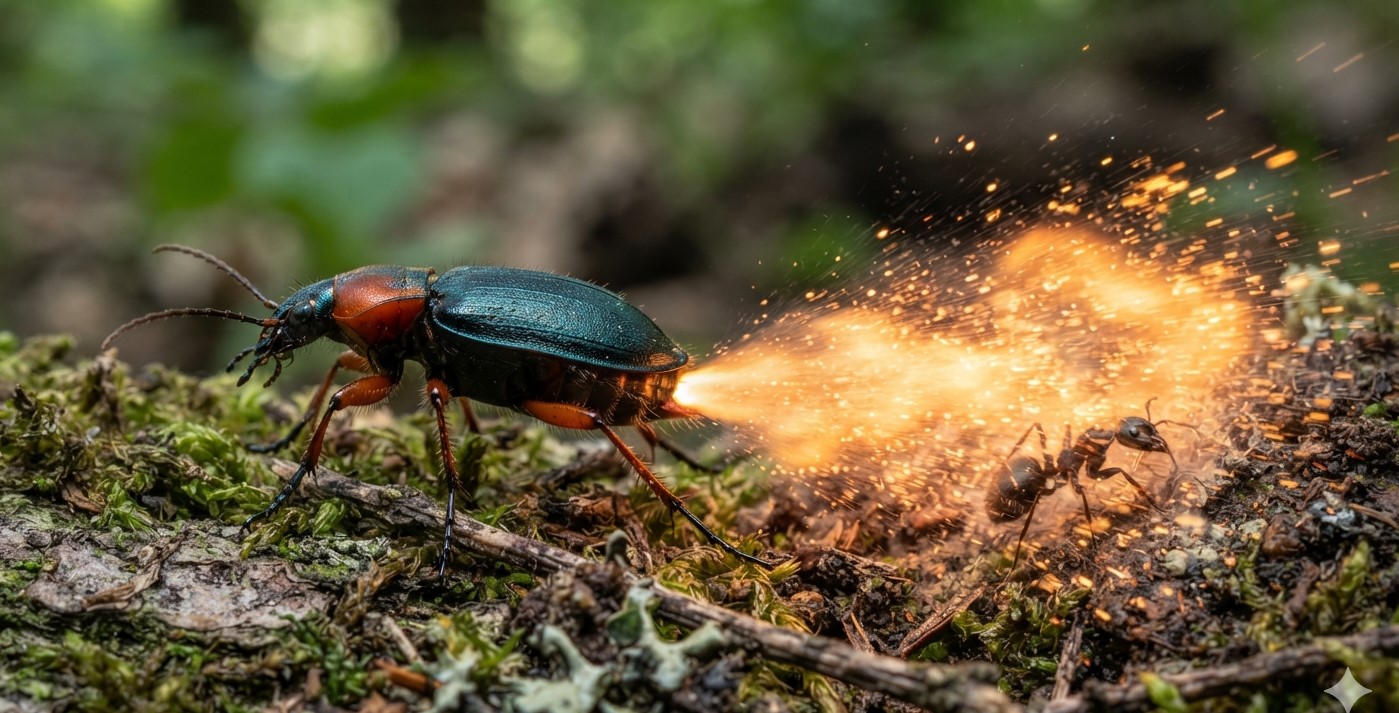
Pick up a bombardier beetle and you will hear it before you feel it. There is a sharp crack, like a tiny cap gun, and then a stinging puff of vapor across your fingers. What just happened inside that half-inch body is a controlled explosion — a chemical reaction that reaches the boiling point of water, fires in a machine-gun burst of discrete pulses, and can be aimed with enough precision to hit a single segment of the beetle’s own leg.
The strangest part is not that the beetle can do this. It is that the beetle survives doing it.
How the bombardier beetle builds a bomb inside its own body
The trick is that the bomb is never assembled until the instant it is needed.
Near the tip of the abdomen, a bombardier beetle carries two paired glands, each split into two compartments. The larger one is the reservoir — a soft, muscle-wrapped sac holding a watery solution of hydroquinones and hydrogen peroxide. On their own, these two ingredients are stable. The beetle can carry them around for weeks without incident, the way you might carry two sealed bottles in the same bag.
The second compartment is the reaction chamber, and this is where the chemistry turns violent. Its walls are lined with enzymes — catalases and peroxidases — held apart from the fuel by a one-way valve. When the beetle is attacked, muscles squeeze the reservoir and force a dose of fuel through that valve into the enzyme-lined chamber.
The reaction is immediate. The catalases rip the hydrogen peroxide apart into water and free oxygen. The peroxidases oxidize the hydroquinones into benzoquinones, which are genuinely nasty compounds — irritating to eyes, mouths, and respiratory tissue across basically every animal that has been tested against them. Both reactions dump heat.
How much heat? In 1969, Daniel Aneshansley and Thomas Eisner at Cornell put thermocouples on discharging beetles and measured the answer directly. The spray leaves the body at approximately 100 degrees Celsius — the boiling point of water — with a heat content of roughly 0.2 calories per milligram. A meaningful fraction of the liquid flashes to steam on the way out, which is what produces the audible pop and the visible puff of vapor.
The beetle is, in effect, firing superheated steam and a chemical irritant simultaneously, using a fuel it manufactured itself and stored safely until the moment of use.
The pulse jet that took 45 years to explain
For decades, the discharge was assumed to be a single spurt. It is not.
In 1990, a Cornell team joined by Harold Edgerton — the MIT engineer who invented high-speed strobe photography and shot the famous milk-drop coronet images — turned that technology on the African bombardier beetle Stenaptinus insignis. The spray, they found, is not a stream at all. It is a rapid train of discrete pulses, firing at roughly 500 per second.
The authors made an analogy that has stuck ever since: the beetle’s ejection system works on the same principle as the pulse jet engine of the German V-1 flying bomb. Intake, combustion, exhaust, repeat — hundreds of times a second, in an insect.
But why it pulsed stayed unresolved for another 25 years. The chambers are about a millimetre long and buried inside a living animal, which makes them difficult to watch.
The answer arrived in 2015, when a team led by Eric Arndt used synchrotron X-ray imaging to film the reaction happening inside live, discharging beetles. The mechanism turned out to be elegantly self-regulating. Fuel enters the reaction chamber through the valve. The explosion begins. The pressure spike pushes out a flexible expansion membrane, and that membrane’s movement physically slams the valve shut — cutting off the fuel supply mid-reaction. The pulse is ejected, pressure drops, the membrane relaxes, the valve reopens, and fresh fuel floods in.
Explosion, close, fire, relax, reopen. Several hundred times a second.
Nobody designed this feedback loop. It falls out of the physics of a pressurised chamber with a flexible wall and a one-way inlet. But it is also precisely why the beetle does not destroy itself: the pulsing keeps any single explosion small and brief. A continuous reaction in a sealed millimetre chamber would rupture the abdomen. Chopping it into hundreds of micro-explosions bleeds the energy out in survivable increments.
A bombardier beetle can hit a target on its own back
A weapon is only useful if you can point it, and here the beetle’s performance goes from impressive to faintly unsettling.
In 1999, Eisner and Aneshansley published photographic evidence that Stenaptinus insignis can aim its discharge in virtually any direction. It can target its individual legs. It can target individual segments of individual legs. When aiming at a leg, it accounts for where that leg is currently positioned — meaning the beetle is not firing along a fixed reflex arc but adjusting to its own body posture in real time.
It can also hit sites on its own back. Species in the tribe Brachinini manage this with hardened cuticular deflector plates just outside the chamber opening, which pivot to steer the jet forward over the beetle’s own dorsal surface.
Eisner’s hypothesis for why this precision evolved is that the main threat is not birds or toads but ants — small attackers that arrive in numbers and latch onto specific body parts. Against an ant clamped onto your middle leg, a general-purpose blast forward is useless. You need to shoot your own knee.
What happens when a toad swallows a bombardier beetle
In 2018, Shinji Sugiura and Takuya Sato at Kobe University ran an experiment that answers a question most people never think to ask: what if the predator is fast enough that the beetle never gets to fire?
They offered the Asian bombardier beetle Pheropsophus jessoensis to two toad species, Bufo japonicus and B. torrenticola. Toad tongues are quick, and every single toad successfully swallowed its beetle.
Then the researchers heard explosions coming from inside the toads.
Forty-three percent of the toads vomited the beetles back up, between 12 and 107 minutes after swallowing them. Every recovered beetle was still alive and active. Most went on to live for at least a fortnight afterward. The beetles had detonated their chemical defense inside a stomach and triggered the toad’s own vomiting reflex — turning a predator’s digestive system into an escape route.
Larger beetles escaped more often than small ones, and beetles that had been experimentally “unloaded” by making them discharge beforehand were far less likely to get out. The chemistry, not luck, was doing the work.
Why doesn’t the bombardier beetle cook itself?
Three things protect it.
The chamber is armored. It is heavily sclerotized — the same cuticle hardening that makes beetle shells rigid — so it can take repeated pressure spikes without deforming.
The reaction is brief. Each pulse lasts a fraction of a millisecond. Heat has almost no time to conduct into surrounding tissue before the fluid is already outside the body.
And the exit is fast. The spray leaves at speed, carrying the thermal energy with it. The beetle is not holding boiling liquid; it is passing it through.
There is a lingering question about how much the heat actually matters for defense. Some work suggests predators react intensely even to cooled discharge, which would mean the benzoquinone chemistry is doing most of the deterring and the temperature is partly a byproduct of generating pressure. It remains genuinely open.
The part nobody has fully explained
Bombardier beetles are not rare or exotic. The tribe Brachinini contains hundreds of species across roughly 20 genera, and many live under rocks and logs in ordinary places — including North America and Europe. The defensive behaviour of only a handful has ever been studied in detail.
We can describe what the bombardier beetle does with real precision. We have filmed the valve closing. We have measured the temperature and counted the pulses. What we understand less well is exactly how the deflector plates convert a simple ejection into a steerable turret, and how a nervous system that fits inside a grain of rice computes a firing solution on a moving leg.
For an animal you could cover with a postage stamp, that is a substantial amount of unfinished business.
Sources
- Aneshansley, D.J., Eisner, T., Widom, J.M. & Widom, B. (1969). Biochemistry at 100°C: Explosive Secretory Discharge of Bombardier Beetles (Brachinus). Science 165: 61–63.
- Dean, J., Aneshansley, D.J., Edgerton, H.E. & Eisner, T. (1990). Defensive Spray of the Bombardier Beetle: A Biological Pulse Jet. Science 248: 1219–1221.
- Eisner, T. & Aneshansley, D.J. (1999). Spray aiming in the bombardier beetle: Photographic evidence. PNAS 96(17): 9705–9709.
- Arndt, E.M. et al. (2015). Mechanistic origins of bombardier beetle (Brachinini) explosion-induced defensive spray pulsation. Science 348: 563–567.
- Sugiura, S. & Sato, T. (2018). Successful escape of bombardier beetles from predator digestive systems. Biology Letters 14(2): 20170647.
- Sugiura, S. (2018). Anti-predator defences of a bombardier beetle: is bombing essential for successful escape from frogs? PeerJ 6: e5942.