The Mystery of the Reindeer Whose Eyes Turn Blue
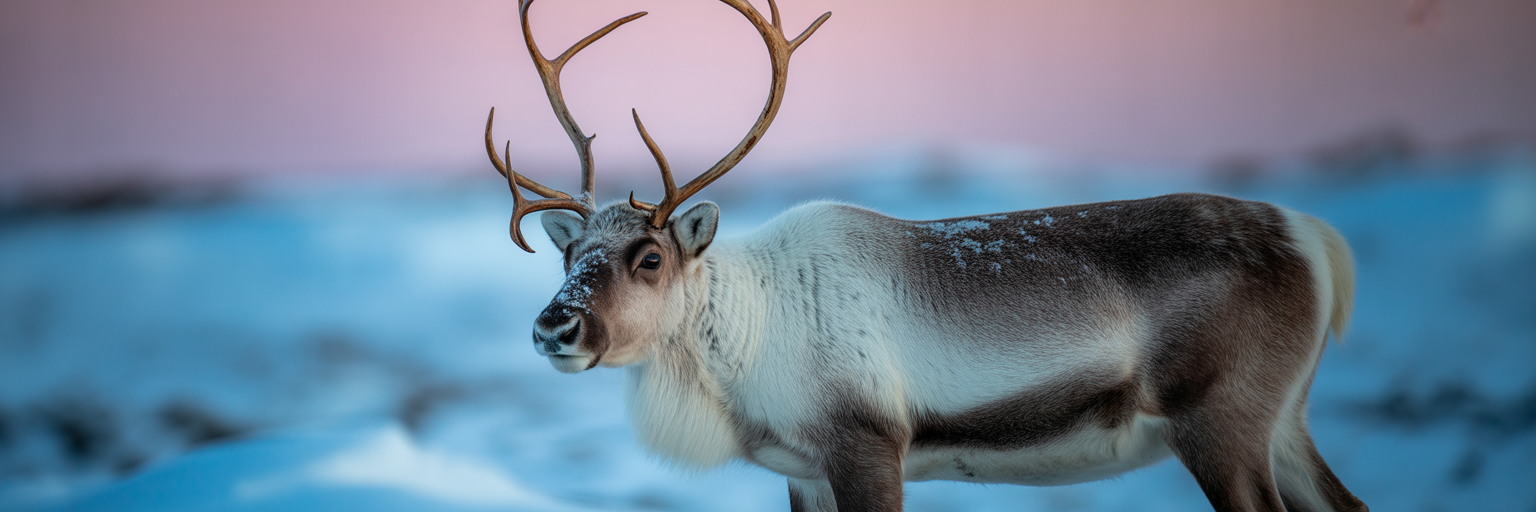
In the high Arctic, the sun vanishes for months, plunging the world into a prolonged twilight. For the creatures that endure this polar night, survival depends on extraordinary adaptations, none more surprising than what happens inside a reindeer’s eye. This is the story of the reindeer whose eyes turn blue, a remarkable transformation driven by the planet’s most extreme light cycles. The seasonal reindeer eye color change from a brilliant gold in summer to a deep, rich blue in winter is a genuine natural wonder.
The Arctic environment swings between two poles of light. Summer brings 24-hour daylight, bathing the tundra in constant brightness. Winter counters with the polar night, a period of perpetual dimness where the sun never crests the horizon. This dramatic environmental pressure is the driving force behind the reindeer’s visual shift. It is important to clarify a common misconception from the start. This change does not happen in the iris, the colored part of the eye we typically associate with eye color. Instead, the transformation occurs in a specialized structure deep within the eyeball. This article explores the science behind this phenomenon, explaining the mechanism, its survival advantages, and how it fits into the broader picture of their unique vision.
Anatomy of a Night-Vision Eye: The Tapetum Lucidum
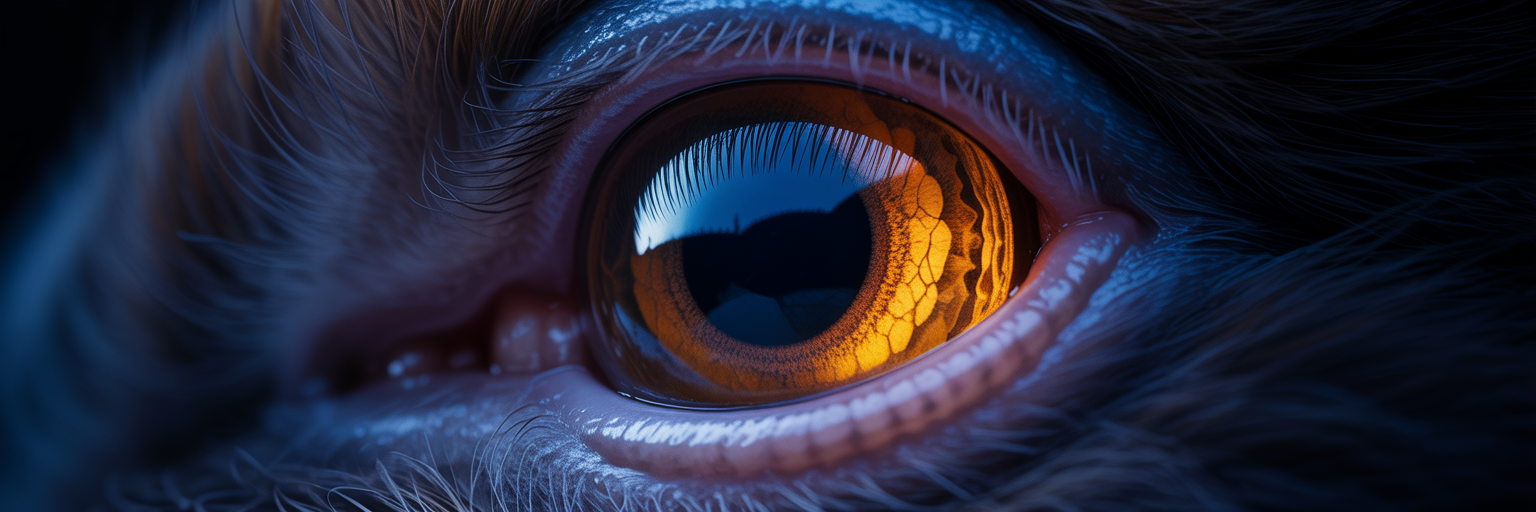
To understand the reindeer’s shifting eyes, we must first look at a feature common to many nocturnal animals: the tapetum lucidum. This is a retroreflective layer of tissue located just behind the retina. The primary tapetum lucidum function is to act as a biological mirror. When light enters the eye and passes through the retina, any photons not absorbed by the photoreceptor cells hit the tapetum and are reflected back. This gives the light-sensitive cells a second chance to capture the light, dramatically enhancing vision in dim conditions.
The effect is similar to the reflective strips on a safety vest or a cyclist’s jacket. Those strips don’t produce their own light, but they are incredibly efficient at bouncing light from an external source, like car headlights, directly back toward the source. This makes the wearer highly visible in the dark. The tapetum lucidum does the same for photons inside the eye. This principle of retroreflection is even used by humans. For instance, mastering your offshore trolling setup often involves using lures with reflective surfaces that catch and scatter faint light, attracting fish in deep, dark water.
The tapetum itself is composed of a precise matrix of collagen fibers. The specific arrangement and spacing of these fibers determine which wavelengths, or colors, of light are most effectively reflected. This detail is the key to the reindeer’s seasonal change. While many animals, from cats to crocodiles, possess this night-vision-boosting layer, the Arctic reindeer is the only mammal known to have a tapetum lucidum that seasonally changes its color and function. This ability is just one of many unique sensory adaptations found in nature, rivaling even the predator that hunts using invisible pressure waves.
The Pressure-Driven Shift from Gold to Blue
The mechanism behind the reindeer’s color-changing eyes is a fascinating example of physiological engineering, driven by the relentless darkness of the Arctic winter. The process begins as the polar night sets in. The constant low light forces the reindeer’s pupils to remain fully dilated for months on end. This prolonged, wide-open state has a significant secondary effect on the eye’s internal plumbing.
Inside the eye, a fluid called the aqueous humor constantly circulates. The widely dilated pupil physically obstructs the drainage channels for this fluid. As a result, the pressure inside the eyeball, known as intraocular pressure, begins to rise. This process is mechanically similar to what happens in glaucoma in humans, but for the reindeer, it is a natural and reversible adaptation. This increased pressure is the direct trigger for the color change.
The high pressure physically squeezes the tapetum lucidum. This compression forces fluid out from between the collagen fibers that make up the tapetum, causing them to pack together much more tightly. This change in spacing alters the layer’s optical properties. In the summer, the collagen fibers are relaxed and more widely spaced, a structure that is perfect for reflecting longer wavelengths of light, which we perceive as gold or yellow. In the winter, the compressed, tightly packed fibers become tuned to reflect shorter wavelengths of light, which we see as deep blue. This is a structural color, not a change in pigment. The color comes from the physics of light interacting with a nanostructure, much like the iridescent colors of a butterfly’s wing.
This entire mechanical process is a key area of reindeer vision science. As a study published in Proceedings of the Royal Society B detailed, the pressure-induced compression of the collagen matrix is the definitive cause of the seasonal color shift, linking environmental light levels directly to the eye’s internal structure.
Survival Advantage in the Blue Arctic Twilight
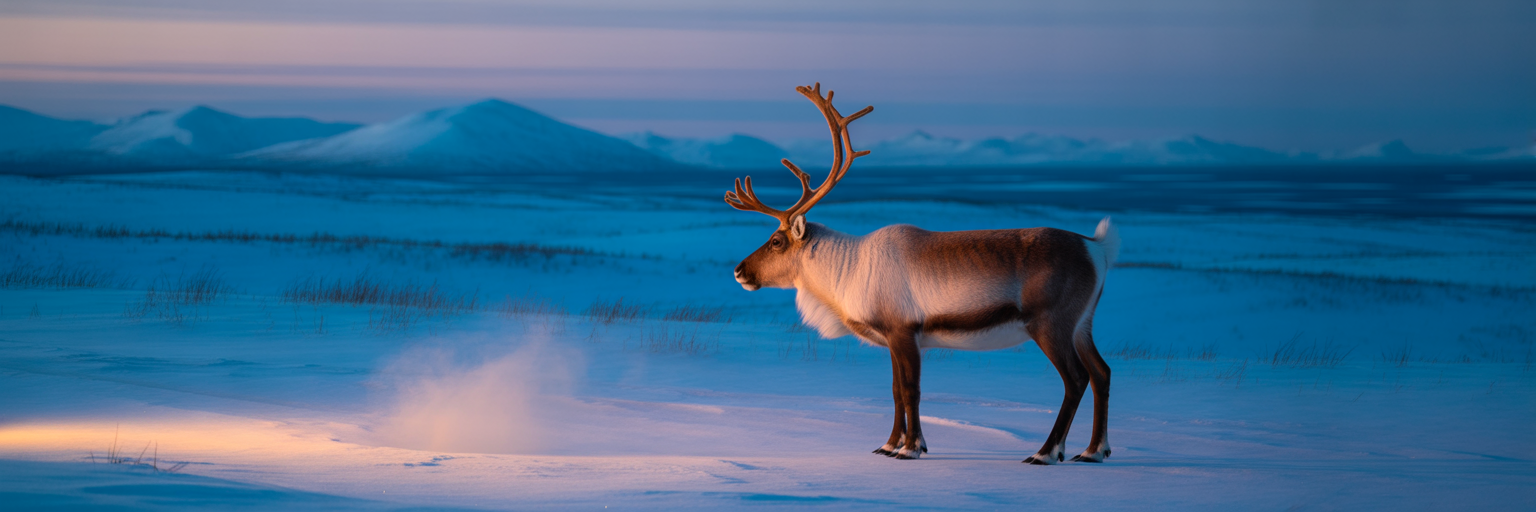
This remarkable transformation is not for show; it is a critical survival adaptation. The question of how do reindeer see in the dark is answered by this seasonal trade-off. The blue-reflecting winter tapetum is specifically tuned to the ambient light of the polar night. This environment is dominated by scattered, short-wavelength blue light, the only color that effectively permeates the twilight atmosphere. By shifting its reflectivity to blue, the eye maximizes its ability to capture the most abundant type of light available.
The blue state also increases the scattering of light within the eye. While this might seem counterproductive, it makes it more likely that any scarce photon, regardless of its initial trajectory, will eventually strike a photoreceptor cell. This boosts light sensitivity to its absolute maximum. However, this heightened sensitivity comes at a cost: visual acuity. The increased scattering creates a fuzzier, less detailed image. For the reindeer, this is a vital evolutionary compromise. It is far better to see a blurry, moving shape that might be a wolf than to see nothing at all.
In contrast, the golden tapetum of the summer is suited for bright conditions. It reflects more light out of the eye, preventing the photoreceptors from being overwhelmed and helping to maintain sharper, more detailed vision when light is plentiful. The practical advantages of the winter vision state are clear:
- Spotting the subtle movement of predators like wolves against the snow.
- Locating patches of lichen, a primary food source that absorbs UV light, making it stand out.
- Navigating the familiar but dimly lit landscape during the long polar night.
This adaptation is an extreme solution for an extreme environment, much like the animal that survives by shrinking its own organs to conserve energy. The following table summarizes the key differences between the two states.
| Feature | Summer State (Golden) | Winter State (Blue) |
|---|---|---|
| Collagen Fiber Spacing | Relaxed and widely spaced | Compressed and tightly packed |
| Reflected Wavelengths | Longer wavelengths (yellows, golds) | Shorter wavelengths (blues) |
| Primary Function | Reflect excess light, maintain visual acuity | Maximize light capture and sensitivity |
| Visual Acuity (Sharpness) | Higher | Lower (fuzzier image) |
| Light Sensitivity | Lower | Significantly higher |
| Optimal Environment | 24-hour daylight of Arctic summer | Prolonged twilight of Arctic winter |
A Broader Look at Reindeer Vision
The seasonal tapetum change is perhaps the most dramatic of the arctic animal adaptations for vision, but it is not the only one. Reindeer vision is a suite of features working together. Another key ability is their capacity to see ultraviolet (UV) light. Humans are blind to this part of the spectrum, but for a reindeer, it provides a huge advantage in a world of white.
Snow is highly reflective of UV light, creating a bright, almost blinding background. However, many things important to a reindeer’s survival absorb UV light. The fur of predators like wolves and the texture of lichen, a vital food source, both appear dark in the UV spectrum. This creates a high-contrast image for the reindeer, making predators and food stand out clearly as dark shapes against a bright white landscape. This is a powerful tool for survival, not unlike the animal that can detect a predator just from its shadow.
It is critical to understand that this UV sensitivity is a separate adaptation from the seasonal tapetum change. The ability to see UV light is a function of the photoreceptor cells in the retina itself, not the reflective layer behind it. The two systems work in concert to give the reindeer the best possible view of its world, but one does not cause the other. Other traits, such as a high density of rod cells (specialized for low-light vision) and pupils that can open exceptionally wide, further illustrate how the entire reindeer visual system is finely tuned for survival in the Arctic.
Disruptions in a Modernizing Arctic
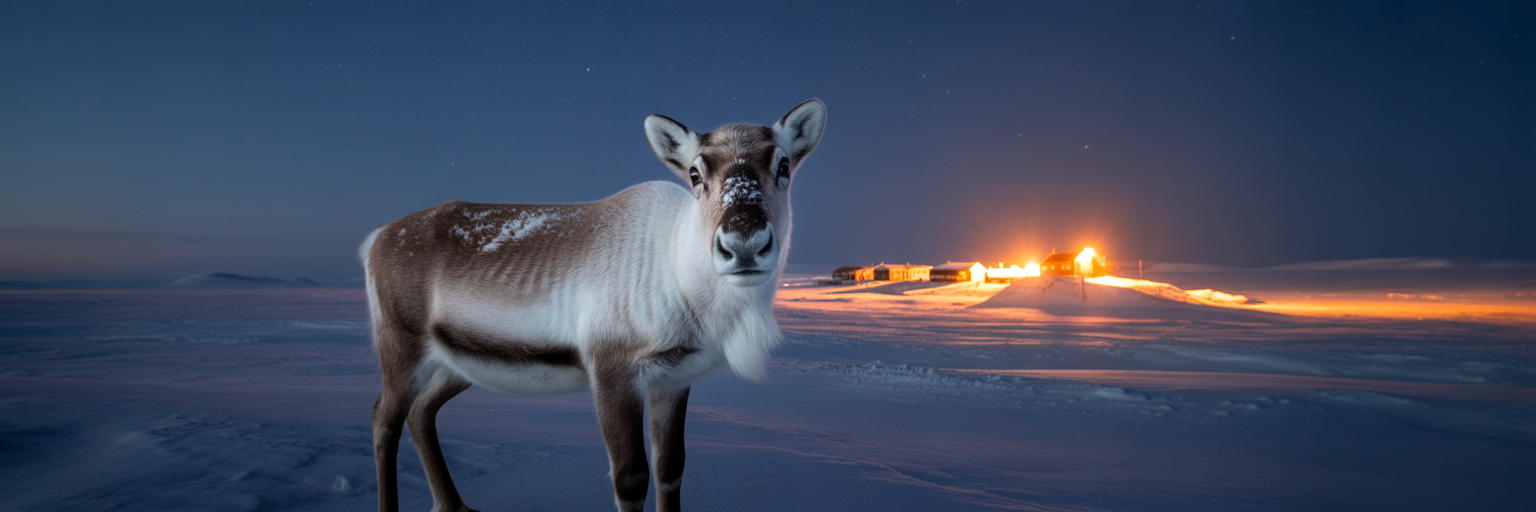
This finely tuned biological cycle, perfected over millennia, now faces a modern threat: artificial light pollution. The increasing presence of human activity in the Arctic, from settlements and industrial sites to research stations, is introducing light into the winter darkness. This disrupts the core trigger for the reindeer’s seasonal adaptation.
Recent research has shown that reindeer exposed to artificial light at night during the winter do not undergo the complete transformation. Their pupils fail to remain fully dilated, which means the intraocular pressure does not rise sufficiently to fully compress the tapetum. Instead of turning a deep, sensitive blue, the tapetum of these reindeer often settles into a greenish, intermediate color. This state is a maladaptive compromise, offering neither the sharp acuity of the summer eye nor the extreme sensitivity of the winter eye.
The consequences for the reindeer could be severe. An impaired ability to spot predators or find scarce food in the dim natural twilight could directly impact their fitness and survival rates. It is a stark reminder of how human activity, even when seemingly localized, can have far-reaching and unintended consequences, disrupting ancient and delicate evolutionary adaptations that are essential for life in one of the world’s harshest environments.
Frequently Asked Questions About Reindeer Eyes
Q1: Can you see the blue color just by looking at a reindeer?
A: No, the change is deep inside the eye. The tapetum lucidum is behind the retina, so you would only see its reflection (as ‘eyeshine’) when a bright light is shone directly into the eye in the dark, similar to how you see a cat’s eyes glow in a photo.
Q2: Do other animals’ eyes change color like this?
A: To date, Arctic reindeer are the only species known to have this seasonal, pressure-driven color change in their tapetum lucidum. While many animals have a tapetum, this dynamic adaptation is unique to reindeer.
Q3: Is the change painful for the reindeer?
A: The increased eye pressure would be extremely painful and damaging for humans, but reindeer have evolved to tolerate this seasonal change. It is a normal, functional part of their biology, not a pathological condition.
Q4: How quickly does the color change happen?
A: The transition is gradual, occurring over several weeks as the seasons change from fall to winter and again from spring to summer. It is not an overnight switch but a slow physiological adjustment to the changing light levels.
Q5: Does this happen to all reindeer?
A: This adaptation is specific to Arctic reindeer (also known as caribou in North America) that live in regions with extreme seasonal light changes. Reindeer living in more temperate climates with less dramatic light shifts do not exhibit this same dramatic transformation.