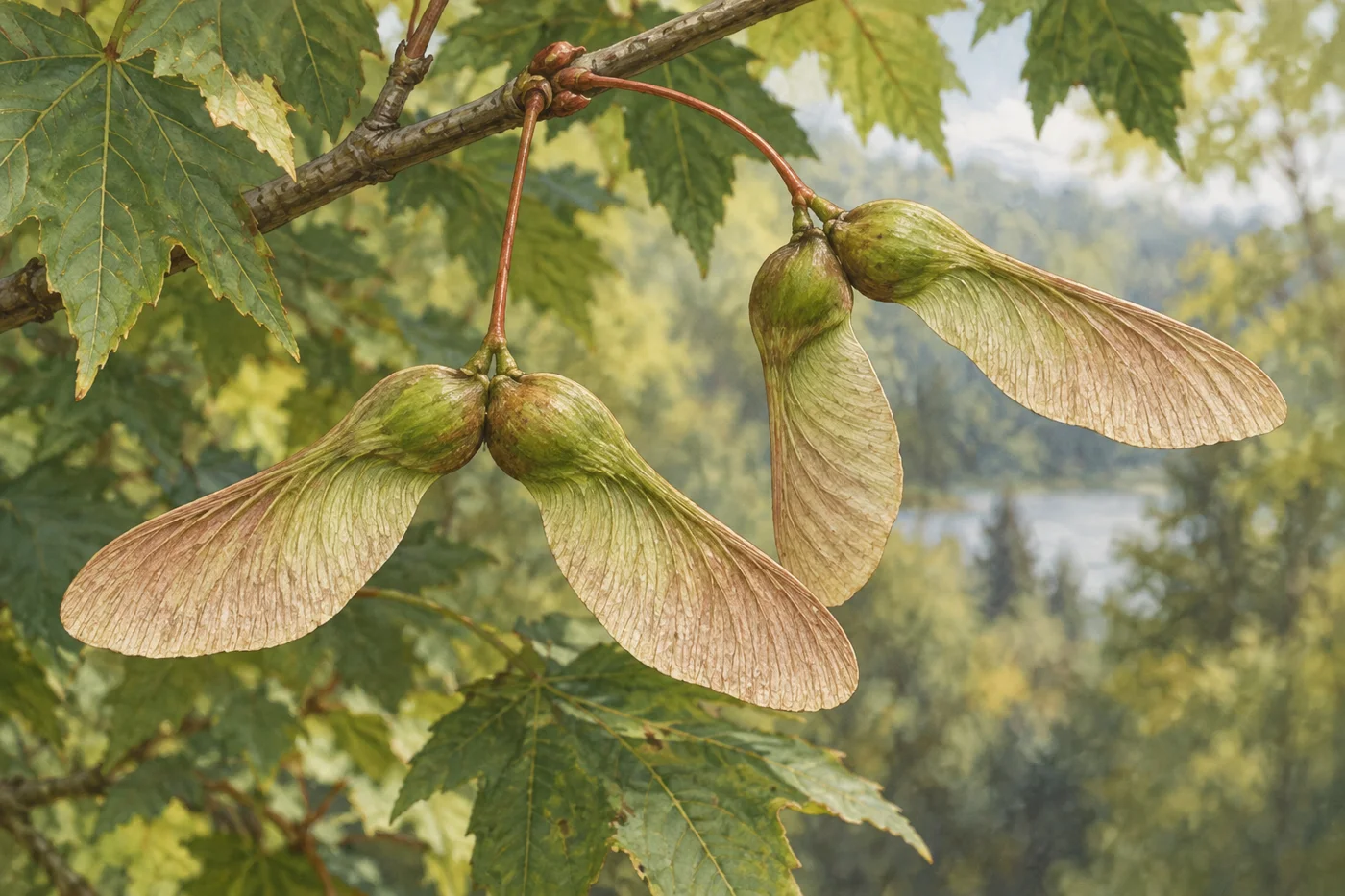
A maple seed’s spinning descent looks playful, but the motion is part of its dispersal machinery. Unlike the airborne body-shaping strategy described in our article on gliding snakes, a maple samara uses a thin wing and sustained rotation to slow its fall.
There is no engine inside the fruit. Gravity supplies the descent, and the shape and mass distribution allow the surrounding air to turn it. That rotation changes the flow around the wing, producing a useful aerodynamic force. The familiar “helicopter” is a natural example of autorotation.
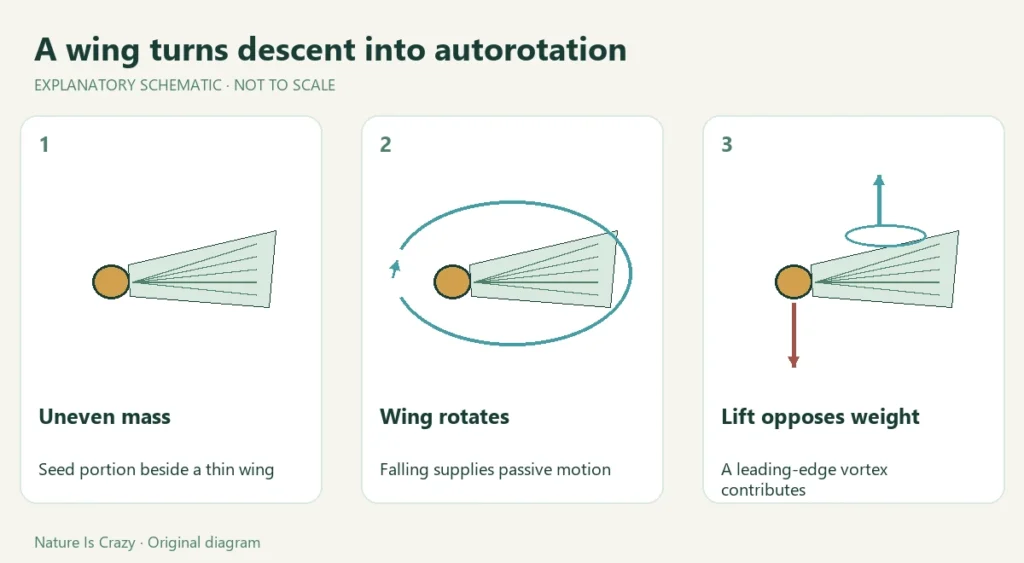
A samara combines a heavy end and a light wing
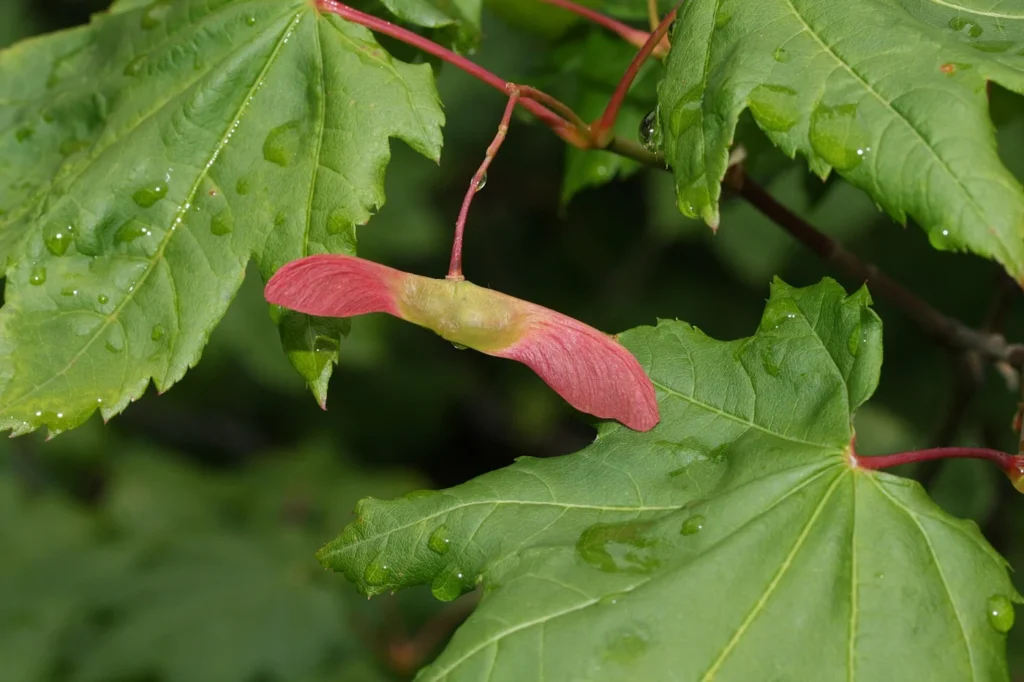
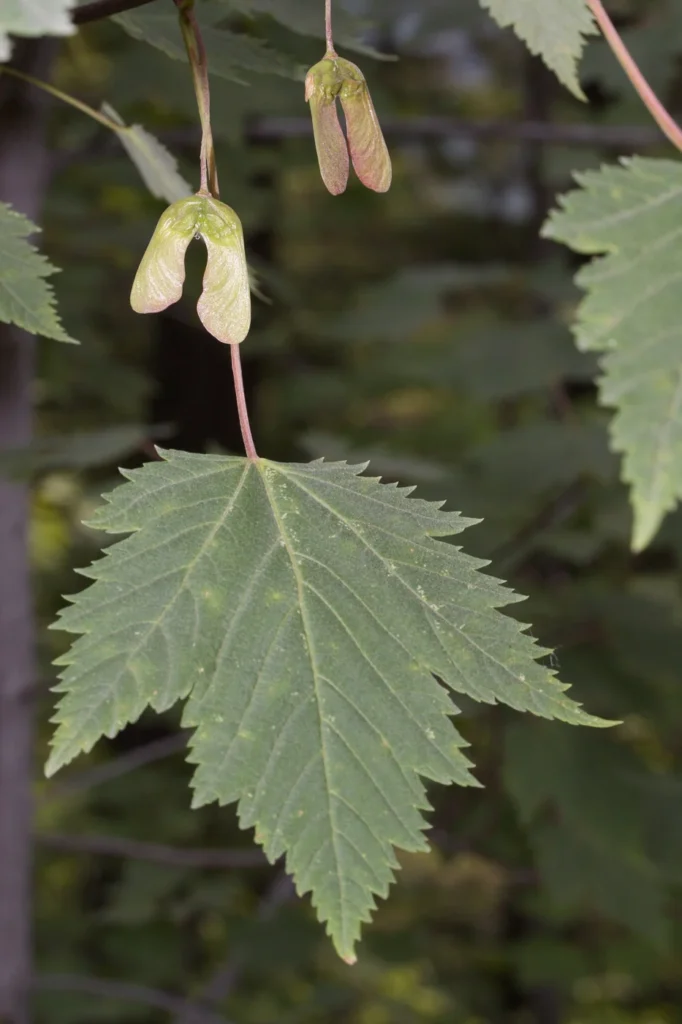
A samara is a winged dry fruit. In a typical maple example, the seed-containing portion forms a relatively concentrated mass beside a thin extending wing. Paired fruits are often visible on the tree; the individual flying units can separate before or during dispersal.
The wing and the mass do different jobs. The heavy portion influences balance and rotation, while the broad light portion interacts with the air. Simply making a paper shape that looks similar does not guarantee identical flight: thickness, flexibility, weight and the location of that weight can all matter.
As the unit falls, aerodynamic forces can begin turning it. Once established, the rotation lets the wing continually sweep through air. Its motion is therefore different from that of a flat object dropping with an unchanging orientation.
A vortex forms near the wing’s leading edge
Researchers investigating maple flight found a leading-edge vortex: a rotating flow structure near the front edge of the moving wing. The pressure distribution associated with that flow contributes to lift, opposing the downward motion.
The research team’s account of its experiments describes both enlarged model seeds and real samaras. Models moved through oil under conditions chosen to reproduce relevant aspects of the natural flow. The team also examined real seeds in a wind tunnel, using smoke to visualize the air around them.
The combination is important. A model makes forces and flow easier to measure; a real seed checks whether the mechanism occurs in the natural object. A convincing explanation connects the two rather than relying only on an attractive simulation.
Lift need not make the seed rise
In ordinary conversation, “lift” often means taking something upward. In aerodynamics, lift describes a force relative to the flow. A falling samara can generate useful lift while continuing to lose height. The force slows its descent rather than necessarily reversing it.
If the average upward aerodynamic force balances the fruit’s weight, the fruit can descend at an approximately steady speed instead of continuing to accelerate. Surrounding wind can simultaneously carry it sideways. Slower descent can increase the time available for that movement.
Our article on dandelion seeds and their separated vortex rings explores another way to prolong an airborne journey. The vortices differ: a maple’s leading-edge flow belongs to a rotating wing, while a dandelion’s ring forms above a porous tuft.
Rotation can settle into a stable pattern
A study of stable samara autorotation examined natural fruits and artificial versions with deliberately distributed masses. It related terminal descent to measurable geometric and aerodynamic properties.
That work illustrates why flight cannot be explained by wing area alone. A large wing attached to a very different mass has a different loading. Moving the center of mass can change the way forces turn the object. Geometry and weight enter the same mechanical problem.
The study concerned stable autorotation and particular samara types. It should not be read as a guarantee that every maple fruit falls with an identical rate or angle. Natural fruits vary, and a damaged wing or disturbance can change a particular descent.
Computational studies reveal the changing flow
A numerical study of a falling maple seed investigated the coupled motion of the seed and surrounding fluid. Such work helps explore how a changing orientation and a developing wake influence one another during descent.
The word “coupled” has a practical meaning here. Air exerts forces on the seed; the seed’s movement changes how air passes around it; the altered flow then changes the forces. Treating the fruit as a fixed wing in an unchanging stream misses some of that interaction.
Models are useful because they can expose flow patterns that are difficult to follow with unaided observation. Their value depends on the assumptions and comparisons supporting them. A colorful visualization is an explanation aid, not evidence that every detail of a natural descent has been reproduced.
A familiar trick appears in different flyers
Research on leading-edge vortex mechanics places rotating and flapping wings within a broader family of aerodynamic problems. Similar flow structures can enhance lift in different organisms, even though their wings, movements and energy sources differ.
That is why comparing a samara with a hovering insect can be useful but incomplete. The insect powers its wing motion with muscles. The falling fruit relies on descent and passive rotation. Sharing an aerodynamic mechanism does not make their overall flight systems interchangeable.
For a further example of movement emerging from geometry and distributed forces, read how salp chains swim with multiple jets. A maple samara is a much smaller cast of characters: one fruit, an uneven distribution of mass and a wing that turns falling into a longer journey.
Featured image credit: AI-generated editorial illustration of maple samara. Conceptual imagery, not a documentary photograph; anatomy and scale are illustrative.