
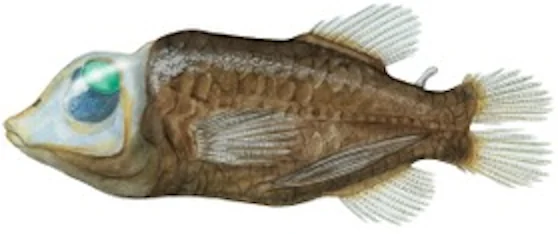
A barreleye fish looks as though someone installed a cockpit over its face. Inside the clear dome sit two green, upward-pointing eyes. The dark spots above the mouth are nasal structures, not a second pair of eyes. Like the scallop's mirror-based eyes, this arrangement solves a visual problem with anatomy that initially seems almost impossible.
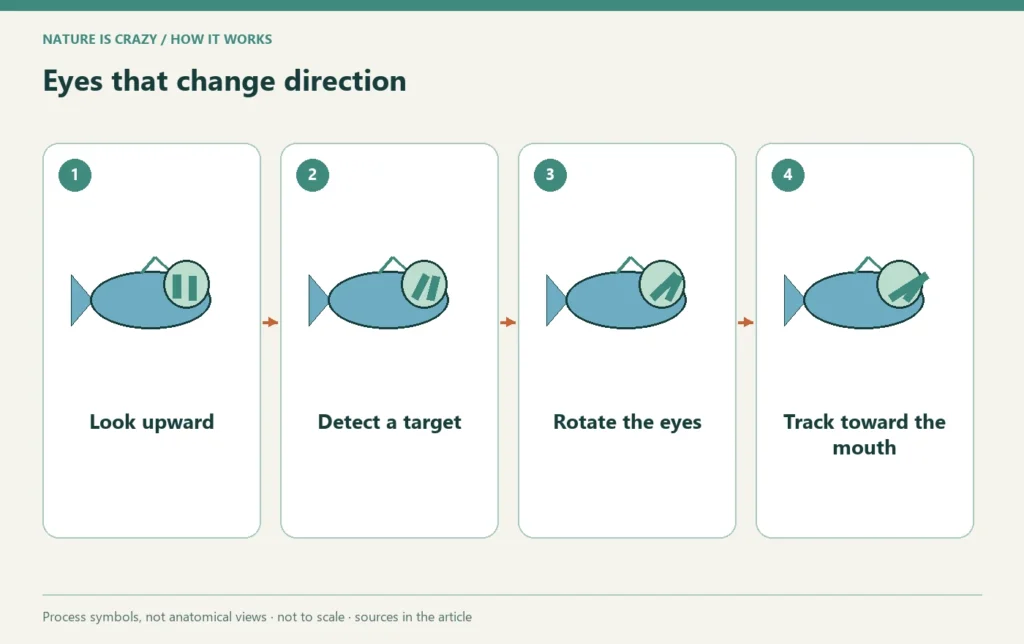
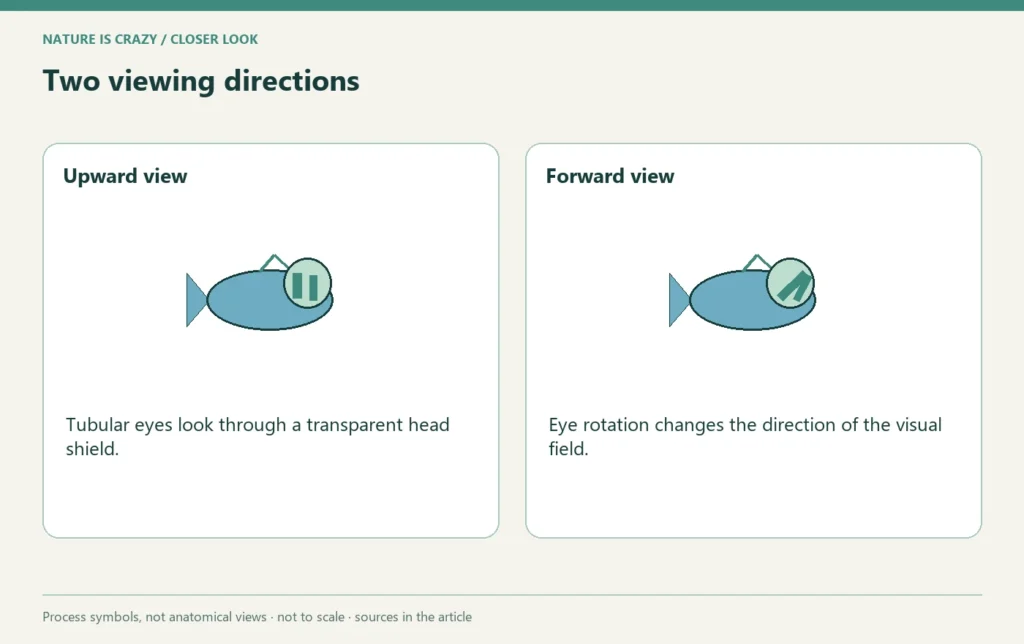
The surprise is movement. In Macropinna microstoma, the eyes do not remain locked toward the surface. They can turn forward while the fish changes its body position. That flexibility helps explain how an animal equipped to watch the water overhead can also direct food toward a small mouth at the front of its head. A transparent shield gives the moving equipment room to operate.
Why an upward-looking fish needs movable eyes
Daylight becomes weaker as it travels down through seawater. In the mesopelagic zone, looking upward offers a different view from looking sideways: a faintly illuminated ceiling above, darker water around it, and occasional points of biological light. A tube-shaped eye concentrates its visual equipment into a restricted direction. That can be useful for detecting a dim object but creates a problem when the object moves outside the field of view.
Imagine watching everything through a fixed pair of binoculars while trying to eat. Bringing food to your mouth would not automatically keep it in sight. Earlier descriptions left scientists with a comparable puzzle about the barreleye. The mouth and the upward visual field did not obviously line up. Eye rotation provides a way to change the view without abandoning the advantages of tubular eyes.
The discovery required a living fish
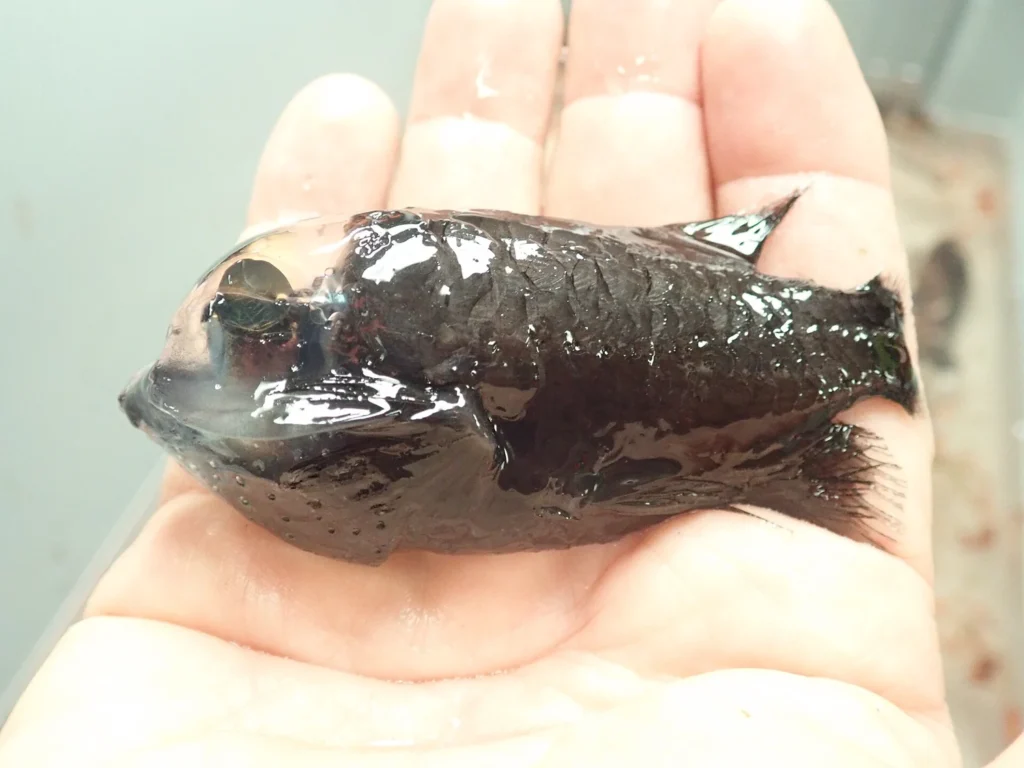
The anatomy became clearer through MBARI's observations of living barreleyes. Remotely operated vehicles allowed researchers to watch the fish underwater, where its soft head covering remained intact. A specimen that survived temporarily in a shipboard aquarium also let them observe changes in eye position under more controlled conditions.
That distinction matters. A delicate animal hauled up in a net is not necessarily an accurate model of its living appearance. Soft tissues can collapse or disappear during capture and preservation. The conspicuous dome had been missing from many older illustrations. The difference between a damaged specimen and a living animal was therefore part of the mystery, rather than a minor artistic detail.
Researchers described eyes turning from an upward orientation toward the front as the fish shifted its body. The original study of the tubular-eye paradox connected those observations to a more plausible feeding arrangement. This was a functional explanation grounded in behavior, not simply a new photograph of an odd-looking head.
What the transparent dome actually covers
The clear structure is a fluid-filled shield over the upper part of the head. Calling the whole fish's skull transparent can create the wrong picture. Its bones, mouth, and body have not become invisible. The striking feature is an external covering through which the eyes can be seen, with space around those eyes for their unusual orientation and movement.
Nor do the green structures represent a brain on display. The eyes contain the optical machinery, and their coloration has attracted particular interest. Researchers have proposed that green filtering could improve the contrast of useful signals in downwelling light. The precise contribution of this filtering to natural hunting is a question to distinguish from the directly observed fact that the eyes rotate.
A possible thief among drifting tentacles
One proposed hunting scenario is particularly wild. Siphonophores trail arrays of stinging tentacles through the water, capturing small animals. A barreleye might maneuver among those tentacles and take trapped prey. Its shield could help protect sensitive structures during those encounters. MBARI's researchers presented this as a working hypothesis, not a fully documented account of every meal.
Fragments of gelatinous animals in collected stomachs provide evidence about diet, but they do not reveal an entire hunting sequence. The fish could consume different drifting organisms, and stomach contents alone cannot establish exactly how each was caught. This is an important difference from argonauts' directly observed air-capture behavior, where researchers could follow the action from the sea surface to depth.
The barreleye's large fins also make sense in a setting where precision matters. Hovering and making controlled adjustments can be more useful than constantly rushing ahead. A hunter trying to keep a faint target within a narrow visual field needs stability as well as sensitivity. Its peculiar eyes belong to a complete swimming animal, rather than functioning as isolated gadgets.
Not every barreleye works the same way
Barreleyes belong to a family with several unusual optical arrangements. Research on other opisthoproctid fishes documents how much diversity can be hidden by the fragility and scarcity of deep-sea specimens. A feature demonstrated in Macropinna should not automatically be assigned to every relative with tube-shaped eyes.
The same caution applies to spectacular labels. This fish does not see everything in every direction, and a transparent shield does not make it invulnerable. A narrow visual system offers advantages alongside limits. Changing eye position helps with one of those limits; it does not erase all the difficulties of finding food in dim, open water.
What makes the barreleye extraordinary is the combination: sensitive tubular eyes, a clear protective covering, controlled hovering, and the ability to redirect its gaze. Other animals hide with light, as hatchetfish do using their illuminated bellies. Macropinna instead shows how a predator can reorganize the act of looking. The floating cockpit is strange enough to attract attention; the moving eyes inside it are what turn the spectacle into a biological explanation.
Featured image credit: Illustration of a barreleye fish with tubular eyes beneath its transparent head shield. Image: J. Hlidberg (Jon?), K. and E. Hjørne; Wikimedia Commons source; CC BY 4.0. Resized and converted to WebP.
Featured image credit: Illustration of a barreleye fish with tubular eyes beneath its transparent head shield. Image: J. Hlidberg (Jon?), K. and E. Hjørne; Wikimedia Commons source; CC BY 4.0. Resized and converted to WebP.