
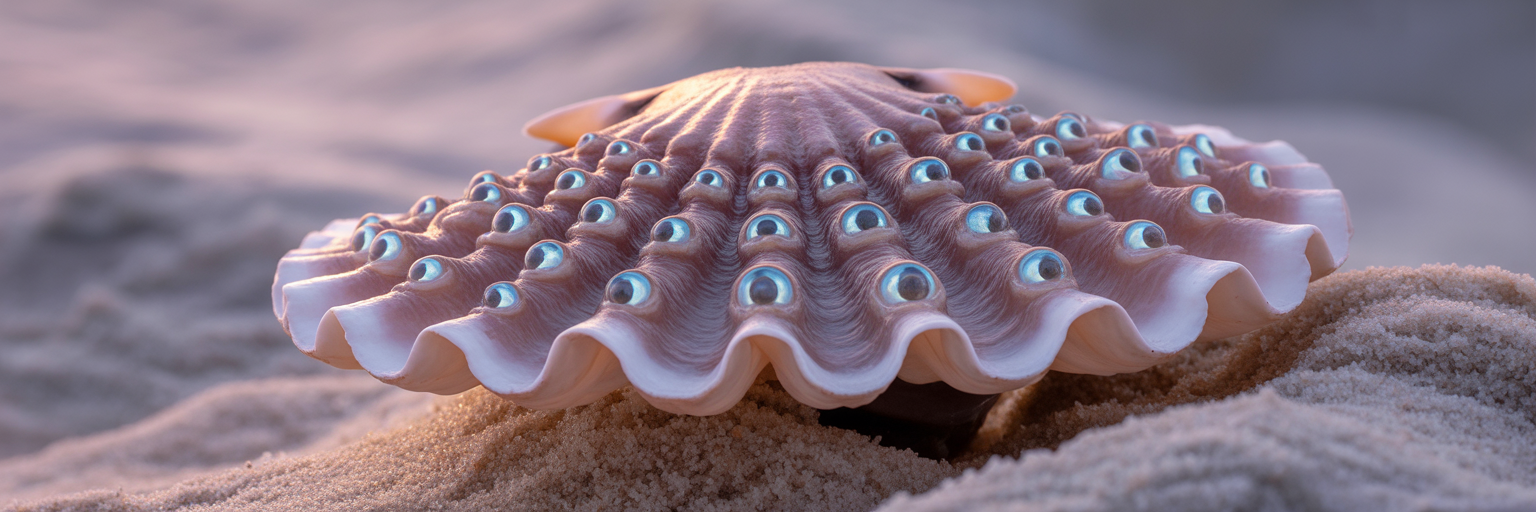
In the popular imagination, the scallop exists in two familiar forms: as a delicate, buttery morsel on a dinner plate, or as the iconic, fan-shaped shell found scattered along sandy beaches. This image suggests a simple creature, a bivalve content to filter-feed its life away. Yet this perception overlooks a stunning biological marvel. A living scallop, when observed in its natural underwater habitat, is a far more complex organism, equipped with a visual system that defies convention. Along the fleshy edge of its body, it possesses dozens, sometimes up to 200, individual scallop eyes that glitter like tiny jewels. These sophisticated organs are the key to its survival, providing a panoramic awareness of its surroundings.
So why do we so rarely see or even hear about these eyes? The answer lies in their size and location. Each eye is only about a millimeter in diameter, a tiny speck that is easily missed. They are arranged along the mantle fringe, the soft, curtain-like tissue that lines the inside of the shell. This mantle is only visible when the scallop is alive, underwater, and has its shell slightly open. Once the animal dies and the soft tissue decays, the eyes disappear, leaving only the empty shell behind. This hidden anatomy prompts fascinating questions. What could a creature like this possibly need with so many eyes? And more importantly, how do these tiny, hidden orbs even work? Their mechanism is fundamentally different from our own, operating on principles that seem borrowed from astronomy rather than biology.
Anatomy of a Bivalve’s Gaze
To truly appreciate the scallop’s visual system, one must look past the shell and examine the living animal. The eyes are not randomly placed but are part of a highly organized sensory apparatus that gives the scallop a constant stream of information about its environment.
A Crown of Tiny Jewels
When light hits them just right, a scallop’s eyes shimmer with an iridescent, often brilliant blue hue. They are arranged in neat rows along the scalloped edge of the mantle, resembling a crown of tiny, glittering beads. This jewel-like quality is not just for show; it is a result of their unique internal structure, which is designed to capture and focus the faint light that penetrates the water column. Each eye sits on a short stalk, allowing it to pivot slightly and gather light from different angles, contributing to the animal’s overall field of view.
The Mantle: A Sensory Command Center
The eyes do not operate in isolation. They are embedded within the mantle, a multifunctional organ that serves as the scallop’s primary interface with the world. The mantle is also equipped with a fringe of small tentacles that constantly feel and “smell” the water, detecting chemical cues from potential food sources or approaching predators. This combination of visual and chemical sensors makes the mantle a sophisticated command center. It integrates different types of sensory input to build a comprehensive picture of the immediate surroundings, a critical function for a largely stationary animal. This intricate system is a reminder that some creatures have evolved to sense the world in ways we can barely imagine, like the animal that can detect a predator just from its shadow.
A Panoramic View of the Seabed
The arrangement of eyes around the scallop’s circumference provides a significant functional advantage: an almost 360-degree field of view. This panoramic awareness is not designed for seeing fine details. Instead, it is a highly effective motion-detection system. It allows the scallop to spot changes in light and shadow from nearly any direction, whether it’s a predator approaching from above or the side. This wide, low-resolution system stands in stark contrast to the high-acuity, forward-facing vision of predators. While a fish might use its eyes to track a single target, the scallop uses its array of eyes as an early warning system. It is also important to note that the number of eyes is not fixed. It varies between species and even between individuals, often increasing as the scallop grows larger. This highlights the dynamic and adaptive nature of marine animal eyes and their evolution.
A Reflection of Genius, Not a Lens
The most remarkable aspect of the scallop’s visual system is not the number of its eyes, but how they function. Unlike human eyes, which use a lens to bend and focus light, scallop eyes operate on a completely different principle. They are reflective, not refractive. This makes them less like a camera and more like a sophisticated telescope.
To understand how do scallops see, it helps to use an analogy. The human eye works like a refracting telescope or a camera, where a convex lens at the front bends incoming light to form an image on the retina at the back. The scallop eye, however, functions like a reflecting telescope, such as the Hubble or James Webb Space Telescopes. Instead of a lens, it uses a concave mirror at the very back of the eye to gather and focus light. The light’s path is counter-intuitive: it enters the pupil, passes straight through the transparent retina, hits the mirror, and is then reflected back onto the retina to form an image. This design, confirmed by a groundbreaking 2017 study highlighted by publications like Science, is an extraordinary example of convergent evolution, where nature arrived at a solution similar to one invented by human astronomers.
This reflective system offers distinct advantages for an underwater creature. A mirror can be made more compact than a lens of equivalent power, and it can gather light over a wider field of view. In the dim, murky conditions of the seabed, this ability to maximize light collection is a powerful survival tool. The entire structure is optimized for sensitivity, prioritizing the detection of movement over the resolution of fine details.
| Feature | Human Eye (Refractive) | Scallop Eye (Reflective) |
|---|---|---|
| Primary Focusing Element | Cornea and Lens | Concave Mirror |
| Mechanism | Bends (refracts) light to a focal point | Reflects light to a focal point |
| Light Path | Light enters, is focused by the lens onto the retina at the back | Light enters, passes the retina, reflects off a mirror, and focuses back onto the retina |
| Common Analogy | Camera, Refracting Telescope | Reflecting Telescope (e.g., Hubble) |
| Primary Advantage | High acuity and detailed image formation | Wide field of view and high sensitivity in low light |
Building a Biological Mirror, Crystal by Crystal
The genius of the scallop eye lies in its mirror. This is not a simple, polished surface but a complex, multi-layered structure built with a level of precision that rivals human engineering. The scallop achieves this feat through a remarkable process of biological self-assembly, constructing a perfect optical device from organic materials.
The Guanine Crystal Blueprint
The reflective material at the heart of the scallop’s mirror is guanine, one of the four main nucleobases found in DNA and RNA. In its crystalline form, guanine is one of the most reflective materials produced by nature, which is why it is also responsible for the silvery sheen on fish scales. The scallop harnesses this property to create its guanine crystal mirror, turning a fundamental building block of life into a key component of its advanced visual system.
A Feat of Biocrystallization
What makes the scallop’s use of guanine so incredible is the control it exerts over the crystallization process. In nature, guanine typically forms irregular, prism-shaped crystals. However, for a mirror to work effectively, it needs a perfectly flat surface. The scallop has evolved the ability to force guanine to grow into microscopic, perfectly square tiles. This is a feat of biocrystallization that scientists still struggle to replicate in a lab. This ability to construct such a precise biological structure is a marvel, similar to how other organisms have evolved intricate mechanisms for survival, such as the Venus flytrap mechanism explained in other natural wonders.
The Multi-Layered Mosaic
The scallop’s mirror is not a single, smooth surface. Instead, it is a complex mosaic composed of 20 to 30 stacked layers of these tiny guanine tiles, each separated by a thin layer of cytoplasm. This layered structure is not accidental; it functions as a highly efficient dielectric mirror. As light passes through the layers, it reflects off each guanine tile. The precise spacing of the layers is tuned to cause constructive interference for specific wavelengths of light. This means that the reflections from each layer add up, dramatically amplifying the reflectivity for certain colors. The mirror is specifically tuned to reflect the blue-green light that penetrates deepest into the scallop’s marine habitat. This elegant solution maximizes the eye’s ability to gather the most abundant light, making it an incredibly efficient sensor for its environment.
The Double Retina and What Scallops Perceive

Just when the scallop eye seems as complex as it could be, another layer of sophistication reveals itself: a double-retina system. Each of the scallop’s tiny eyes contains not one, but two separate light-sensing retinas, a distal (outer) retina and a proximal (inner) one. This dual-layered sensor adds another dimension to scallop vision, allowing it to process visual information in a way that is still not fully understood.
The current scientific hypothesis, supported by research summarized in publications like Smithsonian Magazine, suggests that the concave mirror at the back of the eye focuses light differently onto each retina. The distal retina, located further from the mirror, is thought to receive a broader, less focused image corresponding to the scallop’s peripheral field of view. This blurry image would be excellent for detecting large-scale changes in light and shadow, making it a perfect early warning system for an approaching predator. The proximal retina, positioned closer to the mirror’s focal point, is believed to receive a slightly sharper image from the central field of view. This may allow the scallop to assess stationary objects or textures with greater clarity.
This dual-system likely provides the scallop with a more nuanced perception of its world. It is not just about spotting danger. This unique form of vision might help it identify suitable habitats. For example, a scallop could potentially distinguish the dappled light patterns created by a seagrass bed, which signals a safe area with plenty of food, from the uniform light of the open, exposed seabed. This ability to see both the immediate threat and the promising environment would give the scallop a significant survival advantage, allowing it to make simple but critical decisions about where to settle and when to flee.
Vision in Action: The Great Escape
The scallop’s complex visual system is not an abstract wonder; it is directly connected to a dramatic and effective survival behavior. When a threat is detected, the scallop’s eyes trigger a rapid and powerful escape response. This entire sequence, from detection to flight, is a testament to the efficiency of its biology.
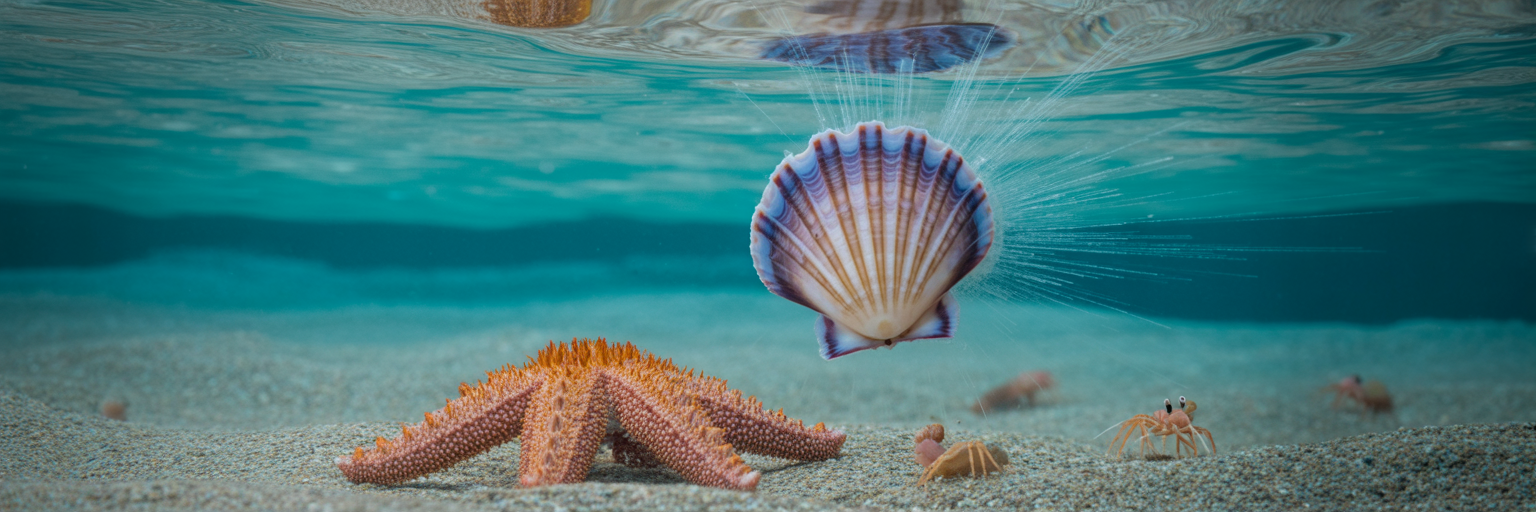
One of the scallop’s classic predators is the sea star. Though slow-moving, a sea star is relentless, and once it gets a grip on a scallop’s shell, the battle is usually over. The scallop’s vision is perfectly adapted to detect the subtle shape and slow approach of such a threat long before it gets close enough to touch. The escape response unfolds in a series of swift, coordinated steps:
- The array of eyes detects a looming shape or a sudden shadow, sending a neural alarm signal.
- This signal instantly triggers the scallop’s single, powerful adductor muscle, which is the large, round part of the scallop that humans typically eat.
- The adductor muscle contracts forcefully, clapping the two halves of the shell together.
- This action expels a powerful jet of water from the hinge-side of the shell, creating a form of jet propulsion.
- This propulsion sends the scallop swimming away from the danger in a distinctive, erratic, zig-zagging motion. This unpredictable movement makes it difficult for a predator to track and capture. This theme of predator-prey interaction is common in nature, with some predators evolving equally unique methods, like the predator that hypnotizes prey with light.
These natural predator-prey dynamics take place within complex offshore ecosystems that humans also interact with. For those interested in the human element of navigating these waters, understanding the environment is crucial, much like mastering your offshore trolling setup is for anglers. The scallop’s escape is a beautiful example of how a specialized sensory system can lead to a highly effective survival strategy, allowing a seemingly vulnerable creature to outmaneuver its enemies.
Limits and Mysteries of Scallop Sight
Despite the incredible complexity of the scallop’s eyes, it is important to maintain a balanced perspective. The resulting vision is not sharp or detailed in the way human vision is. A scallop does not see the world with the clarity of a photograph. Its visual system is a highly specialized tool optimized for one primary purpose: detecting motion and changes in light to trigger a life-or-death survival response. It is a system built for sensitivity, not acuity.
This raises a fascinating neurological challenge that scientists refer to as the “binding problem.” How does the scallop’s relatively simple nervous system process visual input from up to 200 separate eyes and integrate it into a single, coherent perception? How does it combine all those tiny, individual snapshots of the world to make a coordinated decision to swim in a particular direction? This is a profound mystery. The puzzle of how a scallop processes so much information is similar to other biological enigmas, such as the secrets of planarian regeneration, where simple organisms display remarkably complex abilities.
Researchers are still exploring many open questions about scallop sight. For instance, can scallops actively change the curvature of their mirrors or the size of their pupils to adjust focus? Do they use their two retinas to perceive depth or distance? The answers remain elusive, hidden within the intricate biology of this surprising animal. Ultimately, the scallop eye stands as a powerful testament to the diverse and often counter-intuitive solutions that evolution can produce. It is one of nature’s most unusual and efficient optical designs, a tiny reflecting telescope perfected for survival on the ocean floor.
Frequently Asked Questions About Scallop Eyes
The unusual nature of the scallop’s visual system often leads to many questions. Here are answers to some of the most common ones.
Do all scallops have 200 eyes?
No, the number is highly variable. It can range from just a few dozen to around 200, depending on the specific species, as well as the age and size of the individual scallop. Larger, older scallops tend to have more eyes than smaller, younger ones. There is no single fixed number that applies to all scallops.
Can scallops see in color?
This is a complex question. Their eyes are highly tuned to reflect and detect blue-green light, which is the wavelength that penetrates deepest into their typical marine habitat. While they are extremely sensitive to this part of the spectrum, it is unknown if they perceive “color” in the same way humans do. It is more accurate to say their vision is specialized for detecting the most vital and abundant light frequencies in their environment, rather than for distinguishing a wide range of hues.
Are scallop eyes edible?
Technically, yes. The eyes are part of the mantle, which is edible along with the adductor muscle. However, the eyes are minuscule, each only about a millimeter in diameter. They are not harvested or consumed as a separate food item and are usually discarded with the rest of the viscera. The part of the scallop people eat is almost exclusively the large adductor muscle.
Why did scallops evolve mirror eyes instead of lens eyes?
The mirror-based eye is an alternative evolutionary solution to the universal problem of seeing. For the scallop’s specific needs and environment, this design offers several advantages. The reflective system allows for a very wide field of view in a compact structure and is extremely efficient at gathering the faint, scattered light found underwater. It is not necessarily “better” than a lens-based eye, but rather a different and equally successful adaptation tailored to a stationary, filter-feeding lifestyle where detecting motion is more important than seeing detail.