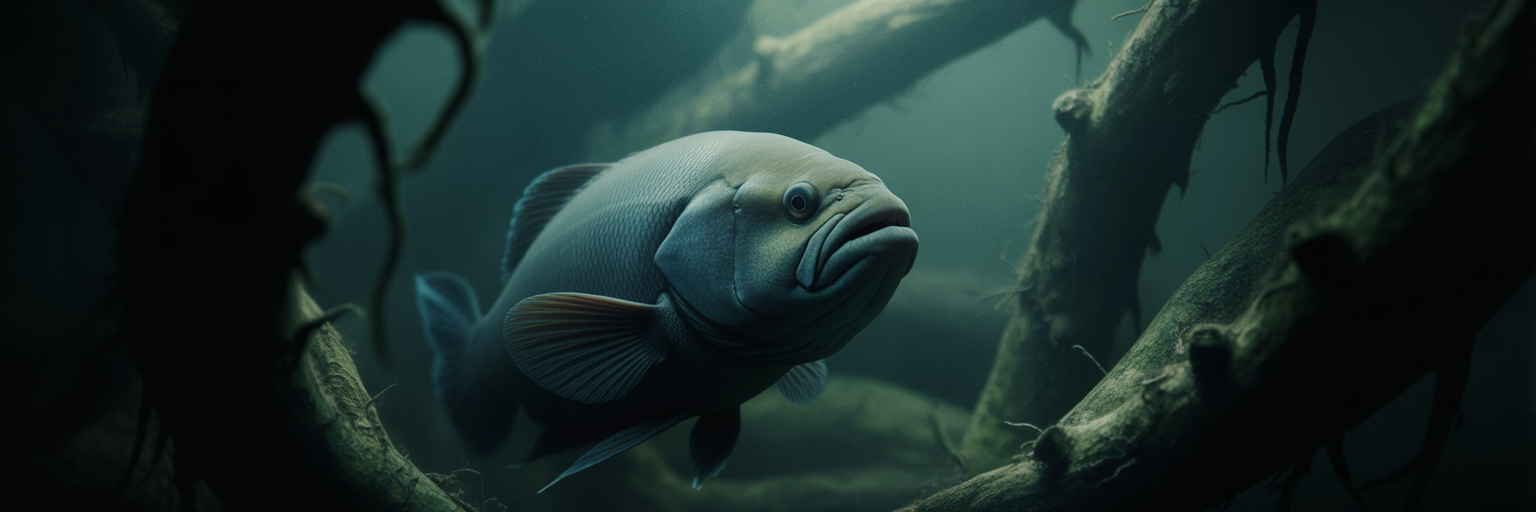
Something Wicked This Way Swims
Picture a river in the Amazon basin. The water is the color of strong tea, thick with silt and decaying leaves. Sunlight tries to pierce the surface but gives up a few inches down, surrendering to an oppressive, liquid darkness. Down here, the world is silent, muffled. Your eyes are useless. Your ears pick up nothing but the dull thrum of your own pulse. The water presses in, a heavy, suffocating blanket. In this place, the five senses you have relied on your entire life have not just failed you; they have abandoned you completely. This isn’t just water; it’s another planet operating under a different set of physical laws.
Now, ask yourself a question. What if sight wasn’t about light? What if you could feel the shape of the world without ever touching it? We tend to think of our five senses as the complete toolkit for perceiving reality. But what if some creatures, born and bred in this absolute blackness, decided those tools were insufficient? What if they stumbled upon a kind of dark art, a forbidden knowledge that allowed them to perceive the world in a way that feels less like biology and more like sorcery?
There are things moving in this black water. They glide with an unnatural smoothness, a purpose that suggests they are not blind at all. They are aquatic phantoms, electrical specters navigating a complex world of sunken logs and tangled roots with an eerie confidence. They don’t bump into things. They don’t get lost. It’s as if they can see everything, every predator, every morsel of food, every hiding place, without ever needing eyes. In this lightless kingdom, these silent warlocks are the all-seeing masters, and their presence is deeply unsettling.
Their secret is not some arcane spell. It is electricity. But this is not the simple, crude electricity that powers your toaster. This is something else entirely. It is a living, breathing extension of their very being, a sixth sense woven from the fundamental forces of the universe. They generate a personal field of energy, an invisible aura that extends from their bodies and paints a three dimensional map of their surroundings in their minds. These are the fish that see with electricity, and they have turned a basic principle of physics into a form of perception so precise and so absolute that it feels supernatural. They don’t just live in the dark. They own it.
Meet the Electrical Conspirators
In this shadowy underworld of electrical perception, two figures stand out. They are not partners, but they are the undisputed masters of this strange power, each with a terrifyingly different approach. Think of them as the key players in a bizarre, aquatic conspiracy, a brute and a brain who have both perfected the art of seeing with static. They are the poster children for nature’s unsettling ingenuity.
The Brute: The Electric Eel
First, meet Electrophorus electricus, the electric eel. Its appearance is a masterful deception. It looks like a sluggish, overgrown sausage, a lazy, serpentine log content to drift near the riverbed. Do not be fooled. This creature is a swimming extension cord with a grudge. It is nature’s poorly insulated taser, capable of unleashing a staggering 600 volts on command. The eel is the muscle of this operation, a creature that solves its problems with overwhelming, undeniable force. It doesn’t need to be subtle. When you can shut down the nervous system of anything that gets too close, subtlety becomes an unnecessary luxury.
The Brains: The Elephantnose Fish
Then there is the other one, the ghost in the machine. The elephantnose fish, a member of the Mormyridae family, is the polar opposite of the eel. Its appearance is almost comical, with a strange, trunk-like chin appendage called a Schnauzenorgan that it uses to probe its environment. But its strange looks hide a chilling intelligence. The elephantnose fish has one of the largest brain-to-body-size ratios of any vertebrate, and a disturbing amount of that cognitive power is dedicated to one thing: processing the information from its electric sense. It is the silent spy of the murky depths, a ghostly navigator that uses its power not for brute force, but for espionage.
The contrast is stark. The eel is a sledgehammer, delivering a single, devastating blow. The elephantnose is a scalpel, performing delicate surgery on the fabric of reality. One is a loud, terrifying predator whose presence is announced with a flash of biological lightning. The other is a quiet, calculating phantom that knows you’re there long before you have any idea it exists. They are two masters of the same dark art, each demonstrating a different path to absolute power in the dark.
| Attribute | Electric Eel (The Brute) | Elephantnose Fish (The Brains) |
|---|---|---|
| Nickname | Swimming Power Outlet with a Bad Attitude | The Ghost in the Machine |
| Primary Method | High-Voltage Ambush | Surgical-Precision Espionage |
| Style | Loud, Unsubtle, Overwhelming Force | Silent, Evasive, Creepily Intelligent |
| Vibe | A bouncer who enjoys his job too much. | A codebreaker listening to secrets no one else can hear. |
| Special Move | The 600-Volt ‘Freeze Ray’ | Mapping your soul via electrical whispers. |
How to See With Static

So, how does this forbidden power actually work? The source lies in specialized cells called electrocytes. But thinking of them as mere “cells” is a disservice. They are more like arcane power cells, organic batteries that the fish cultivates within its own body, stacked in long columns like the chambers of a wand. This is the core of how do electric fish work, and it feels less like biology and more like a pact with physics.
The process of “active” electrolocation can be broken down into a few steps that feel more like a magic ritual than a biological function:
- Weaving the Invisible Cloak: First, the fish generates a weak, continuous electric field around its body using its tail-mounted organic battery. This field isn’t a weapon; it’s a sensory bubble. It’s an invisible, electrical skin that extends out into the water, a personal web of energy that becomes the fish’s entire world.
- Feeling the Fabric of Reality: The fish then perceives its surroundings by detecting distortions in this field. Imagine a spider sitting at the center of its web, feeling for the slightest vibration. Now imagine that spider is feeling for disturbances in the electrical fabric of spacetime itself. Anything that enters the field, whether it’s a rock, a plant, or a tasty shrimp, has a different electrical conductivity than the surrounding water. This difference warps the field, creating a “shadow” or a “bright spot” in the fish’s perception.
- Building a Ghostly Image: The fish’s skin is covered in thousands of hyper-sensitive electroreceptors, tiny organic sensors that read these distortions with incredible precision. Its brain, a powerful biological computer, processes this flood of information to construct a perfect, 360-degree “image” of its world. It isn’t seeing with light. It’s feeling the electrical shape of everything around it in three dimensions.
This is the answer to what is electrolocation in fish, and it is why these creatures are the undisputed masters of the dark. While our eyes are blinded by mud and shadow, electricity passes through it all effortlessly. This sense is so unbelievably precise that some species can detect the minute electrical discharge from a hidden crayfish’s muscle twitch. It’s a complete circumvention of the rules of normal perception. It’s a fascinating topic, much like understanding the creature that can hear with its knees, which shows how evolution finds bizarre solutions to sensory challenges. These fish didn’t just adapt to the dark; they conquered it by developing a sense that renders light obsolete.
The Eel’s High-Voltage Ambush
To truly appreciate the horror of this electrical mastery, let’s follow the electric eel hunting method. An unsuspecting fish, maybe a cichlid or a tetra, swims carelessly through the murky water. It is blissfully unaware of the long, log-like shape resting near the riverbed. The eel is perfectly still, but this is not the stillness of rest. It is the coiled, predatory patience of a loaded weapon waiting for a target to wander into its sights.
The moment the prey fish gets close enough, the attack happens faster than thought. The eel unleashes a massive, high-voltage discharge, a biological lightning strike of up to 600 volts. The effect is instantaneous and absolute. The prey’s nervous system is hijacked, its muscles locked in a violent, final spasm. It is frozen in time, completely immobilized in milliseconds. It doesn’t just stun the prey; it remotely seizes control of its body and shuts it down. The sheer, horrifying power of this biological weapon is breathtaking.
But the attack is not over. In fact, the creepiest part is yet to come. As noted by researchers and detailed in a National Geographic article, the initial shock is not just a weapon but also a remote control. After the high-voltage blast incapacitates the victim, the eel switches tactics. It begins to emit a series of weaker, rapid-fire pulses. These pulses are not strong enough to kill, but they are just the right frequency to cause the paralyzed victim’s muscles to twitch involuntarily. The eel, now cloaked in darkness, uses its own electrolocation to detect these tiny, forced movements.
Think about that for a moment. The eel stuns its prey into helplessness and then forces the victim’s own body to reveal its exact location. It’s not just a stun gun; it’s a stun gun with a built-in GPS that uses the corpse as the beacon. The eel weaponized its own sixth sense, turning its attack into a sensory tool. This isn’t the work of a simple brute. This is the cold, calculated strategy of a predator that manipulates the very biology of its victims. It is a creature that kills you and then makes your own body lead it to the meal.
The Ghostly Whispers of the Elephantnose

Now, let us leave the world of brute force and enter the subtle, spectral realm of the elephantnose fish. Where the eel is a thunderclap, the elephantnose is a whisper. Its entire existence is a testament to the precision and finesse of the elephantnose fish sixth sense. It uses its weak electric field and its hyper-sensitive chin appendage, the Schnauzenorgan, to probe the environment with the care of a brain surgeon. Its world is one of intricate details, not overwhelming power.
Its abilities are nothing short of uncanny, a laundry list of supernatural feats performed in total darkness:
- Distinguishing Friend from Foe (and Furniture): It can instantly tell the difference between a living creature and a non-living object. A rock has one electrical signature, a waterlogged leaf has another, and a potential mate has a completely different one. It reads the electrical essence of everything it encounters.
- X-Ray Vision for Mud: The elephantnose can locate tiny insect larvae and worms buried deep in the mud. It doesn’t need to see or smell them. It detects their faint, bio-electric fields, the tiny sparks of life hidden beneath the silt, and plucks them out with unnerving accuracy.
- Mapping in the Dark: It creates detailed, three-dimensional mental maps of complex underwater structures. It can navigate through a maze of tangled roots or a field of rocks flawlessly, time and time again, in absolute blackness, because it has already memorized the electrical shape of its territory.
Perhaps their most unsettling ability is communication. Elephantnose fish modulate the frequency and waveform of their electric discharge to “talk” to each other. This is a secret, silent language of electrical pulses, a stream of ghostly whispers completely undetectable to any other animal. They use this silent language for everything: intricate courtship rituals, tense territorial disputes, and coordinating group movements, all conducted in an eerie, spectral silence that makes the water around them seem haunted. This is a level of adaptation as strange as the animal that uses bubbles as tools for its survival.
This advanced ability is powered by their unusually large brains, which are almost entirely dedicated to processing a constant, overwhelming stream of electrical information. They are not just living in the dark; they are living in an invisible reality of their own creation, a world of electrical shapes and whispers that we can’t even begin to perceive.
A Power Too Good to Invent Just Once
Here is where the story gets even stranger. This electrical sixth sense, this supernatural ability to see in the dark, is so powerful and so advantageous that it has evolved independently in at least six different, unrelated groups of fish around the globe. According to Wikipedia’s compilation of research on electric fish, this phenomenon, known as convergent evolution, is a classic example of nature arriving at the same terrifyingly effective solution multiple times.
This shouldn’t be viewed as a mere coincidence. It is evidence that this power is a fundamental force of nature in aquatic environments, a secret waiting to be unlocked by any lineage desperate or clever enough to find it. It’s like a ghost in the evolutionary machine, a pre-written script for survival that keeps reappearing, suggesting its dark inevitability.
The most stunning example is the comparison between the South American knifefishes, the Gymnotiformes which include our friend the electric eel, and the African elephantfishes, the Mormyridae. These two groups are separated by the Atlantic Ocean and millions of years of divergent evolution. They are no more related than a bat is to a bird. Yet both lineages independently developed sophisticated electric organs, thousands of electroreceptors, and enlarged brain regions to process the information. They both stumbled upon the exact same dark art on opposite sides of the world.
This parallel makes the ability feel less like a random mutation and more like a law of the aquatic underworld. This kind of evolutionary trickery is as mind-bending as understanding how fake eyes scare predators. The fact that nature keeps returning to this electrical solution proves it’s the ultimate trump card for life in the dark. It is a form of “magic” that has been tested, perfected, and re-invented over millions of years, making it feel less like biology and more like a fundamental truth of what it takes to become a master of the abyss.
The Unsettling Genius of Electric Fish

In the end, what are we to make of these creatures? They have hijacked a fundamental force of physics and twisted it into a multi-tool. For them, electricity is a sensory organ, a weapon, a compass, and a language all in one. The brute force of the eel and the creepy intelligence of the elephantnose are just two expressions of this unsettlingly efficient adaptation. They represent an almost alien form of life that has mastered a reality completely hidden from our own senses.
Perhaps the most unnerving part is that scientists are still uncovering the full extent of their abilities. With each new study, we find that their electrical world is more sophisticated and complex than we ever imagined. This leaves us with the chilling sense that we have only scratched the surface of their capabilities. What other bizarre secrets are hidden in their silent, electric conversations? This is a common theme in nature, where creatures develop shocking survival tactics, such as the animal that survives venom by breaking it down mid-attack.
So the next time you look out over a dark, murky lake or a slow-moving river, don’t just wonder what’s swimming in it. Wonder what’s *watching* you from within it. Wonder what might be mapping your shape, reading your bio-electric field, and judging your intentions not with eyes, but with an invisible, all-encompassing web of electricity. These fish fundamentally challenge our human-centric understanding of perception. They are a testament to the fact that the natural world is filled with abilities that border on the supernatural, hiding in plain sight, or in this case, in plain darkness. The true monsters are not always the ones you can see.