
An Invisible War in the Night Sky
The night sky seems peaceful, but it is a battlefield where an ancient war rages every single night. In this invisible conflict, the undisputed king is the bat, a predator armed with biological sonar so precise it can track a single hair in total darkness. But even kings have challengers, and in this case, the challenger is the unassuming tiger moth. At first glance, it is just another fluttery insect drawn to a porch light, a fragile snack waiting to happen. That assumption is a fatal mistake.
This is not a simple story of predator and prey. This is a tale of sophisticated acoustic warfare in animals, where the moth brings military-grade countermeasures to a bug fight. It has developed a defense so advanced it feels like something out of a top-secret weapons program. The tiger moth does not just flee or hide. It fights back on the same frequency as its attacker, engaging in a high-stakes duel of sound waves.
The central conflict is one of information. The bat hunts with perfect data, and the moth’s strategy is to corrupt that data with electronic-style warfare. It actively jams the bat’s guidance system, turning a precision weapon into a confused mess of noise. How can a delicate insect with a brain the size of a pinhead outsmart one of nature’s most perfect hunting systems? The answer lies in a biological weapon that is both bizarre and brilliant.
The Hunter’s Perfect Weapon: Bat Echolocation
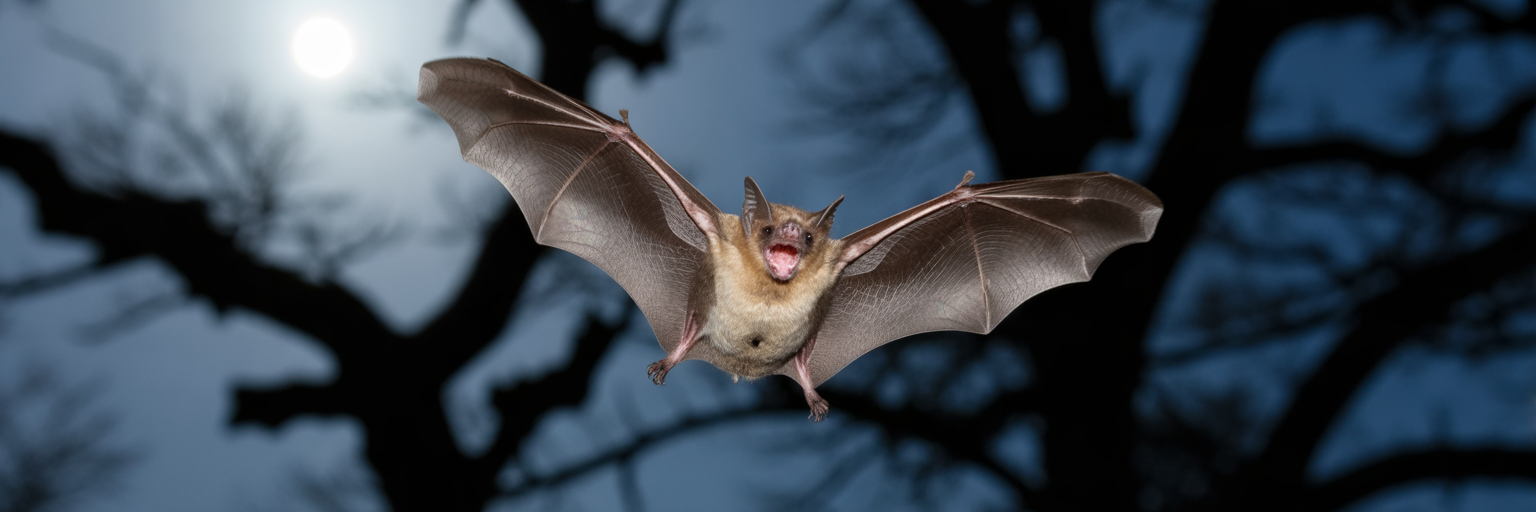
To appreciate the moth’s achievement, you first have to understand the terrifying perfection of its enemy’s weapon. Bat echolocation is not just hearing well in the dark. It is an active sonar system that would make a submarine captain jealous. The bat emits a series of high-frequency clicks, far beyond the range of human hearing. These sound waves travel outward, bounce off objects, and return to the bat’s exquisitely sensitive ears.
Its brain then processes these returning echoes with breathtaking speed, building a detailed, three-dimensional “sound map” of its surroundings. This is not a blurry outline. The bat can determine a target’s size, shape, distance, speed, and even its texture. It can distinguish a juicy beetle from a fluttering leaf in pitch-black conditions from dozens of feet away. Nature is full of creatures with unique sensory abilities, like the predator that hunts using invisible pressure waves, but the bat’s sonar is a masterclass in precision targeting.
As the bat closes in on its prey, its clicks accelerate into a terrifying crescendo known as the “terminal buzz.” This rapid-fire burst of sound provides a constant, high-resolution track on the target’s final movements, ensuring there is almost no chance of escape. The bat is a guided missile with teeth, and its sonar is a seemingly flawless guidance system. Faced with such an opponent, a moth’s chances should be zero. The system is perfect. It is unstoppable. Or so it would seem.
The Unlikely Aerial Ace: Meet the Tiger Moth
Now, let us turn our attention to the hero of this story. The tiger moth family is a large and diverse group, but certain species, like the famous *Bertholdia trigona*, have become legends of aerial combat. Many of these moths are strikingly beautiful, with intricate patterns and bold colors on their wings. This immediately presents a paradox. Why would a nocturnal creature, hunted by a predator that uses sound instead of sight, bother with such vibrant, visible markings?
These moths live an otherwise ordinary insect life. They hatch from eggs, munch on plants as caterpillars, and then emerge as winged adults with a singular, urgent purpose: to reproduce before being eaten. The immense evolutionary pressure exerted by bats has forced them down a strange and wonderful path. The question of how moths avoid bats has many answers, but the Bertholdia trigona defense is one of the most spectacular.
Its delicate appearance is a masterful deception. It looks like a fragile piece of art, a decorative flourish in the night. But beneath that exterior lies a sophisticated piece of biological hardware, an acoustic weapon forged in the crucible of a million-year arms race. This is not a passive victim. This is an aerial ace, a combatant with a secret weapon. So how does this fluttering piece of art survive an encounter with a guided missile made of teeth and fur?
The Sound-Making Machinery: A Biological Noise Generator

The secret to the moth’s defense is not in its wings or its camouflage, but in a specialized pair of organs on its thorax called “tymbals.” These are small, ridged patches of cuticle that function like a biological noise generator. The mechanism is a marvel of natural engineering, a solution so strange it rivals other evolutionary wonders like the Suriname toad that gives birth through holes in its back.
To produce its defensive clicks, the moth flexes a dedicated internal muscle. This muscle contraction buckles the tymbal inward, producing a sharp, loud click. Think of the sound a metal pop-top on a glass jar makes when you press it down. When the moth relaxes the muscle, the tymbal pops back to its original shape, producing a second click. The moth can do this with incredible speed, firing off thousands of clicks in a rapid-fire burst.
These are not just random noises. The ultrasonic clicks moth produces are precision-engineered. They are broadcast in the ultrasonic range, specifically within the same frequency bands that bats use for echolocation. This is not a scream of terror. It is a targeted transmission, a carefully crafted signal designed to interfere with the enemy’s most vital sensor. The tymbals are the moth’s ammunition factory, churning out the sonic bullets it needs to survive the night.
The Art of Sonar Jamming: A Tiger Moth’s Masterclass
Having the hardware to make noise is one thing. Knowing how to use it to wage psychological warfare is another. The tiger moth is a master of this craft, employing a strategy so effective it is the envy of military engineers: bat sonar jamming.
Phantom Echoes: The Science of Confusion
The moth’s clicks are not meant to startle the bat. They are a far more sophisticated form of electronic countermeasures. When a bat is hunting, it sends out a pulse and listens for the faint echo returning from the moth’s body. The tiger moth waits for the bat’s pulse and then, in the critical milliseconds before its own echo would return, it unleashes a volley of its own clicks.
This creates a dense cloud of “phantom echoes” that floods the bat’s sensory system. The bat is suddenly bombarded with hundreds of false signals, making it impossible to distinguish the real echo from the moth’s body from the blizzard of acoustic chaff. Instead of detecting a single, small, trackable target, the bat’s sonar perceives a large, blurry, and confusing sound cloud. It is the acoustic equivalent of a fighter jet releasing a cloud of metallic strips to confuse an incoming radar-guided missile. The moth’s true location is masked, and the bat’s perfect weapon is rendered useless.
Evidence from the Field: The Numbers Don’t Lie
This is not just a clever theory. It is backed by hard evidence. In controlled experiments published in the journal *Science*, researchers found that bats only managed to capture the sound-producing *Bertholdia trigona* about one-fifth of the time. However, when the moths’ tymbals were silenced, the bats’ success rate shot up dramatically. This proves that the clicks are not just a coincidence; they are a direct and highly effective defensive weapon. The data is clear: the moths that can scream in ultrasound are the ones that live to fly another day.
| Defense Theory | Mechanism | Effectiveness & Evidence |
|---|---|---|
| Startle (Acoustic Startle) | A sudden, unexpected loud noise startles the bat, causing it to flinch or abort its attack. | Limited. While possible, it doesn’t explain the consistent, low capture rate. Bats would likely habituate to the sound over time. |
| Aposematism (Acoustic Warning) | The clicks act as a warning signal, telling the bat ‘I taste bad.’ This works for bats that have had a previous bad experience. | Partially true for some toxic species, but doesn’t protect non-toxic moths or naive bats. It’s more of a learned deterrent than an active defense. |
| Sonar Jamming (Information Warfare) | The clicks actively interfere with the bat’s sonar by creating phantom echoes, masking the moth’s true location. | Highly effective. Supported by experiments showing a >75% drop in bat success. The clicks directly degrade the quality of the bat’s sensory information. |
This table compares the primary hypotheses for the function of tiger moth clicks. While startle and warning effects may play a minor role, overwhelming evidence points to sonar jamming as the primary and most effective defensive strategy.
The Predator’s Response: An Escalating Acoustic Arms Race

The bats, however, are not passive victims in this evolutionary drama. The battle between bat and moth has sparked a co-evolutionary acoustic arms race that has been escalating for millions of years. For every defensive measure the moths develop, the bats work on a countermeasure.
Faced with sonar jamming, some bats have learned to fight back. Research has shown that bats actively try to overcome the jamming by making compensatory changes, such as lengthening the duration of their terminal buzz to try and get a clearer signal through the noise. Others may shift the frequency of their echolocation calls, searching for a “clear channel” outside the moth’s jamming band. It is a constant tactical adjustment in the heat of battle.
But the moths have their own counter-counter-strategies. They do not just broadcast noise wildly. They can assess the threat level, distinguishing between a bat’s distant, searching calls and its urgent, final-stage attack buzz. They save their energy-intensive jamming clicks for when they are absolutely necessary, deploying their ultimate weapon only when the threat is imminent. This high-stakes chess match has unfolded over millennia:
- Bats evolve echolocation to hunt insects at night.
- Moths evolve ears to detect bats.
- The tiger moth evolves ultrasonic clicks to jam sonar.
- Bats evolve counter-jamming techniques, like changing frequencies.
- Tiger moths evolve adaptive clicking, saving energy and responding only to direct threats.
A Global Phenomenon of Sonic Defense
While the tiger moth is a poster child for this strategy, it is far from an anomaly. This form of acoustic defense is a surprisingly widespread and successful evolutionary solution. Scientists now estimate that nearly 20% of all moth species worldwide may produce ultrasonic sounds for defense. This is a testament to the effectiveness of sonar jamming.
Even more fascinating is that this ability has evolved independently in multiple, unrelated moth lineages. This is a classic example of “convergent evolution,” where different species arrive at the same solution to the same problem. Just as nature has found various ways for tiny insects to survive fungal artillery fire, it has repeatedly concluded that fighting sound with sound is a winning strategy. The fact that this complex defense has appeared time and time again is powerful evidence of its success.
For some toxic species of tiger moth, the clicks may even serve a dual purpose. For a naive bat that has never encountered one, the clicks act as a jammer. For an experienced bat that has previously tried to eat one and had a disgusting experience, the clicks serve as an acoustic warning sign, a clear message that says, “Don’t even try it. You remember what happened last time.”
The Echoes of Survival
The battle for survival in the nocturnal world is often fought not with claws and teeth, but with information and signal processing. The tiger moth’s story is a profound lesson in information warfare. Its victory is not one of strength, but of cunning. It survives by turning its predator’s greatest strength into its greatest weakness.
This elegant and complex system of jamming and counter-jamming developed without a designer, driven solely by the relentless pressure of natural selection. It brings us back to the image of the quiet night sky, but now we see it differently. It is not empty and silent. It is a place filled with an invisible, high-frequency war, a symphony of clicks and echoes that tells a story of life and death.
The next time you see a moth fluttering around a light, pause for a moment. It might not be just a simple insect. It could be a veteran of an ancient acoustic war, a tiny fighter jet with its engines on standby, ready to scramble at a moment’s notice.