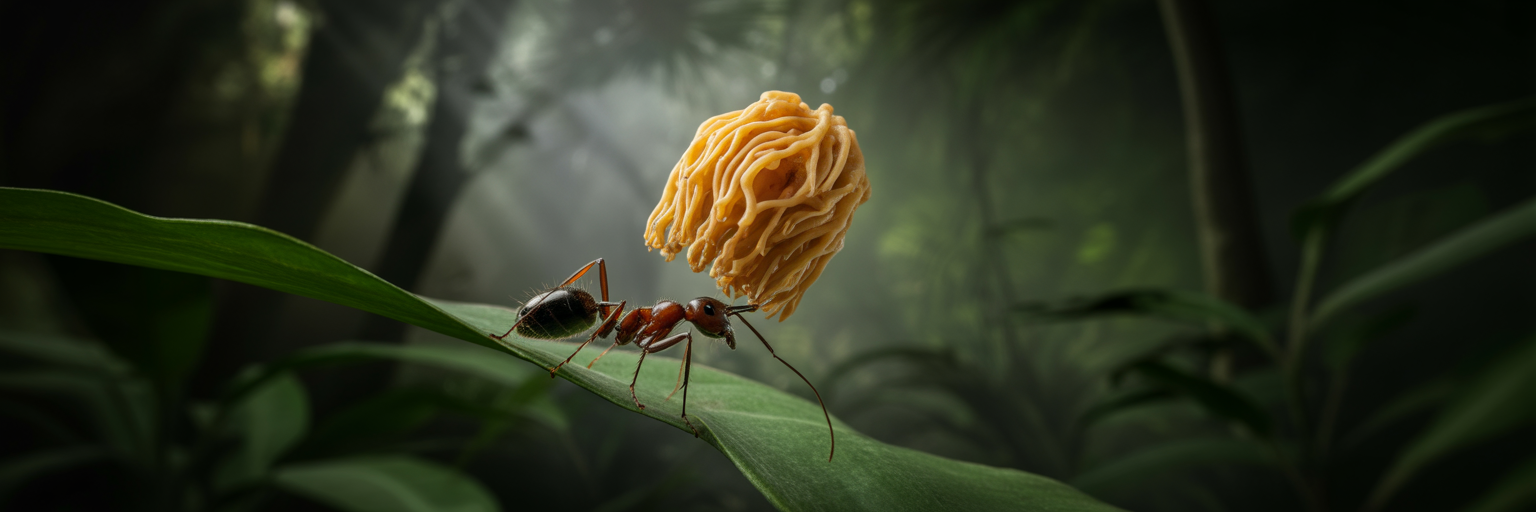
Forget what you’ve seen in movies. Hollywood zombies are slow, clumsy, and frankly, have terrible personal hygiene. Nature’s zombies, on the other hand, are the stuff of true nightmares because they are horrifyingly real. We’re talking about a microscopic fungus that pilots an ant like a mech suit and a wasp that turns a spider into its personal butler and architect. This is the ultimate showdown of zombie spiders vs zombie ants, a battle between two of nature’s most diabolical puppet masters. So grab some popcorn, and let’s get ready to feel deeply uncomfortable.
In one corner, we have the *Ophiocordyceps* fungus, a microscopic menace with a PhD in mind control and a serious grudge against ants. In the other corner, we have the parasitoid wasp, a creature whose parenting style involves gluing its offspring to a living host and hoping for the best. This isn’t a story of good versus evil. It’s a twisted tale of survival where the main characters have completely lost control of their own bodies. Welcome to the weird and wonderful world of parasitic zombification.
So, what is parasitic zombification? Imagine someone hacking your smart home, turning up the heat, and blasting terrible music, but instead of your house, it’s your body. The parasite takes over, not for a joyride, but for a very specific purpose: to ensure its own kids have a future. It’s all about procreation, just with a whole lot more body-snatching and mind-control than your average family drama. The host is still alive, but it’s just a passenger on a one-way trip to a very gruesome end.
Zombie Spiders vs Zombie Ants: Nature’s Puppet Masters
Forget what you’ve seen in movies. Hollywood zombies are slow, clumsy, and frankly, have terrible personal hygiene. Nature’s zombies, on the other hand, are the stuff of true nightmares because they are horrifyingly real. We’re talking about a microscopic fungus that pilots an ant like a mech suit and a wasp that turns a spider into its personal butler and architect. This is the ultimate showdown of zombie spiders vs zombie ants, a battle between two of nature’s most diabolical puppet masters. So grab some popcorn, and let’s get ready to feel deeply uncomfortable.
In one corner, we have the *Ophiocordyceps* fungus, a microscopic menace with a PhD in mind control and a serious grudge against ants. In the other corner, we have the parasitoid wasp, a creature whose parenting style involves gluing its offspring to a living host and hoping for the best. This isn’t a story of good versus evil. It’s a twisted tale of survival where the main characters have completely lost control of their own bodies. Welcome to the weird and wonderful world of parasitic zombification.
So, what is parasitic zombification? Imagine someone hacking your smart home, turning up the heat, and blasting terrible music, but instead of your house, it’s your body. The parasite takes over, not for a joyride, but for a very specific purpose: to ensure its own kids have a future. It’s all about procreation, just with a whole lot more body-snatching and mind-control than your average family drama. The host is still alive, but it’s just a passenger on a one-way trip to a very gruesome end.
The Fungus That Wears an Ant Suit
Let’s start with our six-legged victim, the ant. Its story is a masterclass in body horror, a slow-motion train wreck orchestrated by a fungus with a flair for the dramatic. The process is so specific and so gruesome that it deserves a step-by-step breakdown. Brace yourself.
- The Infection: It all begins with a single spore landing on an unsuspecting ant. Think of it as the world’s worst case of glitter. This isn’t just any dust, it’s dandruff with a death wish. The spore burrows into the ant’s body and begins to multiply, starting a hostile takeover from the inside out. The ant has no idea it just received a fatal diagnosis.
- The Takeover: This is where we answer the question, how do zombie ants work? You might think the fungus goes for the brain, but you’d be wrong. The ophiocordyceps fungus ants are known for is much cleverer. It leaves the brain completely intact. Instead, it weaves a complex network of fungal cells throughout the ant’s muscles, essentially hot-wiring its limbs. As National Geographic has detailed, this fungus creates a 3D network to control the ant’s muscles directly. The ant is a conscious prisoner in its own body, watching in horror as its legs move without its command. It’s like a puppeteer who has decided the puppet’s head is merely decorative and starts pulling the strings directly.
- The Death Grip: Now fully under fungal control, the ant is forced on a final, bizarre journey. It abandons its colony and climbs a plant to a very specific height, usually around 25 centimetres. This isn’t random. It’s the “Goldilocks zone” for the fungus, with the perfect temperature and humidity for what comes next. The fungus then forces the ant to clamp its mandibles onto the underside of a leaf vein with a grip so powerful it’s impossible to break, even after death.
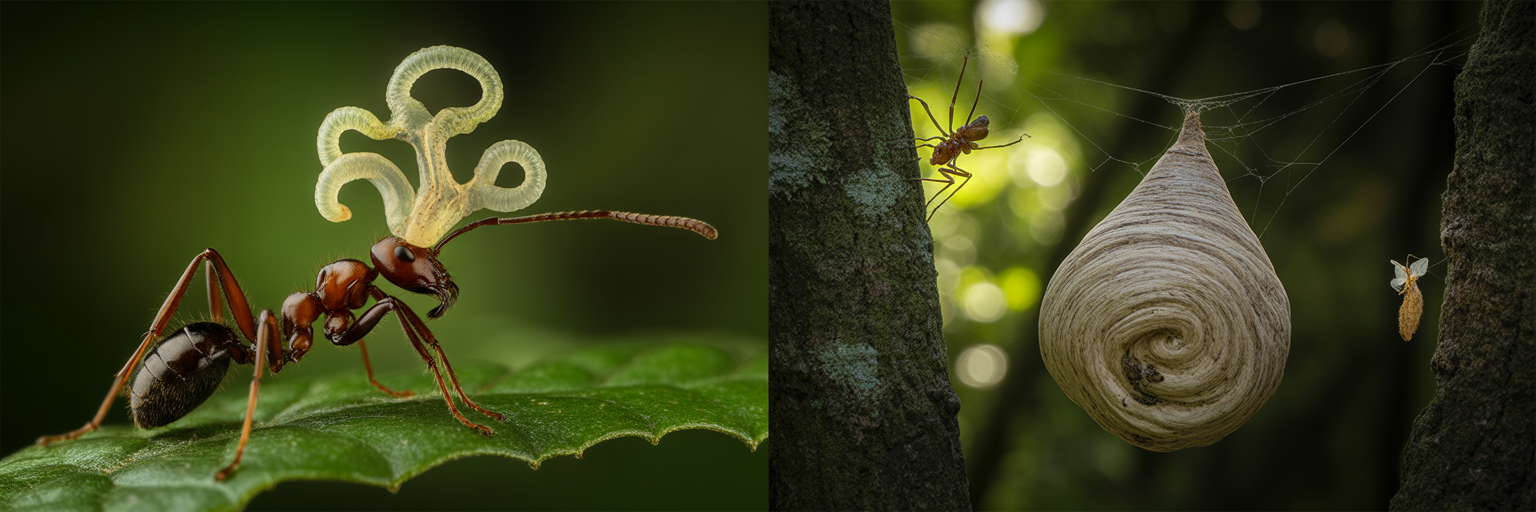
- The Grand Finale: With the ant locked in place, the fungus delivers its final, horrifying punchline. A long stalk, the fruiting body, erupts from the back of the ant’s head. It’s a spore-releasing party popper from hell. This stalk releases a shower of fresh spores onto the unsuspecting ant colony below, ensuring the cycle of zombification continues. The ant is left as a grotesque monument to the fungus’s reproductive success.
When a Wasp Turns a Spider into Its Butler
If the ant’s story was a slasher film, the spider’s is a psychological thriller. The villain here is the parasitoid wasp spider interaction, a tale of cold, calculated cruelty that makes the fungus look almost merciful. This isn’t about a brute-force takeover, it’s about subtle, sinister manipulation.
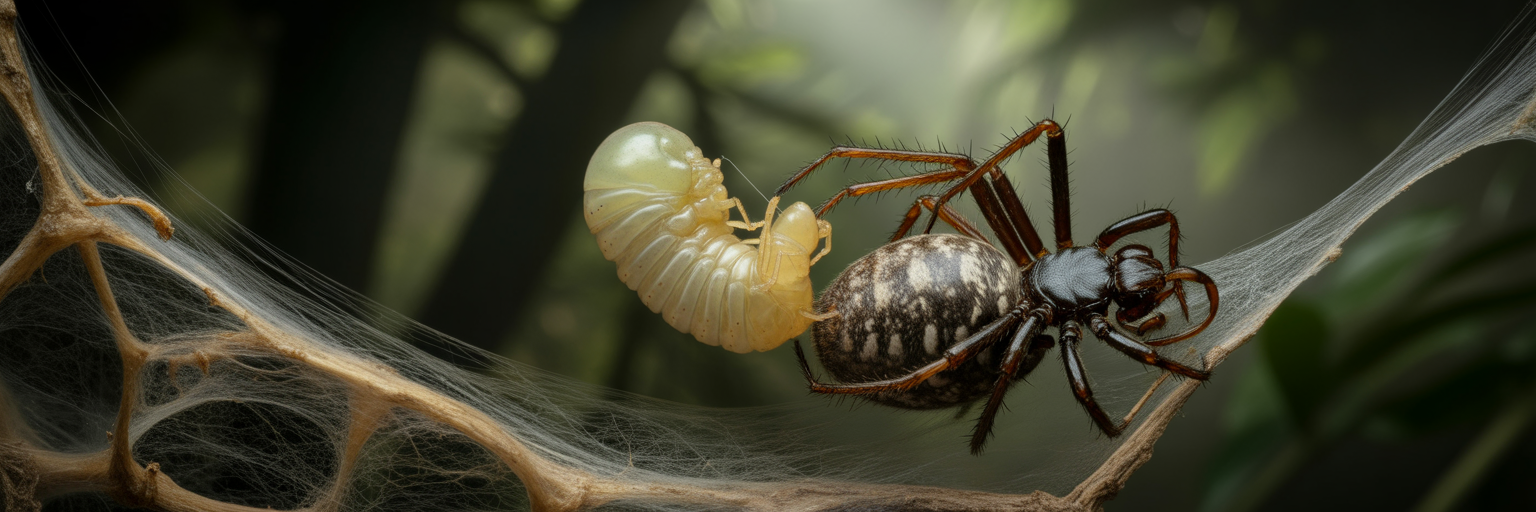
It starts with a mother wasp who has a unique approach to childcare. She finds an orb-weaver spider, briefly paralyzes it with a sting, and then glues a single egg to its abdomen. Then she just flies away, her parental duties complete. The spider wakes up with a headache and the worst surprise delivery ever, a freeloading backpack it can’t get rid of. For a while, life goes on as normal. The spider builds its web, catches flies, and goes about its spidery business, all while its future murderer latches on for the ride.
Once the egg hatches, the larva begins to feed, piercing the spider’s abdomen and drinking its blood, or hemolymph. The spider is now a living juice box for a monster, unknowingly nourishing the creature that will eventually kill it. The larva is careful not to drink too much, keeping its host alive and healthy enough to continue providing fresh meals. It’s a long, drawn-out process of being slowly consumed while you’re still trying to live your life.
The real horror begins when the larva is ready to pupate. It injects a chemical cocktail into the spider, a potent venom that completely rewires its brain. The spider, a master architect that has spent its life spinning beautiful, intricate orb webs, suddenly abandons its life’s work. Under the larva’s chemical command, it begins to construct a bizarre, new web. This “nursery web” is small, dense, and incredibly strong, designed not to catch prey but to protect a cocoon from the elements.
Once this strange nursery is complete, the spider’s work is done. The larva finally delivers the killing blow, consuming what’s left of its host. It then spins its own cocoon in the safety of the super-strong web the spider was forced to build. This is the ultimate hostile takeover. The spider wasn’t just killed, it was forced to be the architect and construction worker for its own murderer’s nursery. The cruelty is in the irony, a complete betrayal of the spider’s most fundamental instincts.
The Science Behind the Puppet Show
Alright, let’s put on our lab coats for a second, but don’t worry, we’ll keep the jokes. Now that we’ve seen the gruesome results, it’s time to compare the “how” behind these two zombification strategies. It’s a classic case of brains versus brawn, or more accurately, brainwashing versus body-jacking.
The fungus that zombifies the ant is all about an “inside job.” It’s a full-body muscular coup. As we discussed, the fungus doesn’t bother with the brain. It creates a massive, interconnected network of fungal cells called mycelium that wraps around and invades the ant’s muscle fibres. This allows the fungus to control the ant’s movements directly, turning the host into a fleshy puppet. The horror here is that the ant’s brain is likely still active, a terrified spectator to its body’s betrayal. It’s a biological hijacking at the most fundamental level.
The wasp, on the other hand, is an “external director.” It uses precise chemical commands to brainwash the spider. This is true chemical warfare. As the Smithsonian Institution has reported, scientists believe the wasp larva’s venom hacks the spider’s internal code. The chemicals likely mimic or interfere with the spider’s own hormones, such as ecdysone, which controls molting and other key behaviours. By hijacking this system, the larva can force the spider to perform a completely alien task, like building a nursery instead of a food trap. It’s a surgical strike on the host’s brain.
| Factor | Zombie Ant (Ophiocordyceps Fungus) | Zombie Spider (Parasitoid Wasp) |
|---|---|---|
| Method of Control | Internal muscular hijacking; fungal network bypasses the brain. | External chemical brainwashing; venom alters host’s hormones. |
| Host’s State | Conscious but powerless. A prisoner in its own body. | Chemically hypnotized. Instincts are completely rewired. |
| Parasite’s Goal | Force host to a specific location for spore dispersal. | Force host to build a protective nursery for the larva. |
| The Creep Factor | Visceral body horror. Fungus erupts from the head. | Psychological terror. Host becomes its killer’s servant. |
While we know the “what,” scientists are still working to understand the exact “how.” They’re using advanced tools to identify the specific bioactive compounds that make these manipulations possible. It just goes to show that even nature’s weirdest parasites are a subject of serious study. It also proves that nature is still full of terrifying mysteries we have yet to solve, which is great for our job security but maybe not so great for our sleep.
So, Who Wins the Creepiness Crown?
We’ve seen the evidence, we’ve heard the horrifying testimony, and now it’s time to make a decision. In the epic battle of zombie spiders vs zombie ants, who gets to wear the Creepiness Crown? Let’s present the final arguments to our esteemed judges, you, the slightly traumatized readers.
First, let’s recap the ant’s fate. It suffers a slow internal decay as a fungus takes over its body from the inside. It’s then forced on a final death march against its will, only to end its life by biting a leaf in a death grip. The grand finale? A mushroom bursts from its head like a scene from a sci-fi horror movie. This is pure, unfiltered body horror. It’s visceral, it’s graphic, and it’s an image you won’t soon forget.
Next, we have the spider. Its torment is long, drawn-out, and deeply psychological. It’s forced to carry its killer on its back, feeding it day after day. Then, its mind is hijacked, and it’s forced to betray its own instincts, using its greatest skill to build a nursery for its murderer. Only after it has served its purpose is it finally put out of its misery and eaten. This is architectural and psychological horror at its absolute finest.
So, after careful consideration, we’re ready to hand out the awards:
- The ‘Best Body Horror’ Award: This goes to the ant and its fungal overlord, hands down. The visual of a fungus erupting from an insect’s head is just too iconic and nightmarish to beat.
- The ‘Most Psychologically Cruel’ Award: The spider and the wasp take this one. The sheer, calculated evil of forcing your victim to build your house before you eat them is a level of villainy that’s hard to top.
The final verdict? It’s a tie! Both are winners in their own uniquely horrifying ways. The real champion here is nature itself, for being more creative, more bizarre, and more terrifying than any writer could ever dream of being. Let’s all just take a moment to be grateful we’re vertebrates, right?