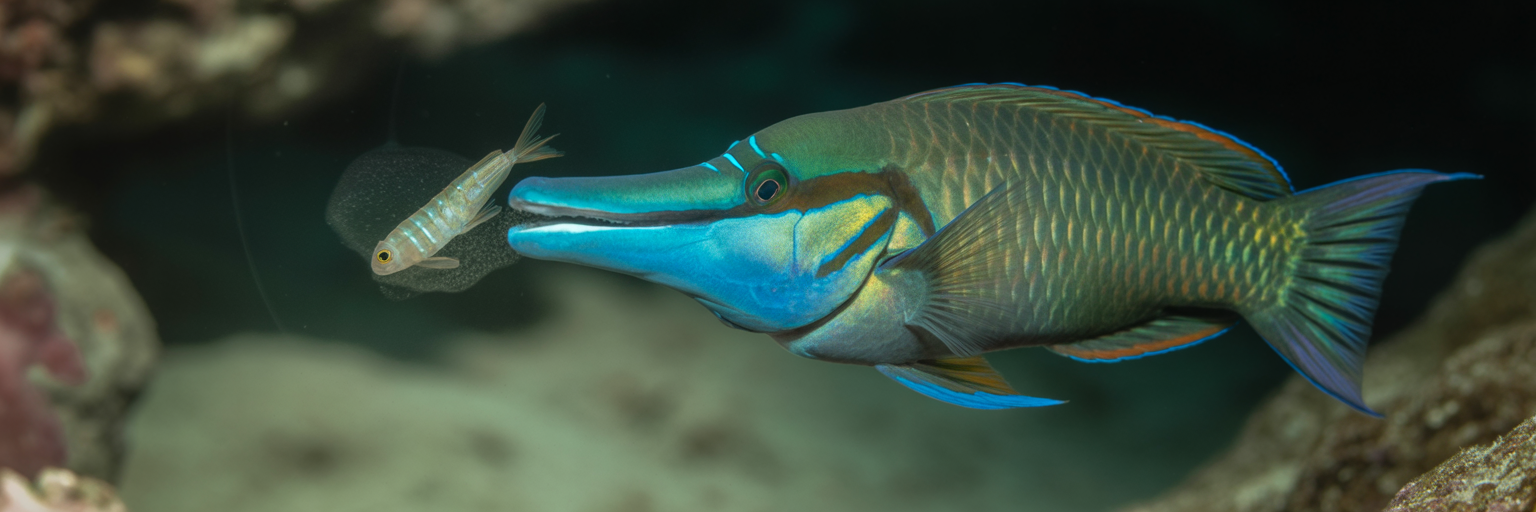
The Reef’s Most Deceptive Predator
Picture a sun-drenched coral reef in the Indo-Pacific. It’s a bustling underwater city, teeming with life. Parrotfish crunch on coral, clownfish dart between anemones, and countless other species paint the landscape with vibrant color. Among them swims the slingjaw wrasse (*Epibulus insidiator*), a fish that, at first glance, seems like just another citizen. It’s colorful, unassuming, and blends right in with the thousands of other wrasse species going about their day. It looks perfectly normal. It is anything but.
This fish is hiding one of nature’s most unsettling biological weapons. Its entire face is a spring-loaded trap, a biological cannon designed for a single, violent purpose. The slingjaw wrasse can launch its jaws forward at incredible speed, turning its own mouth into a projectile to snatch unsuspecting prey. It doesn’t just bite; it fires its face at its food.
This adaptation is a true nightmare of biological engineering. It’s a system so bizarre it defies easy explanation. To understand this creature, we have to dissect how evolution assembled this weapon, piece by piece. We will explore the intricate mechanics of its jaw, the shocking physics of its attack, and the predatory tactics that make it one of the reef’s most effective hunters. The sheer weirdness of this fish is both terrifying and a stunning marvel of natural selection, a testament to the extreme solutions life finds to survive.
Anatomy of a Biological Spring-Trap
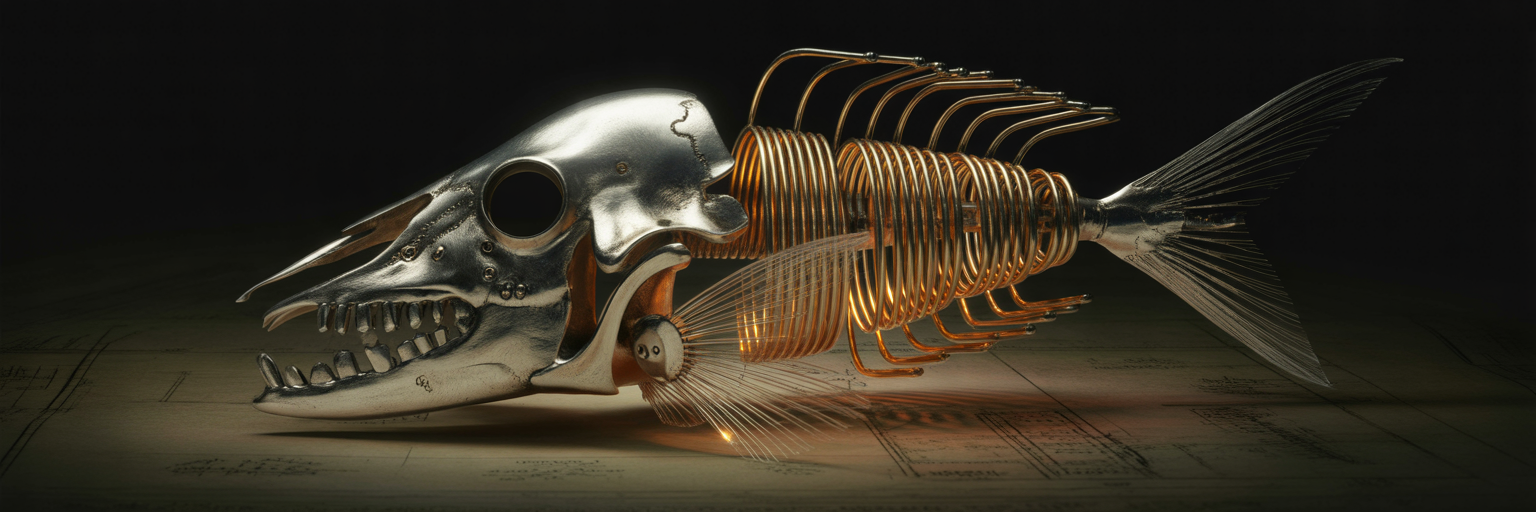
The slingjaw’s attack isn’t powered by muscle alone. It’s a mechanical event, relying on a complex assembly of bones and ligaments that work together like a meticulously designed machine. To understand the weapon, you have to look at its parts list. The entire system is a masterpiece of leverage and stored energy, far more complex than a simple hinge.
The Four-Bar Linkage System: Nature’s Multi-Tool
At the heart of the mechanism is what engineers call a four-bar and six-bar linkage system. Forget simple biology for a moment and think of a complex folding knife or an intricate multi-tool. Multiple levers and joints are connected in a precise sequence. When one part moves, it forces all the other parts to move in a coordinated, explosive chain reaction. In the slingjaw wrasse, the bones of its skull and jaw are not just fused together; they are arranged into a collapsible and expandable framework. This allows the jaw to travel a huge distance forward without dislocating, all while maintaining structural integrity.
Storing and Releasing Explosive Energy
The power behind the launch comes from specialized ligaments that function like high-tension rubber bands. Before a strike, the fish contracts muscles to stretch these ligaments, loading them with immense elastic potential energy. The principles of storing and releasing energy in biological tissues are fundamental. While the slingjaw wrasse uses this for predation, humans have explored ways to enhance muscle recovery and function through biomechanical interventions. Understanding how energy is managed in biological systems has led to advancements in therapies like those discussed in articles about using PEMF therapy to enhance athletic recovery.
This stored energy is held in place by the quadrate bone, which acts as a trigger. A tiny rotation of this bone releases the tension, and the ligaments snap back to their original shape, catapulting the jaw assembly forward. The protrusion is astonishing: the jaw extends up to 65% of its head length. For a human, that would be like your jaw shooting forward several inches from your face. This makes it a true fish with extendable jaw, a feature that sets it apart from almost all other vertebrates.
The Slow, Unsettling Reset
What goes out must come back in, but the return trip is unnervingly different. While the strike is a violent, instantaneous blur, the retraction is a slow, deliberate process. The fish must carefully pull the entire jaw apparatus back into its skull, resetting the linkage system and preparing the ligaments for the next launch. This stark contrast highlights just how specialized the mechanism is. It’s built for a one-way explosive action, a biological cannon that takes time to reload. Watching it slowly reassemble its own face is almost as creepy as the attack itself.
| Component | Mechanical Function | Real-World Analogy |
|---|---|---|
| Premaxilla (Upper Jaw) | The projectile that shoots forward | The cannonball |
| Quadrate Bone | The trigger that initiates the launch | A firing pin or release latch |
| Specialized Ligaments | Store and release elastic potential energy | Tightly wound springs or rubber bands |
| Mandible (Lower Jaw) | Drops down to create a large opening | A trapdoor |
| Hyoid Apparatus | Rapidly expands the floor of the mouth | A bellows or vacuum pump |
The Physics of a High-Speed Suction Attack
The anatomy of the jaw explains the “how,” but the physics of the attack reveals just how extreme this feeding mechanism truly is. The slingjaw wrasse doesn’t just hit its prey; it manipulates the water around it with violent force, creating a situation from which there is no escape.
Faster Than the Eye Can See
The entire jaw extension happens in a fraction of a second. It’s an event so fast that most prey animals have no time to register what is happening. The jaw launches and retracts in a blur of motion, a flicker that is difficult for the human eye to even process. According to a functional analysis published in the International Journal of Design & Nature and Ecodynamics, the jaw protrusion reaches speeds of 2.3 m/s. This incredible burst of motion is reminiscent of other hyper-fast predators, such as the star-nosed mole that eats faster than you can blink.
The Power of a Vacuum
Here’s the most crucial part of the Epibulus insidiator feeding strategy: the jaw itself is not the primary weapon. The real killer is suction. As the tubular mouth shoots forward, it rapidly expands, creating a powerful vacuum in front of it. This negative pressure is what actually does the work, yanking small crustaceans and fish out of their tight hiding spots in the coral. The prey isn’t bludgeoned; it’s inhaled from a distance. The jaw is just the engine that creates the inescapable vortex.
Surviving Extreme G-Forces
The speed of the attack is impressive, but the acceleration is even more shocking. The same research shows the snout can accelerate at over 10 g. To put that in perspective, fighter pilots can experience blackouts at similar g-forces during high-speed maneuvers. The slingjaw wrasse’s head is built to withstand this incredible violence on a regular basis. In a counterintuitive twist, studies have found that smaller, younger slingjaw wrasses actually have higher snout acceleration than adults. This may give more vulnerable juveniles an extra edge, allowing them to secure a meal with even greater speed and force.
How Evolution Built the Perfect Slingjaw Wrasse
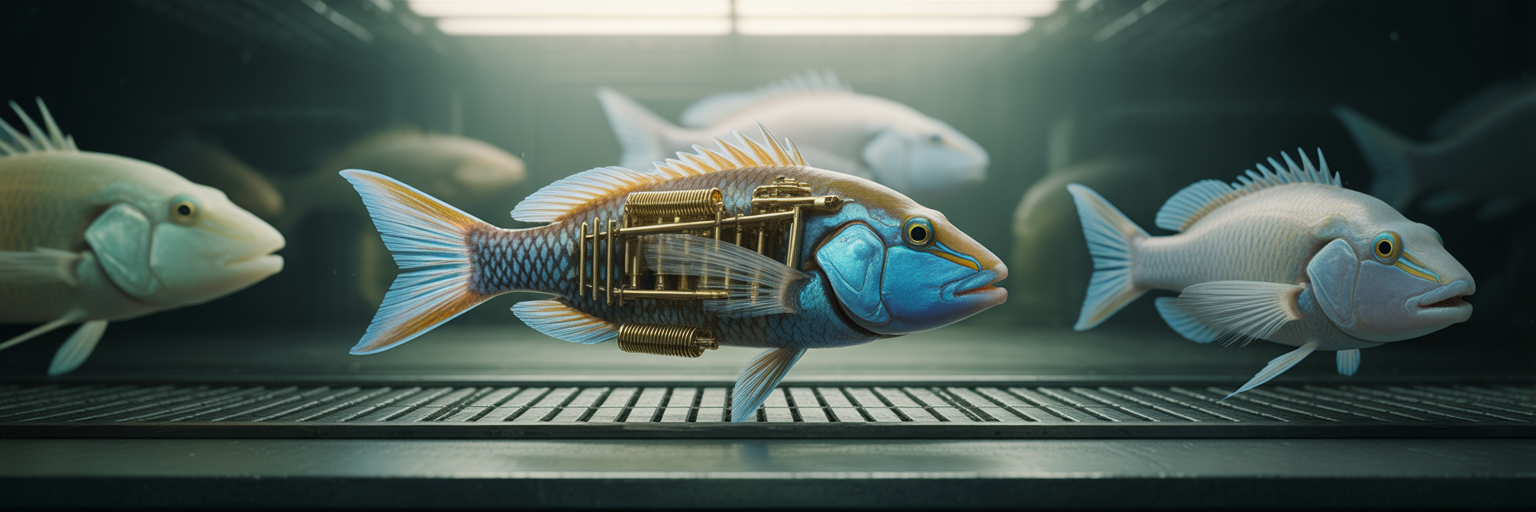
A weapon this complex doesn’t appear overnight. The slingjaw wrasse’s face cannon is the result of millions of years of an evolutionary arms race. As prey like shrimp and small fish became better at hiding in the intricate latticework of coral reefs, predators needed a new tool to reach them. The extendable jaw was the answer, a radical reorganization of cranial bone structures that gave this fish an enormous competitive advantage.
The journey from a standard wrasse mouth to this projectile weapon likely happened in gradual steps:
- Initial Pressure: Prey becomes increasingly skilled at hiding within the complex, tight spaces of coral reefs, making them inaccessible to fish with standard jaws.
- Gradual Elongation: Over generations, mutations favoring slightly longer jaw bones allow some individuals to reach deeper into crevices, granting a survival advantage.
- Ligament Specialization: Ligaments in the jaw begin to evolve greater elasticity, allowing them to store and release energy rather than just providing structural support.
- Development of a Trigger: The bones of the skull, particularly the quadrate, shift and adapt to form a mechanical linkage that can hold the energized ligaments in a “cocked” position and then release them instantly.
- Refinement of Suction: As the jaw extension becomes faster and more pronounced, the shape of the mouth and the movement of the hyoid apparatus co-evolve to maximize the creation of a powerful suction vacuum.
- The Final Product: The fully integrated system emerges—a high-speed, projectile suction-feeder that gives the slingjaw wrasse exclusive access to a previously protected food source.
This key innovation allowed the slingjaw wrasse to exploit a food niche that was completely off-limits to its competitors. It doesn’t need to be the fastest swimmer on the reef, just the fastest striker at close range. This evolutionary journey of specialization is a common theme in nature, where creatures develop extraordinary abilities to gain an edge. A similarly fascinating example of co-evolution and deception can be seen in the caterpillar that tricks ant colonies into raising it as their own.
Master of Ambush and Deception
Having a face cannon is one thing; knowing how to use it is another. The slingjaw wrasse is a master of ambush, combining its mechanical weapon with cunning psychological warfare. Its hunting strategy is a chillingly effective sequence of patience, deception, and explosive violence. It is without a doubt one of the most fascinating weird ocean animals on the planet.
The hunt unfolds in several distinct phases:
- The Stalk: The slingjaw wrasse moves with unnerving patience, often hovering motionless as it scans the coral for any sign of movement.
- The Approach: It closes the distance slowly, relying on its deceptive coloration to avoid spooking its target. It needs to get within a few inches for the attack to be effective.
- The Inspection: The wrasse peers directly into the tiny crevice or hole where its prey—a small shrimp or fish—is hiding, confirming the target’s location.
- The Strike: In a single, explosive movement that is over in a fraction of a second, the jaw launches forward, and the suction force yanks the victim from its shelter.
- The Aftermath: The prey is inhaled into the mouth, and the wrasse slowly retracts its jaw apparatus, resetting the trap for its next unsuspecting meal.
To make matters worse for its prey, the slingjaw wrasse is also a skilled mimic. It can rapidly change its color and pattern to imitate harmless, non-predatory fish species. This isn’t just a defensive camouflage; it’s an offensive tactic. By masquerading as a “friendly neighbor,” it can get well within firing range before its true identity is revealed. The deception gets it close, and the jaw mechanism finishes the job. The slingjaw wrasse’s projectile feeding is a remarkable hunting strategy, but it’s not the only fish to weaponize its mouth. A different but equally impressive technique is employed by the archerfish that shoots bugs out of the air with water, showcasing another way evolution has turned feeding into a feat of marksmanship.
The Wrasse’s Role in the Reef Ecosystem
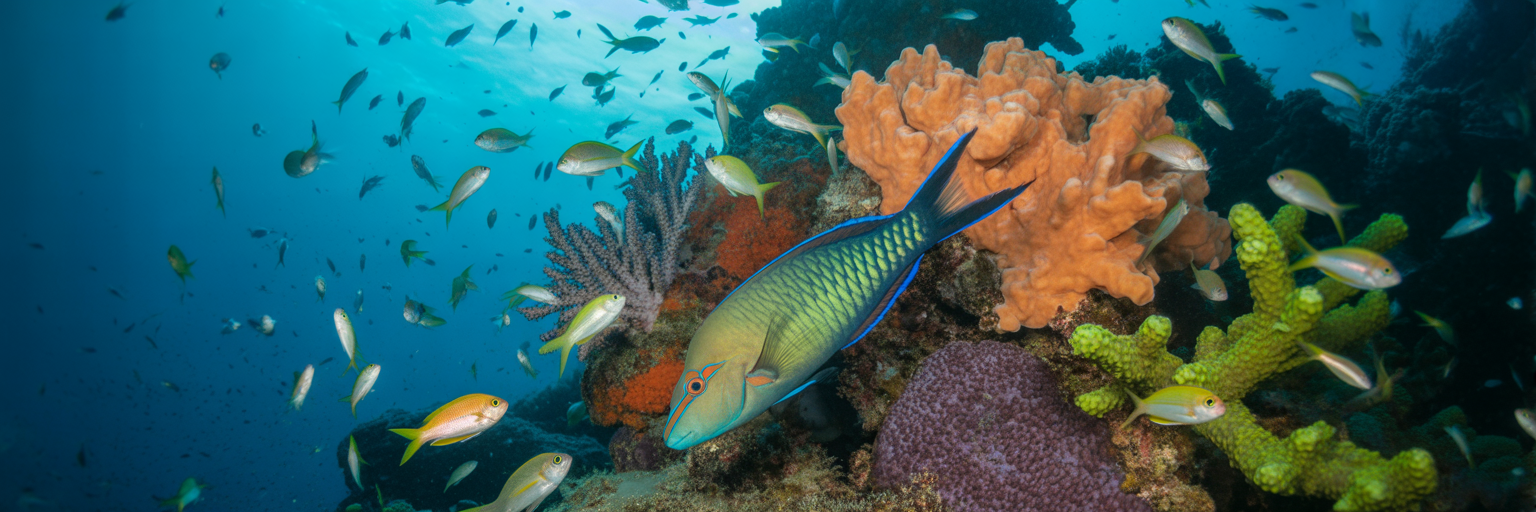
Beyond its shocking feeding mechanism, the slingjaw wrasse plays an important part in the health of its environment. Found in coral reefs across the Indo-Pacific, from the Red Sea to Oceania, this fish is a key member of a complex and delicate ecosystem. As one of the reef’s specialist coral reef predators, it has a unique job.
By targeting small, cryptic crustaceans and fish that hide deep within the coral, it helps control populations that other predators simply cannot reach. This specialized diet ensures that no single group of small organisms can dominate the reef’s micro-habitats, contributing to the overall biodiversity and balance of the ecosystem. Typically a solitary hunter, the slingjaw wrasse spends its days patrolling its territory, methodically searching for its next meal.
However, this high degree of specialization also makes the slingjaw wrasse vulnerable. Its survival is directly tied to the health of the coral reefs it calls home. Threats like climate change, which causes coral bleaching, and pollution destroy the intricate structures where its prey hides. Without a healthy reef, the slingjaw wrasse loses both its home and its food source, a stark reminder that even the most formidable weapons are useless without a world to use them in. The slingjaw wrasse’s specialization is just one of many strange and wonderful adaptations found in reef ecosystems. For instance, its neighbor, the parrotfish that sleeps inside a bubble of its own slime, has an equally bizarre survival strategy that contributes to the reef’s health in a completely different way.
A Final Look at Nature’s Creepiest Weapon
The slingjaw wrasse is a living, breathing paradox. It is a creature of serene beauty that conceals a mechanism of extreme violence. Its jaw is a triumph of biomechanical engineering, a spring-loaded trap perfected over millions of years. The physics of its attack are mind-bending, generating forces that seem impossible for a creature of its size. It is the ultimate tool born from an evolutionary arms race, a weapon that gave it access to a world no other fish could touch.
More than anything, this fish is a chilling reminder that mundane appearances can hide the most extreme adaptations. It embodies the idea of a “nightmare of biological engineering,” yet its strangeness is a testament to the incredible problem-solving power of natural selection. The existence of the slingjaw wrasse proves that the ocean is filled with creatures operating by rules that seem borrowed from science fiction. The slingjaw wrasse’s method is shocking, but nature’s reproductive strategies can be even more unsettling. The bizarre adaptations for survival extend to all aspects of life, such as the case of the Suriname toad that gives birth through holes in its back.
It leaves you to wonder: if a fish can evolve a face cannon, what other bizarre, hyper-specialized weapons are still waiting to be discovered in the planet’s unexplored depths?