
When nineteenth-century naturalists first hauled deep-sea anglerfish up from the Atlantic, every specimen they examined was female. This went on for decades. The males appeared to be missing from the species entirely.
They were not missing. They were attached — small, degenerate, and easily mistaken for parasites or tumours growing on the female’s body. In 1924 the Icelandic biologist Bjarni Sæmundsson found two such growths on a female anglerfish and assumed they were the fish’s own offspring, somehow lodged on her belly. It fell to a Danish colleague, Charles Tate Regan, to dissect one and reach the correct conclusion: this was the male, and it had grown into her.
How anglerfish mating actually works in the deep sea
The problem the anglerfish is solving is one of arithmetic. The bathypelagic zone is the largest habitat on the planet by volume and one of the emptiest. Two individuals of the same species who need to find each other in that darkness may get one chance in a lifetime. Letting the male swim away afterward is a bet that he will find her again, and that bet is nearly always lost.
So the male does not leave.
Males in these species hatch tiny, and they stay tiny. They often have no functional digestive system worth the name, oversized nostrils for tracking a female’s pheromone trail, and a set of pincer-like denticles at the jaw. When a male finds a female, he bites and holds on.
Then the tissues merge. Skin fuses to skin, and eventually the two circulatory systems join into one. From that point the male has no independent existence: he receives all his nutrients through the female’s blood, his eyes and most of his organs degenerate, and what remains is essentially a permanently attached testis drawing life support from a partner hundreds of times his size. In Photocorynus spiniceps, a documented female measuring 46 millimetres carried a fused male of 6.2 millimetres. In Melanocetus johnsonii, a 75-millimetre female was found with a 23.5-millimetre male attached to her belly.
Some species tolerate several attached males at once.
The immunological impossibility at the heart of anglerfish mating
Here is the part that should not work.
Every vertebrate has an adaptive immune system whose entire function is distinguishing self from non-self. It is why organ transplants require immunosuppressant drugs for life, and why grafting tissue from one animal onto a genetically different animal of the same species normally provokes violent rejection.
Anglerfish do exactly that — permanently, with shared blood supply — and nothing rejects.
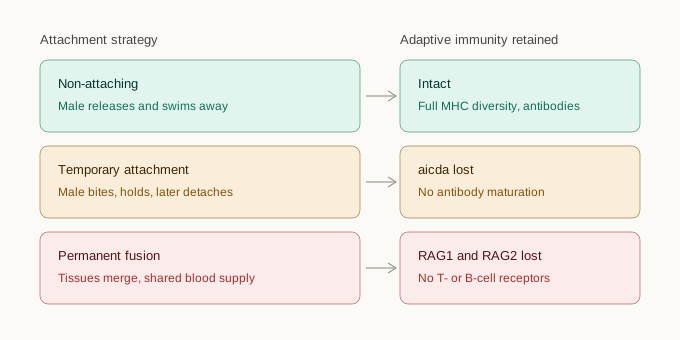
In 2020, Jeremy Swann and Thomas Boehm at the Max Planck Institute of Immunobiology and Epigenetics, working with Theodore Pietsch at the University of Washington, sequenced DNA from 31 preserved anglerfish specimens spanning non-attaching, temporarily attaching, and permanently attaching species. They expected to find some clever tolerance mechanism — perhaps unusually matched tissue-compatibility genes.
They found demolition instead.
The pattern tracks the degree of attachment with unsettling precision. Species where males attach only temporarily have lost functional aicda, a gene required for antibody maturation. Species with permanent single attachment have lost their U-type MHC class I genes. Species where multiple males fuse to one female have essentially nothing left: no functional U-type MHC class I, and at most one or two of the remaining class I or class II genes.
In the most extreme cases — Photocorynus spiniceps among them — the RAG1 and RAG2 genes are pseudogenised. Those two genes perform the genetic shuffling that generates the diversity of B-cell and T-cell receptors. Without them there is no functional antibody repertoire and no conventional T-cell response at all.
Boehm’s assessment was blunt: in a human being, that combination of losses would constitute fatal immunodeficiency.
So what keeps them alive?
They are running on innate immunity alone — the older, non-specific arm of the immune system that most vertebrates treat as a first line of defence rather than the whole defence. Something in that system has evidently been enhanced enough to compensate, though the details have not yet been worked out.
That gap is not a footnote. It is the reason immunologists find these fish interesting well beyond marine biology. If a vertebrate lineage can discard machinery textbooks describe as essential and survive, then the vertebrate immune system is considerably more modular than assumed — and understanding how anglerfish compensate could inform treatment for humans with impaired adaptive immunity.
There is also a chicken-and-egg question the researchers themselves raise. Did immune loss enable sexual parasitism, or did some other evolutionary pressure erode the immune system first, with fusion becoming possible afterward as a consequence? Boehm’s team leans toward the second: unknown forces drove the immune changes, and sexual parasitism exploited the opening. Notably, this reproductive strategy appears to have evolved independently several times within the group, which suggests the immunological groundwork was already laid.
A note on calling the male a parasite
The term “sexual parasitism” is standard, and it is worth flagging that it may be misleading.
A commentary published alongside the 2020 study made the case that fusion is costly to the male too. He forfeits every future mating opportunity, cannot hedge, and cannot upgrade if a better-provisioned female appears later. Meanwhile the female gains a permanently available, permanently faithful sperm supply in an environment where finding a mate is the single hardest problem she faces.
Framed that way, it is not obvious who is parasitising whom. It may simply be the most extreme pair bond that has ever evolved.
How a male finds a female in the largest habitat on Earth
Fusion is the endpoint. Getting there is its own problem, and the male’s body is built almost entirely around solving it.
Free-swimming males of many ceratioid species have enormous, highly developed olfactory organs — nostrils disproportionate to the rest of the head — which strongly implies they track females by scent, following pheromone gradients through water where visibility is effectively zero. Several species also have unusually large eyes for a deep-sea fish at that size, likely tuned to detect a female’s bioluminescent lure rather than to see in any general sense.
What they conspicuously lack is a way to feed themselves. The male’s digestive tract is typically reduced to the point of being non-functional after the larval stage. He hatches with a fuel tank, not a kitchen. Every hour he spends searching burns down a reserve he cannot replenish, which means the search has a hard deadline: find a female or starve.
That constraint explains a great deal about why the strategy looks the way it does. When the cost of failure is certain death and the odds of a second encounter are negligible, permanent attachment stops looking like an extreme adaptation and starts looking like the only rational move available.
Not every anglerfish does this
It is worth being precise, because popular accounts tend to flatten the group.
Sexual parasitism is a feature of the deep-sea ceratioids, not of anglerfish generally. The anglerfish most people have actually encountered — monkfish, the shallow-water goosefish sold in fish markets — has entirely conventional reproduction, with males and females of comparable size that meet, spawn, and separate.
Even within the ceratioids the strategy varies considerably. Some species show no attachment at all. Some attach temporarily and detach again. Some fuse permanently with a single male. Some accumulate multiple fused males on one female. And the 2020 genetic work suggests at least one species in their sample sits partway along the transition, with immune changes underway but full fusion not yet established.
That gradient is what made the study possible. Because the group contains species at every stage, researchers could line up attachment strategy against immune genotype and watch the correlation hold across the whole range — which is considerably stronger evidence than a single dramatic case would provide.
Sources
- Swann, J.B., Holland, S.J., Petersen, M., Pietsch, T.W. & Boehm, T. (2020). The immunogenetics of sexual parasitism. Science 369(6511): 1608–1615.
- Max Planck Institute of Immunobiology and Epigenetics (2020). Immune functions traded in for reproductive success. Research release.
- Nature Reviews Immunology (2020). Loss of immunity lets a sexual parasite hold on tight. 20: 588.
- Pietsch, T.W. (2009). Oceanic Anglerfishes: Extraordinary Diversity in the Deep Sea. University of California Press.
- Miller, R.D. et al. (2022). Histocompatibility and Reproduction: Lessons from the Anglerfish. Life 12(1): 113.
Related discovery: Why Female Blanket Octopuses Dwarf Males