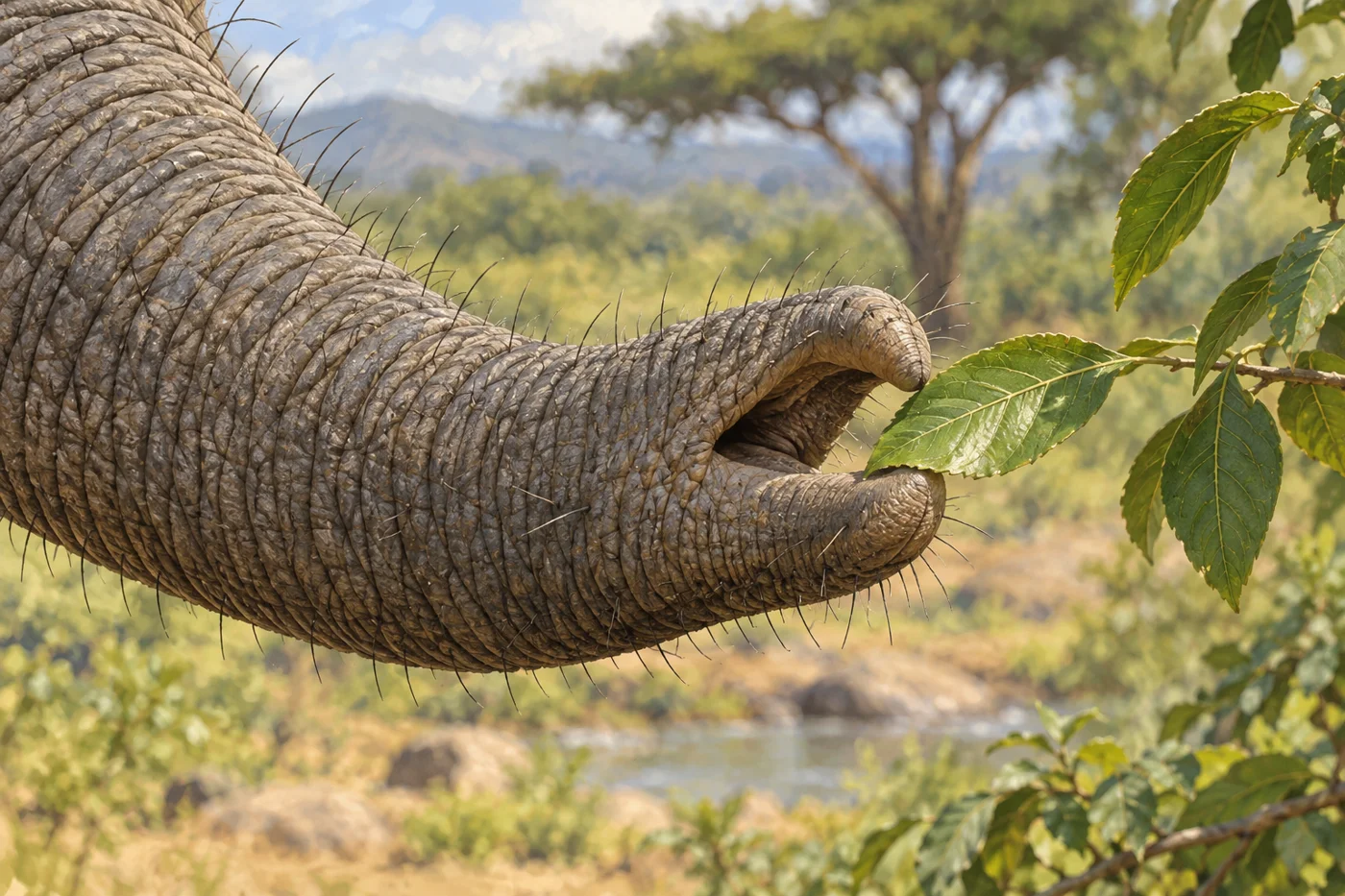
A trunk can move a branch, pick up a small object and bring food to an elephant’s mouth. Its power is obvious; its sensory details are easier to overlook. Like the specialized touch system described in our article on the star-nosed mole’s sensory nose, the trunk combines movement with a remarkable capacity to receive information through contact.
One part of that system is its whiskers. These hairs are not decoration on otherwise insensitive skin. Their distribution, attachment and material properties influence how contact with an object produces a signal. To understand them, it helps to follow the sequence from touching a whisker to information arriving at its base.
Whiskers are arranged for a working trunk
A study of elephant trunk whisker anatomy examined their distribution, follicles and nerves. Whiskers were particularly dense near the tip, and the investigators found differences between African savanna and Asian elephants.
That is important when reading a general claim about “the elephant trunk.” The two groups differ in tip anatomy and aspects of their whisker arrays. A photograph of one species should not automatically be used to illustrate a specific anatomical measurement from the other.
The follicles are innervated, linking contact with the sensory system. The whisker shaft itself is not a miniature nerve extending into the air. It is a mechanical structure: bending and other changes at contact transmit forces toward the attachment region, where the animal can detect the consequences.

The elephant moves the trunk, rather than whisking like a rat
Many familiar whiskered mammals actively move facial whiskers back and forth. Elephant trunk whiskers are not used in that same autonomous sweeping pattern. Movement of the trunk brings the hairs into contact with objects.
This changes the mechanical setting. A whisker on a moving trunk can encounter an object as the animal wraps, balances or grasps. The arrangement of hairs along different portions of the trunk therefore matters, not just the presence of whiskers at its very end.
The anatomical study also observed uneven wear associated with lateralized trunk use. In plain language, repeatedly using the trunk preferentially to one side can leave an asymmetric pattern. The sensory apparatus belongs to a body that has habits, rather than remaining a pristine diagram throughout life.
A whisker does not have to be equally stiff everywhere
In 2026, a study of functional gradients in elephant whiskers investigated how shape and material properties vary along the shaft. The work focused on Asian elephant whiskers and combined biological measurements with mechanical investigation.
The researchers found a transition from a relatively stiff base toward a softer tip. That arrangement changes what happens when contact occurs at different positions. A uniformly stiff rod and a rod with a flexible tip do not bend or vibrate in precisely the same way.
This is sometimes described as information being built into the material. The phrase does not mean the hair thinks. It means its structure helps transform different contacts into different mechanical responses before the nervous system interprets them.

Our article on the material structure of limpet teeth explores another biological object whose performance depends on its construction. A tooth resists forces; a whisker also helps convey information about them.
Contact location changes the signal reaching the base
The research institute’s account of the whisker work describes imaging, material testing, physical prototypes and simulations. The team investigated how the gradients influence the response when objects touch different parts of a whisker.
The proposed sensory advantage is that contact position affects the mechanical signal arriving at the base. That makes distance along the shaft potentially distinguishable from the resulting response. The experiments and models address a mechanism that could contribute to the animal’s precise handling of objects.
A model of the whisker is not a complete model of the elephant’s perception. The brain must receive and interpret sensory input in a moving animal, alongside information from other tissues and senses. Demonstrating a useful mechanical response is a significant step without explaining every subsequent neural process.
Skin and wrinkles form part of the same contact system
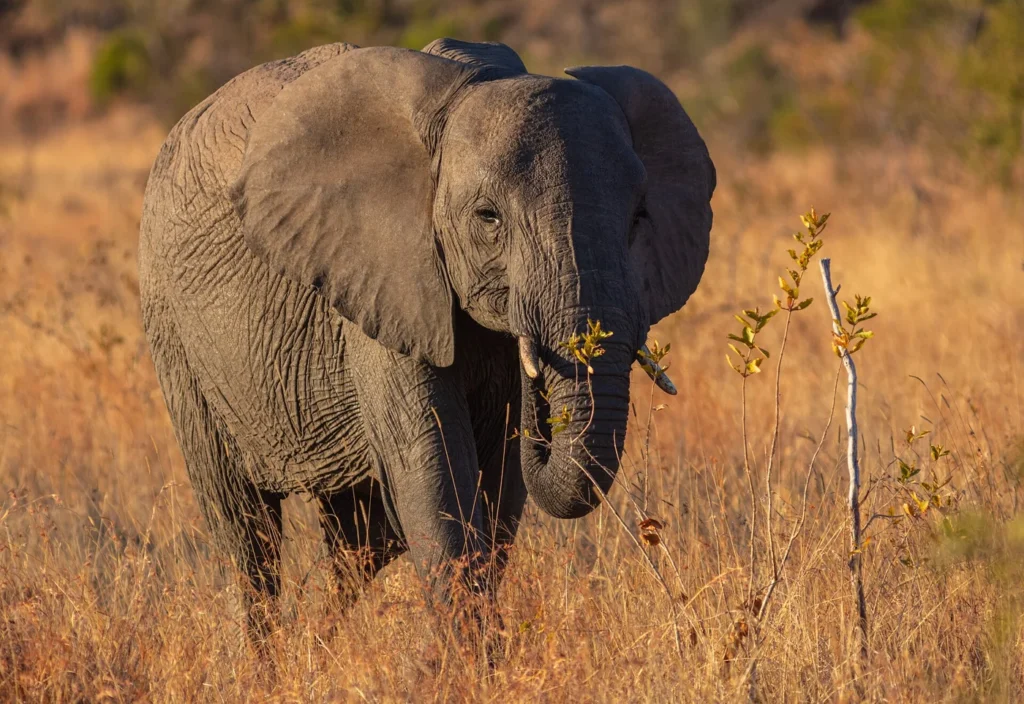
The whiskers emerge from a trunk covered in skin that folds, stretches and grips. A study of trunk wrinkle development found species differences and changes associated with development and habitual bending.
Those findings help explain why the mounting environment matters. A sensory hair on thick, folded skin faces different constraints from a hair projecting from a small mammal’s cheek. The surface supporting it moves and changes shape while the elephant uses the trunk.
The study traced wrinkles during development as well as later life. Some aspects of the surface arise before use, while others are related to repeated behavior. An adult trunk therefore reflects both growth and experience.
Several components contribute to delicate handling
Powerful muscles do not explain delicate manipulation by themselves. An animal also needs information about where an object is, whether contact has occurred and how its grip is changing. Whiskers contribute a route for receiving some of that information.
It would be an oversimplification to credit every careful movement entirely to whiskers. Skin receptors, muscular control, experience and other senses also belong in the larger account. The research identifies particular components and investigates their contributions, rather than reducing an elephant’s dexterity to one feature.
For a contrasting example of a sensory system divided across different surroundings, see how four-eyed fish see air and water. The elephant’s case is tactile: contact becomes informative partly because a hair’s geometry and material properties shape the signal before it reaches the animal’s sensory machinery.
Featured image credit: AI-generated editorial illustration of elephant trunk whiskers. Conceptual imagery, not a documentary photograph; anatomy and scale are illustrative.