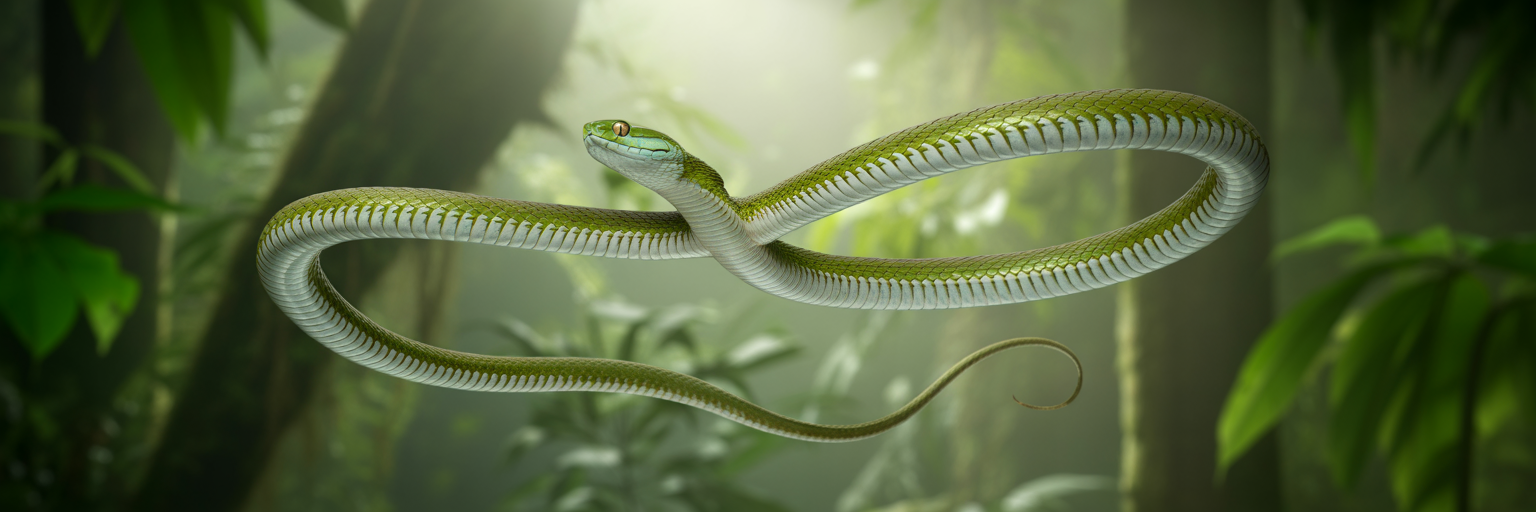
The image of a “flying snake” often conjures up mythical creatures or scenes from a fantasy film. Yet, in the rainforests of Southeast Asia, snakes of the genus Chrysopelea regularly launch themselves from treetops, gliding through the air with remarkable control. This behavior raises a fundamental question that moves beyond sensationalism: Do these animals truly fly, or is it a more complex form of gliding? Understanding how flying snakes glide requires deconstructing their entire aerial process, from takeoff to landing. This article will move past popular descriptions to reconstruct a complete glide based on rigorous scientific studies, examining the snake’s launch, its instantaneous body transformation, the physics of its descent, and the crucial role of its in-air undulation.
Deconstructing the Myth of the Flying Serpent
The legend of the flying serpent is ancient, but the reality is a masterclass in biomechanics. The five species of Chrysopelea are not powered fliers like birds or bats. They cannot flap their bodies to generate continuous thrust and ascend at will. Instead, they are the only known limbless vertebrates that are dedicated gliders. Their “flight” is an act of controlled falling, where they expertly manipulate aerodynamic forces to slow their descent and travel significant horizontal distances. The central question is not simply whether they can fly, but what is actually happening when a snake takes to the air.
To answer this, we must dissect the mechanics of their unique locomotion. This involves investigating how they initiate a glide from a standstill, how they instantaneously reshape their entire body into an airfoil, and how their signature S-shaped wriggling motion contributes to a stable journey. The answer to the question “can snakes fly” is not a simple yes or no. It lies in understanding the precise physics that allow an animal with no wings to navigate the three-dimensional space of the forest canopy. By examining the evidence from kinematic studies and aerodynamic experiments, we can build a clear picture of this incredible feat of evolution.
The Physics of How Flying Snakes Initiate a Glide
A successful glide begins long before the snake is airborne. The entire launch sequence is a deliberate and powerful process designed to set the stage for a controlled descent. It is not a simple fall but a calculated series of movements that convert potential energy into the kinetic energy needed for gliding.
The ‘J-Loop’ Takeoff
The process starts with the snake positioning itself at the end of a branch. It dangles its front half over the edge while the rear half of its body remains anchored. It then pulls its head back and forms the lower portion of its body into a distinctive “J” shape. This loop acts like a compressed spring. With a powerful muscular contraction, the snake thrusts itself forward and slightly upward, launching away from the branch with initial momentum.
The Critical Dive for Airspeed
Immediately after takeoff, the snake does not attempt to glide horizontally. Instead, it enters a controlled, ballistic dive. This initial drop might look like a failure, but it is a crucial maneuver. By falling steeply, the snake rapidly converts its potential energy from height into the kinetic energy of speed. It must achieve a minimum airspeed, typically around 8 to 10 meters per second, for aerodynamic forces to become effective enough to generate significant lift. Without this dive, the snake would not be moving fast enough to transition from falling into a glide.
An Instantaneous Body Transformation
As it accelerates downward, the snake performs a dramatic and immediate transformation. It actively splays its ribs outward and forward while simultaneously pulling its stomach inward, toward the spine. This action flattens its entire body, changing its cross-section from a round cylinder into a wide, flattened, and slightly concave shape, almost like a Frisbee or a wing. This is not a passive change. It is a controlled muscular action that turns the snake’s body into a single, continuous airfoil, preparing it to interact with the oncoming air and begin generating the lift necessary for gliding.
The Entire Body as a Single, Dynamic Airfoil
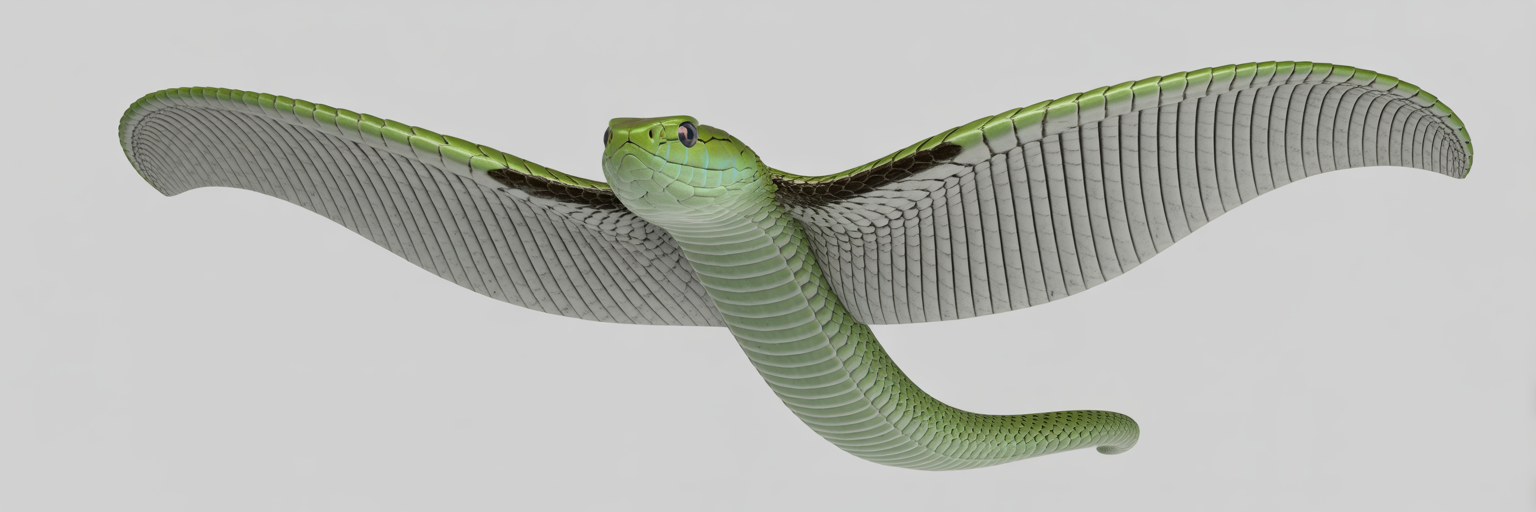
Once the snake has built up sufficient speed and flattened its body, it transitions from a falling object into a gliding wing. The flattened, concave cross-section is the key to its aerial performance. As air flows over the snake’s body, it must travel a longer path over the curved top surface compared to the shorter, concave path underneath. This difference in path length creates a pressure differential. The air moving faster over the top exerts lower pressure, while the slower-moving air underneath exerts higher pressure. The result is a net upward force known as lift.
This principle is fundamental to animal gliding aerodynamics, but the flying snake’s application is unique. Its entire body, from head to tail, functions as a single, dynamic airfoil. Unlike a flying squirrel with its fixed skin membrane or a bird with its rigid wings, the snake’s “wing” is flexible and can be adjusted continuously throughout the glide. This dynamic morphology allows for subtle changes in shape and orientation to optimize lift and maintain stability.
Research has shown this body shape to be remarkably effective. A 2014 study published in the Journal of Experimental Biology found that this specific cross-section generates a surprisingly high lift coefficient, a measure of how effectively a shape can produce lift. At certain angles of attack, the snake’s body can generate more lift than some conventional engineered airfoils. This high lift production is a primary reason for their impressive glide performance. This ability to transform its body for a specific environmental interaction is a hallmark of specialized animals, much like the archerfish that shoots bugs out of the air with water, showcasing how evolution produces highly effective biological mechanisms.
Solving the Puzzle of Aerial Undulation
Perhaps the most visually striking and misunderstood aspect of a flying snake’s glide is its constant in-air wriggling. It is natural to assume this S-shaped motion provides propulsion, like a snake swimming through water. However, current research indicates its primary function is not thrust but stabilization. This aerial undulation is a sophisticated, active control system that makes a long, controlled glide possible.
The motion consists of two distinct waves traveling down the snake’s body. There is a large-amplitude horizontal wave, moving side-to-side, and a smaller-amplitude vertical wave, moving up-and-down. These waves are out of phase with each other, creating a complex, three-dimensional movement. This system is essential for flying snake stability. A 2020 study in Nature Physics used experiments and simulations to demonstrate that without this undulation, a gliding snake would quickly become unstable and tumble out of the air. The undulation serves several critical functions:
- Prevents Tumbling: Computer models of non-undulating snakes show they are inherently unstable. They quickly begin to roll or pitch uncontrollably, losing their airfoil shape and falling. The undulation acts as a constant series of micro-corrections that prevent this from happening.
- Maintains Orientation: To generate lift, the snake’s flattened body must be kept at an optimal angle relative to the oncoming airflow. The S-shaped motion ensures the body remains properly oriented, maximizing lift generation throughout the glide.
- Enables Steering: The snake is not just a passive glider. By making subtle changes to its undulation, it can execute turns and actively steer toward a specific landing target, a vital skill for navigating the cluttered rainforest canopy.
An effective analogy is a kayaker using constant, small paddle adjustments to stay upright and on course in choppy water. The snake’s undulation is a similar form of active control, turning what would be an uncontrollable fall into a directed and stable glide.
Mapping the Glide from Takeoff to Landing
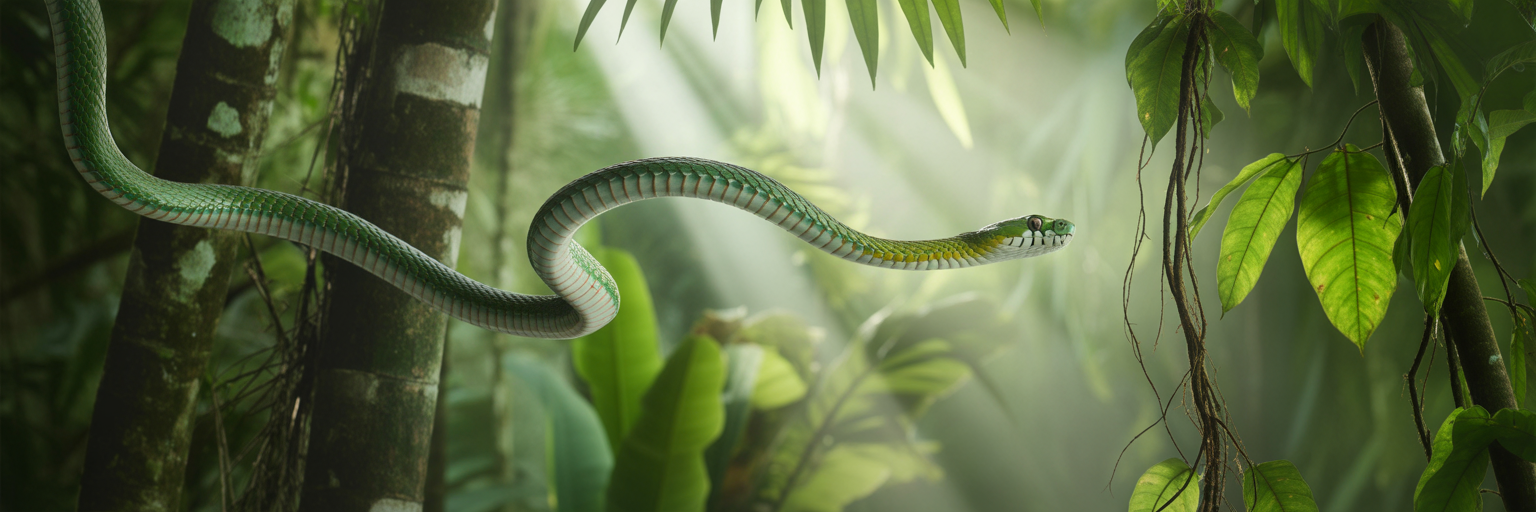
By integrating the launch, body transformation, and undulation, we can reconstruct the entire trajectory of a flying snake’s glide. Data from 3D kinematic studies of Chrysopelea paradisi flight reveals a consistent and predictable path. The glide is not a simple, straight-line descent but a series of distinct phases, each with a specific purpose.
The journey begins with the steep initial dive to build speed. This is followed by a “shallowing” phase, where the snake generates enough lift to significantly decrease its vertical rate of descent and transition into a much flatter glide angle. This is the moment that can be mistaken for gaining height. However, it is crucial to distinguish between shallowing the descent and achieving a positive climb. While the snake can dramatically reduce its rate of fall, its trajectory in still air is always angled downward relative to the horizontal. It never ends a glide at a point higher than where it began or achieves a true upward climb under its own power.
Once stabilized, the snake enters a long, shallow descent, maintaining a near-constant horizontal velocity as it travels toward its target. Its performance is often measured by its glide ratio, the horizontal distance traveled for every meter of vertical drop. With ratios sometimes exceeding 2:1, they are firmly classified as true gliders, far more efficient than simple parachuters like some spiders or ants. The snake’s ability to perform such rapid, complex movements is a marvel of biology, similar to how the star-nosed mole eats faster than you can blink, showcasing nature’s high-speed solutions.
| Glide Phase | Primary Action | Velocity Change | Altitude Change | Key Body Function |
|---|---|---|---|---|
| Launch | Propulsive push-off from a surface | Initial acceleration from zero | Begins descent from a fixed point | Muscular propulsion (‘J-loop’) |
| Ballistic Dive | Steep downward acceleration | Rapidly increases to optimal glide speed | Steepest rate of descent | Minimizing drag to build speed |
| Shallowing | Transition to a shallow glide angle | Stabilizes as lift counteracts weight | Rate of descent decreases significantly | Body flattens into an airfoil to generate lift |
| Stable Glide | Controlled, shallow descent | Maintains a near-constant horizontal velocity | Slow, steady descent | Aerial undulation for stability and steering |
| Landing | Flaring up to reduce speed and absorb impact | Rapid deceleration just before contact | Final descent to target | Body posture adjustment for a controlled impact |
Inside the Lab: Studying an Aerialist
Understanding the complex physics of a flying snake’s glide requires sophisticated scientific methods that go far beyond simple observation. Researchers have developed a range of techniques to deconstruct this behavior and measure the forces at play.
- Controlled Launch Environments: To study the glides in a repeatable way, scientists often use tall, elevated launch towers. These are frequently set up in large, open indoor spaces, such as a university gymnasium or theater, to eliminate variables like wind. This setup provides a consistent starting height and a clear, obstacle-free area for the snake to glide, allowing for precise measurements of its trajectory.
- 3D Motion Capture: The cornerstone of modern research on this topic is 3D motion capture. This involves using multiple, synchronized high-speed cameras positioned at different angles around the gliding area. By computationally combining the footage from these cameras, researchers can reconstruct a precise, three-dimensional digital model of the snake’s body. This allows them to track its position, shape, and undulation at every instant of the flight with millimeter accuracy.
- Wind and Water Tunnels: To measure the fundamental aerodynamic forces, scientists use physical models in controlled environments. They create 3D-printed, rigid models of the snake’s unique airfoil cross-section and place them in wind tunnels. This allows them to measure forces like lift and drag under steady, predictable airflow conditions. Some studies also use water tunnels, where dye or reflective particles in the slower-moving fluid allow for clear visualization of the complex swirls of air, known as vortices, that form around the snake’s body. The intricate mechanism of the snake’s body changing shape is a fascinating example of rapid biological movement, much like the mechanics of a Venus flytrap snapping shut.
Why Aerodynamic Models Still Fall Short
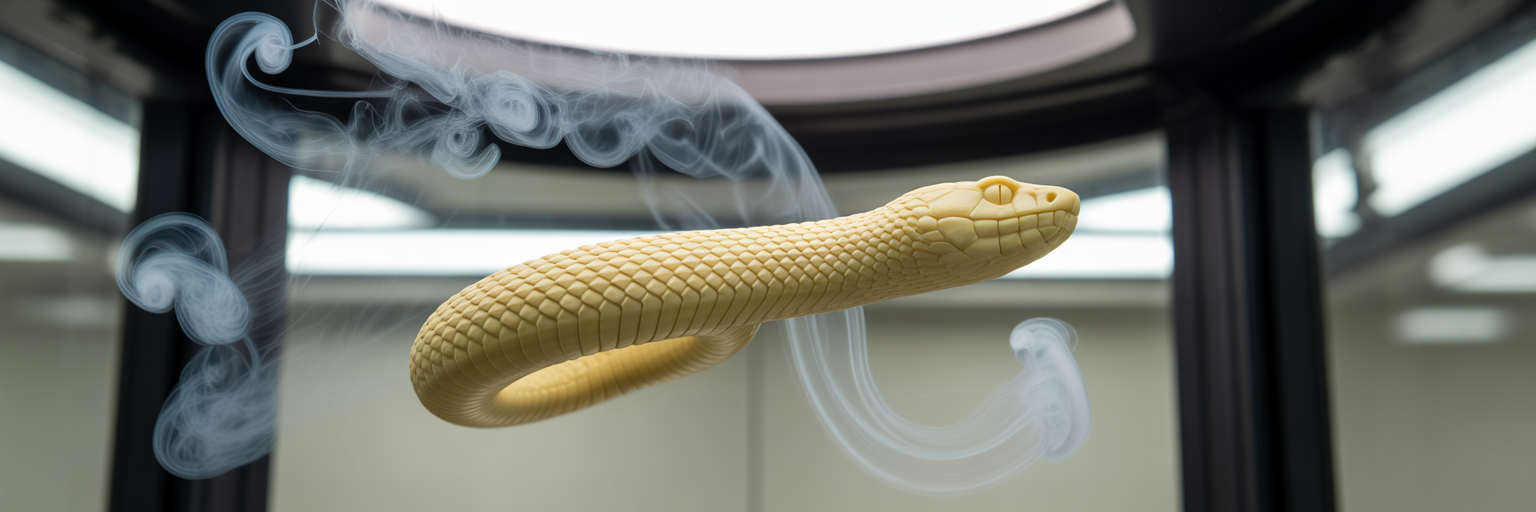
Despite the advanced tools used to study them, flying snakes continue to present a puzzle for aerodynamicists. One of the biggest challenges is that their observed glide performance is consistently better than what our current aerodynamic models predict. This discrepancy highlights the limits of our understanding.
Many early or simplified models of snake flight rely on “quasi-steady” aerodynamic theory. This approach makes a simplifying assumption: it calculates the forces on the snake’s body at any given moment as if it were moving in a steady, unchanging state. However, this theory is inadequate for describing the reality of snake aerial locomotion. The snake’s body is constantly changing shape and undulating, which creates highly “unsteady” airflow patterns that the quasi-steady model cannot account for.
The key to this puzzle likely lies in the complexities of unsteady aerodynamics. The snake’s constant motion generates vortices, which are swirling patterns of air, at the leading and trailing edges of its body. These vortices do not simply dissipate. They can interact with the body and the surrounding airflow in ways that may significantly enhance lift production. This phenomenon, known as vortex-induced lift, is not captured by simpler models but could be a major contributor to the snake’s remarkable performance. The current frontier of research is to develop models that can accurately simulate the intricate, real-time feedback loop between the snake’s active body movements, the resulting unsteady airflow, and the generation of these complex vortex structures.
The Final Verdict on Flying Snake ‘Flight’
After examining the evidence from takeoff to landing, we can deliver a clear verdict on the aerial abilities of the flying snake. The findings from biomechanics and fluid dynamics provide definitive answers to the core questions surrounding their unique form of locomotion.
First, can flying snakes gain height? The answer is no. In still air and under their own power, they are always in a state of descent. They are masters of converting potential energy from height into horizontal travel, but they cannot generate the thrust needed to achieve a positive climb angle or end a glide higher than they started. The moments that appear to be upward movement are actually a “shallowing” of the glide path, where they dramatically reduce their rate of fall.
Second, are they truly flying? The answer to “can snakes fly” in the way a bird does is also no. They are not powered fliers but are instead supreme gliders. They do not flap to overcome gravity. Instead, they generate exceptional lift with their flattened bodies to slow their fall and control their path with a precision that rivals many winged animals.
Third, what does the aerial undulation accomplish? It is not for propulsion. It is a critical, active stabilization system. This constant S-shaped motion prevents the snake from tumbling uncontrollably, keeps its body oriented to maximize lift, and allows it to steer toward a landing target.
Finally, what remains unexplained? The biggest mystery is the precise, moment-to-moment interaction between the snake’s morphing body, the unsteady airflow it creates, and the role of vortices in potentially enhancing lift. While we know what they do with incredible accuracy, a complete explanation of how they achieve such high aerodynamic performance remains a compelling challenge for scientists.
Frequently Asked Questions About Flying Snakes
Are flying snakes venomous?
Yes, they are mildly venomous. However, they are not considered dangerous to humans. Their venom is effective on their small prey, like lizards and frogs, but their small, rear-facing fangs make it very difficult for them to bite a person, and their venom is not potent enough to cause a serious reaction in humans.
Where do flying snakes live?
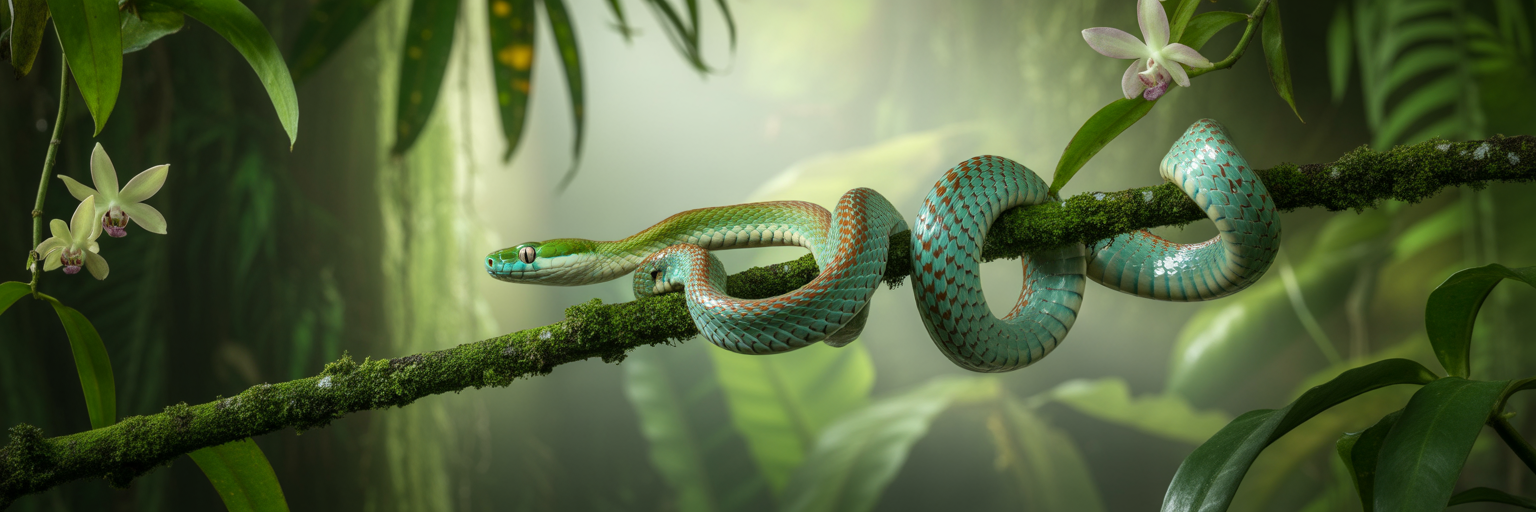
Flying snakes are native to the tropical rainforests of Southeast and South Asia, including countries like India, Sri Lanka, Vietnam, and the Philippines. They are arboreal, meaning they live in trees, an environment that is essential for their gliding lifestyle.
How far can a flying snake glide?
Their glide distance depends heavily on their launch height. Measured glides have documented horizontal travel exceeding 100 meters (over 300 feet) when launching from a sufficient height, showcasing their incredible efficiency as gliders.
Can a flying snake correct a bad glide?
Yes. The in-air undulation is an active stability and control system. This allows them to correct for instability, prevent tumbling, and actively steer their bodies to navigate around obstacles and aim for a specific landing spot.
Why do they glide in the first place?
Gliding is a highly energy-efficient method for moving between trees in the rainforest canopy. It allows them to hunt for prey (such as lizards, frogs, birds, and bats), escape from predators, and travel across their habitat without having to descend to the dangerous forest floor.