
A dung ball seems an unlikely reason to consult the galaxy. For the nocturnal beetle Scarabaeus satyrus, however, the pale band of the Milky Way helps keep dinner moving in a straight line. Its challenge is simpler than finding a distant destination: choose a heading, then avoid circling back toward competitors. Its sky-based reference is one more addition to the extraordinary range of biological compasses used by animals.
A compass for getting away
After shaping a ball at a dung pile, a rolling beetle benefits from leaving quickly. Other beetles can steal its work. A straight route provides an efficient escape, even when the landscape offers few obvious landmarks. The sky supplies a reference that remains useful as the insect moves.
This is orientation rather than a complete navigational map. The beetle does not need to calculate coordinates or recognize a destination. A compass can help it maintain a heading without telling it where that route ends.
What a straight line actually solves
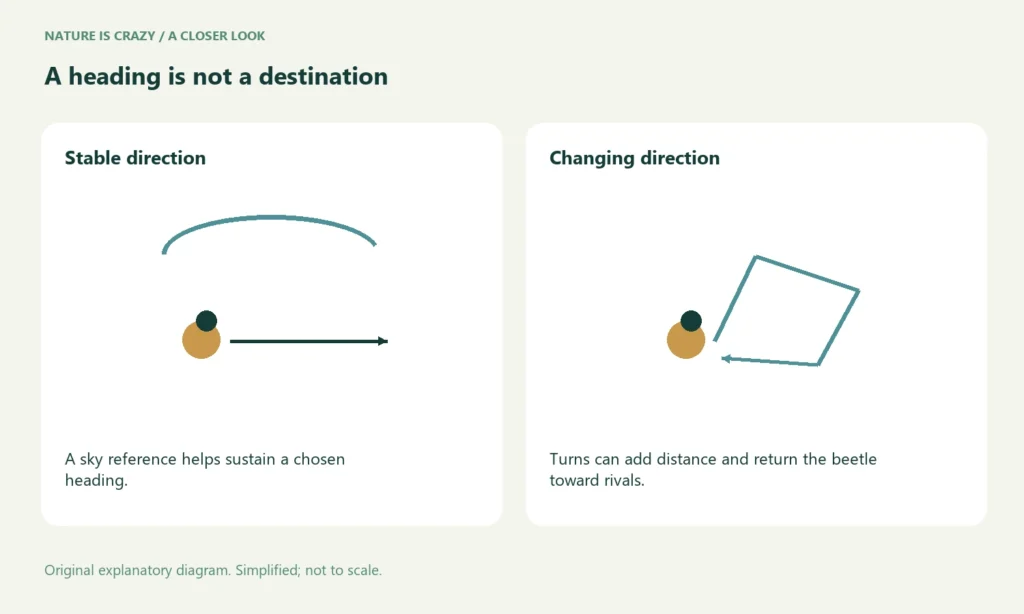
For a rolling beetle, a good compass need not point north. Any sustained heading that carries the ball away from the crowded food source can be useful. If the insect keeps changing direction, the extra distance costs time and may take it back toward rivals. The benefit comes from consistency, not from choosing a special destination.
This is why a beetle’s route and a migratory bird’s journey should not be treated as the same task. Long-distance navigation may require recognizing a position relative to a goal. Rolling away requires stabilizing motion against a reference. A sky that looks featureless to a casual observer can still offer enough information for that smaller problem.
Compare this visual solution with magnetic crystals that orient bacteria. In both cases, the useful information depends on what the organism needs to accomplish.

The planetarium experiment
In a 2013 study of celestial orientation, researchers tested beetles outdoors and in a planetarium. Blocking their view of the sky made their routes less efficient. Indoors, the team could present a complete star field, selected stars, darkness, or the Milky Way alone.
The beetles performed similarly under the complete sky and the Milky Way by itself. A few bright stars were less useful. The result points to the broad band of light as a directional cue; it does not require the insects to recognize human constellations.

The beetle does not need an astronomer’s view
A human looking through binoculars sees detail that a beetle’s small eyes cannot resolve. That does not make the Milky Way useless to an insect. The collective glow can supply a large-scale pattern even when most individual stars are too faint to distinguish.
Research on the mechanism of Milky Way orientation tested artificial celestial patterns and examined the brightness distribution the insect could detect. The relevant information is not simply that a band exists: differences in brightness across the sky can help break its directional symmetry. A perfectly uniform stripe would leave more ambiguity than a stripe with unequal regions.
The distinction matters because “uses the stars” can suggest a miniature constellation chart. The evidence instead supports extracting a simpler visual feature. A compass does not have to reproduce the entire sky to preserve a direction.
Why the beetle dances
A beetle sometimes climbs onto its ball and rotates before setting off. Later research described a snapshot strategy: it samples celestial cues and compares that reference with the view while rolling. “Snapshot” describes a model of the behavior, not a claim that its brain works exactly like a camera.
This differs from animals that detect Earth’s magnetic field. Even bacteria with internal compass crystals solve directional problems using different equipment.
Why manipulating the sky makes the evidence stronger
Watching a beetle roll on a clear night shows a correlation. Changing which features appear above it offers a test of causation. The planetarium allowed researchers to isolate cues that naturally occur together, then measure the animals’ ability to leave the arena under each condition.
Removing a cue is especially informative when other aspects of the task remain available. If performance deteriorates without the Milky Way, that provides a different kind of evidence from simply observing successful rolling beneath it. Reintroducing a simplified pattern then asks how little visual information is enough.
The result is a chain of explanation: a behavioral problem, a proposed sensory cue, and an intervention that changes performance. A similarly careful separation of sound and perception appears in experiments on rattlesnake warnings that alter distance judgments.
The lesson is not that dung beetles understand the galaxy. An animal can exploit a reliable environmental pattern without representing its astronomical origin. To the beetle, the Milky Way is useful information; its value lies in keeping a valuable ball on course.
When streetlights overwhelm the sky
A 2021 light-pollution study found that beetles at an illuminated urban site turned toward artificial lights instead of using their usual celestial reference. A darker rural site provided a comparison.
Featured image credit: Image: Udo Schmidt from Deutschland. Original image · CC BY-SA 2.0. Resized and converted to WebP; image remains under its original license.