Somewhere under a hardwood forest in Ohio, a nymph is currently in its fourteenth year of sitting in the dark drinking sap from a tree root. It has been doing this since before some of the trees above it were planted. In three years, on cue, it will dig upward with millions of siblings, spend about four weeks screaming and mating, and die.
The genus is Magicicada, and it comes in two varieties: 13-year and 17-year. Both numbers are prime, divisible only by themselves and one. This is one of the very few cases in biology where the abstract mathematical property of a number appears to have direct evolutionary consequences.
Why periodical cicadas emerge all at once
Start with the simpler question, because the synchrony matters as much as the interval.
Periodical cicadas are defenceless. They do not bite, sting, or produce toxins. They fly badly. They are large, slow, conspicuous, and apparently delicious to anything with a beak. Individually, a cicada is a free meal.
Collectively, they are an unsolvable logistics problem. Emergence densities can exceed a million individuals per acre, and the strategy is called predator satiation: release so many bodies at once that every predator in the county eats until it physically cannot continue, and the vast surplus survives to breed. Birds, raccoons, foxes, fish, and squirrels all gorge, and it barely dents the population.
Kathy Williams and colleagues documented this quantitatively in a 1993 study of a 13-year emergence in Arkansas, tracking mortality against emergence density and confirming that survival improved sharply where cicadas emerged in the greatest numbers. Being common is the defence.
That explains synchrony. It does not explain 17.
The prime number argument
The classic explanation, proposed formally by entomologists Monte Lloyd and Henry Dybas in 1966 and later popularised by Stephen Jay Gould, is about avoiding coincidence.
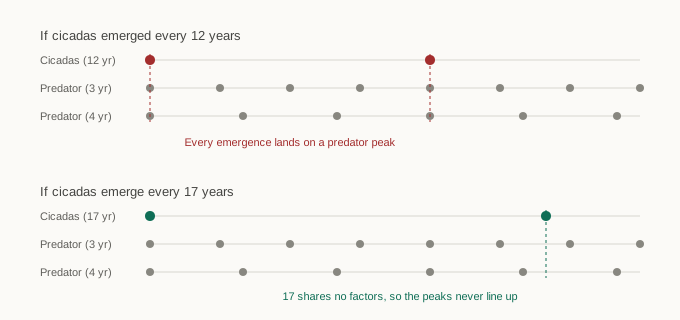
Imagine a predator with a boom-and-bust population cycle of its own — say a bird whose numbers peak every three years, or a parasite that runs on a five-year cycle. If cicadas emerged every 12 years, that 3-year predator would be at peak abundance for every single emergence, because 3 divides 12 evenly. A 4-year predator likewise. A 6-year predator likewise. A 12-year cycle is a standing invitation.
Now try 17. A 3-year predator lines up with a 17-year emergence only once every 51 years. A 5-year predator, once every 85. A 6-year predator, once every 102. Because 17 shares no factors with anything smaller than itself, no shorter-cycled specialist can ever synchronise reliably enough to make cicadas a dependable food source. The prime interval makes specialisation on periodical cicadas evolutionarily unprofitable.
There is a second, related argument that many researchers now consider the stronger one: hybridisation avoidance. Broods with different cycle lengths that emerge in the same year can interbreed, and hybrid offspring with intermediate, non-synchronised timing lose the protection of the mass emergence entirely. Prime-numbered cycles minimise how often different broods coincide — a 13-year and a 17-year brood share an emergence year only once every 221 years. Composite cycles would collide far more often, bleeding the population’s synchrony away.
The problem with the prime number argument
Here is where honest reporting requires a caveat that most articles about periodical cicadas skip.
Every cicada species on Earth faces predation. Only a handful anywhere are periodical — Magicicada in North America, plus isolated cases in India and Fiji. If prime-numbered periodicity were straightforwardly the optimal anti-predator solution, it is difficult to explain why it is so vanishingly rare.
This has pushed researchers toward layered explanations. One leading account invokes glacial cooling: during ice ages, cool summers made it harder for nymphs to reach maturity, selection favoured longer development, and adult densities dropped so low that finding a mate became the limiting problem. Under those conditions, synchronised emergence would be strongly favoured — and only after periodicity was locked in would selection begin fine-tuning the interval toward primes.
In this version the prime numbers are real but late. They are a refinement on a system that evolved for other reasons.
Field evidence from 2013 gave the predation side genuine support: William Koenig and Andrew Liebhold found that cicada emergences appear to push local bird populations onto numerical trajectories that leave predation pressure measurably lower at the next emergence. The cicadas are not just satiating predators in the moment; they may be reshaping predator population dynamics across the whole interval.
The debate is not settled. It is a good example of a question where the popular explanation is roughly right, incomplete, and still being actively worked on.
Nobody knows how they count
The deepest mystery about periodical cicadas is not the number. It is the counting.
A nymph spends 13 or 17 years underground with no direct access to seasons — no daylight, minimal temperature variation at depth, no obvious calendar. Yet emergence is accurate to the year across millions of individuals spread over hundreds of miles, and they all come up when soil temperature at 20 centimetres hits roughly 18°C.
The leading model involves counting years indirectly, through the trees. Nymphs feed on xylem fluid from roots, and that fluid changes composition as the host tree cycles through dormancy and leaf-out each spring. Counting those annual chemical shifts would give a usable calendar. Supporting evidence comes from an elegant accident: when researchers grew host trees on an artificially doubled flowering cycle, cicadas feeding on them emerged years early.
Recent work adds a second layer. Field excavation of nymphs of known ages, combined with gene expression profiling, points to an internal four-year “gate” coupled to a body-size threshold — the nymph can only transition at certain checkpoints, and only if it has grown enough. Thirteen and seventeen may partly emerge from the interaction between that gating rhythm and growth rate.
A creature with no brain to speak of, no light, and no clock is tracking nearly two decades and hitting its mark to within a few weeks. We still cannot fully explain it.
The four weeks that justify seventeen years
What happens above ground is brief and extraordinarily loud.
Nymphs surface at night, climb the nearest vertical surface, and moult into adults, leaving the amber exoskeletons that end up plastered across tree trunks and fence posts. The adults need several days to harden before the chorus starts.
Male periodical cicadas sing using tymbals — ribbed membranes on the abdomen that buckle and pop, with the largely hollow abdomen acting as a resonating chamber. A single male is loud. A chorus of hundreds of thousands in the same stand of trees reaches sound pressure levels comparable to power tools, loud enough that people living inside an emergence report difficulty holding conversations outdoors. Different Magicicada species sing distinct songs and respond to distinct female wing-flick replies, which is how three or four species emerging in the same place at the same time avoid interbreeding.
After mating, females cut slits into the thin branches of woody plants with a blade-like ovipositor and deposit eggs inside. The damage causes branch tips to wither and break — an effect called flagging, which is visually alarming and generally harmless to mature trees, though young saplings and orchard stock can take real losses.
Then the adults die, all of them, more or less at once.
An ecological pulse that lasts for years
The aftermath is where periodical cicadas stop being a curiosity and start being a force.
An emergence dumps an enormous quantity of nitrogen-rich biomass onto the forest floor over a few weeks. Decomposing cicadas act as a massive fertiliser pulse, and studies of forest plots have measured elevated nitrogen availability, increased microbial activity, and improved growth in plants for seasons afterward.
The effects ripple through animal populations too. Predators that gorge on the emergence — birds, small mammals, fish — often show elevated reproductive success that year. And the consequences of that boom are precisely what makes the Koenig and Liebhold finding interesting: a bird population that spikes in a cicada year may then crash or shift in subsequent years, leaving predation pressure lower when the next emergence arrives.
The cicadas are not merely surviving their predators. Across a 17-year cycle they may be actively manipulating them.
Meanwhile the newly hatched nymphs drop from the branches, burrow into the soil, find a root, and begin counting again. The next generation of that Ohio brood will emerge in the 2040s, into a forest none of them will ever see the current version of.
Sources
- Lloyd, M. & Dybas, H.S. (1966). The periodical cicada problem. Evolution 20: 133–149 and 466–505.
- Williams, K.S., Smith, K.G. & Stephen, F.M. (1993). Emergence of 13-yr periodical cicadas (Cicadidae: Magicicada): phenology, mortality, and predator satiation. Ecology 74(4): 1143–1152.
- Yoshimura, J. (1997). The evolutionary origins of periodical cicadas during ice ages. The American Naturalist 149(1): 112–124.
- Koenig, W.D. & Liebhold, A.M. (2013). Avian predation pressure as a potential driver of periodical cicada cycle length. The American Naturalist 181(1): 145–149.
- Ito, H. et al. (2015). Evolution of periodicity in periodical cicadas. Scientific Reports 5: 14094.
- Saito, Y. et al. (2026). Decoding the periodical cicada clock: field evidence and genomic insights. Proceedings of the Royal Society B 293(2062).