
The Amazing Bird That Carries Water in Its Feathers
In the vast, sun-scorched deserts of southern Africa, survival hinges on ingenious solutions. One of the most remarkable belongs to a father bird who performs a seemingly impossible task. Across the arid landscapes of the Kalahari and Namib deserts, the male Namaqua sandgrouse undertakes a daily mission that defies conventional biology. He transports life-sustaining water to his chicks, not in his beak or crop, but absorbed directly into his belly feathers. This is the story of the bird that carries water in its feathers, a feat of natural engineering born from the pressures of an extreme environment.
The challenge is immense. Water holes are few and far between, and the sandgrouse nests on the open ground, often many kilometers away from the nearest reliable source. The chicks, though able to walk and feed themselves soon after hatching, are flightless and completely vulnerable. They cannot make the long and dangerous journey to water. Their survival depends entirely on the father’s ability to bring the water to them. This behavior is far more complex than simply soaking ordinary plumage. It relies on a highly specialized anatomical adaptation, a microscopic marvel that allows the male to become a living canteen for his offspring.
Life in a Water-Scarce World
Life in the desert is a constant battle against dehydration. With scorching temperatures and scarce, unpredictable rainfall, every drop of water is precious. For ground-nesting birds like the sandgrouse, these challenges are amplified. To protect their young from predators such as jackals and falcons that patrol oases, sandgrouse parents make a critical trade-off. They choose nesting sites on the barren, open ground, far from the life-giving water sources where threats congregate. This strategy increases safety but creates a formidable logistical problem: how to hydrate their chicks.
The young sandgrouse are precocial, meaning they hatch with their eyes open and are covered in down, ready to move and forage for seeds within hours. However, they remain flightless for their first month of life, tethered to the area around their nest. This inability to travel makes them completely dependent on their parents for water. In the intense desert heat, a growing chick needs a regular supply of water to survive, making the father’s daily journey an absolute necessity. These desert bird adaptations are a testament to the incredible ways life finds a way to persist. Some animals have even evolved to thrive by shrinking their own organs to conserve energy, a strategy detailed in the incredible story of the animal that survives by shrinking its own organs. For the sandgrouse, the solution lies not in conserving energy, but in transporting a vital resource.
A Father’s Daily Pilgrimage for Water
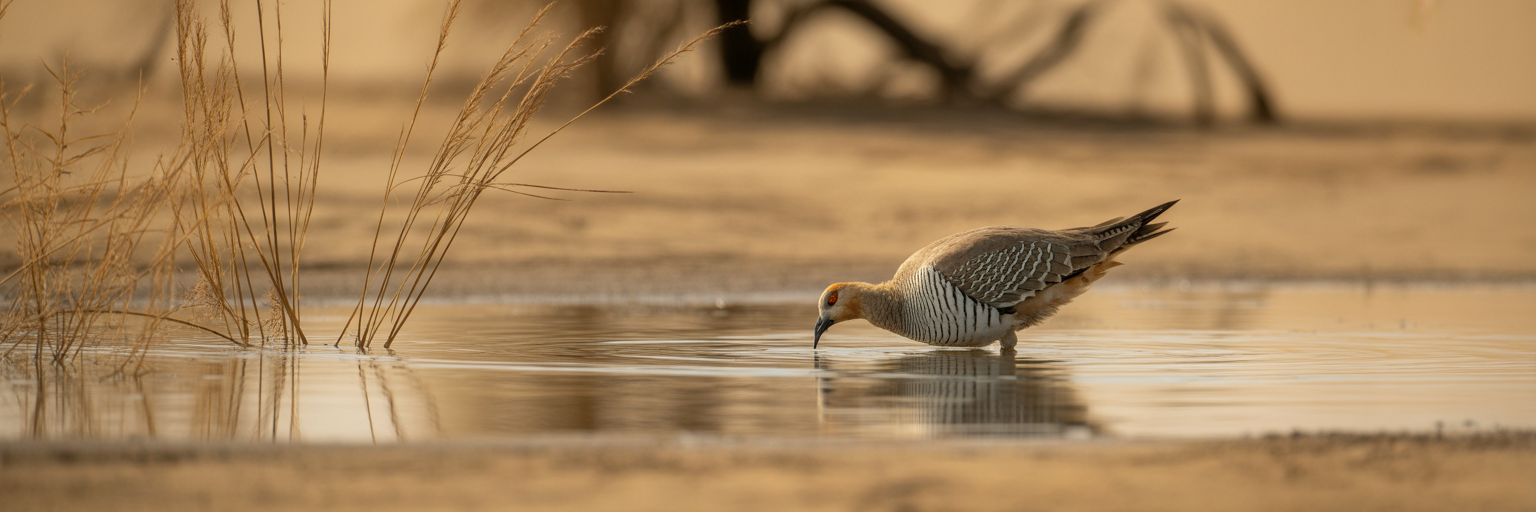
Each morning, the male sandgrouse embarks on his pilgrimage. He can fly at speeds approaching 60 kilometers per hour, covering distances of up to 30 kilometers or more to reach a favored watering hole. His arrival is a study in purpose. While other birds may drink quickly and depart, the sandgrouse has a different agenda. He wades into the shallow water, often chest-deep, and begins a distinctive rocking and bobbing motion. This is not a casual bath; it is a deliberate act to force water past the outer feathers and into the specialized absorbent plumage beneath.
For several minutes, he will fluff and agitate his belly feathers, ensuring they become completely saturated. This behavior stands in stark contrast to that of most other birds, whose feathers are naturally water-repellent, or hydrophobic. A duck’s feathers, for example, are designed to keep the bird dry and insulated. The male sandgrouse, however, possesses feathers that are hydrophilic, engineered specifically to attract and hold water. After his belly is fully loaded, he takes flight, his body heavy with the precious cargo he carries back to his waiting family. The journey is a race against evaporation, a testament to a father’s dedication in one of Earth’s most unforgiving landscapes.
The Microscopic Secret of Water-Holding Feathers
The ability of the male sandgrouse to carry water is not magic; it is a masterpiece of microscopic engineering. For decades, the exact mechanism remained a mystery. As highlighted in a report from The Royal Society, modern imaging techniques like scanning electron microscopy have finally revealed the secrets hidden within the Namaqua sandgrouse feathers. Unlike the smooth, interlocking structure of a typical flight feather designed for water repellency, the male’s belly feathers are uniquely modified for absorption.
The feather’s barbules, the tiny filaments branching off the main barbs, are the key. They have a unique two-zone structure. The inner zone, closest to the feather’s central shaft, is a dense collection of barbules that have a helically coiled base and a straight, hair-like tip. When these feathers become wet, a remarkable transformation occurs. The coiled bases of the barbules passively unwind and rotate. This action shifts them from a position parallel to the barb to one that is perpendicular, creating a dense, tangled forest of fibers. This newly formed matrix is incredibly effective at trapping and holding water molecules.
Simultaneously, the barbules in the outer zone, which are straighter, curl inward when wet. They act as a protective cover, holding the water within the inner fibrous mesh and reducing loss from spillage. This entire shape-changing process is driven by the physical properties of keratin, the protein that makes up feathers. It is a completely passive system that is fully reversible. Once the feathers dry, the barbules return to their original coiled state, ready for the next water-carrying mission.
The Physics of a Leak-Proof Flight
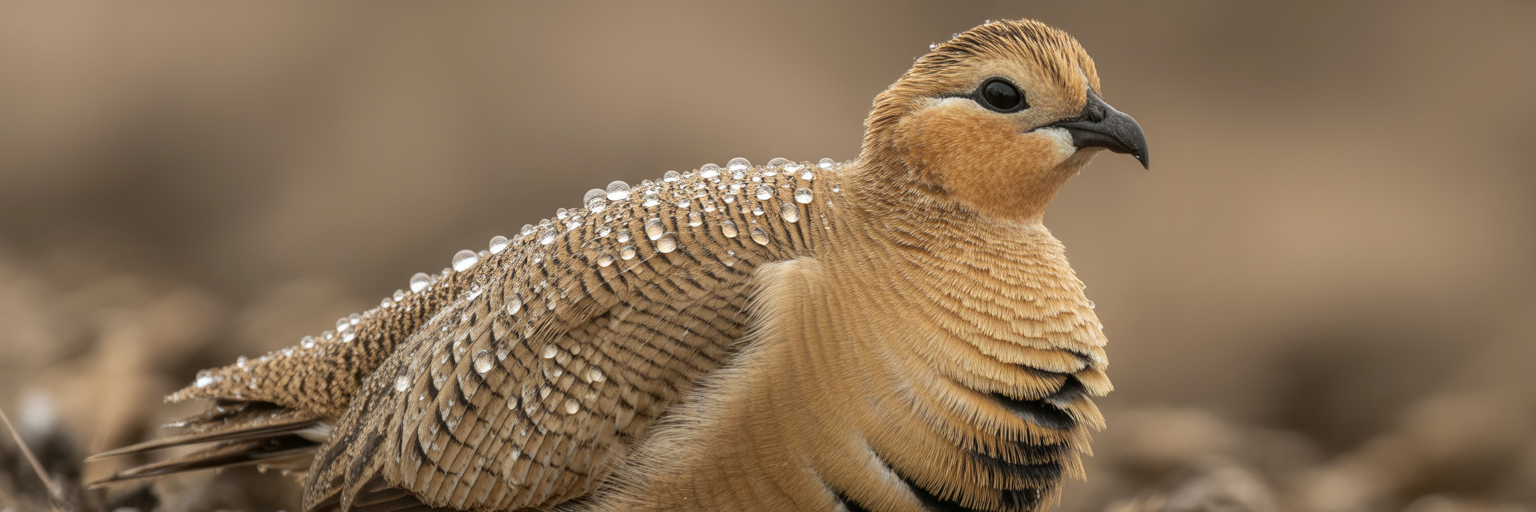
Holding onto a significant amount of water during a high-speed, 30-minute flight seems impossible, yet the sandgrouse achieves it through a combination of brilliant structural design and fundamental physics. The primary force at play is capillary action. After the feather barbules unwind and form their dense, sponge-like mesh, the tiny spaces between the fibers act like microscopic straws, drawing water in and holding it against the pull of gravity. This is the same principle that allows a paper towel to absorb a spill.
Surface tension also plays a critical role. Water molecules have a natural tendency to cling to each other and to the surfaces they touch. Within the feather structure, this cohesion forms thousands of minuscule, tear-drop-shaped containers of water around the individual barbules. These tiny liquid pockets are surprisingly resilient, resisting the jolts and air resistance of flight. The feather’s overall architecture provides the necessary support. The stiff main shaft (rachis) and barbs create a rigid framework, while the highly flexible barbules deform to create the water-trapping matrix. This combination of a strong frame and a dynamic, absorbent filling is the essence of successful sandgrouse water transport.
The results are impressive. A male sandgrouse can carry approximately 25 milliliters of water, which can be up to 15% of his total body weight. Even after accounting for evaporation during the long flight back to the nest, he can still deliver between 10 and 18 grams of water, a life-saving drink for his thirsty chicks.
A Drink of Water at the Nest
The arrival of the male at the nest is a moment of high drama and relief. The chicks, who have been waiting under the watchful eye of their mother, immediately recognize his return and the promise of water. They eagerly crowd around him, chirping with anticipation. The father stands upright, presenting his water-laden belly to his offspring. This posture is the signal for the chicks to begin drinking.
The process is a marvel of cooperative behavior. The chicks press their small beaks into the wet plumage and use their bills to methodically strip or “squeegee” the water from each feather. They work their way through the saturated patch, drawing out every available drop. The father stands patiently for several minutes, remaining still until his chicks have had their fill and his feathers are nearly dry. This unique delivery system is the only way the young birds can obtain water, making each of these interactions a life-or-death event. This level of parental dedication is seen across the animal kingdom in many forms, including the strange birth process of the Suriname toad that gives birth through holes in its back, another example of evolution finding an extraordinary solution to the challenges of reproduction.
A Specialized Role for the Father
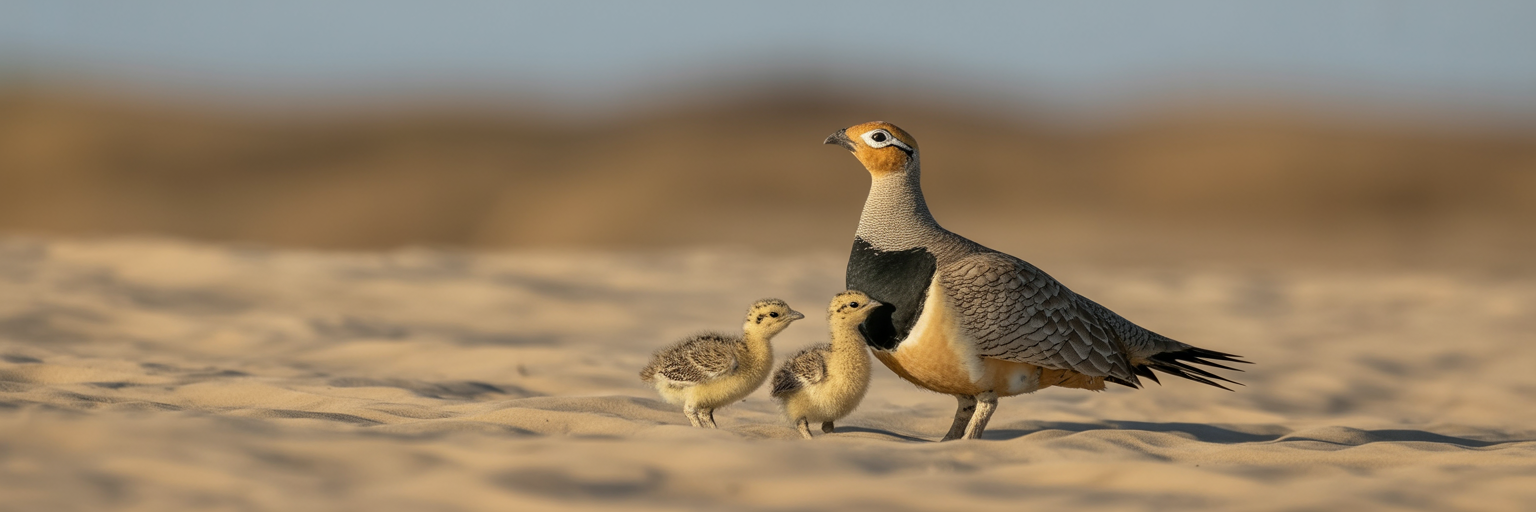
A common question is whether the female sandgrouse also participates in this remarkable water-carrying duty. The answer is no; this task is reserved exclusively for the male. While the female plays an equally vital role by staying with the chicks to provide shade from the relentless sun and guard against predators, she is not equipped for water transport. Her belly feathers are conventional and water-repellent, lacking the specialized coiled barbules that allow the male’s feathers to absorb and hold liquid.
This is a classic example of sexual dimorphism, where males and females of the same species evolve different traits and behaviors tied to their specific parental roles. Evolution has shaped the male sandgrouse into a living water tanker, a specialization that complements the female’s role as a guardian. This division of labor ensures the chicks are both protected and hydrated, maximizing their chances of survival in a harsh environment. The distinct adaptations of each parent are a perfect illustration of how natural selection can fine-tune a species for reproductive success.
| Feature | Male Sandgrouse | Female Sandgrouse |
|---|---|---|
| Primary Parental Duty | Water transport and delivery | Brooding and guarding chicks |
| Belly Feather Structure | Specialized with coiled barbules | Conventional, water-repellent |
| Water-Holding Capacity | High (up to 25 ml) | Negligible |
| Behavior at Water Hole | Wades and soaks belly feathers | Drinks only |
From Legend to Scientific Breakthrough
The story of the water-carrying sandgrouse traveled from desert folklore to scientific fact over nearly a century. As Audubon magazine reports, one of the first documented accounts came from naturalist E.G.B. Meade-Waldo in the late 19th century. His observations of birds arriving at nests with wet bellies were met with considerable skepticism from the scientific community of the time. The idea of a bird using its feathers as a sponge was simply too strange to be readily believed.
It wasn’t until the 1960s that the behavior was definitively confirmed. Researchers Tom Cade and Gordon MacLean conducted meticulous fieldwork in the Kalahari Desert, observing, capturing, and weighing the birds before and after their visits to water holes. Their work provided undeniable proof that the males were indeed transporting significant quantities of water in their plumage. However, the question of “how” remained unanswered for another 50 years. The true breakthrough came with the advent of modern imaging technology. Using scanning electron microscopy (SEM) and micro-computed tomography (micro-CT), scientists were finally able to see the feather’s intricate microscopic architecture and document its dynamic, shape-changing properties. This journey from a curious anecdote to a detailed biomechanical understanding is a perfect illustration of the scientific process in action.
Nature’s Design Inspiring Human Technology

The sandgrouse feather is a prime example of a highly efficient, passive liquid transport system, and it has captured the attention of engineers and material scientists. This is the essence of biomimicry: studying nature’s time-tested solutions to inspire human innovation. The feather’s ability to both absorb and hold water, and then release it in a controlled manner, offers a blueprint for new technologies. One of the most promising applications is in developing advanced materials for water collection in arid regions. Imagine fog-harvesting nets that not only capture moisture from the air but also store it efficiently, much like the sandgrouse’s feathers.
The potential uses extend beyond water collection. The principles could be applied in medical devices for the controlled delivery of fluids or in industrial processes that require precise liquid management. Nature has already solved countless complex problems, from energy efficiency to material strength, as seen in the elegant mechanics of the Venus flytrap mechanism. In the same way, the principles of specialized design are critical whether evolving a feather or engineering a tool for a specific task, such as choosing trolling lures for big game fishing. By studying the sandgrouse, we learn not only about a remarkable bird but also about new possibilities for our own technology.
Frequently Asked Questions About the Sandgrouse
How much water can a sandgrouse carry?
A male sandgrouse can absorb about 25 ml of water into his specialized belly feathers. This is roughly 15% of his body weight. Although some of this water is lost to evaporation during the flight back to the nest, he can still deliver a substantial drink to his chicks.
Do the female sandgrouse carry water too?
No, this is a male-only duty. The female’s belly feathers lack the special coiled barbules and microscopic structure needed for water absorption. Her role is to stay at the nest to brood and protect the chicks.
Why can’t the chicks just go to the water themselves?
Sandgrouse chicks are flightless for about a month after hatching. Since the nests are often located many kilometers from the nearest water source to avoid predators, the journey is too far and dangerous for the young birds to undertake on foot.
Is the water stored inside the bird’s body?
This is a common misconception. The water is not stored internally in a stomach or crop. It is carried entirely externally, held within the complex, sponge-like structure of the male’s modified belly feathers.
How does the water not fall out during flight?
The question of how birds carry water this way is answered by physics. A combination of strong capillary action, which draws water into the tiny spaces between feather fibers, and surface tension, which makes water molecules cling to each other and the feathers, holds the liquid securely against gravity and air resistance.
Are other birds able to do this?
No, this is a highly specialized adaptation that is believed to be unique to the 16 species of sandgrouse found in the world’s driest regions. It is an evolutionary solution tailored specifically to the extreme challenges of their desert habitats.