We all love a good zombie movie. The slow, shambling hordes, the desperate survivors, the questionable decisions made in a dimly lit basement. But let me tell you a secret: Hollywood is late to the party. Nature has been directing its own zombie horror show for millions of years, and spiders are the unwilling stars. These aren’t your brain-eating, Romero-style zombies. These are the victims of zombie spider parasites, tiny terrors that hijack a spider’s mind and body for their own twisted purposes. It’s one of the most fascinating examples of weird animal parasites you’ll ever come across.
So, what does it mean to be a zombie in the spider world? It’s not about a hunger for brains. It’s about complete and total submission. The parasite takes over, turning the spider into a mindless drone with one final, terrible task to complete. We have two main villains in this story, each with a distinct management style. First, there’s the parasitoid wasp, the ultimate micromanaging tyrant. It gives the spider one last project with a killer deadline. Then there’s the entomopathogenic fungus, which is more like that creepy coworker who slowly moves their stuff onto your desk until you’re just a fuzzy, forgotten husk in the corner.
You might be wondering, why spiders? Well, they’re perfect victims. Many live solitary lives, so there’s no one around to notice their personality has taken a dark turn. Their predictable, instinct-driven behaviours, like web-building, are easy to hack. So grab some popcorn, because we’re about to explore one of nature’s most bizarre and brutal horror stories.
An Introduction to Zombie Spider Parasites
We all love a good zombie movie. The slow, shambling hordes, the desperate survivors, the questionable decisions made in a dimly lit basement. But let me tell you a secret: Hollywood is late to the party. Nature has been directing its own zombie horror show for millions of years, and spiders are the unwilling stars. These aren’t your brain-eating, Romero-style zombies. These are the victims of zombie spider parasites, tiny terrors that hijack a spider’s mind and body for their own twisted purposes. It’s one of the most fascinating examples of weird animal parasites you’ll ever come across.
So, what does it mean to be a zombie in the spider world? It’s not about a hunger for brains. It’s about complete and total submission. The parasite takes over, turning the spider into a mindless drone with one final, terrible task to complete. We have two main villains in this story, each with a distinct management style. First, there’s the parasitoid wasp, the ultimate micromanaging tyrant. It gives the spider one last project with a killer deadline. Then there’s the entomopathogenic fungus, which is more like that creepy coworker who slowly moves their stuff onto your desk until you’re just a fuzzy, forgotten husk in the corner.
You might be wondering, why spiders? Well, they’re perfect victims. Many live solitary lives, so there’s no one around to notice their personality has taken a dark turn. Their predictable, instinct-driven behaviours, like web-building, are easy to hack. So grab some popcorn, because we’re about to explore one of nature’s most bizarre and brutal horror stories.
The Wasp’s Method: A Tiny Brain Surgeon
If the fungal parasite is a brute, the parasitoid wasp is a neurosurgeon with a mean streak. Its method is precise, calculated, and frankly, a masterclass in villainy. This isn’t a random attack; it’s a carefully orchestrated heist of the spider’s free will.
The Attack: A Sting with a Purpose
It all starts with a terrible first date. A female wasp, like one from the Polysphincta wasp spider group, carefully selects her victim. She’s looking for a healthy, robust spider that can serve as both a bodyguard and a pantry for her future offspring. She lands on the spider, delivers a quick, paralyzing sting, and then does something truly awful. She glues a single egg to the spider’s abdomen. The spider wakes up, probably feeling a bit groggy, and goes about its day, completely unaware that it’s now carrying its own doom on its back.
Chemical Warfare: Hijacking the Brain
Once the egg hatches, the larva begins its work. It doesn’t just feed on the spider; it starts a campaign of chemical warfare. This is the key to how do zombie spiders work in this scenario. The larva injects a cocktail of chemicals that act as a neurological override switch. According to research highlighted by the Smithsonian Institution, these wasps are sophisticated chemists. They inject venom containing psychotropic compounds that appear to hack the spider’s own hormonal system, turning its biological code against it. It’s believed these chemicals mimic the spider’s molting hormones, tricking its brain into initiating a completely different set of behaviours.
The Final Project: Building a Death Cocoon
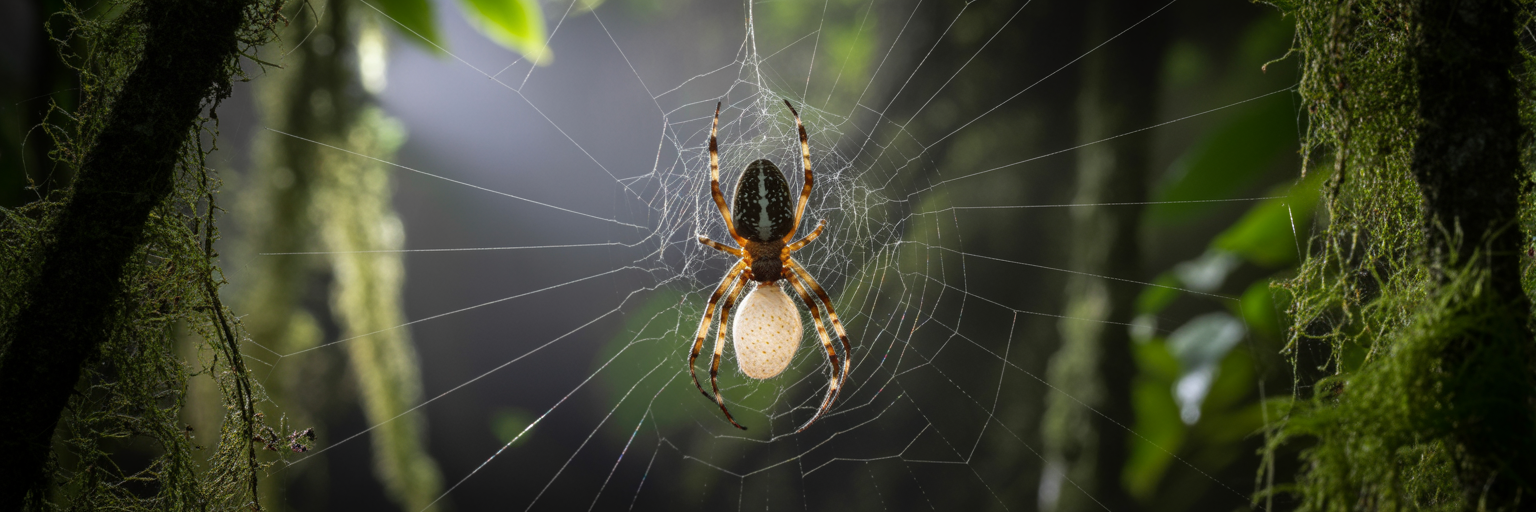
This is where things get truly strange. As the larva gets ready to pupate, it gives the spider one final, terrible assignment. The spider, now a mindless puppet, begins to dismantle its own beautiful, intricate web. In its place, it builds a new structure: a thick, heavily reinforced web designed not to catch food, but to protect the wasp larva. This is the grim finale of the parasitoid wasp life cycle. The spider is essentially building a fortified nursery for the creature that is actively eating it alive. It’s the worst internship in the history of the animal kingdom.
The Host’s Demise
Once the “cocoon web” is complete, the spider’s work is done. It hangs motionless in the center of its creation. The wasp larva, having no more use for its host, delivers the final blow, sucking the spider dry of its remaining fluids. It then spins its own cocoon inside the safe, custom-built web, ready to emerge as an adult and start the whole horrifying cycle over again. The spider gets no thank you, no severance package, just the quiet dignity of being a drained husk swinging in the breeze.
The Fungal Approach: A Fuzzy, Hostile Takeover
If the wasp is a meticulous micromanager, the spider mind control fungus is the corporate raider staging a hostile takeover. There’s no subtlety here, just a slow, creeping invasion that ends in a burst of spores. It’s less of a psychological thriller and more of a body horror film.
Infection by Spore: Death from Above
This nightmare begins with a single, microscopic spore landing on an unsuspecting spider. It’s a stealth attack from above. The spore germinates, penetrates the spider’s exoskeleton, and begins to grow inside its body. The spider has no idea that it’s just become a walking terrarium for a fuzzy, malevolent fungus. It’s not a sudden mugging; it’s a slow, inevitable doom that has already taken root.
A Different Kind of Mind Control
Unlike the wasp, this fungus doesn’t bother with fancy brain chemistry. Its method is far more direct. It’s a brute. The fungus grows its network of filaments, called mycelium, throughout the spider’s body cavity, physically weaving itself into the spider’s muscles and tissues. It’s like a terrible roommate who slowly fills the entire apartment with their junk until you can’t even move. The fungus doesn’t need to convince the brain; it just takes control of the limbs directly, causing spasms and forcing the spider to move against its will.
The ‘Death Grip’: A Final, Fateful Pose
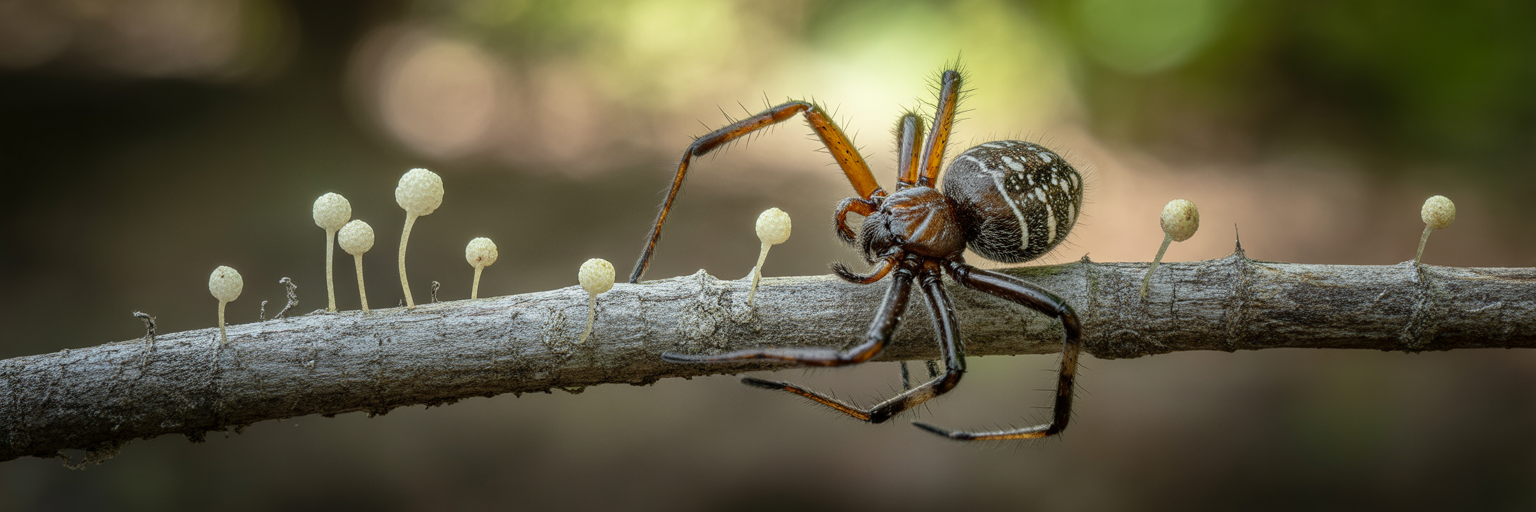
As the fungus nears the end of its takeover, it forces the spider into one final, iconic act. It compels the spider to climb to a high point, usually the underside of a leaf or a twig. Once there, the spider is forced to bite down with all its might, locking its fangs in a permanent “death grip.” For the fungus, it’s all about location, location, location for maximum evil. This high perch is the perfect launchpad for what comes next.
The Grand Finale: A Corpse That Blooms
With the spider locked in place, the fungus consumes what’s left of its insides and prepares for the grand finale. Fruiting bodies, or stalks, erupt from the dead spider’s body, often bursting straight through its head or abdomen. The spider has become a living—well, formerly living—party popper of death. This gruesome finale, where the spider’s body becomes a launchpad for new spores, is a hallmark of araneopathogenic fungi. As experts at Kew Gardens note, these fungi have evolved incredibly specific ways to ensure their life cycle continues, often at the dramatic expense of their eight-legged hosts. These stalks release a fresh cloud of spores onto the unsuspecting spiders below, and the fuzzy, hostile takeover begins anew.
| Aspect of Takeover | Parasitoid Wasp (The Micromanager) | Entomopathogenic Fungus (The Hostile Takeover) |
|---|---|---|
| Method of Attack | A precise sting to lay an egg and inject chemicals. | Airborne spores land on the spider and germinate. |
| Type of Mind Control | Chemical brainwashing; hijacks hormones to alter complex behaviors. | Physical invasion; mycelium grows inside, controlling muscles. |
| Host’s Final Act | Builds a super-strong, specialized ‘cocoon web’ for the wasp larva. | Climbs to a high place and locks on in a ‘death grip’. |
| Parasite’s Goal | A safe, custom-built nursery for its offspring to pupate. | A high-and-mighty perch to spread spores as widely as possible. |
This table breaks down the two main strategies these parasites use. While both end in a dead spider, the wasp is a neuroscientist, and the fungus is a real estate developer.
An Ancient Grudge: The Evolutionary Arms Race
These horror stories aren’t just random acts of cruelty. They are the result of millions of years of co-evolution, a highly specific and personal, long-running grudge match between parasite and host. A particular species of wasp has beef with a particular species of spider, and they’ve been locked in this brutal dance for ages. It’s not just any wasp attacking any spider; it’s a specialist with a very specific set of tools for a very specific victim.
From the parasite’s point of view, this is the ultimate life hack. Why go through the trouble of building a nest, finding food, and protecting your young when you can trick someone else into doing it all for you? And not only do they build the nursery, they also are the nursery food. It’s a strategy of maximum efficiency, outsourcing all of life’s hard work to an unwilling employee who also happens to be the main course.
But this raises a question: does the spider fight back? You bet it does. While our zombified spider is clearly having a very bad day, the species as a whole is not taking this lying down. This is an evolutionary arms race. Spiders may evolve better grooming habits to remove eggs or spores. Their immune systems might develop ways to fight off fungal infections or neutralize wasp venom. In response, the parasites have to evolve even more sophisticated methods of attack. The wasp’s chemical cocktail gets more complex, and the fungus’s spores get stickier. This back-and-forth is a beautiful, brutal, and utterly fascinating real-time example of evolution at work.
Should You Worry? A Guide for Anxious Humans
Okay, let’s be real. You’ve just read about mind-controlling wasps and body-snatching fungi. This sounds exactly like the beginning of a low-budget horror movie. The question on your mind is probably, “Are we next?” I’m here to deliver the good news. Spoiler alert: you’re safe. You can unclench.
The reason you don’t have to worry about a wasp larva turning you into its personal construction worker is simple: you are a terrible host. For starters, our immune system is like a very aggressive bouncer at a very exclusive club, and these parasites do not have the right ID. More importantly, our body temperature is all wrong. At a cozy 37°C (98.6°F), we’re basically a raging furnace compared to a spider. Most of these fungi and wasp larvae would be cooked before they could even get started. It’s like trying to build a gingerbread house in an oven.
Besides, our brains are already far too cluttered with work stress, remembering dozens of passwords, and arguing with strangers on the internet. A parasite wouldn’t be able to get a word in edgewise. The most important factor is host specificity. The parasite’s chemical or biological “key” is designed for a very specific spider “lock.” Trying to use it on a human is like trying to open a bank vault with a paperclip. It’s just not going to work. And it’s not just us saying it. As pointed out by experts at Washington University, while these parasites are masters of zombification in their chosen hosts, the biological leap to humans is pure science fiction. Our physiology is just too different. So, the only thing you need to worry about on your next hike is walking face-first into a normal spider web, which is annoying, but decidedly less existentially terrifying.
Nature’s Tiny Puppet Masters: The Ecological Role
After all this talk of body-snatching and mind control, it’s easy to paint these parasites as pure, mustache-twirling villains. But in the grand theater of the ecosystem, they aren’t monsters. They’re more like nature’s essential, if slightly terrifying, middle managers. Their job is population control, and they are ruthlessly good at it.
By targeting common and abundant spider species, these wasps and fungi act as a natural system of checks and balances. They prevent any single spider species from becoming too dominant, which in turn helps maintain biodiversity among both spiders and the insects they prey on. They ensure no one group gets too powerful, keeping the entire community stable. Their creepy work actually serves a vital purpose.
Their ecological roles can be broken down like this:
- Population Control: They are incredibly effective at keeping spider numbers in check, preventing overpopulation that could disrupt the local food web.
- Promoting Biodiversity: By culling the most common species, they create space for less common spiders to thrive, ensuring a richer, more diverse community.
- Indicators of Health: The presence of these highly specialized parasites is actually a good sign. It means an ecosystem is stable and complex enough to have supported these intricate relationships over thousands of years.
In the end, the story of the zombie spider parasites is a perfect reminder that the natural world is more bizarre, complex, and endlessly fascinating than anything we could ever invent. It shows that for every creature, there’s another creature that has figured out a weird, wonderful, and frankly, horrifying way to make a living off it. It’s a world of tiny puppet masters and their unwilling marionettes, a creepy and captivating performance that leaves you feeling both deeply unsettled and full of wonder.