Beyond Fangs: The Strangest Ways Animals Kill
When you think of predators, you probably picture a lion’s jaw or a shark’s teeth. But nature’s most effective killers often skip the blockbuster action for something far more peculiar.
Forget the dramatic chase scenes and the raw power. Pull up a chair and welcome to the club for nature nerds who appreciate the truly bizarre. We are about to dive into nature’s weird, indie-horror film festival, where the killers are less about brute force and more about being mad scientists, con artists, or physics-defying magicians. This is a guided tour of the strangest ways animals kill, an unhinged hit list that proves intelligence, deception, and a little bit of chemistry can be far deadlier than a mouthful of fangs.
Some animals looked at the whole ‘chasing your food’ thing and thought, “There has to be a better way.” And boy, did they find one. These creatures have evolved hunting methods that are so outlandishly creative, they make a tiger look downright unimaginative. They’re the ones who brought a science experiment to a knife fight and won.
So, get ready to meet the cast of this wild production. We have the tool-wielding geniuses who could probably fix your leaky faucet before stabbing you with it. We have the walking chemical weapons who treat their enemies to a face-melting surprise. Then there are the master manipulators, the smooth-talking con artists of the wild. And finally, the animals that treat the laws of physics like a friendly suggestion. Let’s get weird.
Nature’s MacGyvers: Killers with Tools
Some animals decided that evolving bigger claws was for suckers. Why work harder when you can work smarter? This section is dedicated to the crafty engineers of doom, the creatures who mastered animal tool use for hunting. They are nature’s MacGyvers, turning everyday objects into instruments of delicious destruction.
The Spear-Wielding Chimpanzee
You thought your cousin who does woodworking was intense? Meet the chimpanzees in Senegal. These chimps have been observed sharpening sticks with their teeth to create crude spears. They then use these shivs to stab bushbabies hiding in tree hollows. It’s premeditated, it’s brutal, and it’s basically the Stone Age, but with more fur and a distinct lack of existential dread. And chimps are far from alone in this deadly craft club. As detailed by Discover Wildlife, many predators have learned to kill with weapons and other tools, proving that intelligence is often more dangerous than muscle.
The Adorable Anvil-Slinging Otter
Sea otters look like the fluffiest, most carefree creatures on the planet. They float on their backs, they hold hands, and they have little pouches for their favorite rocks. It’s all incredibly cute until you realize what the rock is for. That rock is an anvil. The otter will place a hard-shelled victim like a clam or a sea urchin on its belly and then smash it to bits with its favorite rock. They are adorable, seafaring blacksmiths forging their next meal on a fleshy, furry anvil.
The Dolphin with a Conch Shell Trap
Dolphins are famously smart, but the bottlenose dolphins of Shark Bay, Australia, are on another level. They’ve developed a technique called “shelling.” When a fish hides in a large, empty conch shell, the dolphin will use its snout to lift the shell to the surface and then shake it vigorously. It’s the animal kingdom equivalent of shaking a vending machine until the snack falls out. It’s clever, a bit violent, and highly effective.
The Original Catfisher: The Green Heron
Long before internet weirdos were using fake profiles, the green heron was perfecting the art of catfishing. But for an actual fish. This bird is a master of bait-fishing. It will find a small object like a feather, a twig, or even a piece of bread, and drop it onto the water’s surface. Curious fish, thinking they’ve found a tasty snack, swim over to investigate, only to be snatched up by the heron’s beak. It’s a brilliant scheme that proves you don’t need a fancy lure when you have a brain.
| Animal | Tool of Choice | Unsuspecting Victim | The ‘MacGyver’ Move |
|---|---|---|---|
| Chimpanzee | Sharpened Stick | Bushbaby | Crafting a spear to stab prey in its sleep. Brutal and effective. |
| Sea Otter | A Favorite Rock | Crabs, Clams, Urchins | Using a rock as an anvil on its belly to smash open hard shells. |
| Bottlenose Dolphin | Conch Shell | Small Fish | Trapping fish inside a shell and shaking it out at the surface. |
| Green Heron | Feather, Bread, or Insect | Small Fish | Dropping ‘bait’ on the water to lure fish right to its beak. |
This table summarizes the ingenious ways different animals have turned everyday objects into lethal hunting instruments. Each strategy is tailored to the animal’s environment and prey.
When Animals Bring a Lab to a Fight
Sure, tools are impressive. But some creatures looked at the options and decided that teeth, claws, and even sharpened sticks were for amateurs. They invested in biochemistry instead. Welcome to the world of animal chemical weapons, where predators and prey alike have turned their bodies into mobile chemistry labs, ready to deploy some truly nasty surprises.
First up is the undisputed king of weaponized flatulence, the bombardier beetle. This little guy has a two-chamber system in its abdomen. When threatened, it mixes two harmless chemicals together, creating a boiling, caustic spray that it can aim with surprising accuracy. It’s a defense mechanism that basically screams, “I will melt your face with my butt cannon.” It’s not just a deterrent; it’s a statement.
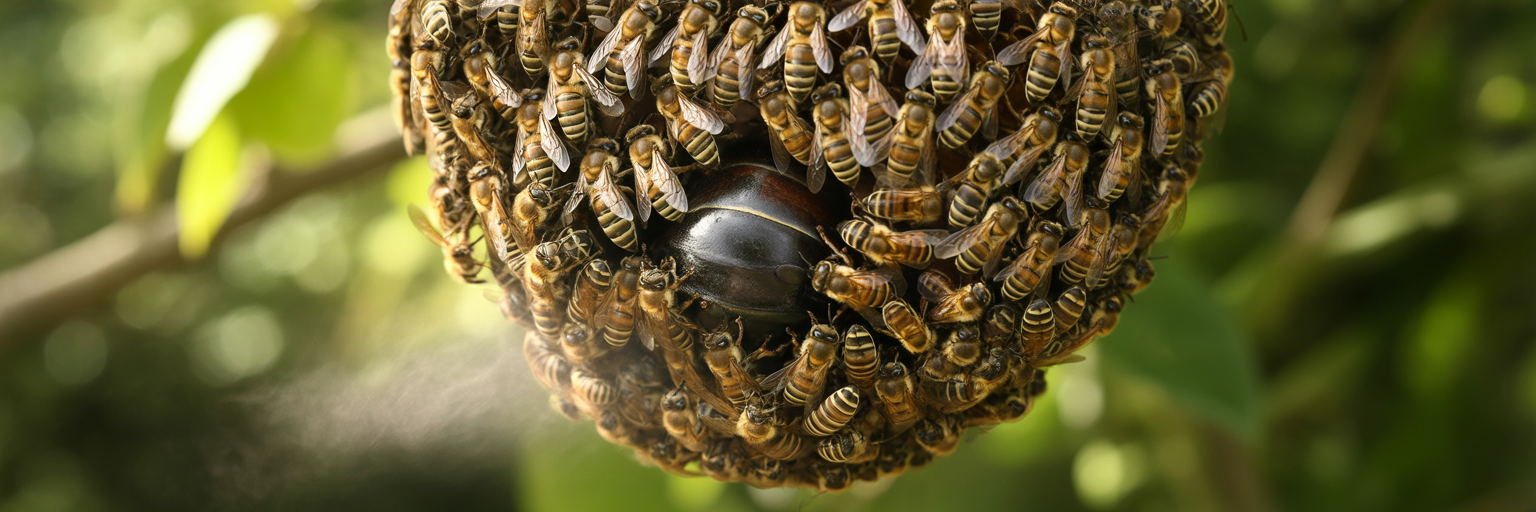
Then there’s the terrifying teamwork of Japanese honeybees. When a giant hornet, a literal murder machine, enters their hive, the bees don’t panic. They execute. Hundreds of them form a “bee ball” around the invader. They don’t sting it. They do something far more horrifying. They vibrate their flight muscles, collectively raising the temperature inside the ball to a scorching 46°C (115°F). This isn’t just a chaotic swarm; it’s a calculated execution. As Discover Wildlife explains, the bees vibrate to generate a deadly fever pitch, effectively roasting the hornet alive in a self-made oven. It is, without a doubt, the most terrifying group hug in history.
To put this in perspective, think of a skunk. A skunk’s spray is unpleasant. It makes you wish you were somewhere else. A bombardier beetle or a bee ball makes sure you’re never anywhere again. One is a social inconvenience; the others are a one-way ticket to the great beyond.
The Con Artists of the Animal Kingdom
Now we enter the shady underbelly of the natural world. This is an exposé on the liars, cheats, and scammers who use deception as their primary weapon. These masters of unusual predator strategies prove that if you can’t outrun your prey, you can always just trick it into eating itself. Let’s open the case files.
- The Bolas Spider: This spider is too cool for webs. Instead, it dangles a single strand of silk with a sticky glob at the end, the “bolas.” It then swings this weapon and releases a puff of pheromones that perfectly mimic a female moth. Hopeful male moths, thinking they’re about to get lucky, fly right into the trap. It’s a deadly dating app where swiping right gets you eaten.
- The Photuris ‘Femme Fatale’ Firefly: The night is dark and full of terrors, especially if you’re a male firefly looking for love. The Photuris female has a dark secret. She can mimic the flash patterns of other firefly species. When a hopeful male from another species responds to her false signals, he flies in expecting a mate and gets a mouthful of mandibles instead. It’s a tragic tale of love, light, and straight-up cannibalism.
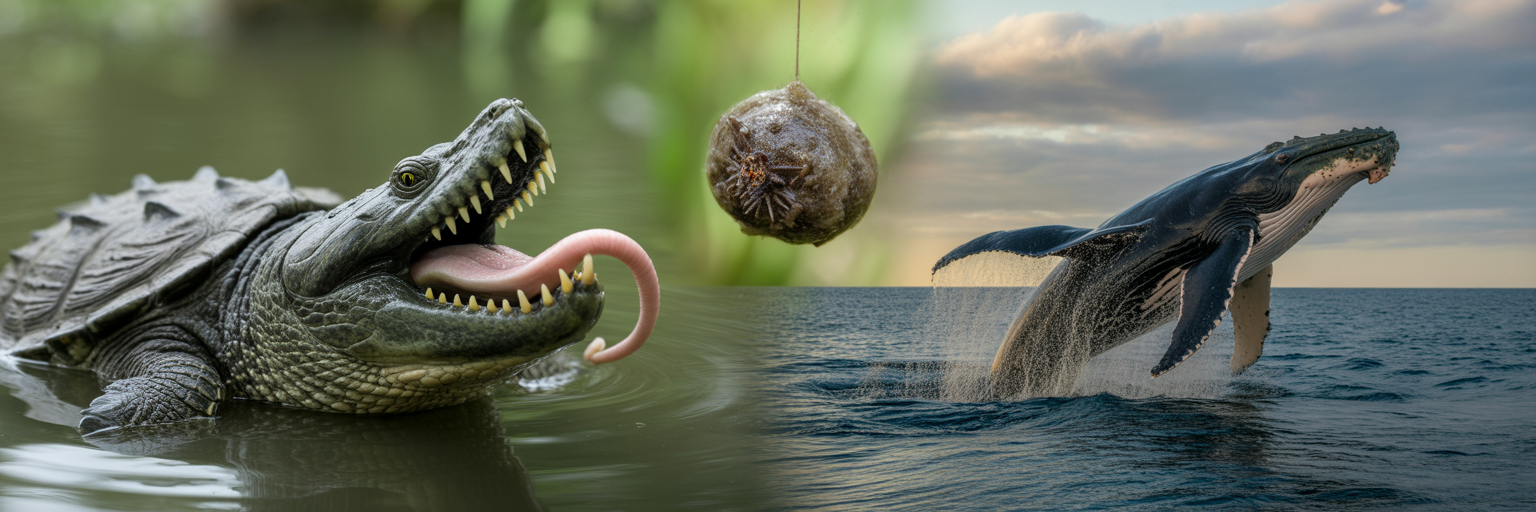
- The Alligator Snapping Turtle: This is a masterclass in patience and one of the most bizarre animal facts you’ll ever hear. The alligator snapping turtle sits at the bottom of a murky river, perfectly still, with its mouth wide open. The only thing moving is its tongue, which is bright red and shaped like a wriggling worm. A curious fish swims in for an easy meal, only to find itself inside a bone-crushing trap. It’s the ultimate “come to me” move, and it’s lethally effective.
So why all the lying? It’s simple evolutionary logic. Chasing food burns calories. Why waste all that energy when you can just convince your dinner to walk, fly, or swim directly into your mouth? It’s the pinnacle of energy conservation, and a little bit evil.
Predators Who Laugh at Physics
We’ve seen tools and tricks, but this section is for the true show-offs. These are the animals that looked at a science textbook and said, “I can use that to kill things.” They weaponize the very laws of physics, creating some of the most weird animal hunting methods on the planet. Prepare to have your mind blown.
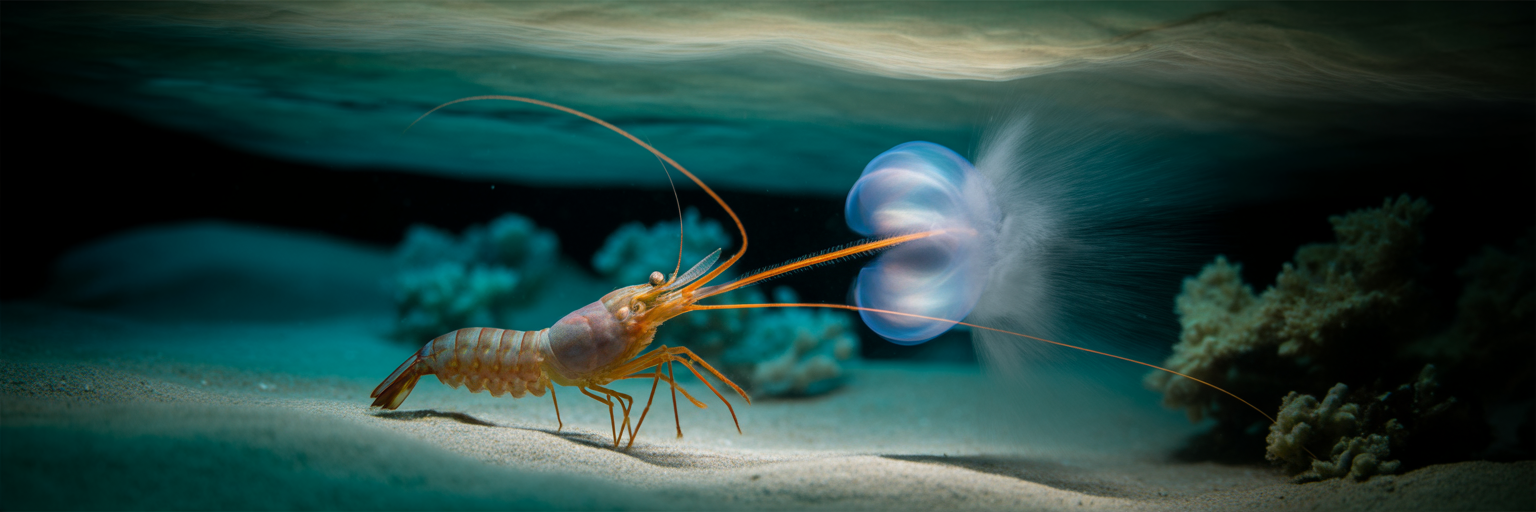
The undisputed champion of this category is the pistol shrimp. This tiny crustacean, often no bigger than your finger, possesses one of the most extreme weapons in nature. It has one oversized claw that it can snap shut at around 100 km/h (60 mph). The speed is so immense that it creates a cavitation bubble, a pocket of low-pressure water vapor. The collapse of this bubble is the real weapon. It generates a shockwave, a sound louder than a jet engine, and for a nanosecond, a flash of light and heat that reaches temperatures hotter than the surface of the sun. A tiny shrimp with the power of a star. It doesn’t punch its prey; it obliterates it with physics.
If one animal weaponizing physics isn’t enough, how about a team? Humpback whales are cooperative geniuses. They use a strategy called “bubble-netting.” A pod of whales will swim in a circle below a school of fish, blowing bubbles as they rise. This creates a circular “net” of bubbles that traps the fish, concentrating them into a tight ball. The whales then surge up through the middle with their mouths open for an easy group meal. It’s the deadliest, most coordinated pool party ever.
Finally, we have the chilling intelligence of orcas in the Antarctic. They hunt seals resting on ice floes, but the seals are out of reach. Or are they? A pod of orcas will work together, swimming in formation to create a powerful wave. They time it perfectly to wash the unsuspecting seal right off the ice and into the water, where the pod is waiting. This isn’t random splashing. It’s a calculated, brutal, and highly effective display of environmental manipulation.
So, Why All the Extra Drama?
After seeing animals cook their enemies, catfish their dinner, and punch with the force of the sun, you might be asking: why? Why go to all this trouble? Why not just bite things like a normal predator?
The answer is simple: the evolutionary arms race. It’s a constant back-and-forth. Prey gets faster, so predators have to get weirder. For every gazelle that learns to outrun a cheetah, there’s a bolas spider figuring out how to skip the chase entirely. These strange strategies aren’t just for show; they provide critical advantages.
- Leveling the Playing Field: These methods allow smaller or slower animals to take down bigger, faster, or better-defended prey. A tiny shrimp can stun a crab, and a bunch of bees can take down a giant hornet.
- Maximum Efficiency: Hunting is hard work. Lying in wait, setting a trap, or boiling your food from a distance is just smart resource management. It’s nature’s ultimate life hack for the lazy but brilliant.
- Exploiting a Niche: These unique methods allow predators to hunt in ways no one else can. The green heron isn’t competing with other birds that dive for fish; it’s created its own market for gullible fish.
Ultimately, these aren’t just weird for the sake of being weird; they are ruthlessly practical solutions to the problem of getting a meal. For every “normal” predator out there, there’s another one cooking its enemies or manipulating physics. It’s a beautiful, terrifying, and hilarious reminder that nature is, and always will be, gloriously crazy.