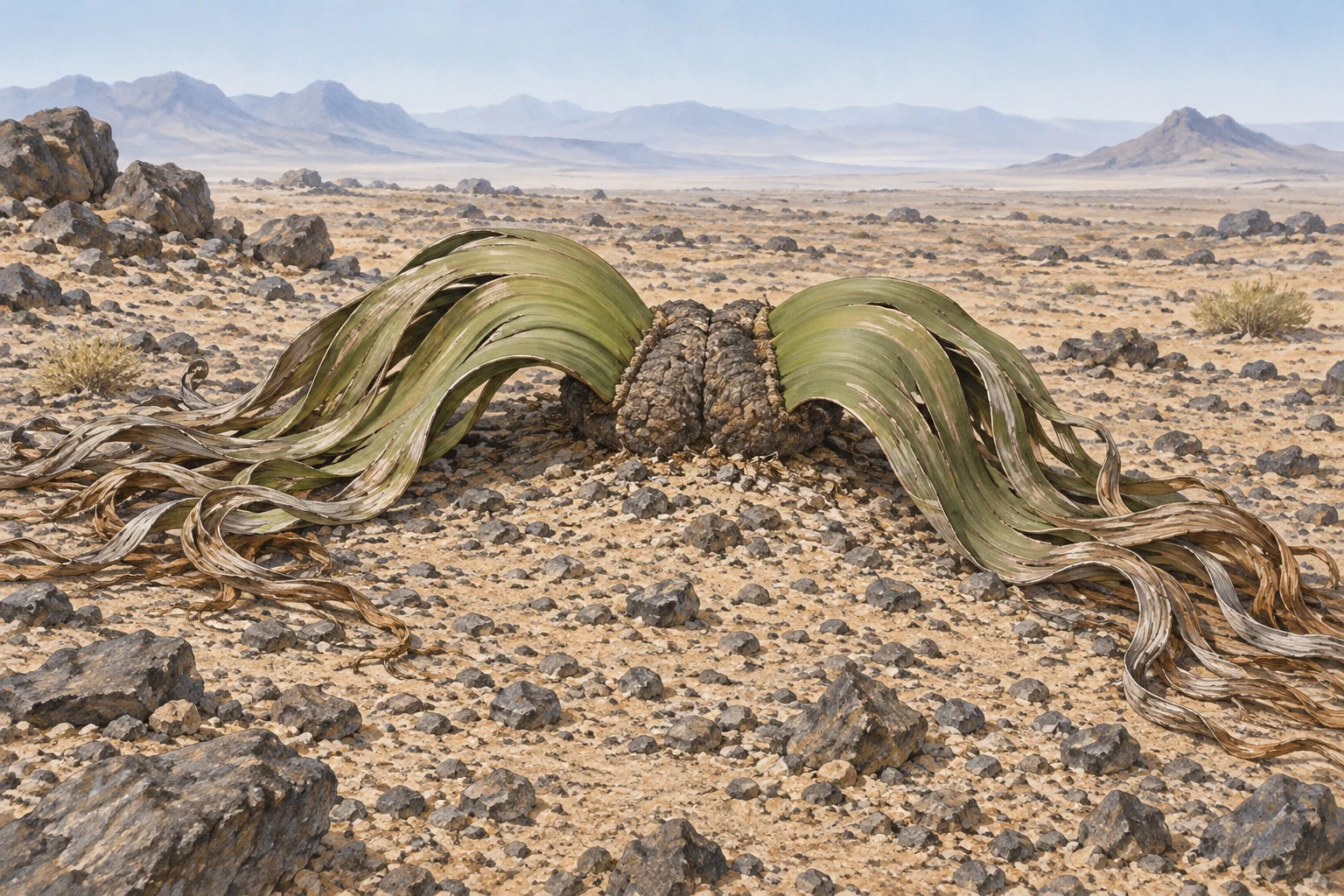
A mature Welwitschia can look like torn straps abandoned on desert gravel. Follow the ribbons back to the woody crown, however, and an extraordinary pattern emerges: the normal adult foliage comes from just two true leaves. Instead of continually producing replacements, the plant keeps adding tissue at their bases. Its foliage offers a very different desert solution from the compact, windowed leaves of Lithops.
Two leaves, many ribbons
Kew’s account of Welwitschia mirabilis describes two large leaves and a low stem base. The leaves split into segments as they age, creating the illusion of numerous separate leaves. Their tips can become dry and ragged while fresh tissue grows near the crown.
“Two” refers to the persistent true leaves of the adult. It does not mean a seedling has no seed leaves, or that every part of the adult foliage stays alive forever. One leaf can contain functioning tissue and an old, damaged tip.
A leaf can be old without every part being old
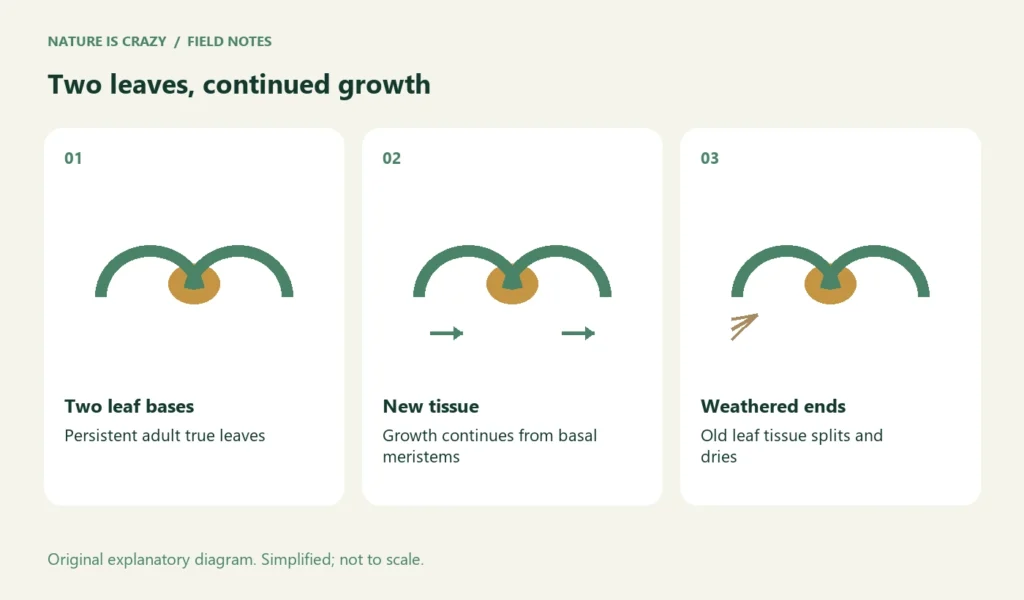
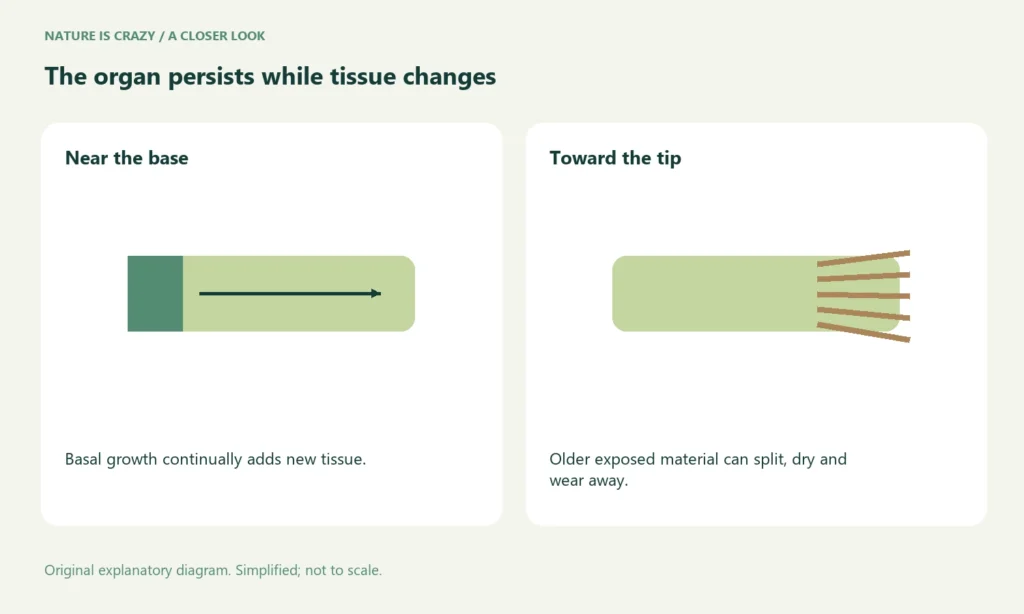
Calling a leaf long-lived can suggest that the same tissue survives intact for centuries. Welwitschia shows why that picture is incomplete. The organ persists while its base produces new material, its older regions extend outward, and exposed ends experience damage and drying.
The distinction is similar to describing a long-lived organism whose cells are continuously renewed. Longevity of the whole does not establish equal longevity of all components. In this plant, the visible gradient from fresher basal tissue to worn distal ribbons helps make that abstract distinction concrete.
It also explains why counting ribbons gives the wrong answer. Splitting changes the outline of an existing leaf; it does not automatically create another leaf with an independent origin at the crown. Trace each strap back to its point of emergence before interpreting the plant’s architecture.
Growth from the base
A 2021 genome study describes a change in the growth system early in development. The shoot’s apical growing point stops functioning, while basal meristems maintain the long leaves. Meristems are regions that keep producing new cells.
A conveyor belt is a useful picture: new material emerges near the base as older material extends outward. The analogy describes the direction of growth, not a fixed speed. Weathering and growth occur together, so the plant can look exhausted without being finished.
Where its water actually comes from
Fog is conspicuous in the coastal Namib, but frequent fog does not by itself prove that it is a plant’s main water supply. A study combining root maps and water isotopes examined plants at a particular desert site and found rain-derived soil moisture to be the principal source, with additional contributions associated with fog and dew.
The team compared where roots occurred with where moisture was retained. That tests the supply beneath the surface instead of relying only on the weather visible above it. Water from an infrequent rain event can remain available in certain soil layers after the surrounding surface looks dry.
The result should not become a universal claim that fog never matters anywhere in the species’ range. It demonstrates that multiple sources can contribute, and that the main source must be established locally. Compare this with fog-associated water collection in desert beetles, where the animal’s behavior and surface are part of a different system.
Long-lived does not mean unchanged
Welwitschia inhabits arid landscapes in Namibia and Angola. Kew’s natural-history discussion connects its distribution with the coastal fog belt. Water supply is more complicated than the appealing claim that every individual lives entirely on fog and never needs moisture in the soil.
Kew notes that some plants are thought to exceed 2,000 years, while acknowledging that exact ages are hard to measure. Such longevity describes the organism, not the age of every cell currently in a leaf. Continuous growth requires new tissue.
Leaves, cones, and the difference between growth and reproduction
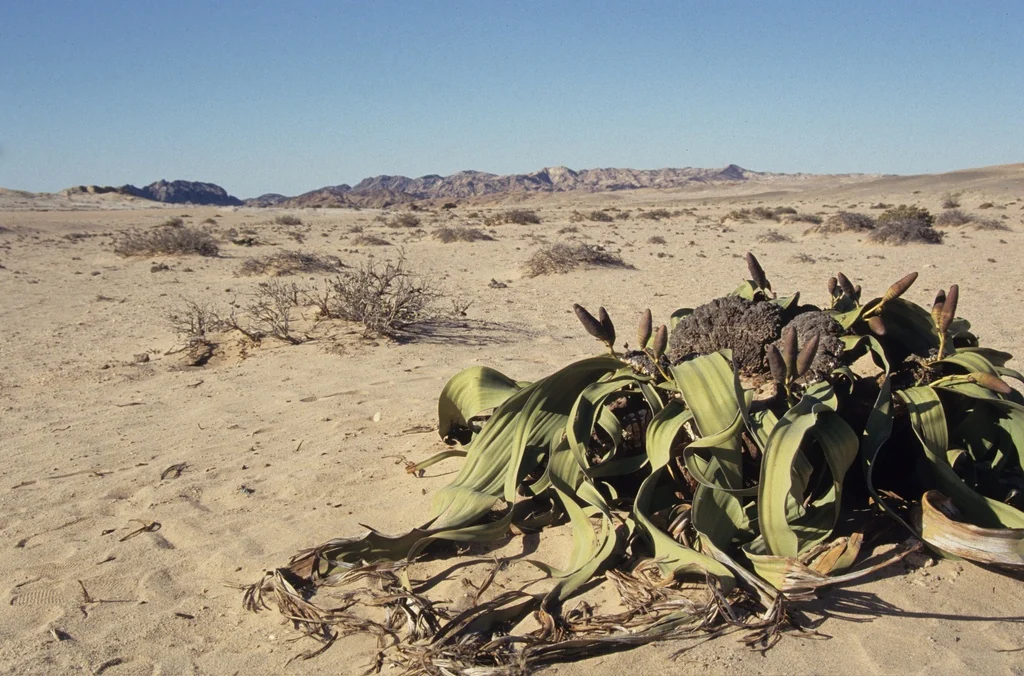
Persistent leaves do not mean the plant has only two visible structures. Welwitschia also produces reproductive cones. Kew describes it as dioecious: pollen and seed cones occur on separate plants. Those cones are not additional leaves in the adult foliage count.
This separation makes photographs easier to interpret. A crown surrounded by cones may look busier than a young plant, but the origin of its long straps remains the defining architectural feature. The supporting photograph provides a real-world comparison with the simplified growth diagram.
Meristems explain where tissue is produced; reproductive structures explain how the plant contributes to the next generation. These functions interact within one organism, but neither can substitute for the other. Continuing to extend a leaf is not the same process as making a seed.
The plant’s extraordinary appearance comes from specific developmental rules, not from breaking all the rules of plant biology. The same principle applies to plant responses to touch without animal nerves: unfamiliar behavior becomes more understandable when the actual tissues and mechanisms are identified.
Different desert solutions
Compare this plant with beetles associated with fog collection. Sharing a desert does not mean using identical survival methods. Each organism’s structure and physiology must be considered separately.
Welwitschia also challenges the idea that every leaf reaches a final size and then stops. Unfamiliar growth patterns are ordinary biology, just as plant responses to touch need not involve animal nerves.
Featured image credit: AI-generated editorial illustration, not a photograph or a precise anatomical reconstruction.