
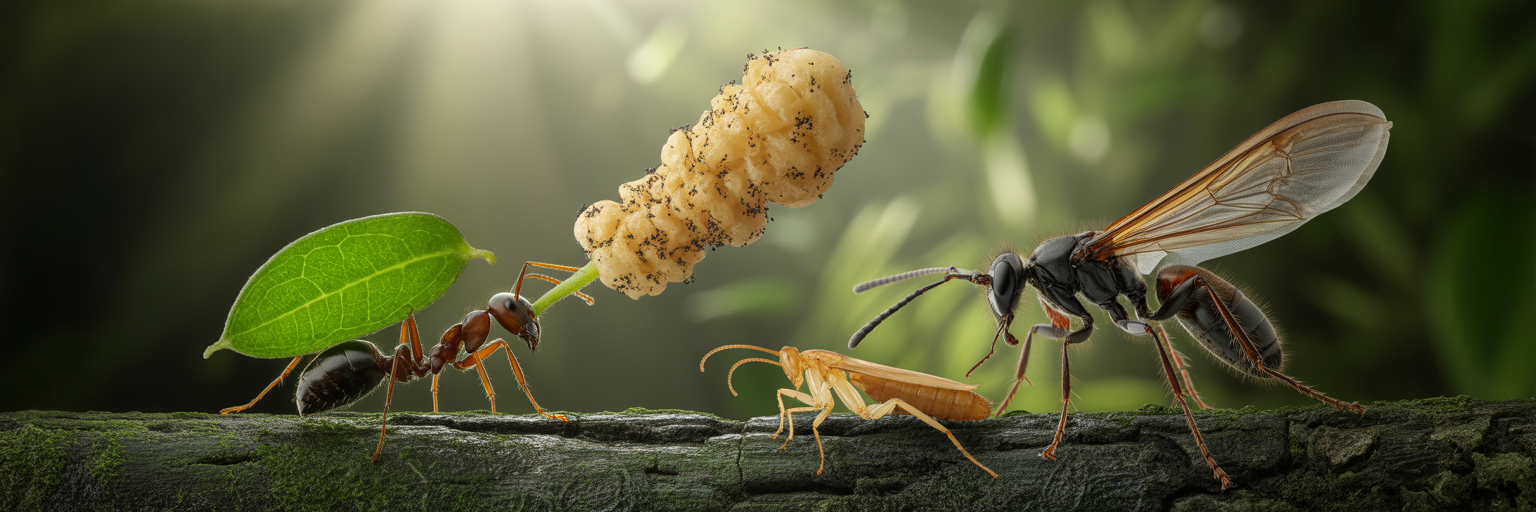
Alright, lean in close. I’m about to tell you a secret. Zombies are real. No, not the groaning, shuffling kind that are weirdly bad at opening doors. I’m talking about something much smaller, slimier, and way more effective. These are the parasites that turn deadly animals into puppets, and they are the true puppet masters of the natural world. This isn’t some freak show one-off, either. According to a report in EL PAÍS, this mind-control strategy has evolved independently at least 223 times. It’s a certified classic.
These tiny tyrants aren’t doing it for kicks. They’re just trying to get ahead in life, whether that means scoring a free ride to a better neighborhood, finding a safe nursery for their kids, or just getting from point A to point B inside a convenient, walking lunchbox. They’ve figured out that the best way to do that is to hijack the nervous system of another creature and take it for a joyride.
So, buckle up. We’re about to go on a weird, slightly gross, but utterly fascinating tour of nature’s most devious puppeteers. We’ll meet a fungus with a flair for the dramatic, a wasp that moonlights as a neurosurgeon, and we’ll even tackle the big question: could this happen to us? Spoiler alert: probably not, so you can put that bunker construction on hold. For now.
The Ant Who Took a Fungal Promotion
Let’s start with the celebrity of the parasite world, the one you’ve probably seen in nature documentaries that made you question everything. Meet Ophiocordyceps unilateralis, better known as the zombie ant fungus. This guy has a real talent for drama and a life cycle that belongs in a horror movie.
Imagine you’re a humble carpenter ant, just going about your day. You’re carrying leaves, gossiping with your coworkers, maybe complaining about the queen again. Then, you get a light dusting of a fungal spore. You don’t even notice. For a while, everything seems normal. But then you start feeling… weird. You’re wandering away from the trail, ignoring your duties, and climbing things for no reason. Your friends think you’ve been hitting the fermented berries a little too hard.
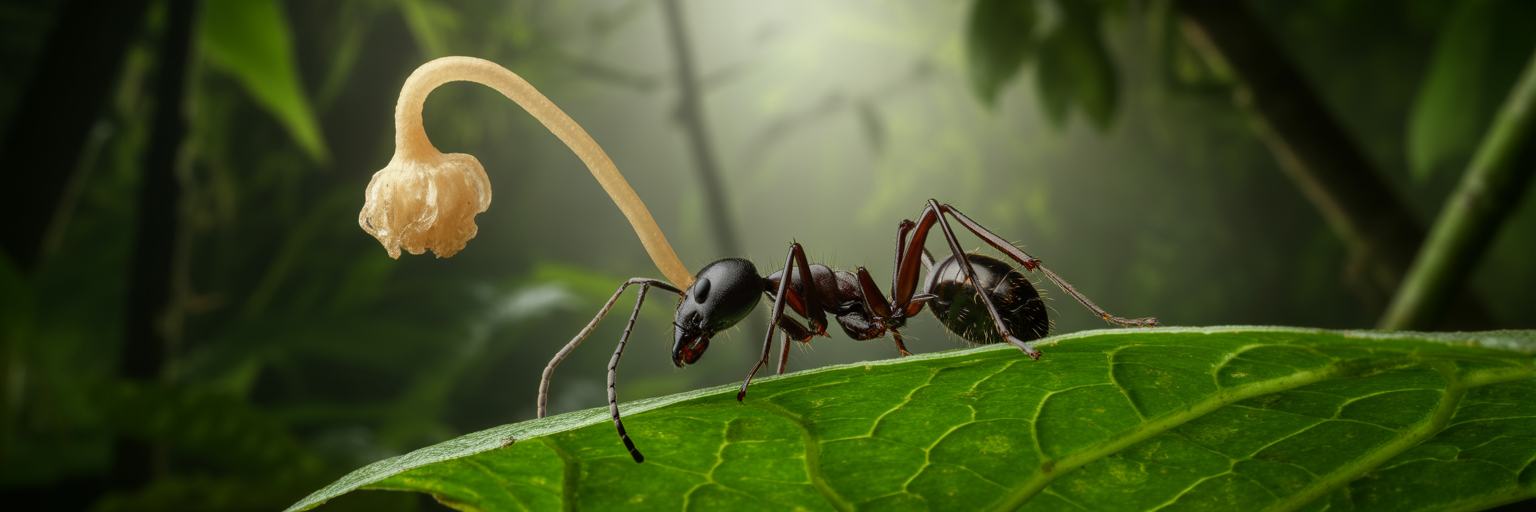
This is the fungus at work. It forces the ant on a “death march,” compelling it to abandon its colony and climb a plant stem. The fungus is a real diva about its living conditions, so it makes the ant climb to a very specific height, usually around 25 centimetres, where the temperature and humidity are just right. Once there, the ant performs its final act: the “death grip.” It bites down on the underside of a leaf vein with a force it never knew it had and holds on for dear life. Which, at this point, isn’t very long.
Here’s the scientific plot twist that makes it even creepier. This bizarre sequence, detailed by National Geographic, isn’t caused by the fungus invading the ant’s brain. Instead, the fungus creates a sprawling network throughout the ant’s body, wrapping around its muscles. It’s not controlling the ant’s mind, it’s hot-wiring its body like a marionette. The ant’s brain is left completely intact, a helpless prisoner in its own body, forced to watch as its limbs move against its will. Now that’s terrifying.
After the ant dies, the fungus delivers its grand finale. A long stalk erupts from the back of the ant’s head, and from its tip, it rains down a fresh batch of spores onto the unsuspecting colony below. It’s a brilliant, if morbid, real estate strategy. One ant’s nightmare is another fungus’s dream home.
The Wasp, the Roach, and the Wardrobe
If the zombie ant fungus is a brute-force puppeteer, our next contestant is a delicate artist. Meet the jewel wasp, a gorgeous, glittering insect that looks like it should be on a runway but actually moonlights as a world-class neurosurgeon with a truly terrible bedside manner. Its mission: find a living, breathing incubator for its baby. Its victim of choice? A common cockroach, several times its size.
Now, roaches are skittish. You see one, you turn on the light, and it’s gone. The wasp knows this, so it can’t just brute-force the situation. It needs to calm the roach down. Permanently. This is where the heist begins. The wasp delivers a two-sting combo that would make a secret agent jealous. The first sting is a quick jab to the roach’s body, delivering a venom that temporarily paralyzes its front legs. This is just to stop it from running away while the wasp prepares for the main event.
The second sting is the masterpiece. The wasp carefully inserts its stinger into the roach’s neck and guides it directly into the brain, targeting two specific clusters of neurons that control the escape reflex. This process, as explained in Scientific American, doesn’t paralyze the roach. It just zaps its motivation. It’s a highly targeted tranquilizer that essentially tells the roach, “Hey, maybe running for your life is overrated.”
The result is one of the most bizarre sights in nature. The roach isn’t dead or paralyzed. It’s just… chill. It loses all will to escape. The wasp can literally grab one of the roach’s antennae and lead it around like a dog on a leash, guiding it back to its burrow. The roach just ambles along, sometimes even stopping to groom itself, completely unaware that it’s being led to its doom. Once in the burrow, the wasp lays an egg on the roach’s abdomen and seals it inside. The jewel wasp cockroach situation provides a perfectly preserved, living pantry for the wasp larva when it hatches. It’s brutal, efficient, and a masterclass in parasitic parenting.
The Fly That Aimed for the Sky
Some parasites have very specific, very weird final requests for their hosts. Case in point: Entomophthora muscae, a fungus with a peculiar talent for making flies fulfill a bizarre final wish to climb as high as possible. Scientists call this phenomenon “summit disease,” which sounds way more majestic than it actually is.
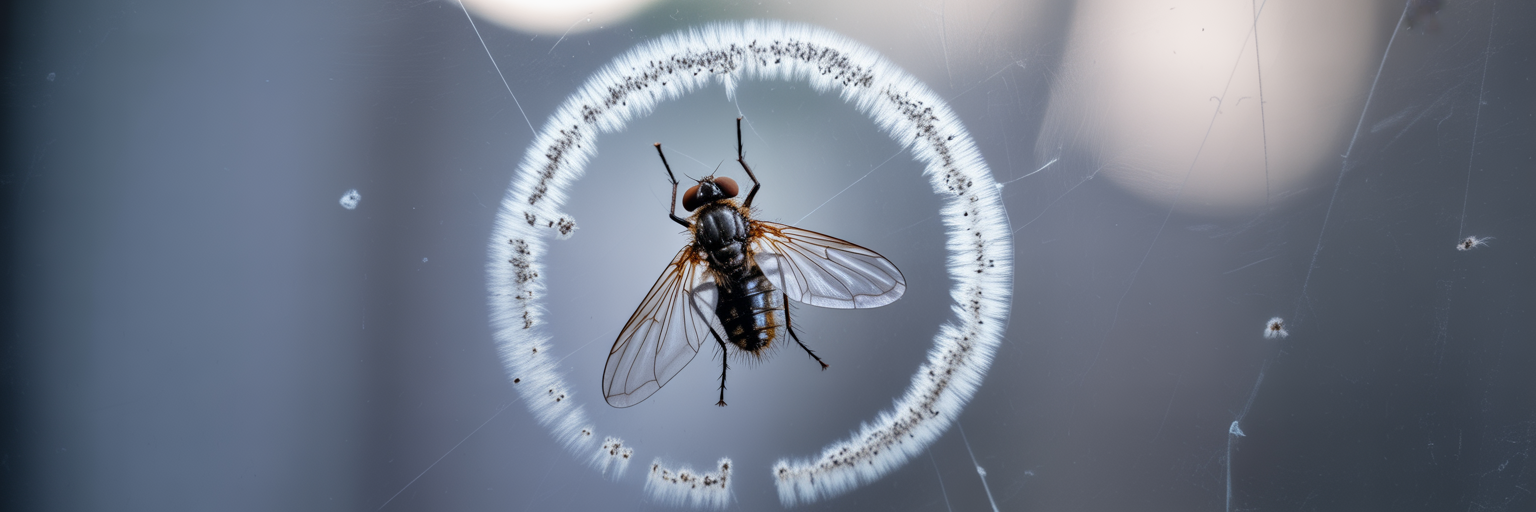
The infection starts simply enough. A housefly gets hit with some fungal spores, and the fungus begins to quietly multiply inside, replacing the fly’s internal organs with its own fungal body. As the end nears, the fly is overcome with an irresistible urge to climb. It will find the highest point it can, whether it’s the top of a plant, the ceiling, or a window pane with a good view. It’s the fly’s last, and weirdest, adventure.
Once it reaches its peak, the fly performs its final, gruesome act. It secretes a sticky substance from its mouth, gluing itself to the surface. It then raises its wings and points its abdomen skyward, dying in this dramatic, almost triumphant pose. This elevated position is the perfect launchpad. The fungus erupts from the segments of the fly’s abdomen, showering spores onto any unsuspecting flies passing below. It’s a morbid form of advertising, ensuring the fungus gets maximum airtime.
But wait, the plot thickens. As reported by The Atlantic, scientists have discovered a potential parasite within the parasite. They found a virus, named Entomophthovirus, living inside the fungus. The mind-bending hypothesis is that the virus might be the real puppet master here, pulling the fungus’s strings, which in turn pulls the fly’s. It’s a turducken of terror, a layered manipulation that shows just how complex this weird animal behavior can get. Nature isn’t just playing chess; it’s playing 4D chess with multiple dimensions of horror, and the fly is just a pawn in the game.
Nature’s Other Mind-Control Freaks
By now, you might be thinking this is just a few isolated weirdos in the insect world. Oh, my friend, we’re just getting started. Host manipulation is a wildly successful evolutionary strategy, and nature has a hijacker for just about everyone. These mind controlling parasites are everywhere, and their methods are as varied as they are creepy. Here are a few more of our favorites:
- Hairworms and Crickets: A cricket accidentally eats a hairworm larva. The worm grows inside it, sometimes up to a foot long, coiled up like spaghetti. When the worm is ready to breed, it needs to get to water. So, it makes the poor cricket desperately seek out a pond or a swimming pool and perform a kamikaze dive. As the cricket drowns, the worm emerges and swims off to find love, leaving its ride to a watery grave. It’s a truly one-sided romance.
- Toxoplasma gondii and Rodents: This single-celled parasite has a simple goal: get from a rat to a cat. Its solution is pure evil genius. It infects the rat’s brain and rewires its survival instincts. Not only does the rat lose its natural fear of cats, but it can actually become attracted to the smell of cat urine. It’s like a dating app designed by your mortal enemy, and it usually ends with the rat getting eaten, allowing the parasite to complete its life cycle in the cat’s gut.
- Sacculina Barnacles and Crabs: This one is a hostile takeover of the highest order. A female Sacculina larva finds a crab and injects a tiny part of itself into the crab’s body. This grows into a network of tendrils that spreads throughout the crab, absorbing nutrients. It chemically castrates the crab, stops it from molting, and then forms a big, fleshy sac where the crab’s own eggs would be. The crab is now an unwitting nanny, caring for the barnacle’s egg sac as if it were its own, fanning it and protecting it from harm.
The main point here is that this stuff is not rare. It’s creepy, it’s rude, but it’s an incredibly effective way to make a living. If you can be hijacked, nature probably has a hijacker designed just for you.
The Science of Being a Puppet
So, we’ve seen the what, but what about the how? How do these tiny terrors actually pull off these incredible feats of manipulation? It’s not magic, just some seriously invasive chemistry and biology. Let’s peek behind the curtain and see how parasites control hosts. It generally boils down to a few main strategies.
Direct Injection: The Neurotoxin Approach
This is the jewel wasp’s method. It’s a neurosurgeon with a syringe. By injecting a precise cocktail of venom directly into the roach’s brain, it can flip specific switches. It doesn’t need to take over the whole system, just the part that says, “A giant, glittering wasp is trying to kill me, I should probably run.” It’s a clean, targeted strike that leaves the rest of the roach’s functions intact.
Chemical Warfare: The Hormone Hijack
Parasites like Toxoplasma gondii are masters of chemical warfare. They don’t invent new “zombie” chemicals. They just mess with the host’s existing system of hormones and neurotransmitters. Think of them as a rogue DJ at your brain’s party, cranking the dopamine up to eleven or cutting the serotonin entirely. By altering these chemical levels, they can change a host’s behavior, making a fearful rat brave or a social ant antisocial.
Physical Takeover: The Body Snatcher
Then you have the brute-force method of the zombie ant fungus. It bypasses the brain almost entirely. Why bother with mind control when you can have direct body control? By building a physical scaffold of fungal cells around the ant’s muscle fibers, the fungus can contract them directly. It’s the ultimate backseat driver, literally grabbing the steering wheel and forcing the car where it wants to go, all while the driver screams in horror.
| Manipulation Method | Example Parasite | Mechanism | Host Outcome |
|---|---|---|---|
| Neurotoxin Injection | Jewel Wasp | Injects venom into specific brain ganglia | Loses escape reflex; becomes a docile ‘zombie’ |
| Hormone Hijacking | Toxoplasma gondii | Alters neurotransmitters like dopamine | Loses fear of predators; may become attracted to them |
| Physical Scaffolding | Ophiocordyceps (Zombie Ant Fungus) | Forms a fungal network around muscle fibers | Body movements are controlled directly; ‘death grip’ |
This table summarizes the primary strategies parasites use to control their hosts, showing that there’s more than one way to build a puppet.
These parasites are master chemists and biologists, and by studying them, scientists get a terrifying but incredibly useful roadmap to understanding how brains and bodies are wired together.
So, Should We Be Worried?
Okay, let’s address the elephant in the room, or rather, the fungus on the brain. After hearing all this, and maybe after watching a certain popular TV show, you’re probably asking: could a parasite like Ophiocordyceps jump to humans and kick off a real-life zombie apocalypse? Can I finally justify building that underground bunker I’ve been dreaming about?
I’m happy to report that the answer is a firm, friendly “no.” You can relax. There are two big reasons why we’re safe from these specific puppet masters. First, our body temperature. Most of these fungi are perfectly adapted to the cool body temperatures of insects. Our cozy, stable 37°C (98.6°F) is like a furnace to them. We’re simply too hot to handle. They would cook before they could even think about taking over.
Second, there’s the complexity barrier. The chemical keys a parasite uses to unlock an ant’s nervous system are incredibly specific. They’ve evolved over millions of years to fit the unique locks of an ant’s biology. The human brain and nervous system are vastly more complex. Trying to use an ant-specific key on a human brain would be like trying to start a spaceship with a car key. It just won’t fit.
That said, while these *specific* parasites aren’t a threat, this is a good reminder that nature is full of mind-bending weirdness. So, as a general rule of thumb, maybe don’t go around licking strange fungi you find in the forest. The real story here isn’t a looming sci-fi plague; it’s the incredible scientific reality these creatures reveal.
Why We Love These Tiny Terrors
After this tour of horrors, you might be wondering why scientists, and weirdos like us, are so fascinated by these morbid relationships. It’s not just because they’re delightfully creepy, though that’s certainly part of the appeal. The truth is, these parasites are invaluable natural tools for understanding some of the deepest mysteries of biology.
By studying which chemicals a parasite uses to make a host do something, scientists can learn what those chemicals do in any brain, including our own. They provide a roadmap to neurochemistry. For example, understanding exactly how a jewel wasp’s venom switches off a roach’s escape reflex could, in a much, much less terrifying way, give us clues for developing new treatments for anxiety disorders. It’s like nature is running the experiments for us.
On a deeper level, these examples challenge our most basic ideas about free will and individuality. They show just how interconnected, and sometimes ruthless, the web of life truly is. It’s a humbling reminder that every creature on this planet is just trying to survive and pass on its genes, even if its methods are pure nightmare fuel. They force us to ask, what does it even mean to be in control?
So, the next time you see an ant behaving strangely, take a closer look. You might be witnessing a tiny, epic drama unfold. Nature is weirder, smarter, and more wonderfully brutal than we can possibly imagine. And sometimes, the one in the driver’s seat isn’t who you think it is.