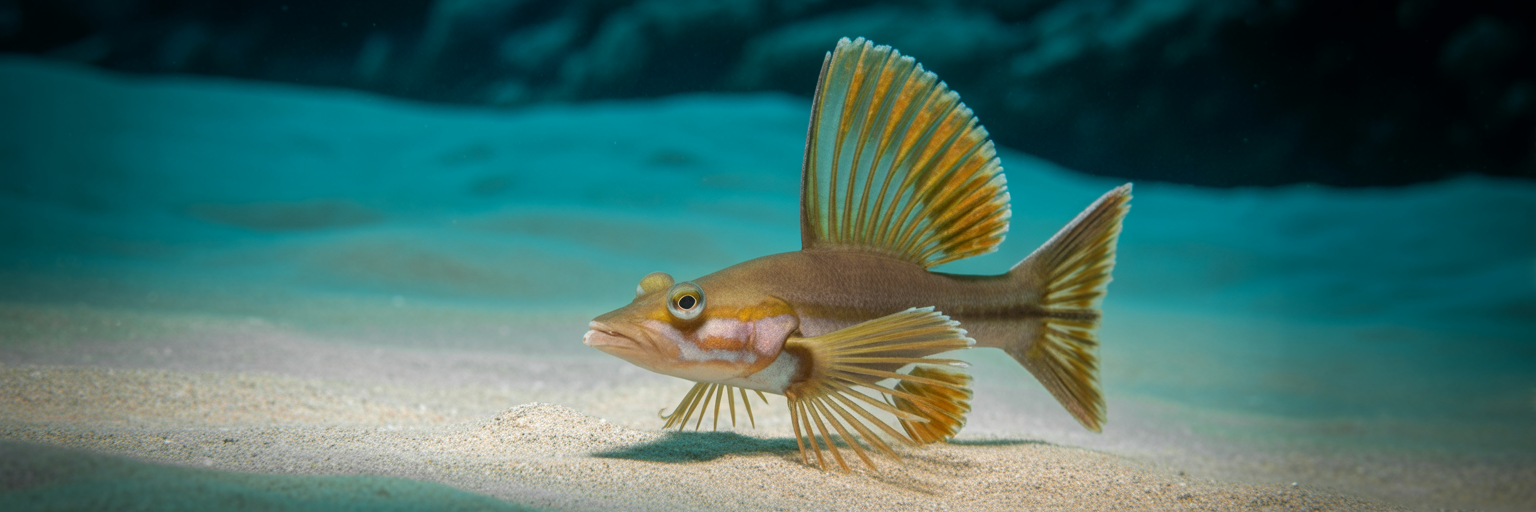
Meet the Fish With Legs That Walks on the Ocean Floor
The sandy bottom of coastal waters often appears as a quiet, uniform expanse, disturbed only by gentle currents and the occasional scuttling crab. Yet, for those who look closer, this seemingly barren landscape holds creatures that challenge our most basic assumptions about life in the sea. Imagine seeing a fish that forgoes swimming and instead strolls across the sediment. This is the world of the sea robin fish, a creature that moves with an unnerving, spider-like grace. It is a true fish that walks on seafloor environments, using six spindly appendages to prowl for its next meal.
At first glance, the sea robin is an assembly of contradictions. It has a large, bony head encased in armor, giving it a prehistoric look. From its sides, enormous pectoral fins can unfurl like colorful, patterned wings, flashing brilliant shades of blue, orange, or red. But its most peculiar features are the three pairs of slender, leg-like structures it uses for locomotion. Instead of gliding through the water column, the sea robin plants these “legs” on the substrate, moving with a deliberate, almost cautious gait. It appears less like a fish and more like an underwater explorer on a mission.
This strange method of walking immediately raises questions. These appendages are clearly not just for support. They tap and probe the sand with methodical precision, suggesting a purpose beyond simple movement. This observation leads to a deeper mystery. How did a fish evolve to walk, and more remarkably, how does it use these limbs to find food it cannot see, buried beneath layers of sand and mud? The answer reveals a stunning example of evolutionary ingenuity. While we might call them legs, these structures are an extraordinary modification of the fish’s pectoral fins, repurposed for a life of walking, digging, and even tasting the world beneath its feet.
From Fins to Feet: The Evolution of Sea Robin Appendages
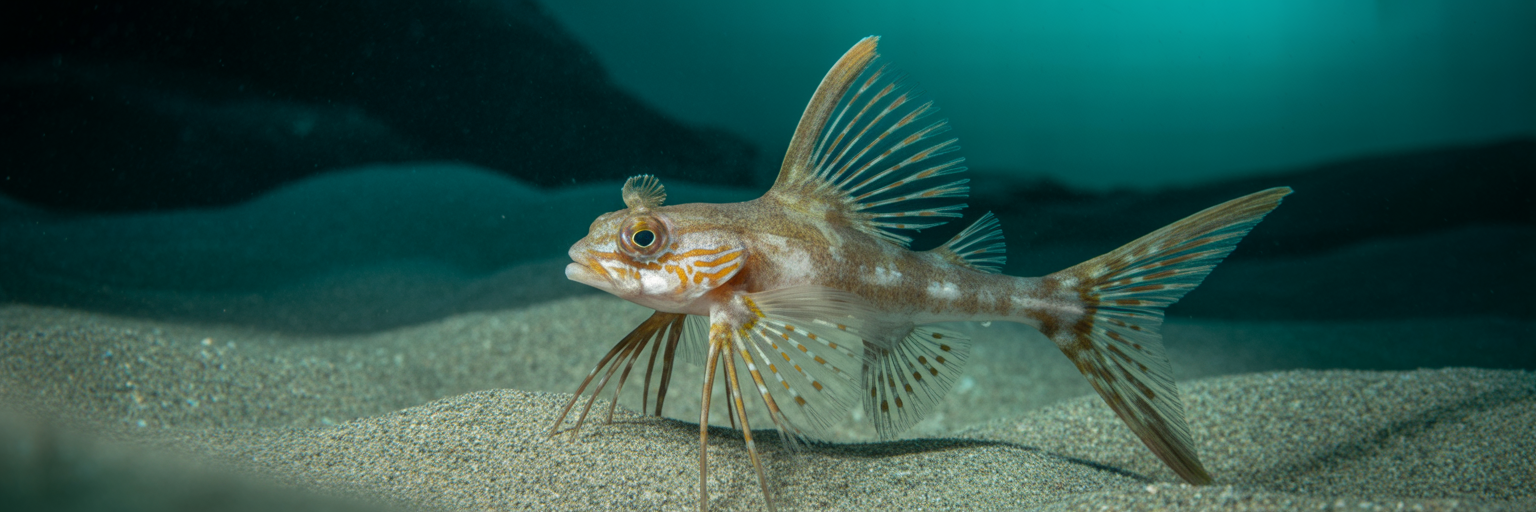
The transition from swimming to walking required a profound transformation of the sea robin’s anatomy. Those “legs” are not true limbs in the terrestrial sense. Instead, they are three pairs of detached and stiffened fin rays that separated from the main pectoral fin over evolutionary time. Each ray is controlled by its own dedicated set of muscles at its base, allowing for independent and highly controlled movement. This muscular control enables the fish to produce a stable, alternating gait, much like a six-legged insect, providing the stability needed to methodically explore the seafloor.
This remarkable adaptation did not arise from scratch. It is a classic case of evolution repurposing an existing genetic toolkit for a new function. Scientists have identified that a gene known as tbx3a plays a critical role in this process. This transcription factor is involved in limb development across many vertebrates, including humans. In the sea robin, this ancient gene was co-opted to guide the development of these specialized, mobile fin rays, effectively turning a portion of a fin into a functional walking appendage. This fish with leg like fins demonstrates how a small genetic shift can produce a major structural innovation.
The evolutionary advantage of this change was immense. By moving from the water column to the seafloor itself, sea robins gained access to an entirely new ecological niche. They could now directly interact with the substrate, a zone rich with burrowing invertebrates that were inaccessible to most other fish. This shift allowed them to exploit a reliable food source that others missed, securing their place in coastal ecosystems. The evolution of new animal structures often opens doors to new ways of life, and the sea robin’s walking fins are a perfect example. Nature is filled with such wonders, where appendages are modified for surprising tasks, much like the star-nosed mole that eats faster than you can blink, using its unique nose for ultra-fast foraging.
A Chemist’s Touch: How Sea Robins Sense the Seafloor
The sea robin’s modified fins are more than just stilts for walking. For certain species, these appendages are sophisticated chemical detectors that allow the fish to perceive its environment through touch. This ability, known as contact-based chemosensation, transforms each step into an act of sensory exploration. The key to this sense lies in specialized structures concentrated at the very tips of the fin rays. These tips are covered in small bumps called papillae, and each papilla is packed with sensory cells that are wired directly to the fish’s nervous system.
Recent scientific discoveries have illuminated the molecular mechanics behind this incredible sense. While it is tempting to say the fish has taste buds on its “fingers,” the reality is more precise. As research highlighted in a 2024 study published in the journal Current Biology revealed, these sensory cells express specific taste receptor proteins. One of the key proteins identified is t1r3, a receptor that, in many animals, is associated with detecting sweet and umami flavors. For the sea robin, this receptor has been repurposed. It is not tasting sugar but is instead highly sensitive to amino acids, the chemical building blocks of protein. This is how do sea robins find food. Buried prey like worms and crustaceans constantly release faint traces of amino acids into the surrounding sediment. When a sea robin’s fin ray touches a spot with a high concentration of these molecules, the t1r3 receptors send a signal to the brain, effectively screaming “food is here.”
This mechanism allows the fish to build a chemical map of the seafloor with every tap of its fin rays, guiding it directly to a hidden meal. So, is the phrase “tasting with their legs” accurate? While it is a simplification, it is functionally correct. The fish uses taste-related receptors located on its locomotive appendages to identify food through direct physical contact. This unique form of chemosensation in fish is a powerful adaptation, turning the dark, murky seafloor into a landscape of detectable flavors.
The Hunt for Hidden Prey
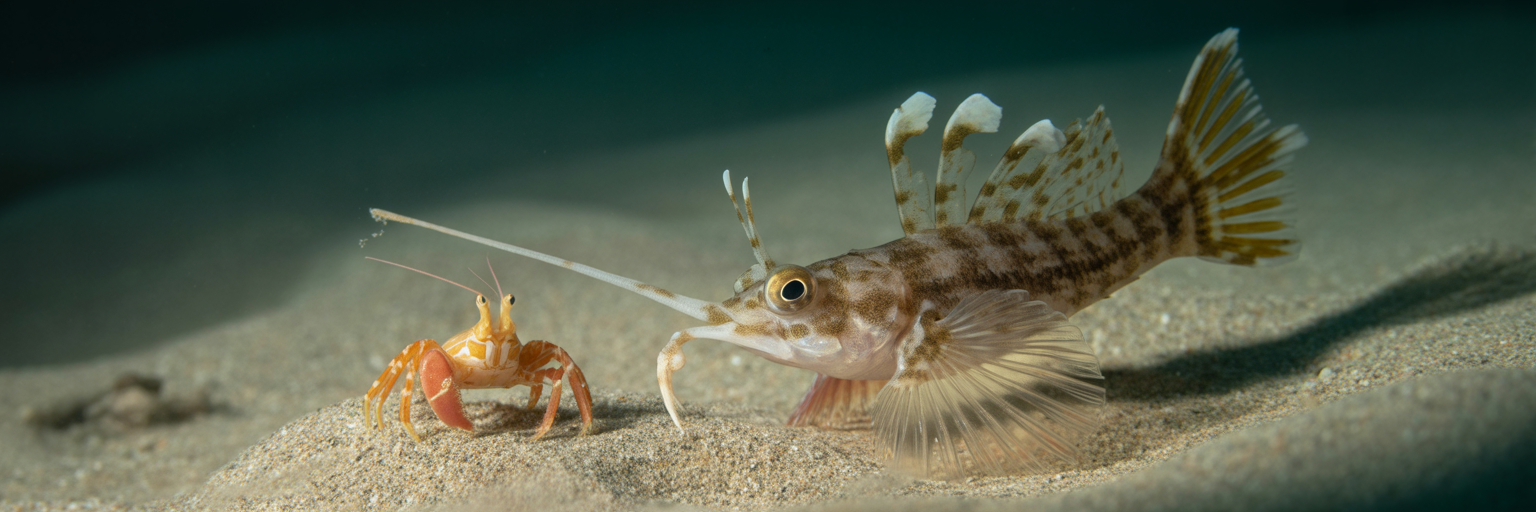
Watching a sea robin on the hunt is like observing a master detective at work. The process is slow, deliberate, and incredibly effective. The fish moves across the sand with its characteristic walk, its body held steady while its six sensory fin rays tap the ground ahead. This methodical probing is the first step in a finely tuned foraging sequence that combines locomotion, sensation, and excavation.
The hunt unfolds in a clear, predictable pattern:
- Methodical Probing: The sea robin “walks” across the sediment, systematically tapping the ground with the tips of its sensory fin rays. Each touch is a chemical test of the substrate.
- Chemical Detection: When a fin ray touches a spot with a high concentration of amino acids leaking from a buried organism, the fish stops instantly. It has found a promising lead.
- Excavation: Using the same strong, flexible fin rays, the fish begins to dig. It pushes and sweeps aside sand or mud, working with surprising dexterity to unearth its target.
- Uncovering the Meal: Once the hidden invertebrate is exposed, the sea robin uses its mouth to quickly snatch and consume it. The entire process is a seamless integration of its unique adaptations.
The sea robin’s diet consists almost exclusively of creatures that make this strategy necessary. It targets marine worms, small crabs, shrimp, and bivalve mollusks, all of which spend their lives burrowed beneath the surface, safe from most predators. The fish’s entire body is built for this task. Its large, wing-like pectoral fins are not just for display. They can be flared suddenly to startle prey out of hiding or pressed against the sediment to provide stability and leverage while its other fins are busy digging. The animal kingdom is filled with ingenious predators, and some fish have developed equally surprising techniques, such as the archerfish that shoots bugs out of the air with water, but the sea robin’s ground game is in a class of its own.
Not All Sea Robins Are Created Equal
The ability to taste the seafloor is a remarkable adaptation, but it is not a universal trait among all sea robins. The family Triglidae is diverse, and this specialized sensory ability appears to be a feature of certain species that have adapted to a specific foraging lifestyle. This variation provides a fascinating natural experiment for scientists studying how and why such complex traits evolve.
The northern sea robin (Prionotus carolinus) is a prime example of a species with this adaptation. Its fin rays are blunt and tipped with the sensory papillae necessary for active digging and chemical detection. It relies heavily on this sense to locate its buried prey. In stark contrast is the striped sea robin (Prionotus evolans). The fin rays of this species are smooth, hard, and tapered into rod-like points. They lack the dense clusters of sensory papillae found on their northern cousins. Consequently, the striped sea robin uses its appendages almost exclusively for walking and physical support, not for sensing hidden food. Its foraging strategy is more opportunistic, focusing on prey it can see on the surface of the sediment.
This difference suggests that the two species have adapted to distinct ecological pressures or foraging opportunities. The northern sea robin is a specialist digger, while the striped sea robin is more of a generalist walker. This divergence within the same family of fish highlights how evolution can fine-tune a single structure for vastly different purposes.
| Feature | Northern Sea Robin (Prionotus carolinus) | Striped Sea Robin (Prionotus evolans) |
|---|---|---|
| Fin Ray Tip Structure | Blunt, tipped with sensory papillae | Tapered, smooth, and rod-shaped |
| Primary Fin Ray Function | Walking, probing, and chemosensation | Walking and physical support |
| Foraging Strategy | Actively digs for buried prey | Opportunistic feeder on surface-level prey |
| Presence of Sensory Papillae | Abundant | Absent |
| Chemosensory Ability | Highly developed for detecting amino acids | Lacking or significantly reduced |
A Window into Evolutionary Innovation

The sea robin is more than just a biological curiosity. It serves as a powerful model organism for understanding some of the deepest principles of evolutionary biology. It presents a clear, observable case where a novel structure, the walking fin rays, and a novel sense, contact chemosensation, emerged together to create a new way of life. The discovery that the same gene, tbx3a, is involved in developing both the physical “leg” structure and the sensory papillae provides a direct link between a genetic switch and a complex, functional trait.
This connection beautifully illustrates the concept of evolutionary “tinkering” or “bricolage.” Evolution does not often invent entirely new genes and structures from scratch. Instead, it works by modifying and repurposing what is already there. The taste receptors on the sea robin’s fins are ancient proteins, but they have been given a new job in a new location. This is a prime example of the evolution of new animal structures through the co-option of existing genetic pathways. The sea robin’s ability to walk and taste with its fins is a testament to the creative and often unexpected pathways of natural selection.
By studying this fish, scientists can watch these principles in action. The sea robin is a living demonstration of how subtle genetic shifts can lead to remarkable adaptations, transforming a simple fin into a multi-functional tool for walking, digging, and sensing. This principle of hijacking existing systems for novel purposes is taken to an extreme in other parts of nature, as seen in how parasites hijack animal behavior for a joyride, but the sea robin’s story is one of self-empowerment, showing how an organism can reinvent itself to conquer a new frontier.
Frequently Asked Questions About the Fish With Legs
Are the sea robin’s ‘legs’ actual legs?
No, they are not true legs like those of land animals. They are highly modified fin rays that have separated from the main pectoral fin. They lack the internal bone structure, joints, and digits found in terrestrial limbs. Instead, they are stiff, flexible rods controlled by dedicated muscles that allow for a walking motion.
Can all sea robins ‘taste’ with their fins?
No, this ability is not universal across all sea robin species. The northern sea robin (Prionotus carolinus), for example, has fin rays tipped with sensory papillae that allow it to detect chemicals from buried prey. However, other species, like the striped sea robin (Prionotus evolans), have smooth fin rays used primarily for walking and lack this advanced chemosensory ability.
What do sea robins eat?
Sea robins are bottom-feeders that specialize in eating invertebrates hidden in the sand and mud. Their diet primarily consists of small crustaceans like crabs and shrimp, marine worms, and small bivalve mollusks. They use their sensory fin rays to locate these buried animals before digging them up.
Are sea robins dangerous?
Sea robins are not dangerous to humans. They are generally small, shy fish that pose no threat. However, they do have sharp defensive spines on their head and along their dorsal fin. If you were to handle one, it is wise to be cautious to avoid a painful poke, but they are not venomous or aggressive.