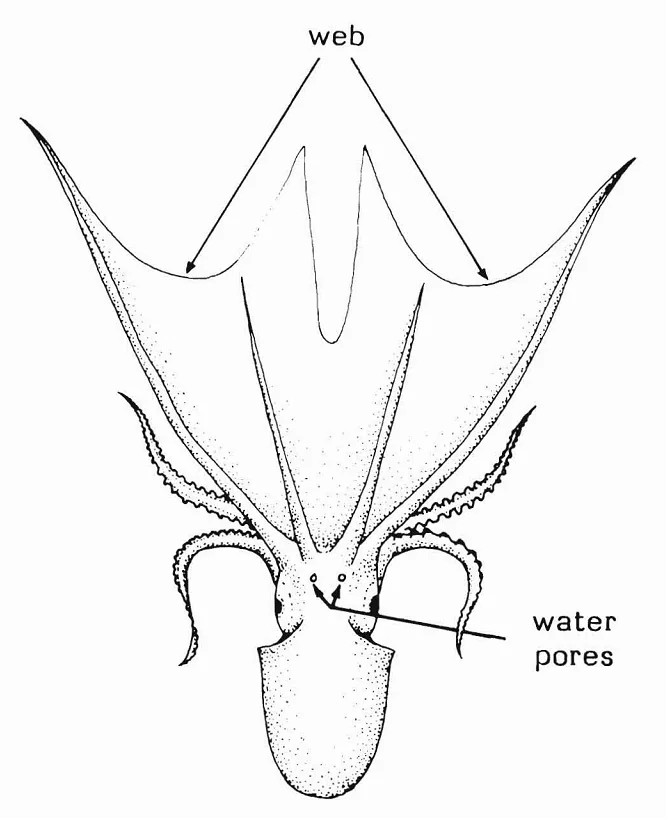
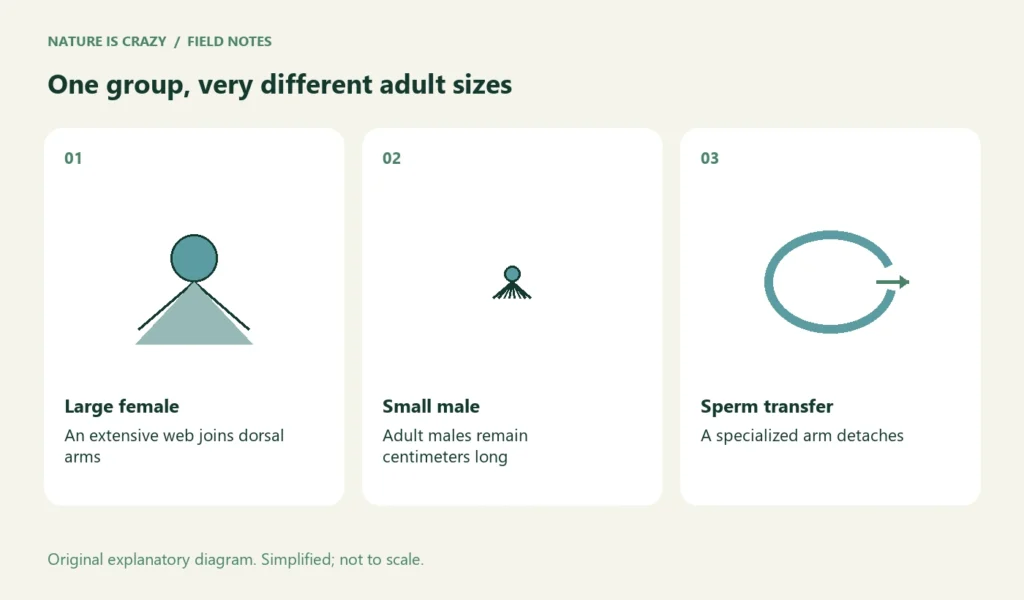
A female blanket octopus can spread an enormous web between her arms. A male of the same group can be only a few centimeters long. Seen separately, they could easily be mistaken for different animals. They are an extreme example of sexual size dimorphism: males and females developing very different adult bodies. The mismatch invites comparison with the tiny males of some deep-sea anglerfish, although their reproductive mechanisms differ.
How large is the difference?
The Florida Museum’s account of a common blanket octopus, Tremoctopus violaceus, describes females exceeding six feet in length while males are about an inch long. These are broad size descriptions, not measurements of a matched pair.
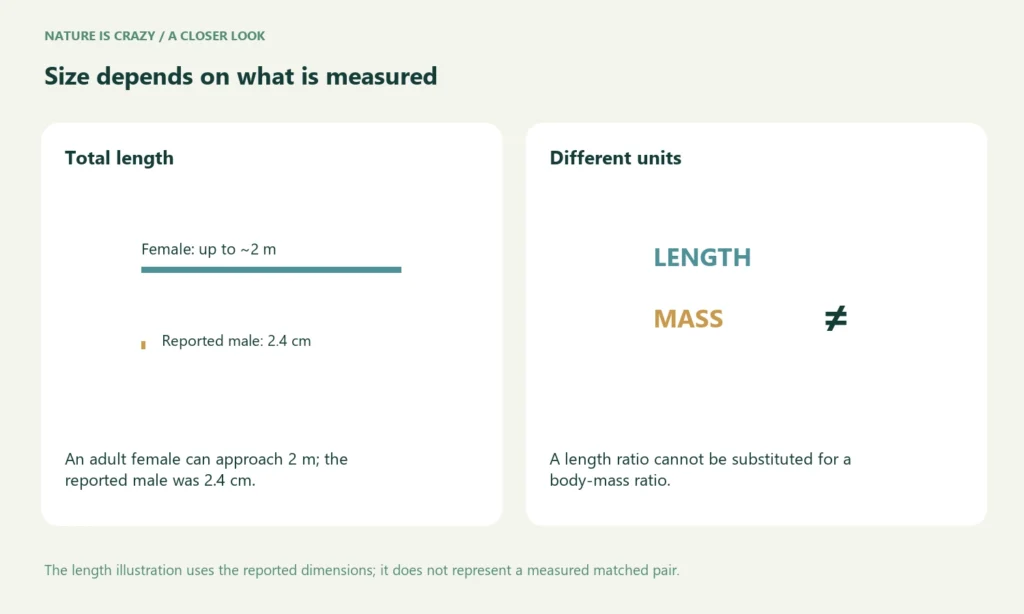
Popular accounts often convert the disparity into a dramatic ratio. The units matter: length, mantle length, arm span, and mass are not interchangeable. An animal thousands of times heavier is not thousands of times longer. Approximate dimensions are clearer than a ratio without its measurement method.
Why length and weight produce different headlines
A length ratio describes one dimension. Body mass reflects an entire three-dimensional animal, so a modest-looking difference in length can accompany an enormous difference in weight. Arms and webbing make total length especially tricky to compare with the mantle, the muscular body surrounding an octopus’s organs.
The first report of a live male described an animal 2.4 centimeters long, while females can attain total lengths near two meters. Those dimensions differ by roughly eightyfold. Reports of much larger mass ratios answer a different question. They should not be turned into a claim that the female is tens of thousands of times longer.
Measurement is part of the explanation, not a technical detail to discard. The size contrast is already extraordinary; keeping the units clear makes the story more impressive because readers can picture what was actually observed.
What the blanket actually is
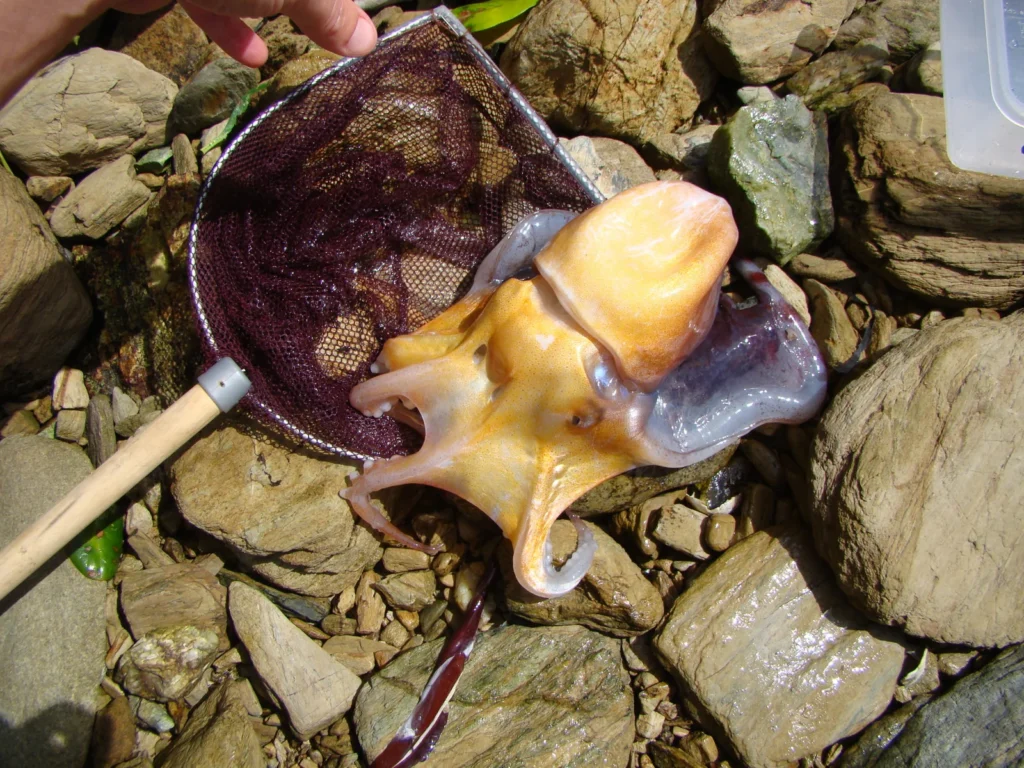
The blanket is an expanded web associated with the female’s dorsal arms. It is living tissue. The Museums Victoria account of Tremoctopus gracilis describes females trailing the web in open water and shedding strips that may distract predators.
That account concerns a different species from the Florida specimen. It helps explain the group, but species-specific observations should not be collapsed into one universal biography. The precise functions of the web remain questions; an impressive display does not prove a single purpose.
The male’s reproductive investment has its own scale
A tiny male is not simply an unfinished version of the female. His specialized reproductive arm has a specific role in sperm transfer. The difference between the sexes includes anatomy and function, not just a body scaled down like a photograph.
In an interview about the live encounter, researcher Mark Norman described the male’s reproductive investment and the surprising appearance of this little pelagic animal. The account emphasizes why recognizing a mature male in the water was significant: an adult need not resemble the much more conspicuous female.
This is a different level of biological organization from RNA editing in octopuses. One concerns the structure and life history of the sexes; the other concerns how genetic information is processed.
A detachable reproductive arm
The tiny male has a specialized arm used to transfer sperm. It detaches and is retained by the female for later fertilization. This provides a transfer mechanism despite the size mismatch, without the male permanently joining her body.
Compare this with sexual parasitism in some anglerfish. Both involve small males, but similar size patterns do not imply identical mating systems.
The stinging-tentacle connection
Small blanket octopuses have been observed carrying pieces of Physalia tentacles, which retain stinging structures. Museums Victoria describes this behavior in males and small females of Tremoctopus gracilis, while noting uncertainty about whether the pieces assist defense, feeding, or both.
The 2002 report of a live male discusses this unusual association as one possible contributor to the evolution of the size disparity. That is a hypothesis about selective pressures, not proof that stolen tentacles alone explain the animal’s adult size.
It also shows why related species should be named carefully. Observations from one species can suggest questions about another without becoming universal facts for the entire genus. The supporting photograph here depicts Tremoctopus robsoni; the commonly cited extreme-size report concerns T. violaceus.
Free-swimming animals also need feeding and defensive strategies that work away from a solid surface. Compare the octopus’s body and web with the feeding houses of giant larvaceans. Both occupy open water, but one carries an arm web and the other builds a disposable mucus filter around itself.
Why did the sexes diverge?
Research documenting a live male blanket octopus helped establish the disparity. Explaining its evolution is harder than measuring it. Large females can accommodate substantial reproductive investment, while males need not make the same investment in eggs. These are evolutionary considerations, not a complete experimental explanation.
Featured image credit: Historical line illustration. Image: Michael Vecchione, Clyde F.E. Roper, & Michael J. Sweeney. Original image · Public domain. Resized and converted to WebP; image remains under its original license.