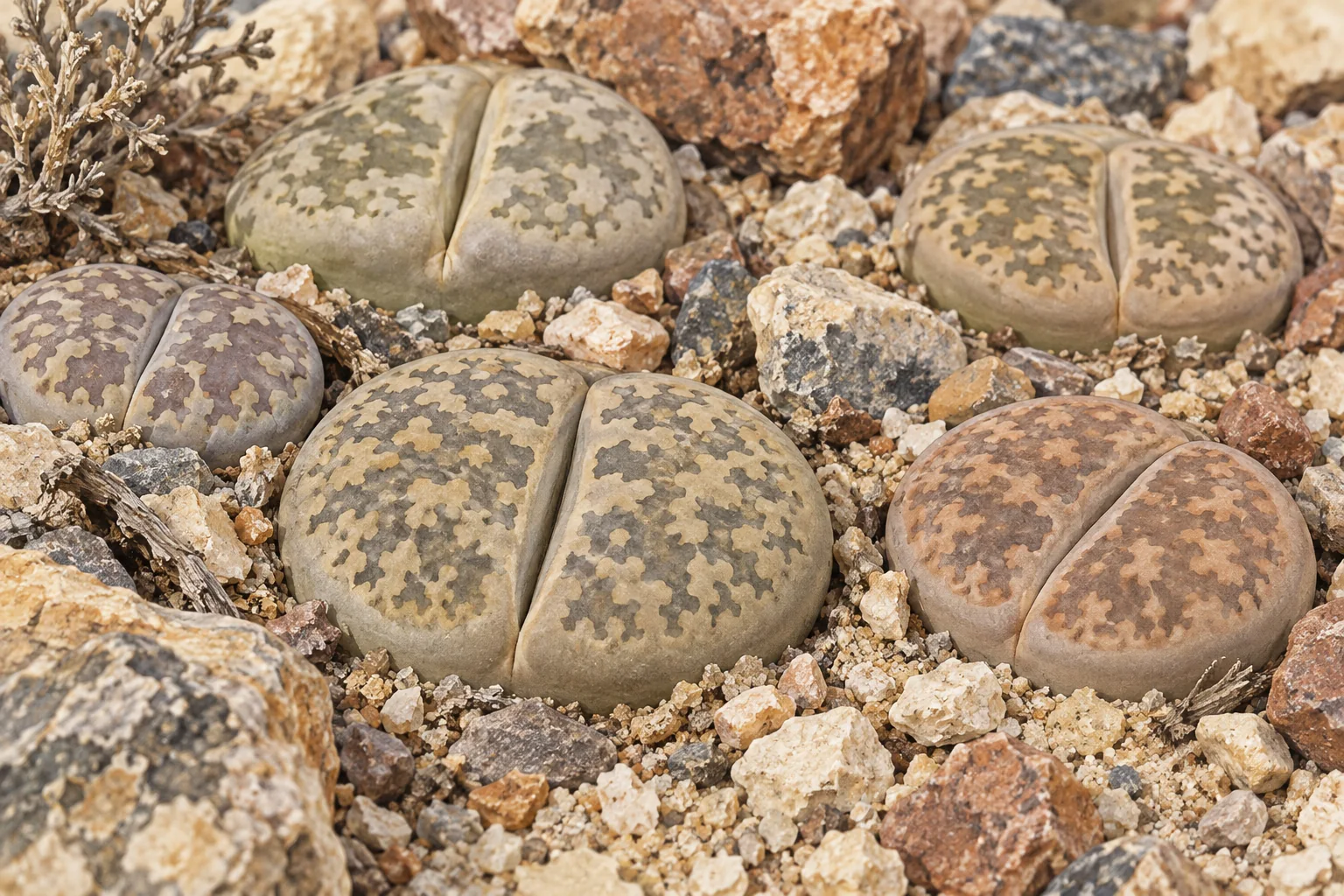
Among desert pebbles, a Lithops plant can disappear in plain sight. Its visible body is a pair of squat, fleshy leaves, not a stone. Parts of their patterned upper surface transmit light into tissue farther inside. A plant that keeps a low profile still needs sunlight. This compact design contrasts with Welwitschia’s two continuously extending leaves, another unusual way to organize desert foliage.
A leaf pair disguised as a pebble
The South African National Biodiversity Institute’s Lithops account describes dwarf succulents with two thick leaves. Their flattened tops form windows, with markings that vary among plants. Much of the body can sit at or below ground level, leaving the tops exposed.
The stone-like appearance is a structural form of camouflage, not a rapid color change on demand. It differs from fast skin-color changes in animals. A similar outcome—being harder to see—can come from different mechanisms.
Why keeping a low profile changes the leaf’s problem
A succulent body stores water in a relatively large volume while exposing a smaller surface. A broad, thin leaf and a thick, compact leaf therefore face different physical trade-offs. The compact design can hold substantial internal tissue without presenting all of it directly to the air.
That advantage creates another challenge: much of the photosynthetic tissue may be shaded by the plant’s own body and surrounding soil. The leaf window addresses access to light while retaining the compact arrangement. It does not eliminate the need for water or make the tissue immune to heat.
The pebble-like form also differs from animals that rapidly change skin color. Both can alter what an observer sees, but a Lithops leaf’s appearance is a relatively fixed structural pattern rather than a fast display.
Light reaches the interior
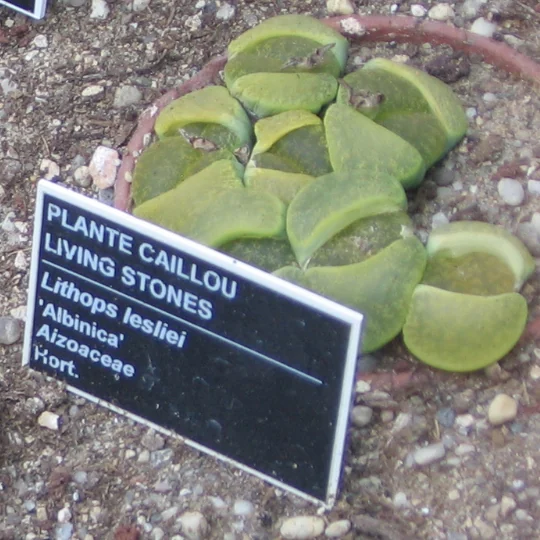
The windows provide a route through a thick leaf. Research on Lithops aucampiae examined how regions within one leaf cope with different light conditions. Upper and deeper photosynthetic tissues experience distinct environments despite belonging to the same organ.
Imagine a room illuminated through a skylight: the opening and receiving surfaces have different jobs. A Lithops window is living tissue, not clear glass. Its pattern and the tissue beneath affect how incoming energy is distributed.
The same leaf contains bright and shaded environments
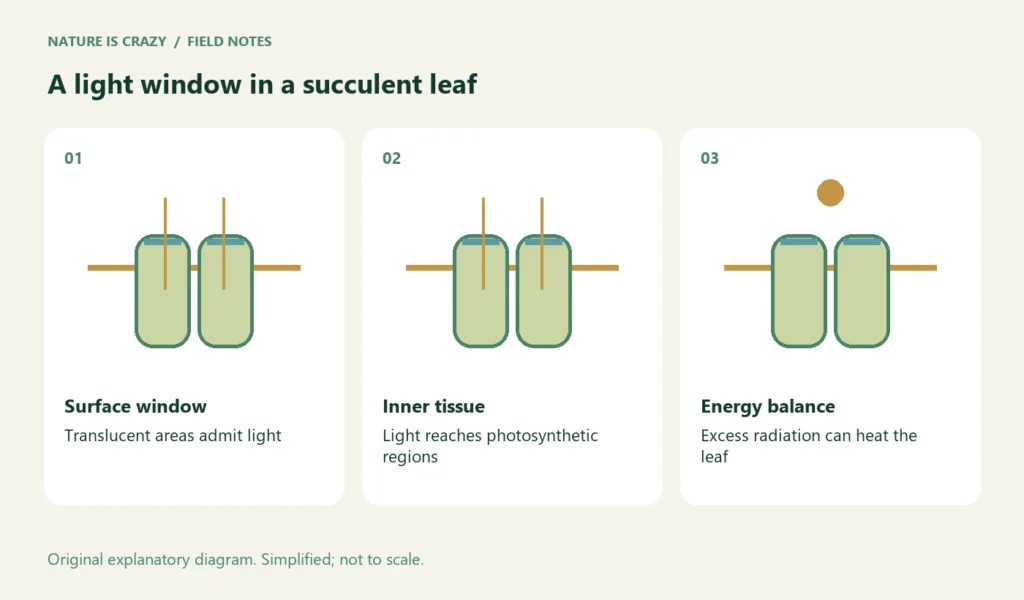
The upper surface receives incoming radiation first, while deeper regions receive a modified, weaker light field. Treating the leaf as uniformly illuminated would miss this internal variation. Research on Lithops aucampiae found regional differences in pigmentation and cellular features associated with those different conditions.
This gives the window a more sophisticated role than simply opening a hole to the sun. It belongs to a system that admits, distributes, uses, and limits radiant energy. Cells near the top and cells deeper inside need not solve their light problems in identical ways.
The window-versus-heat experiment is especially useful because it tests a trade-off. Covering the opening changes incoming energy, and measurements show that this can affect temperature as well as photosynthetic performance. A larger opening is therefore not automatically an improvement.
More light is not always better
A study comparing 17 Lithops species found that window size varied with habitat conditions. Plants from brighter, drier environments tended to have smaller windows than those from rainier regions with less sunshine. Excluding incoming light could also reduce leaf temperatures.
This complicates the story that a bigger window must be better. Light provides energy for photosynthesis, but excess radiation can heat tissue and impair performance. An opening must balance admission and protection. The study does not prove that every marking on every plant has one simple function.
Saving water while taking in carbon dioxide
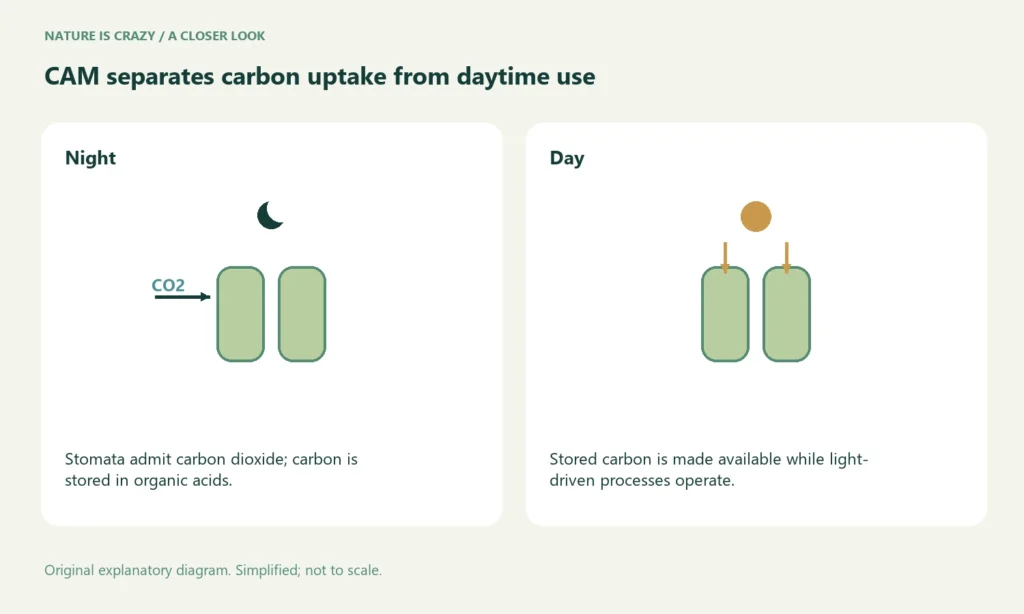
Light is only one requirement for photosynthesis. Plants also need a carbon supply, normally acquired through gas exchange. Opening stomata permits carbon dioxide to enter but also allows water vapor to escape, so the timing of gas exchange matters in dry conditions.
Lithops uses CAM photosynthesis. Arizona State University’s explanation of CAM describes the separation of nighttime carbon uptake from daytime use: carbon is stored in organic acids, then made available while light-driven processes operate. Closing stomata during much of the day helps limit water loss.
The window and CAM solve different parts of the problem. One concerns access to light within the leaf; the other reorganizes carbon uptake over time. Calling either adaptation “the secret” of the plant would overlook the contribution of the other.
These mechanisms also differ from a plant’s response to physical stimulation. An impressive plant trait need not correspond to an animal sense. In Lithops, the most revealing questions concern where light goes, when carbon arrives, and how the plant manages the energy and water costs.
A compact solution to light collection
A broad leaf on a tall stem exposes a large surface to the air. Lithops packages its tissues into a succulent body near the soil. The window combines that arrangement with light access rather than abandoning photosynthesis.
The design does not involve eyes or vision. It works through plant structure and physiology, a distinction also useful for interpreting plant responses to physical stimuli.
Featured image credit: AI-generated editorial illustration, not a photograph or a precise anatomical reconstruction.