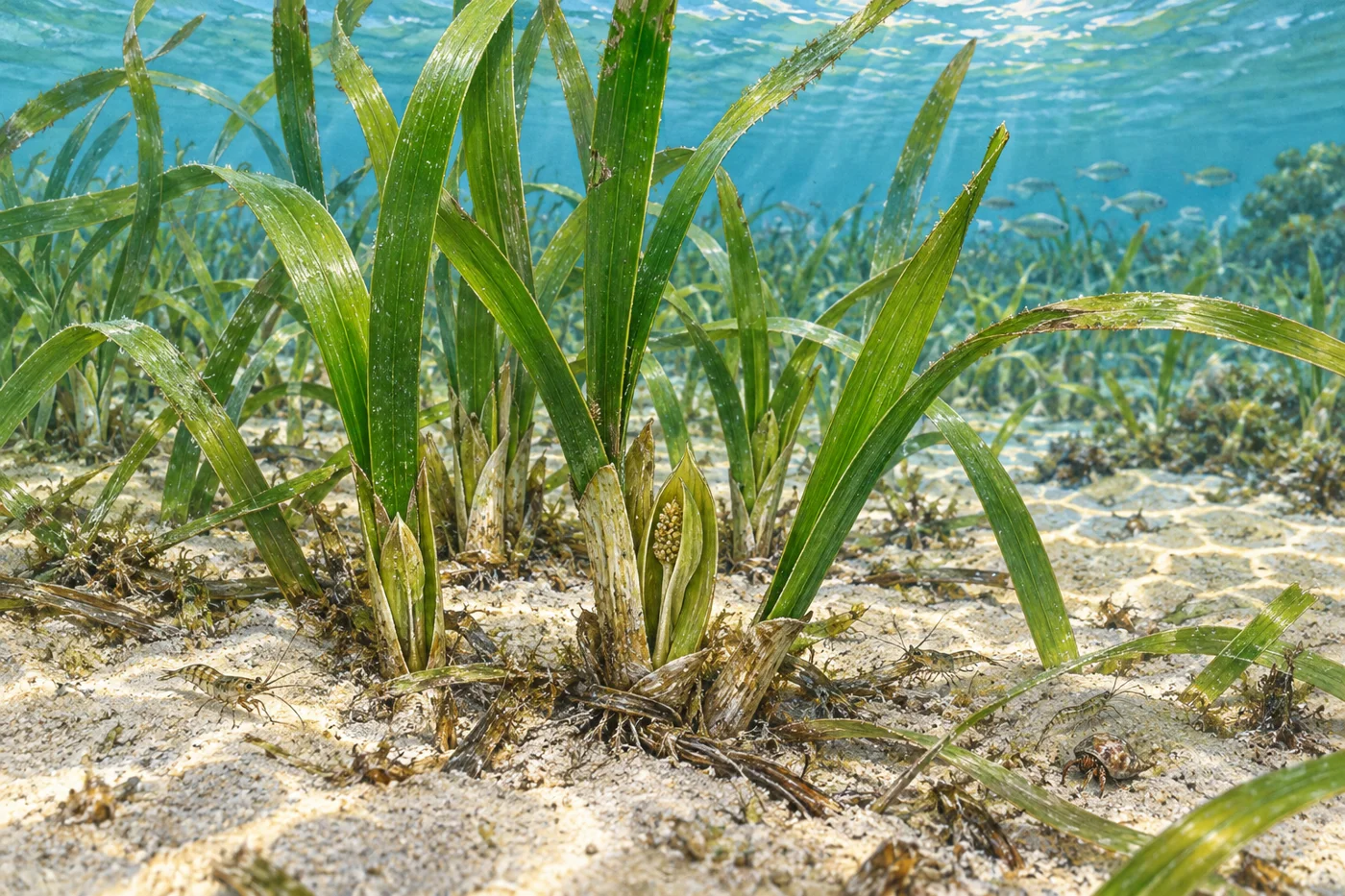
Underwater meadows contain animals with remarkable ways of interacting with their surroundings, including the mollusks in our article on scallops and their many eyes. The plants in those meadows have their own surprises. Turtle grass, Thalassia testudinum, is a flowering plant, and small marine animals can help transfer its pollen.
The discovery does not replace water with animals as the only transport route. The important result is mixed pollination: movement of water and movement of living visitors can both contribute. Researchers had to show more than animals visiting flowers to establish that those visitors could perform the necessary transfer.
Seagrass is a flowering plant, not seaweed
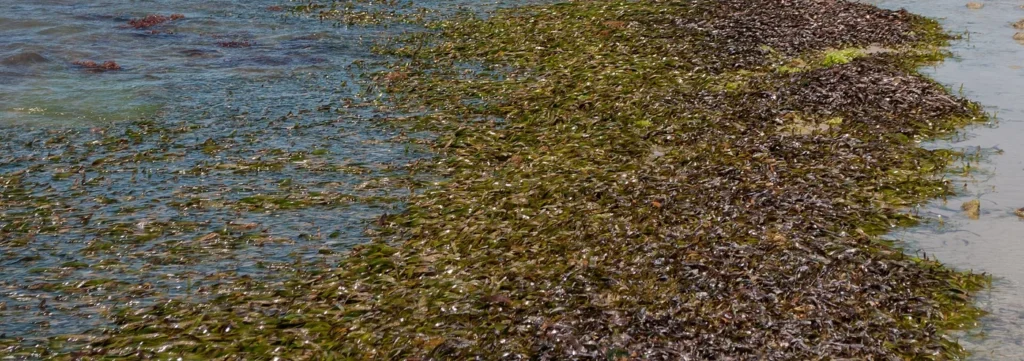
A meadow of straplike underwater leaves can look like a collection of algae. Seagrasses, however, have the organs and reproductive structures of flowering plants: roots, leaves, flowers and seeds. Turtle grass is one of the characteristic species of warm western Atlantic and Caribbean shallows.
NOAA’s description of seagrass meadows explains their role as rooted marine plants and the habitat they create. Their position in shallow water allows sunlight to reach the leaves, while roots and underground stems connect them to the seabed.
A plant living entirely underwater faces a different pollen-transport problem from a land flower. Airborne insects cannot simply move between submerged flowers in the usual way. Water itself can carry pollen, and the structures releasing and receiving it are adapted to that setting.
The pollen travels in a sticky package
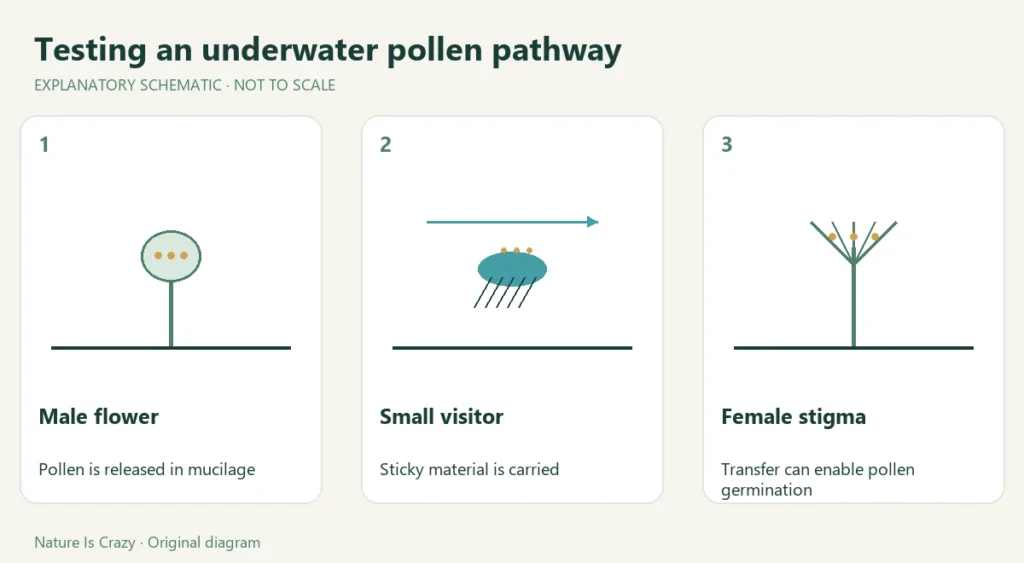
Turtle grass has separate male and female plants. Male flowers release pollen in mucilage, a gel-like material surrounding the grains. Female flowers receive pollen on their stigmas. These structures are small and inconspicuous within the meadow, rather than resembling showy garden flowers.
The mucilage matters because it connects the reproductive material with potential visitors. A moving animal can acquire sticky material during a flower visit and potentially carry it elsewhere. But material sticking to an animal establishes only the first portion of the proposed pathway.
For successful pollination, appropriate pollen must also reach a receptive female structure. A visit to a male flower, a grain on a leg and a visit to a female flower are separate observations. Researchers need evidence connecting them.
Night visitors suggested an unexpected possibility
A study of small invertebrates foraging on seagrass pollen investigated animals visiting turtle grass flowers at night. The visitors included small crustaceans and marine worms, some of which acquired pollen-bearing mucilage.
These observations suggested animal-assisted transport, but the investigators appropriately framed it as a possibility to test. An animal consuming pollen could remove it without delivering any to another flower. Flower visitation and pollination are not synonyms.
That distinction makes the next experiments particularly important. An appealing analogy with bees is easy to propose. Demonstrating the equivalent reproductive service beneath the water requires tracking what happens to the pollen.
On land, some flowers use elaborate tricks to bring the right visitors into contact with reproductive structures, as our article on hammer orchid pollination explains. The seagrass case involves a different setting and mechanism, but the same distinction between attracting a visitor and achieving pollen transfer.
Experiments separated animal movement from water flow
A 2016 experimental study tested whether invertebrates could carry pollen from male flowers to female stigmas without water flow supplying the transport. Animals visited the flowers and transferred pollen-bearing mucilage. Pollen tubes then formed on stigmas, providing evidence of successful pollination.
The absence of flow was a key part of the design. If water movement had remained an uncontrolled transport route, pollen arriving at a female flower could not confidently be attributed to visitors. Removing that route made the animal contribution distinguishable.
Pollen-tube formation supplied another important check. It went beyond showing a stray grain on a receptive surface and demonstrated a biological response associated with germinating pollen. The result connected transport with the plant’s reproductive process.
Flower timing creates a window for those interactions
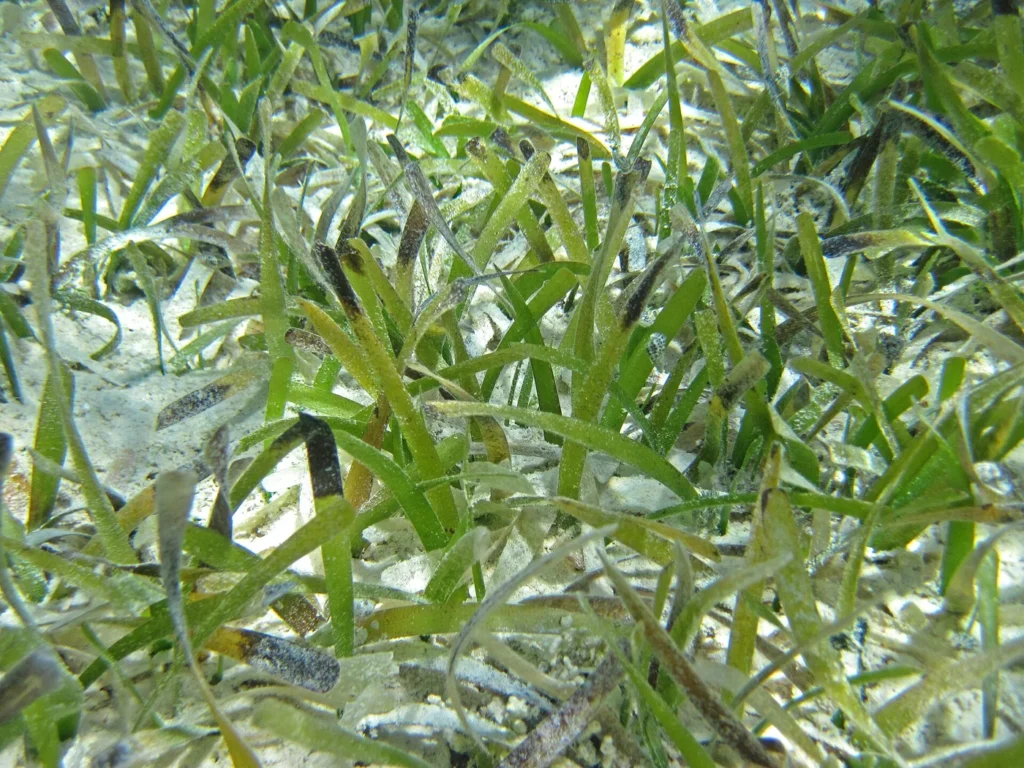
A study of turtle grass flower opening and pollen predation examined the timing of male and female reproductive structures in the field. Such work helps place the later pollination experiments within the plant’s actual reproductive schedule.
Timing matters because a carrier must encounter available pollen and then a receptive flower. If those conditions never overlap, physical ability to move a grain would not be enough. The activity periods of visitors and the availability of reproductive material belong in the same explanation.
This does not imply that every visitor at night is a pollinator or that every transferred grain produces a seed. Pollination is one stage in a longer reproductive sequence, and later development can succeed or fail for other reasons.
The finding expands the picture rather than erasing it
The demonstrated animal contribution applies to the species and circumstances studied. It should not become a claim that all seagrasses depend on underwater insects, or that currents have no role in turtle grass reproduction. The actual finding is richer: a marine flowering plant can use a mixed transport system.
That also changes how the meadow’s inhabitants can be viewed. Small animals are not merely living between leaves or eating material supplied by the plants. Some can participate in moving reproductive material among them. The community includes interactions that are easy to overlook at normal viewing scale.
For another close partnership between a marine animal and photosynthetic organisms, read how giant clams distribute light to their algal partners. Turtle grass provides a different surprise: a submerged flower can receive a pollination service from tiny animals moving through the water around it.
Featured image credit: AI-generated editorial illustration of turtle grass. Conceptual imagery, not a documentary photograph; anatomy and scale are illustrative.