
The Triangle-Weaver Spider Web Slingshot Mechanism
Most spiders are patient anglers, casting a silken net and waiting for a meal to arrive. But in the woodlands of North America, one species has abandoned patience for physics, turning its web into a high-speed catapult.
This is not the familiar narrative of a predator sitting motionless in a static trap. Instead, it is a story of active hunting, where the web itself becomes a weapon. The architect of this incredible device is the triangle-weaver spider, known to science as Hyptiotes cavatus. While its cousins, the orb-weavers, rely on sticky threads and potent venom, this tiny creature employs a far more dynamic strategy. It has engineered a spider web slingshot, a system that stores and releases immense energy to ensnare its prey with explosive force.
This hunting method sets the triangle-weaver apart from nearly all other arachnids. It doesn’t just build a net; it builds a machine. The web is not a passive filter for catching whatever flies by. It is a pre-loaded weapon, held under extreme tension by the spider itself, waiting for the perfect moment to launch. This behavior represents a remarkable evolutionary leap, transforming the spider from a stationary trapper into a projectile hunter.
The existence of such a complex mechanism raises fundamental questions. How does a creature so small generate the power needed to catapult its web through the air at incredible speeds? What evolutionary circumstances could have driven a spider to develop such a bizarre and sophisticated hunting tool? The answers lie in a combination of unique biology, advanced material science, and the pure physics of power amplification.
Meet the Unassuming Architect
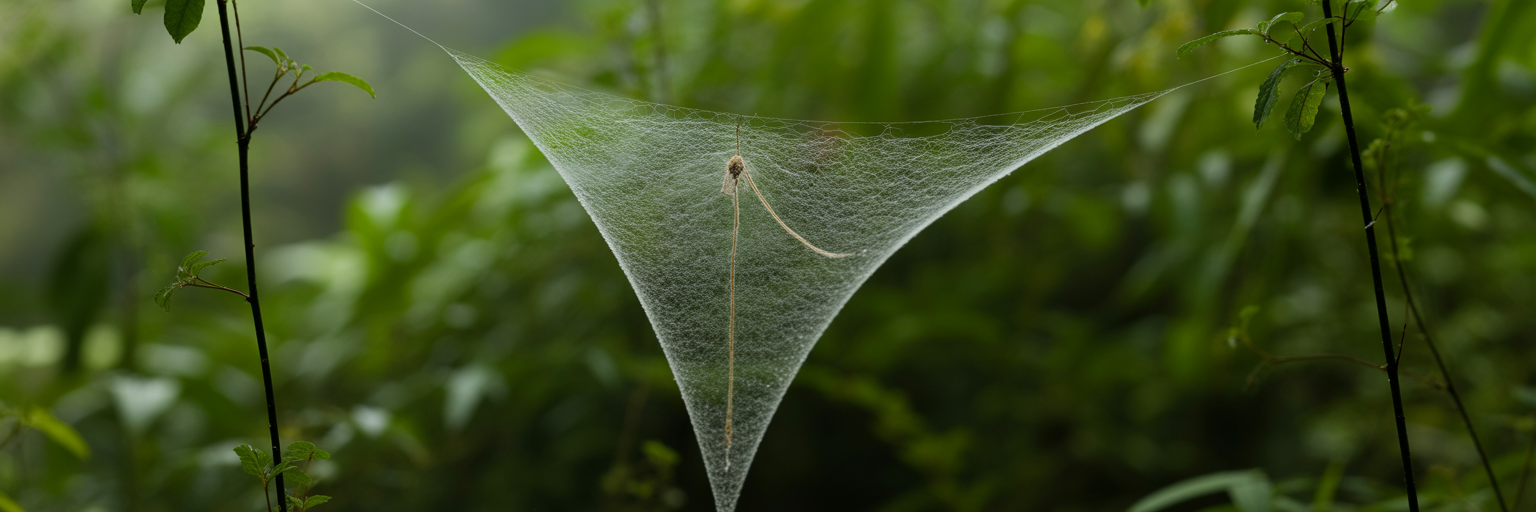
At first glance, the protagonist of this story is anything but remarkable. Hyptiotes cavatus is a tiny spider, often measuring just a few millimeters long. Its mottled brown and gray body provides excellent camouflage, making it look more like a stray piece of bark or a bud on a twig than a formidable predator. Found in the forests and woodlands across North America, it is easily overlooked, a humble resident of the undergrowth.
This unassuming appearance, however, conceals a critical biological secret that is the key to its entire existence. The triangle-weaver spider is venomless. Lacking the chemical weaponry that most spiders rely on to subdue their prey, it faced an evolutionary crossroads. It could not bite and paralyze an insect caught in its web. This single constraint forced it to develop an alternative solution, one based not on biochemistry, but on mechanical engineering.
The spider’s body is perfectly adapted for this role. It acts as a living component of its web-machine, physically connecting the main anchor line to the triangular trap. Clinging to a twig with its rear legs, it grasps the tension line with its front legs, becoming the bridge that holds the entire system in a state of high alert. Its body is not just a trigger but also a sensor. The anchor line it holds is more than just a rope; it is a communication cable. Through this single thread, the spider feels the faintest vibrations, allowing it to distinguish between a gust of wind and the telltale touch of a potential meal.
This deep integration of body and tool is a testament to specialized evolution. Nature is full of such specialists, from spiders that use slingshots to the star-nosed mole that eats faster than you can blink. For Hyptiotes cavatus, its body and web are not separate entities but a single, unified hunting apparatus, designed to solve the problem of being a predator without poison.
A Web Unlike Any Other
The triangle-weaver’s web is a masterpiece of purpose-built design, fundamentally different from the familiar spiral of an orb-weaver. Every element, from its overall shape to the molecular structure of its silk, is optimized for one purpose: storing and releasing kinetic energy.
A Purpose-Built Triangular Frame
Instead of a full, circular net, the spider constructs a precise triangular sector. This web consists of four radial lines that converge at a single point, with capture threads strung between them. This shape is not arbitrary. It is an architecture designed for directional tension. When the spider pulls on the junction point where the radial lines meet, the force is distributed evenly across the entire triangular structure, allowing it to be stretched like a single, cohesive rubber band without any weak points.
The Material Science of a Nano-Spring
The silk itself is an engineering marvel. For a long time, scientists were puzzled by how such a thin material could withstand the incredible strain of being stretched and released repeatedly. The answer was found in its unique molecular makeup. As recent genomic research published in PNAS Nexus revealed, the spider produces exceptionally proline-rich silk. This amino acid allows the silk proteins to form structures that function like a series of nano-springs. This composition enables the silk to store vast amounts of elastic energy as it is stretched and then release it almost instantaneously, a property that sets it apart from the silks of other spiders.
Natural Velcro: The Cribellate Capture Silk
The capture threads of the triangle-weaver also operate on a different principle. Unlike the sticky, glue-covered silk of orb-weavers, this spider uses a dry, fuzzy silk known as cribellate silk. Produced from a specialized organ called the cribellum, this silk is spun into thousands of incredibly fine, looped fibers. When an insect touches the web, these fibers don’t stick to it; they physically snag on the tiny hairs and bristles of the insect’s legs and body. It functions like a natural form of Velcro, creating an immediate and secure entanglement that is purely mechanical, not adhesive.
| Property | Triangle-Weaver Silk (Cribellate) | Orb-Weaver Silk (Ecribellate) | Primary Function |
|---|---|---|---|
| Capture Mechanism | Dry, fuzzy fibers (physical entanglement) | Sticky glue droplets (adhesion) | Snagging vs. Sticking |
| Elasticity | Extremely high, stores and releases energy | High, but primarily for absorbing impact | Energy Storage vs. Impact Dampening |
| Molecular Structure | Rich in proline, acts like nano-springs | Glycine-rich, provides strength and flexibility | Resilience for Repetitive Stretching vs. Tensile Strength |
| Reusability | Can be re-tensioned and reused multiple times | Often damaged and rebuilt daily | Durable Machine vs. Disposable Net |
Together, these elements create a web that is not a passive trap but a dynamic weapon. The triangular frame provides the structure, the nano-spring silk provides the power, and the Velcro-like capture threads provide the inescapable grip.
The Physics of External Power Amplification
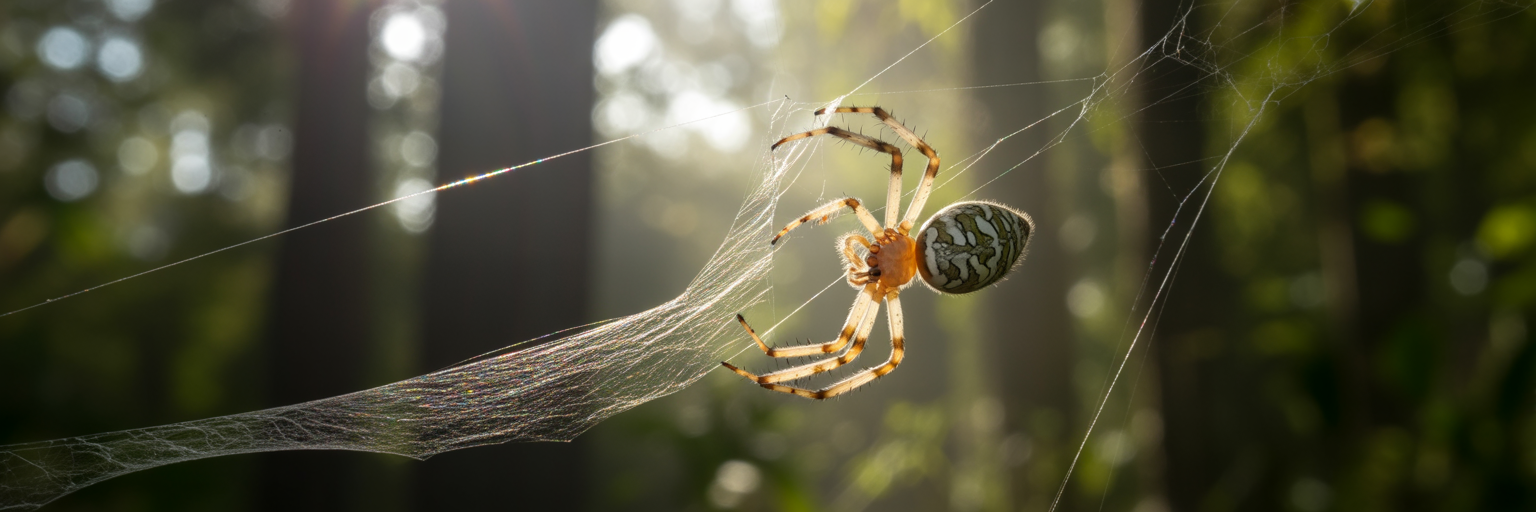
The secret to the triangle-weaver’s incredible power lies in a principle known as external power amplification. In simple terms, this means using an external tool to store energy slowly and release it quickly. A human archer provides a perfect analogy. The archer cannot throw an arrow very fast with their bare hands. However, by using their muscles to slowly draw back the bowstring, they load potential energy into the bow’s limbs. A flick of the fingers then releases this stored energy, launching the arrow at a speed far greater than the archer’s muscles could ever achieve directly.
This is precisely what the triangle-weaver spider does with its web. It contrasts sharply with the “internal” power amplification seen in other animals, like a flea or a grasshopper. These creatures store elastic energy in their own specialized body parts, like springy pads of resilin in their joints, before releasing it for a powerful jump. The triangle-weaver, however, outsources its energy storage to an external object: its web.
The advantage of this method is profound. It allows the spider to break free from the biological limitations of muscle speed and power. A muscle’s output is limited by the rate at which it can contract. The spider overcomes this by using a series of slow, deliberate muscle contractions to load the web with an enormous amount of energy over time. This entire process, as detailed by researchers in the journal PNAS, is a textbook example of external power amplification, where an animal uses an external structure to store and release energy beyond the limits of its own muscles.
The physics involves a simple energy conversion. The spider’s slow, methodical pulling transforms the chemical energy within its muscles into elastic potential energy stored in the stretched silk fibers of the web. This potential energy is held in a stable, high-tension state until the moment of the attack. When the spider releases its hold, that stored potential energy is explosively converted back into kinetic energy, the energy of motion, propelling the web forward. While the spider uses solid-state physics for its attack, other creatures have mastered fluid dynamics, like the archerfish that shoots bugs out of the air with water. Both are masters of projectile hunting, using external tools to achieve what their bodies alone cannot.
Priming the Weapon The Loading Process
The process of loading the web is a masterclass in patience and precision. It is not a single, powerful pull but a slow, meticulous sequence of actions that gradually builds the tension required for the attack. The spider’s movements are deliberate and efficient, designed to store the maximum amount of energy with minimal effort. The entire loading sequence can be broken down into four distinct steps.
- First, the spider attaches the main anchor line of its triangular web to a sturdy point, like a twig or branch. This line serves as the foundation for the entire tensioning system.
- Next, it moves to the junction where the web’s radial lines converge. From here, it grabs the anchor line and begins to pull it back towards itself, away from the anchor point.
- The spider then performs a careful, leg-over-leg motion, reeling in the anchor line and gathering a small bundle of excess silk. With each pull, it draws the line tighter, stretching the entire triangular web like the string of a bow.
- This process continues until the web is under extreme tension, visibly taut and humming with stored potential energy. The spider then holds this tension, sometimes for hours, waiting for prey.
One of the most remarkable aspects of this process is its energy efficiency. Once the web is tensioned, the spider can maintain this high-alert state without expending significant metabolic energy. The energy is not stored in its straining muscles but in the elastic silk of the web itself. The spider’s body is merely the latch holding the system in place.
During this waiting phase, the spider plays three roles simultaneously. It is the motor that loaded the weapon, the sensor that feels for the target, and the trigger that will initiate the launch. This gradual loading process allows the tiny creature to act as a force multiplier, turning a series of small, manageable pulls into a single, devastatingly powerful release.
The Moment of Release Catapulting to Victory
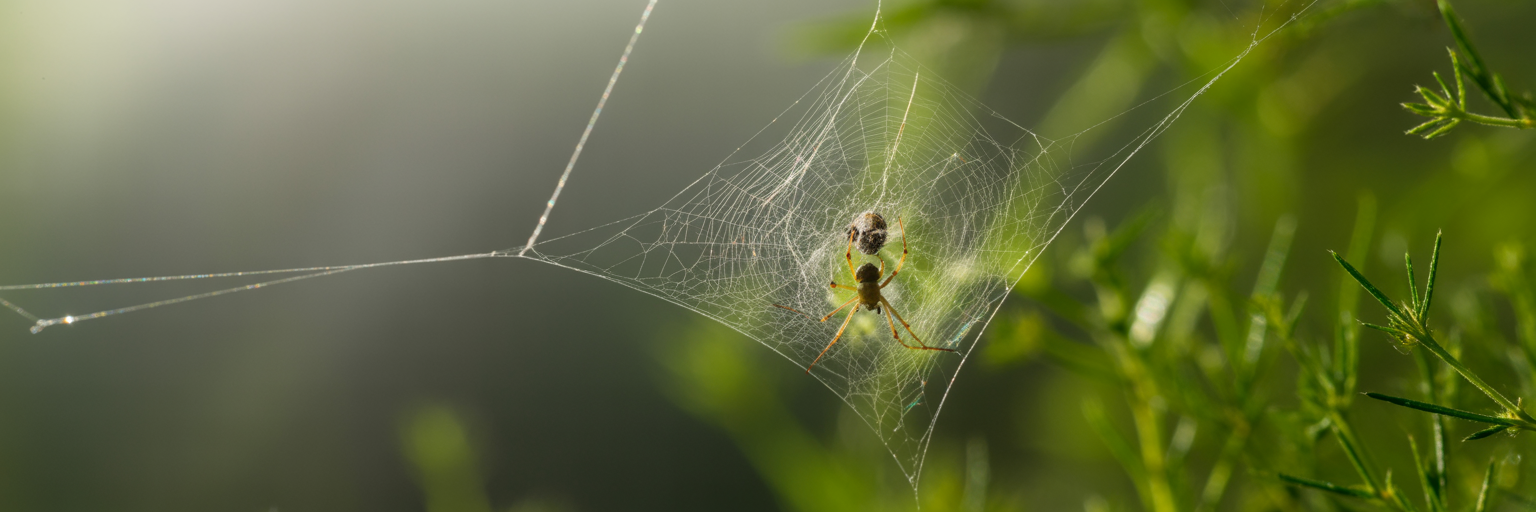
After hours of patient waiting, the climax of the hunt is triggered by the faintest of signals. A fly, a gnat, or any other small insect brushes against one of the web’s fuzzy capture threads. The vibration travels instantly along the radial lines to the junction point, where the spider feels it through the tensioned anchor line it holds. This is the signal to attack.
The spider’s response is brutally simple and incredibly fast. It does not lunge or jump. It simply releases its grip on the bundled-up anchor line it has been holding with its front legs. This single, subtle movement is the trigger pull for the entire weapon system. The instant the line is released, all the potential energy stored in the stretched silk is unleashed.
The result is an explosion of motion. The web and the spider, moving as a single unit, lunge forward. The web accelerates at a staggering rate, reaching up to 772.85 meters per second squared. To put that number in perspective, that is an acceleration more than 26 times greater than what a space shuttle astronaut experiences during launch. The speed of this attack is so extreme it rivals some of the fastest movements in the animal kingdom, a world where predators like the Venus flytrap have also mastered the art of hunting faster than you can blink.
This incredible velocity serves a critical strategic purpose. The web collapses onto the prey so quickly that the insect has zero time to react. Before it can even register the danger, multiple capture threads make contact simultaneously, snagging its legs, wings, and body. This is the ultimate payoff for the spider’s patient loading and one of the most unique spider hunting techniques in the natural world. The sheer speed of the entanglement ensures the prey is immobilized instantly, a perfect solution for a hunter that cannot rely on venom.
The Evolutionary Genius of a Venomless Hunter
The triangle-weaver’s slingshot web is more than just a curiosity; it is an elegant evolutionary solution to a life-threatening problem. For a predator, being venomless is a significant handicap. Without the ability to quickly subdue its prey with a toxic bite, the spider risks injury or even death in a direct struggle with a powerful insect. The slingshot mechanism completely bypasses this problem, replacing chemical warfare with overwhelming mechanical superiority.
This hunting strategy provides a major safety advantage. By launching its web from a distance, the spider avoids any direct physical confrontation. It never has to get close to its struggling prey until it is already thoroughly entangled and immobilized. This minimizes the risk of being kicked, stung, or bitten by its meal. This trade-off, losing venom but gaining a mechanical weapon, is a fascinating example of evolutionary problem-solving, much like how some parasites hijack animal behavior for a joyride to complete their own life cycles.
The effectiveness of this strategy is not just theoretical; it is backed by hard data. Scientific observation has shown that when the triangle-weaver uses its slingshot attack, it has a capture success rate of approximately 70%. In controlled experiments where the spider was prevented from releasing the tension, the success rate dropped to zero. This demonstrates that the slingshot behavior is not just helpful; it is absolutely critical for the spider’s survival.
Furthermore, the attack is not always a one-shot event. After the initial launch, the spider can quickly reel in the anchor line, re-tension the web, and launch it again at the same prey. It can repeat this process multiple times, adding more and more capture threads with each pulse, until the insect is completely wrapped and helpless. Only then does it cautiously approach to feed, its victory secured entirely through physics.
From Spiderwebs to Future Tech
The triangle-weaver spider’s incredible hunting strategy offers more than just a fascinating story from the natural world. It serves as a powerful example of biomimicry, the practice where human engineers and designers look to nature for solutions to complex problems. In this tiny, overlooked spider, we find a master of mechanical engineering and material science.
Studying its unique, proline-rich silk could inspire a new generation of synthetic materials. Imagine creating novel polymers that can store and release elastic energy with the same efficiency as the spider’s web. Such materials could have applications in everything from advanced textiles and resilient protective gear to more efficient components in soft robotics and medical devices.
The principle of external power amplification could also drive innovation in robotics. Small, low-power robots could be designed to perform rapid, high-force actions without needing bulky, energy-intensive motors. By using external elastic elements to slowly store energy and release it in a burst, micro-robots could achieve movements that are currently impossible, opening up new possibilities in manufacturing, exploration, and medicine. This principle of optimizing a system for maximum efficiency with minimal energy is a universal goal in engineering, whether it’s a spider’s web or the process of building a website Aussies actually want to use.
Ultimately, the story of the triangle-weaver spider is a profound reminder of the value hidden within biodiversity. It shows that even a creature we might easily dismiss as insignificant can hold the secrets to advanced physics and next-generation technology. It challenges us to look closer at the world around us, for it is filled with millions of years of evolutionary research and development, waiting to be discovered.
Frequently Asked Questions
Is the triangle-weaver spider dangerous to humans?
No, it is completely harmless. This spider is small, non-aggressive, and lacks venom entirely. Its highly specialized hunting method is designed for capturing small insects and poses absolutely no threat to people or pets. You could hold one in your hand without any risk.
How does the spider not get tangled in its own launching web?
The spider is a master of its own device. It strategically holds onto a specific, non-capture structural line and moves with the web as a single, coordinated unit. It is essentially riding the weapon, not standing in front of it. Furthermore, the fuzzy capture threads are designed to snag the hairy, bristly bodies of insects, not the spider’s own smooth legs, which do not easily get caught.
Why don’t all spiders hunt this way?
Evolution follows many different paths to success. Most spider lineages invested their evolutionary energy into developing potent venom and sticky, glue-based silk for their webs. This combination made passive trapping an extremely efficient strategy. The triangle-weaver’s slingshot is a highly specialized alternative that evolved in a lineage that lost its venom, forcing it to innovate with physics instead of chemistry.
How strong is the spider’s silk?
While it may not have the same raw tensile strength as the dragline silk of some larger spiders, its uniqueness lies in its incredible elasticity and resilience. Its most important mechanical property is its ability to be stretched repeatedly to store enormous amounts of energy without degrading or breaking. This is thanks to its special proline-rich molecular structure, which makes it function more like a high-performance spring than a simple rope.