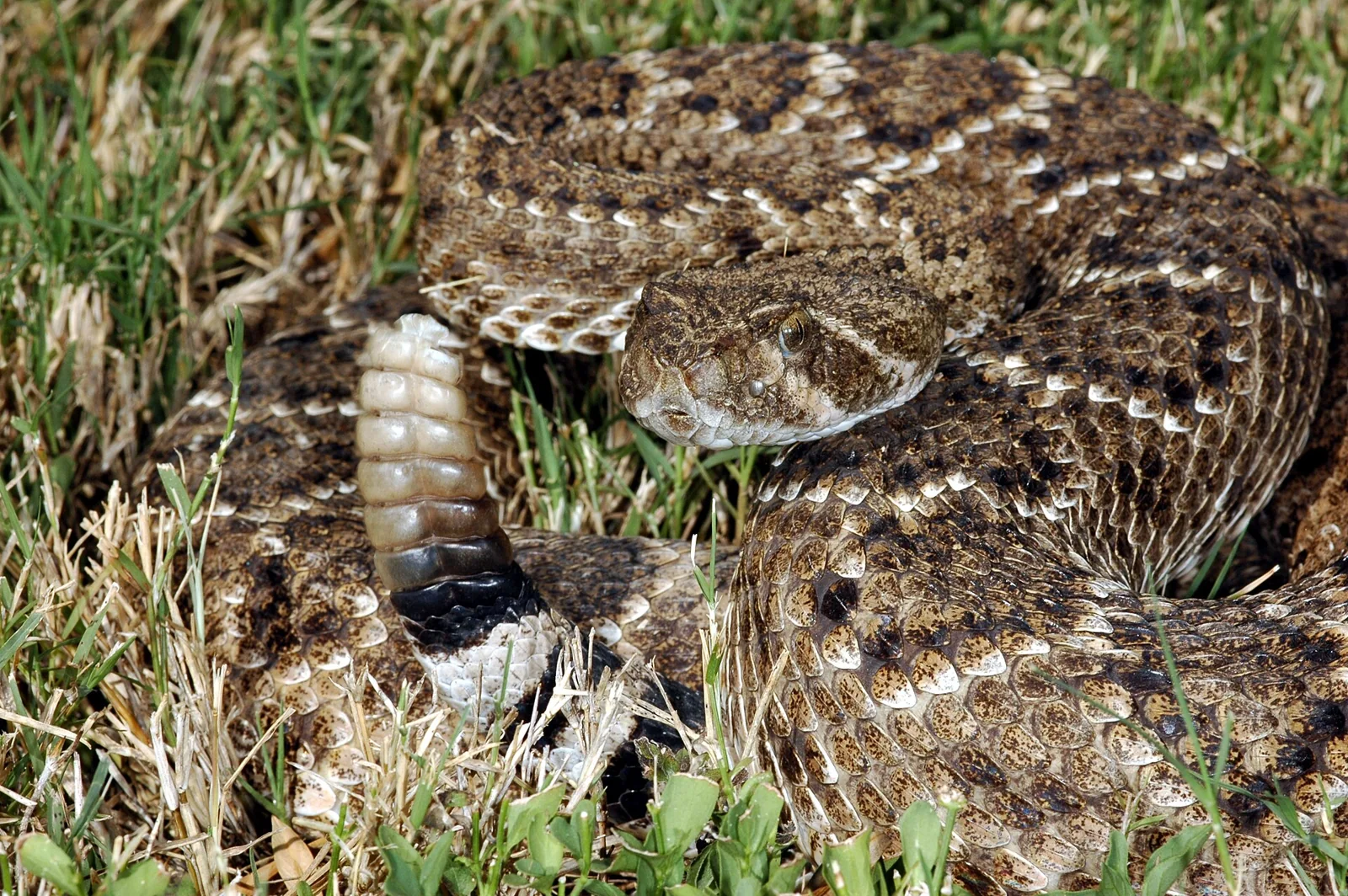
A rattlesnake’s warning is more complicated than a steady buzz. As a threat approaches, the snake can increase its rattling rate, then switch suddenly to a much faster pattern. In experiments, that abrupt change made human listeners judge the source as closer than it really was. Its timing-based warning adds another example to defensive signals that alter a predator’s perception.
The rattle is not a maraca
A rattlesnake does not shake pebbles inside its tail. The Smithsonian’s timber rattlesnake account describes loose keratin sections at the tail tip that contact one another during vibration. Keratin also forms human hair and fingernails.
The Smithsonian’s account of rattle growth notes that new segments appear with shedding. Counting segments is therefore not a straightforward count of years. The structure makes sound, while movement determines the pattern of that warning.
Why the timing of a sound conveys information
Two signals can come from the same place yet suggest different events. A slow sequence and a rapid sequence carry different patterns of change, even when the source has not moved closer. Listeners routinely combine timing with loudness and other cues when interpreting what is happening around them.
For the rattle, the individual contacts become a densely repeated acoustic display. The important experimental variable is how often the tail movement repeats, not a spoken message or a single musical note. A sudden increase changes the pattern that the receiver must interpret.
The comparison with burrowing owl chicks that imitate rattling sounds makes the distinction useful. An owl can borrow the recognizable character of the warning; the rattlesnake’s own display also varies its temporal structure.
A sudden change in tempo
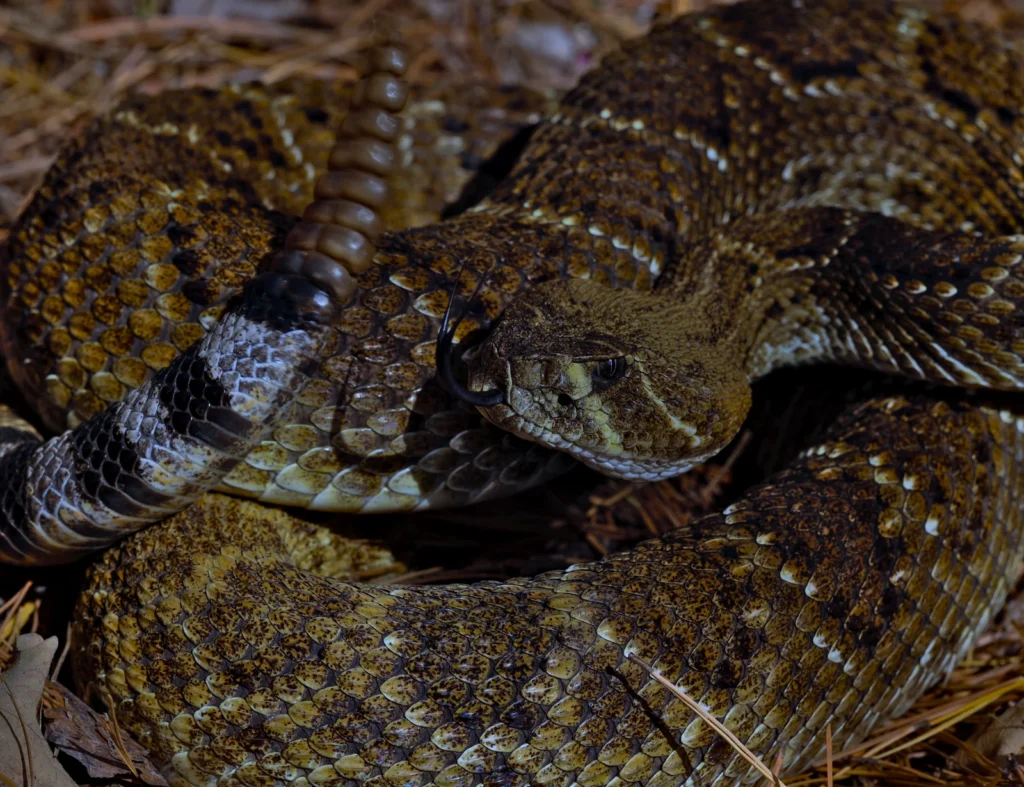
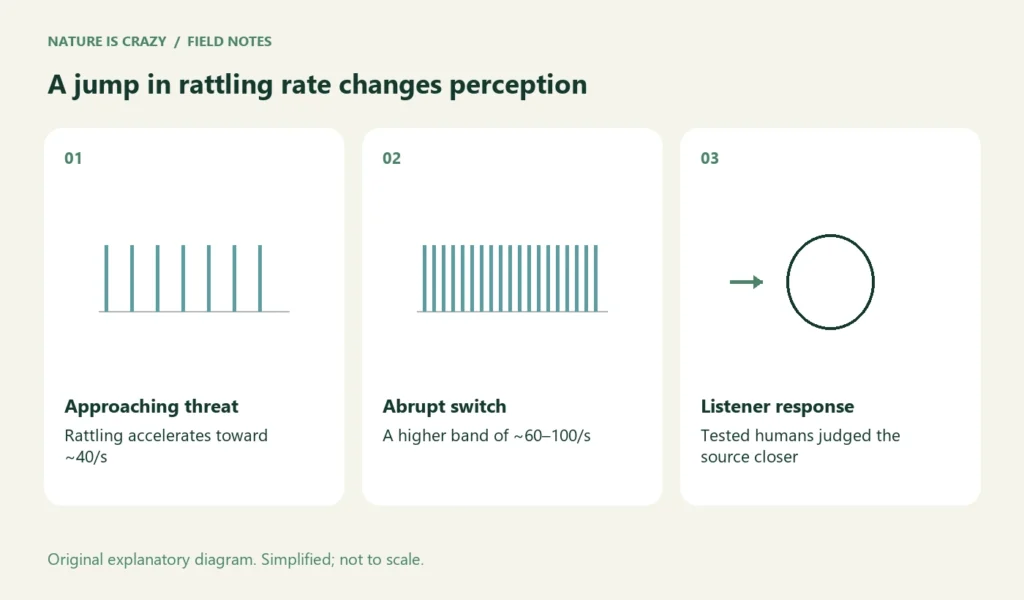
In a 2021 study of rattlesnake acoustic signals, researchers presented approaching visual stimuli. Rattling initially increased with the approaching threat, reaching about 40 shakes per second. The animals then switched abruptly to a higher band of roughly 60–100 per second.
These values describe repetition rate. They do not mean the animal produces a single pure note at that frequency. Rattling is a broader sound, and changing its pulse rate differs from simply changing a musical pitch.
What 40, 60, and 100 shakes per second mean
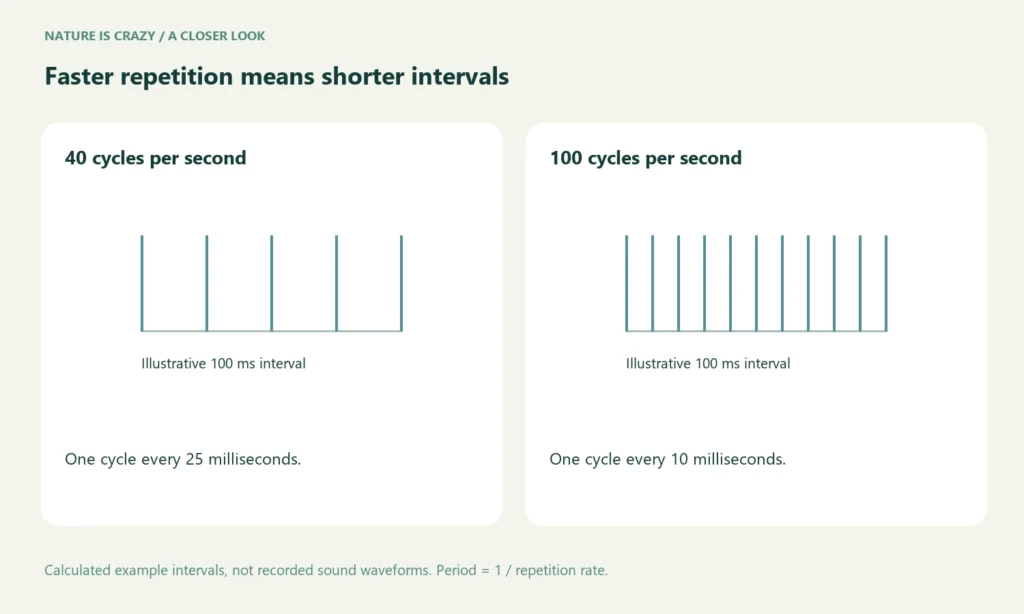
A repetition rate can be expressed as the interval between cycles. Forty cycles per second corresponds to about 25 milliseconds per cycle. At 60, the interval is roughly 16.7 milliseconds; at 100, it is 10 milliseconds. These values are calculated from the rate, not separate measurements of the snakes’ movements.
The shorter interval packs more repetitions into the same time. At these rates, hearing the display as a continuous buzz is unsurprising, yet the changing temporal pattern can still influence how the source is judged. A receiver does not have to count each shake individually for the structure of the signal to matter.
The diagram represents example repetition rates within the reported ranges. It is not a waveform recording, a measure of loudness, or a map of the snake’s actual distance from a person.
Testing human distance judgments
The study also used a virtual-reality setting. The jump to fast rattling created a strong impression that the virtual snake was suddenly nearer. The warning’s timing influenced the listener’s estimate of space, rather than merely announcing the animal’s presence.
Think of footsteps accelerating behind you: their timing may suggest that the walker is catching up before you can measure the distance visually. That analogy illustrates a perceptual problem; it was not the experiment performed with snakes.
Why a virtual snake is useful in a real experiment
In a natural encounter, source distance, loudness, visual size, movement, vegetation, and the listener’s attention can change together. That makes it difficult to identify which feature caused a particular distance judgment. A controlled virtual setting allows researchers to manipulate a sound pattern while keeping an encounter reproducible.
The resulting evidence concerns perception: the listeners’ estimates shifted when the rattling pattern changed. It does not require a living snake to physically approach the participants at that moment. Separating the signal from the original animal is precisely what makes the receiver’s contribution easier to study.
There are two linked processes here. The animal changes its display in response to an approaching visual threat, and human listeners interpret the changed display differently. Combining these observations explains the effect without assuming that the snake has a human-like plan.
This is similar in experimental logic to testing dung beetles under a manipulated night sky. In both cases, researchers isolate information that would normally occur within a complicated natural scene. The difference is the receiver: one study measures the beetle’s course, while the other measures a human’s estimate of distance.
Where the evidence stops
The results support an illusion in human listeners under the tested conditions. They do not show that snakes consciously understand human psychology, that every predator responds identically, or that a rattle reliably measures outdoor distance. Echoes, vegetation, position, and individual behavior complicate real encounters.
Defensive signals can influence another animal before physical contact. Compare this with eye-like markings that deter predators. The site also describes burrowing owl chicks that imitate rattling sounds, a separate form of acoustic defense.
Featured image credit: Image: Clinton & Charles Robertson from Del Rio, Texas & San Marcos, TX, USA. Original image · CC BY 2.0. Resized and converted to WebP; image remains under its original license.