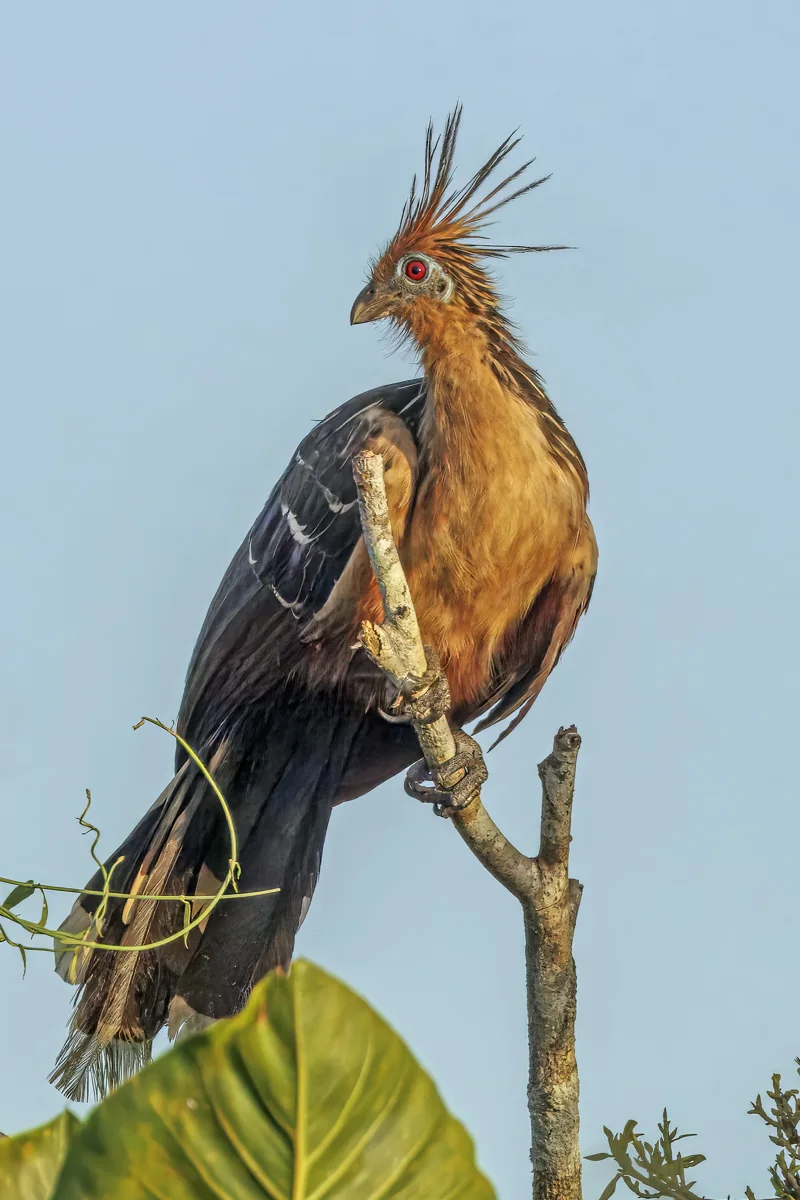
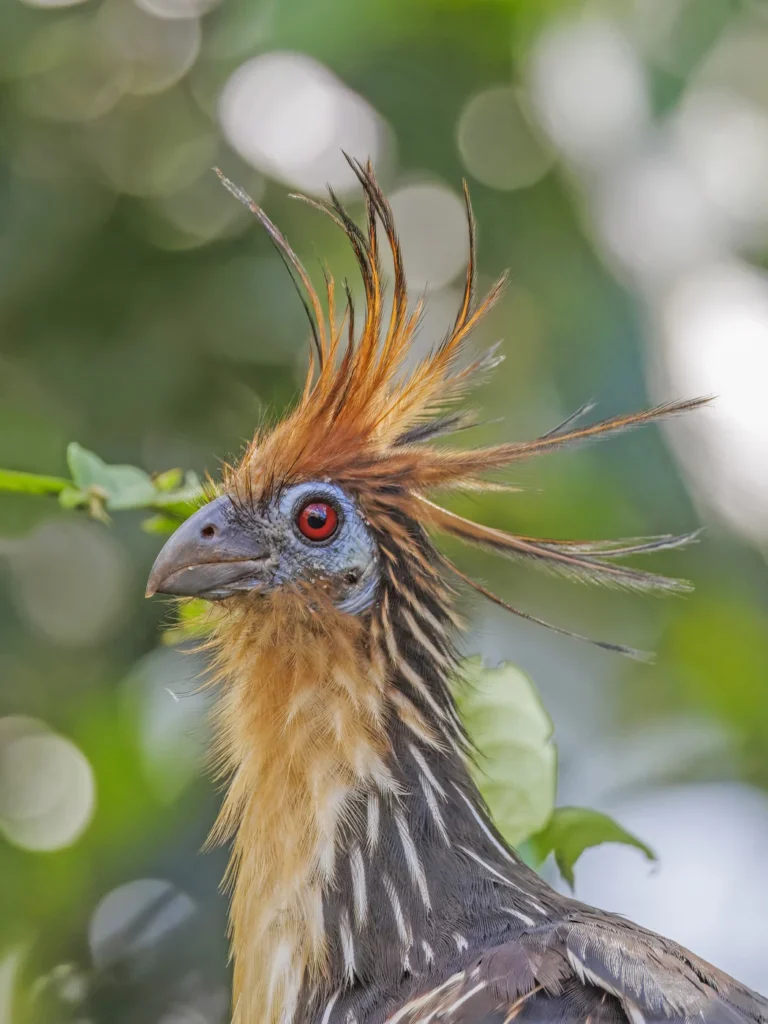
The hoatzin looks extravagant: a spiky crest, bare blue facial skin, and a long tail. Its strangest feature is hidden inside. This South American bird holds leaves in an enlarged foregut, where microbes process its food before it reaches the stomach. Part of a bird’s food-storage system has become a fermentation chamber. Its unusual gut belongs alongside other examples of microbes helping animals turn tough plants into food.
Why leaves are a difficult meal
Leaves contain useful nutrients, but their cell walls make much of that material difficult to access. Eating vegetation and extracting energy from its structural carbohydrates are different problems. A microbial community can contribute biochemical capabilities that the host lacks alone.
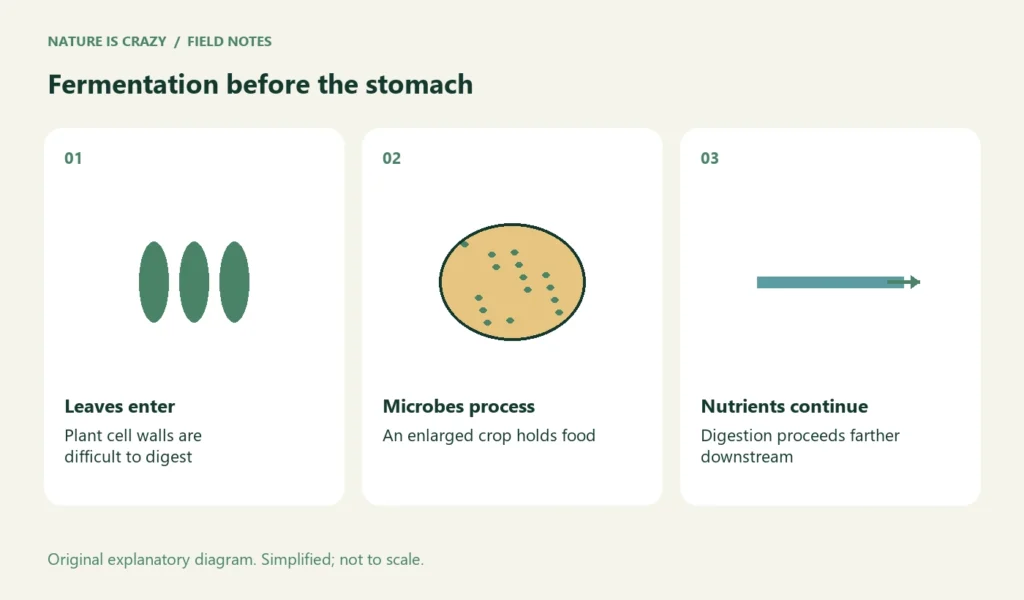
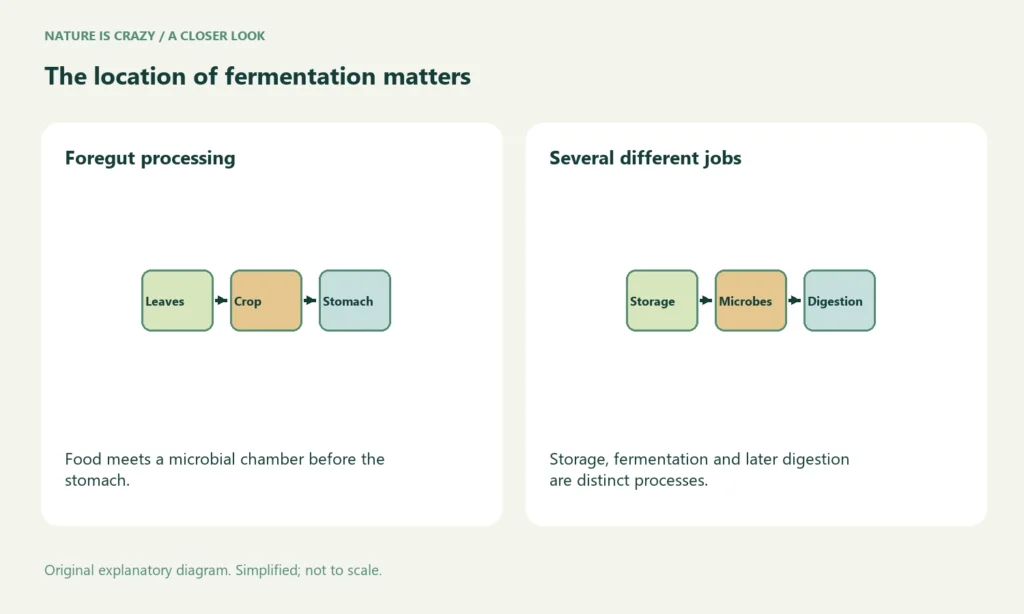
Many herbivores use gut fermentation. The unusual part of the hoatzin’s solution is its location: an enlarged crop and lower esophagus near the beginning of the digestive tract. A typical bird’s crop mainly holds food. In a hoatzin, it also supports microbial processing.
Turning storage space into processing space
A chamber that merely holds food and one that ferments it solve different problems. Storage delays the passage of a meal. Fermentation also changes the material chemically, creating products that can become available to the host. The hoatzin’s enlarged foregut combines retention with a microbial habitat.
An anatomical study of the hoatzin digestive tract examined that specialization in detail. It helps explain why the location of a chamber matters: food can be processed by microbes before continuing into later digestive regions, rather than undergoing microbial breakdown only after much of the ordinary digestive sequence.
Compare this with the physical transformations described in the wombat’s unusually shaped droppings. Both depend on digestive anatomy, but the hoatzin story centers on chemistry and symbiosis rather than the final geometry of waste.
A microbial workforce
Research on wild hoatzin crop bacteria identified a diverse community with many poorly characterized lineages. Retaining plant material gives microbes time to work. Fermentation products and microbial material can contribute to the bird’s nutrition.
The study sampled six adult birds. It reveals a rich community in those samples, rather than a complete inventory of every hoatzin’s microbiome. Identifying bacterial DNA also differs from measuring every organism’s chemical activity.
What microbes contribute that the bird cannot do alone
Plant cell walls are not interchangeable with the softer contents of a leaf. A bird can swallow both together while facing different biochemical obstacles. Microbial processing helps open access to components of a diet that would otherwise be harder to use efficiently.
The original report of foregut fermentation established the bird as an unusual small-bodied example of this feeding strategy. Later studies investigated the inhabitants rather than stopping at the chamber’s appearance. Research on crop methanogens identified another part of that community: archaea associated with the fermentative environment.
Bacteria and archaea are different groups of organisms. A bird’s digestive partnership cannot be reduced to one helpful species or a bottle of generic “good bacteria.” It is a functioning community inside a particular physical and chemical setting.
A comparison with cows
A cow’s rumen and a hoatzin’s crop are different organs, but both provide room for microbial fermentation. A review of avian gut microbiota discusses this convergence: similar dietary challenges can favor comparable functional solutions in unrelated animals.
The bird does not have a cow’s stomach or identical microbes. Both systems instead depend on partnerships between a digestive environment and its inhabitants. That distinction helps explain how microbes help herbivores digest plants.
Why retention is useful—and why it has a cost
Microbes need time to act. Food that races through a chamber may leave before much processing occurs, while longer retention makes the meal available for additional breakdown. This creates a basic digestive trade-off: throughput is not the only measure of success.
A fermentation chamber also occupies space and contains material that the animal must carry. In a flying bird, feeding anatomy therefore interacts with the rest of the body. It would be misleading to portray fermentation as a free upgrade that every bird could simply adopt. Different diets, body plans, and ways of moving favor different solutions.
Research on the crop’s occupants also raises a separate question: which functions belong to the community, and which to specific members? DNA surveys describe who is present; direct measurements of products and digestion show what the system does. Combining those approaches gives a stronger explanation than either alone.
The hoatzin depends on a continuing supply of foliage. On the other side of that relationship, Welwitschia’s persistent leaves show how a plant can organize the production of photosynthetic tissue in an equally unconventional way. The bird and the desert plant solve different problems, but both make more sense when their whole life strategy is considered.
A specialization that fits a whole animal
The University of Michigan’s hoatzin account describes riverbank and wetland habitats, clumsy flight, and young birds that climb using wing claws. The claws are a separate adaptation, not a fermentation tool.
Featured image credit: Image: Charles J. Sharp. Original image · CC BY-SA 4.0. Resized and converted to WebP; image remains under its original license.